SpaceX is still private, so you cannot buy its stock on a public exchange. But several SpaceX-linked products now claim to offer some form of exposure ahead of a possible future IPO, from private secondary shares and funds to tokenized products and pre-IPO futures.
However, these products do not all work the same way. Some may track SpaceX’s value, while others may offer fund-level or derivative exposure without direct equity, voting rights, or dividends. This guide explains the main SpaceX-linked asset classes currently available and what each one actually gives you.
KEY TAKEAWAYS➤ Tokenized SpaceX shares are usually third-party products that track SpaceX’s value, not actual SpaceX equity.➤ SpaceX-linked assets span at least six classes, including private shares, SPVs, tokens, RWA products, perpetual futures, and funds.➤ Rights, liquidity, and post-IPO settlement rules differ significantly across every asset class.➤ Private secondary shares may be the closest route to actual SpaceX equity, but access is usually limited to accredited investors.
In this guide:- What are tokenized SpaceX shares?
- Private SpaceX shares and secondary-market access
- Tokenized SpaceX products, RWA tokens, and pre-IPO futures
- Funds with SpaceX exposure: Private interval funds and listed closed-end funds
- Which SpaceX-linked assets are closest to actual SpaceX shares?
- What rights do SpaceX-linked products give you?
- What happens to SpaceX-linked assets after the IPO?
- How to check if a SpaceX-linked asset is credible
- Which SpaceX-linked option makes the most sense?
- Frequently asked questions
Can you buy SpaceX stock before the IPO?
You cannot buy SpaceX stock on a public exchange before its IPO. Accredited investors may access private SpaceX shares through secondary marketplaces if shares are available and eligibility rules are met. Retail users may find SpaceX-linked tokens, funds, or derivatives, but these products usually provide exposure rather than direct SpaceX ownership.
Most of those products fall under the broad category of “tokenized SpaceX shares” or SpaceX-linked exposure. The problem is that the term can describe several very different structures, some closer to actual equity than others.
What are tokenized SpaceX shares?
Tokenized SpaceX shares are digital products tied to SpaceX’s private-market value, future IPO outcome, or expected public-market performance. Depending on the platform, they may take the form of tokenized exposure, debt-style instruments, real-world asset (RWA) products, or pre-IPO futures contracts.
The important detail is that these products do not all work the same way. Some may track SpaceX’s valuation indirectly, while others may settle using IPO pricing or platform-defined rules. In most cases, the holder does not receive direct SpaceX equity, voting rights, dividends, or company information rights.
The term itself is also used loosely across the market. A “tokenized SpaceX share” may describe:
- A token linked to SpaceX’s private-market valuation
- A debt-style product tied to future performance
- A platform-defined RWA product that settles at IPO pricing
- A perpetual futures contract tied to valuation changes
Before you treat any SpaceX-linked product as stock exposure, check the issuer, legal instrument, shareholder rights, liquidity rules, and settlement terms carefully.
Key definitions:
- Tokenized SpaceX shares are third-party digital assets or tokenized products that reference SpaceX’s private-market value, IPO outcome, or future public-market performance. They usually do not represent direct SpaceX equity unless the legal terms clearly say so.
- A SpaceX-linked asset is any financial product that references SpaceX’s value, private-market price, IPO outcome, or sector relevance without always giving the holder direct equity.
- SpaceX exposure means a product may track, hold, or reference SpaceX value. It does not automatically mean direct SpaceX stock ownership.
Are tokenized SpaceX shares real SpaceX shares?
Usually, no. Tokenized SpaceX products may track SpaceX’s value or possible IPO outcome, but that does not automatically make them actual SpaceX shares. “Real” shares represent equity in the company, subject to share class and legal terms. In contrast, most tokenized products instead provide economic exposure without shareholder rights.
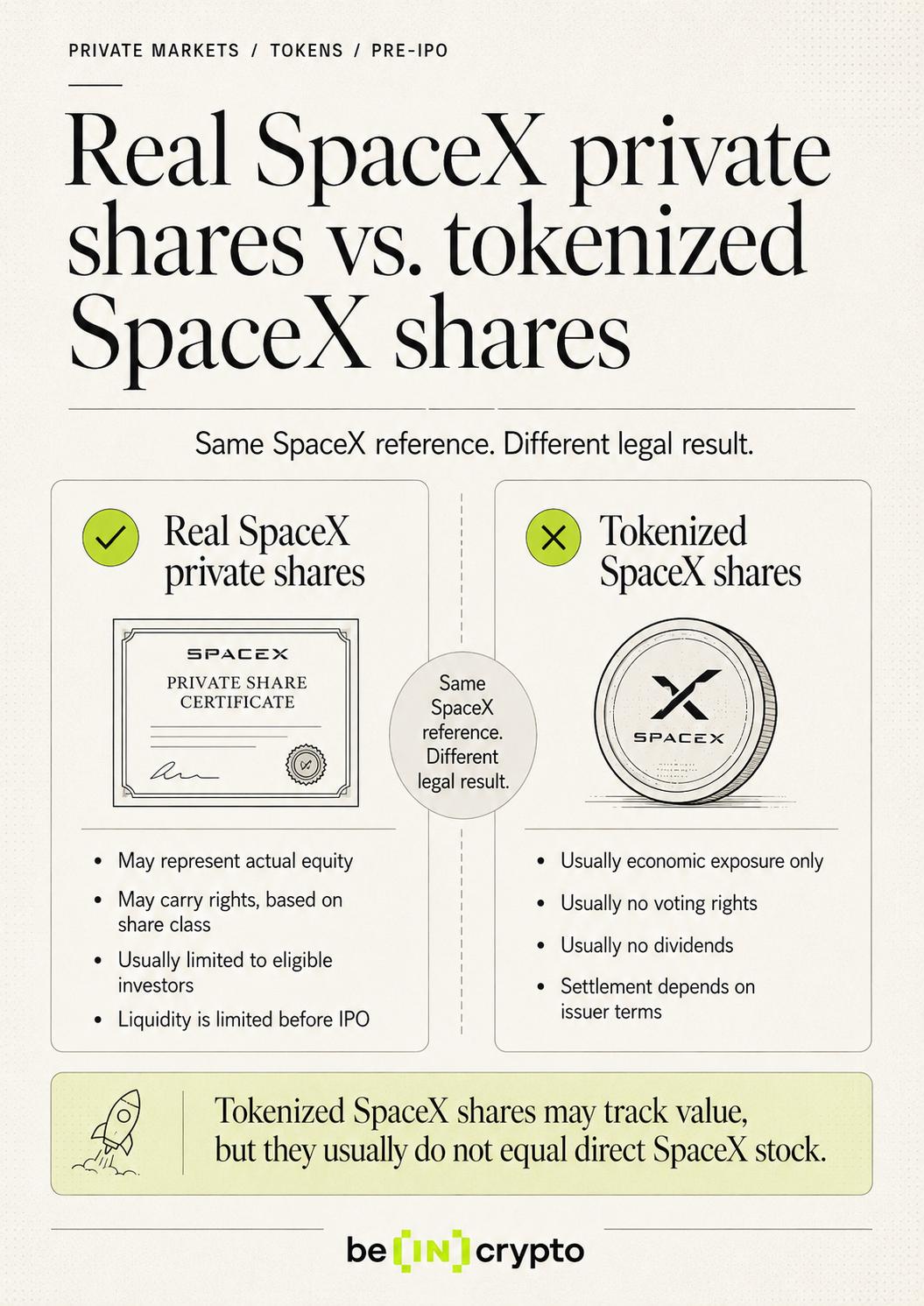 Tokenized SpaceX shares may track value, but they usually do not equal direct SpaceX stock: BeInCrypto
The table below compares private SpaceX shares against tokenized SpaceX exposure across key features.
| Feature | Real SpaceX private shares | Tokenized SpaceX exposure |
| Legal ownership | May represent actual equity | Usually no |
| Voting rights | Depends on share class and company terms | Usually none |
| Dividends | Possible only if declared and applicable | Usually none |
| Information rights | May exist under legal terms | Usually none |
| SpaceX approval or relationship | May exist in a direct share transaction | Usually no |
| Liquidity | Limited private-market liquidity | Platform-defined liquidity |
| Post-IPO outcome | May become public shares, subject to terms | Depends on issuer or platform rules |
Private shares and tokenized products create different legal relationships. Not all private shares give full rights, and not all tokenized products work the same way. Overall, the legal instrument matters more than the product name.
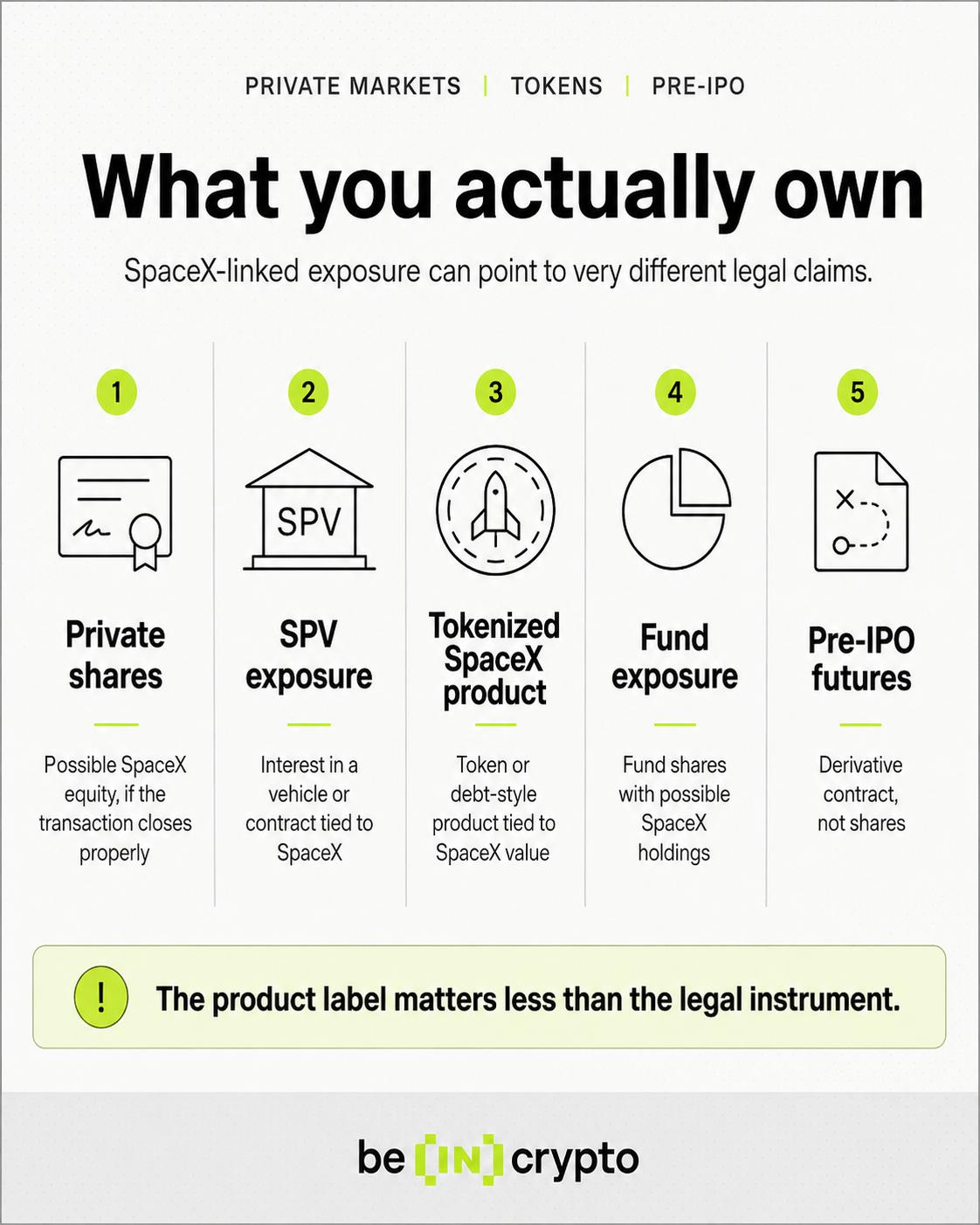 A SpaceX-linked product can reference SpaceX without giving you direct equity: BeInCrypto
The main SpaceX-linked asset classes before the IPO
The main SpaceX-linked asset classes before the IPO include private shares, special purpose vehicle (SPV) or secondary-market exposure, tokenized economic exposure, debt-style tokenized products, RWA pre-IPO tokens, pre-IPO perpetual futures, private-company funds, listed funds, and sector proxies. They differ by ownership, rights, liquidity, and settlement terms.
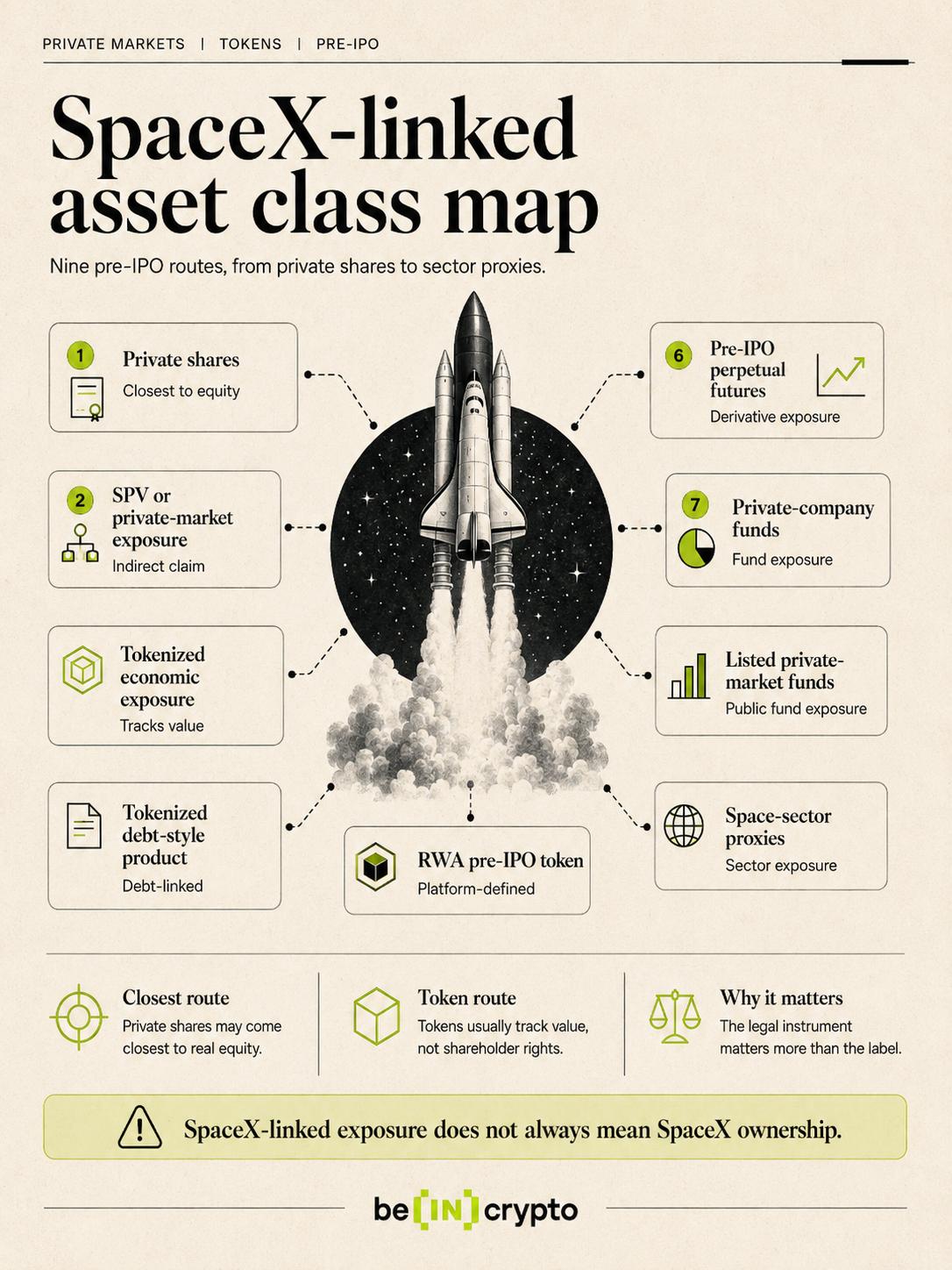 SpaceX-linked assets differ by ownership rights, liquidity, issuer risk, and post-IPO terms: BeInCrypto
The table below maps each SpaceX-linked asset class.
| Asset class | Example products or routes | What you may own | Direct SpaceX shares? | Main risk |
| Private shares | EquityZen, Forge, Hiive | Private SpaceX equity if a real share transaction closes | Sometimes | Eligibility, transfer limits, low liquidity |
| SPV or private-market exposure | SPV-based private deals | Interest in an SPV, fund, or contract tied to SpaceX shares | Not always clear | Complex ownership chain |
| Tokenized economic exposure | PreStocks SpaceX | Token linked to SpaceX value | Usually no | No shareholder rights |
| Tokenized debt-style product | Bitget preSPAX | Debt instrument tied to SpaceX performance | No | Issuer and settlement risk |
| RWA pre-IPO token | BingX SpaceX RWA | Platform-defined RWA exposure | No direct share claim shown | IPO-price settlement risk |
| Pre-IPO perpetual futures | OKX SPACEX/USDT | USDT-settled derivative price exposure | No | Leverage, volatility, liquidation, delisting risk |
| Private-company funds | Private Shares Fund | Fund shares with possible SpaceX exposure | No direct ownership | Fees, valuation marks, redemption limits |
| Listed private-market funds | DXYZ (Destiny Tech100) | Public fund shares with private-company holdings | No direct ownership | Premium/discount, fee, portfolio concentration |
| Space-sector proxies | Space-sector ETFs | Sector exposure | No | Not SpaceX-specific |
“SpaceX-linked” does not describe one product type. It can mean actual private shares, an SPV interest, a fund holding, a token, a debt instrument, a platform-defined RWA product, or a derivative. The label matters less than the legal structure.
Not every “space” investment actually provides SpaceX exposure. Space-sector ETFs may hold satellite operators, aerospace manufacturers, defense contractors, or launch-service companies without holding any SpaceX position. Unless a fund’s official disclosures confirm direct or indirect SpaceX exposure, it should be treated as broad sector exposure rather than a SpaceX-linked asset.
Private SpaceX shares and secondary-market access
Private SpaceX shares are the closest route to actual SpaceX equity before an IPO, but access is usually restricted. Accredited investors may find opportunities through secondary marketplaces if existing shareholders sell and if the buyer meets eligibility, compliance, transfer, and minimum-investment requirements.
Platforms such as EquityZen, Forge, and Hiive operate secondary marketplaces that connect accredited buyers with existing shareholders. Access depends on supply, eligibility, minimum-investment thresholds, company transfer restrictions, and securities rules. Transactions can take time to settle, and these shares are illiquid compared with public stocks.
For instance, EquityZen’s platform disclosures note that investment opportunities are private placements subject to holding period requirements and are intended for investors who do not need a liquid investment. The platform states that investing in private companies involves a high degree of risk, including the risk of substantial loss of investment.
Availability is never guaranteed, though. A transaction may fail if shares are unavailable, a buyer does not qualify, or company approval and compliance requirements are not met.
SPV structures can complicate ownership claims
Some private-market SpaceX exposure may come through SPVs, funds, or layered intermediary structures rather than direct share ownership. In these arrangements, investors may hold interests in a vehicle that owns the shares instead of holding the shares directly.
The extra layers can make ownership chains, transfer rights, fees, and exit terms harder to verify. The Private Shares Fund’s prospectus, for example, notes that the fund may invest through SPVs and that investors do not hold direct claims against underlying portfolio companies.
That’s why you should ideally check the legal owner of the shares, the issuer structure, transfer rights, and post-exit terms before treating any SPV-based deal as direct SpaceX exposure.
Ownership chains matter. Holding an SPV interest is not the same as holding SpaceX shares directly. Always verify the legal structure, not just the marketing description.
Tokenized SpaceX products, RWA tokens, and pre-IPO futures
Tokenized SpaceX products can use different structures. Some may provide tokenized economic exposure, some may use debt-style terms, some may settle with reference to an IPO price, while others may only offer derivative price exposure through futures contracts. As a buyer, you should compare the legal instrument, issuer, backing, rights, and settlement terms first.
The table below uses publicly visible examples to show how these structures differ. It is not an exhaustive list, and product availability can change based on platform rules, jurisdiction, and issuer terms.
Examples of SpaceX-linked token and derivatives products
| Product or route | Product type | What it offers | Direct SpaceX equity? | Key caution |
| Bitget preSPAX | Tokenized debt-style product | Debt instrument designed to reflect SpaceX performance | No | No SpaceX shares, no shareholder rights |
| BingX SpaceX RWA | Pre-IPO RWA token | Platform-defined exposure with IPO-price settlement | No direct share claim shown | Settlement depends on platform terms |
| OKX SPACEX/USDT | Pre-IPO perpetual future | USDT-settled derivative exposure to valuation changes | No | Leverage, liquidation, IPO uncertainty |
| Brokerage stock-token models | Tokenized stock exposure through issuer or SPV terms | Indirect exposure, where available | Usually no direct ownership | Terms vary; company approval may be absent |
Platform disclosures show the differences clearly.
For instance, Bitget preSPAX is described by Bitget as a digital token issued by Republic International Cayman and a debt instrument designed to reflect SpaceX’s economic performance after IPO. Bitget states that holding preSPAX does not mean owning SpaceX shares, and the product gives no voting, dividend, shareholder, or SpaceX equity ownership rights. Bitget also states that preSPAX is not affiliated with or endorsed by SpaceX.
BingX’s SpaceX Pre-IPO RWA product is described as tokens pegged to pre-IPO equity value. BingX says users can trade them on the BingX platform and that after a company IPOs, token value settles with reference to the listed share price. BingX’s disclosures state that Pre-IPO RWA tokens typically do not offer periodic dividends, and that there is no guarantee SpaceX will conduct an IPO in the future.
OKX SPACEX/USDT is described by OKX as a USDT-settled perpetual futures contract. The platform says users do not hold any equity and only trade the perpetual futures’ price movements. It warns that actual share count, valuation, and IPO timing are uncertain. If an IPO is canceled, OKX reserves the right to delist or settle the futures at a price determined at its sole discretion.
Why the product structure matters more than the label
Tokenized private equity is not one fixed product type. The legal and economic setup can change from one platform to another. That means a “SpaceX-linked token” may not work like a SpaceX share, even if the product name points to SpaceX.
Robinhood’s head of crypto, Johann Kerbrat, made the same point during a recent BeInCrypto podcast. Asked how a private equity token relates to the underlying company, he said:
“It will depend on the setup. You have multiple ways to set up. You could issue direct shares on the blockchain if the issuer is willing to work with the token issuer, or you can do things where you have indirect exposure to the company.”
He also said indirect exposure may give users economic upside without full shareholder rights:
“In that case, for example, you won’t really have voting rights, but you will still have all the benefit in terms of cash if the company is going up in price, or if there is an event like going public.”
That’s why, before you invest in any SpaceX-linked product as stock, check the issuer, legal structure, shareholder rights, liquidity rules, and post-IPO settlement terms.
Follow this simple rule: if the product does not clearly explain what you own, do not assume it represents actual SpaceX shares.
Funds with SpaceX exposure: Private interval funds and listed closed-end funds
Funds can offer indirect SpaceX exposure. The fund holder owns fund shares or interests, while the fund holds private-company positions. While this route may add portfolio diversification, it also adds fees, valuation marks, liquidity limits, and premium or discount risk.
Two clear examples with publicly verifiable SpaceX exposure are Private Shares Fund and Destiny Tech100:
The Private Shares Fund (PRIVX) is a registered closed-end interval fund that invests in late-stage private companies. According to the fund’s disclosures, SpaceX appeared among its top 10 holdings as of March 31, 2026. The fund warns that shares are highly illiquid and can be sold only through its quarterly repurchase program, which allows for up to 5% of the fund’s outstanding shares at NAV to be redeemed each quarter. Minimum investments start at $2,500 for Class A and Class L shares.
Destiny Tech100 (DXYZ) is a listed closed-end fund with holdings across private technology companies. According to publicly available data as of February 2026, SpaceX represented approximately 12.6% of the fund’s portfolio exposure, making it the fund’s largest single position. Buyers of DXYZ shares own interests in the fund, not direct SpaceX equity. The fund’s share price may trade at a premium or discount to its net asset value.
In these structures, the exposure comes through the fund itself rather than through direct SpaceX share ownership. Liquidity rules, valuation methods, fees, and market premiums or discounts can influence returns as much as the underlying SpaceX allocation.
Which SpaceX-linked assets are closest to actual SpaceX shares?
Actual private shares are usually the closest route to SpaceX equity, but access is often limited to accredited investors.
SPV or fund exposure may sit one step away from direct ownership.
Meanwhile, tokenized products, RWA tokens, and perpetual futures usually provide economic or derivative exposure rather than direct shares.
| Rank | Route | Closeness to actual SpaceX shares | Why |
| 1 | Direct private shares | Highest | May represent actual equity if the transaction closes properly |
| 2 | SPV or private fund exposure | Medium | May hold or reference SpaceX shares, but the user owns the vehicle interest |
| 3 | Private-company or listed funds | Medium to low | Fund owns exposure; user owns fund shares |
| 4 | Tokenized economic or debt-style products | Low | Usually track value without shareholder rights |
| 5 | Pre-IPO perpetual futures | Very low | Derivative exposure only |
| 6 | Space-sector ETFs or stocks | Weakest | Sector exposure, not necessarily SpaceX-specific |
What rights do SpaceX-linked products give you?
Rights depend on the legal structure. Real private shares may carry equity rights, though share class and company terms matter. Tokenized products and derivatives usually provide no voting rights, dividend rights, shareholder rights, or direct company information rights.
Put simply, funds provide rights against the fund, not SpaceX.
| Product type | Equity ownership | Voting rights | Dividends | IPO settlement | SpaceX endorsement |
| Private shares | Possible | Depends | Depends | May become public shares, subject to terms | Direct relationship may exist |
| SPV exposure | Indirect or unclear | Usually no direct company vote | Depends on SPV terms | Depends on SPV terms | Usually no direct relationship |
| Private or listed funds | No direct SpaceX ownership | Fund-level rights only | Fund-level terms | Fund-level terms | No direct SpaceX relationship |
| Bitget preSPAX | No | No | No | Product terms apply | No |
| BingX RWA token | No direct share claim shown | Check terms | Usually none | IPO-price reference settlement | Check terms |
| OKX pre-IPO perps | No | No | No | Converts to stock perp if IPO completes | No |
| Sector ETFs | No | No | Fund-level rights only | Not applicable | No |
A product with “SpaceX” in its name does not mean SpaceX approved, endorsed, or is affiliated with it. Most major platforms, such as Bitget, BingX, and OKX, disclose that their SpaceX-linked products carry no SpaceX endorsement or affiliation.
What happens to SpaceX-linked assets after the IPO?
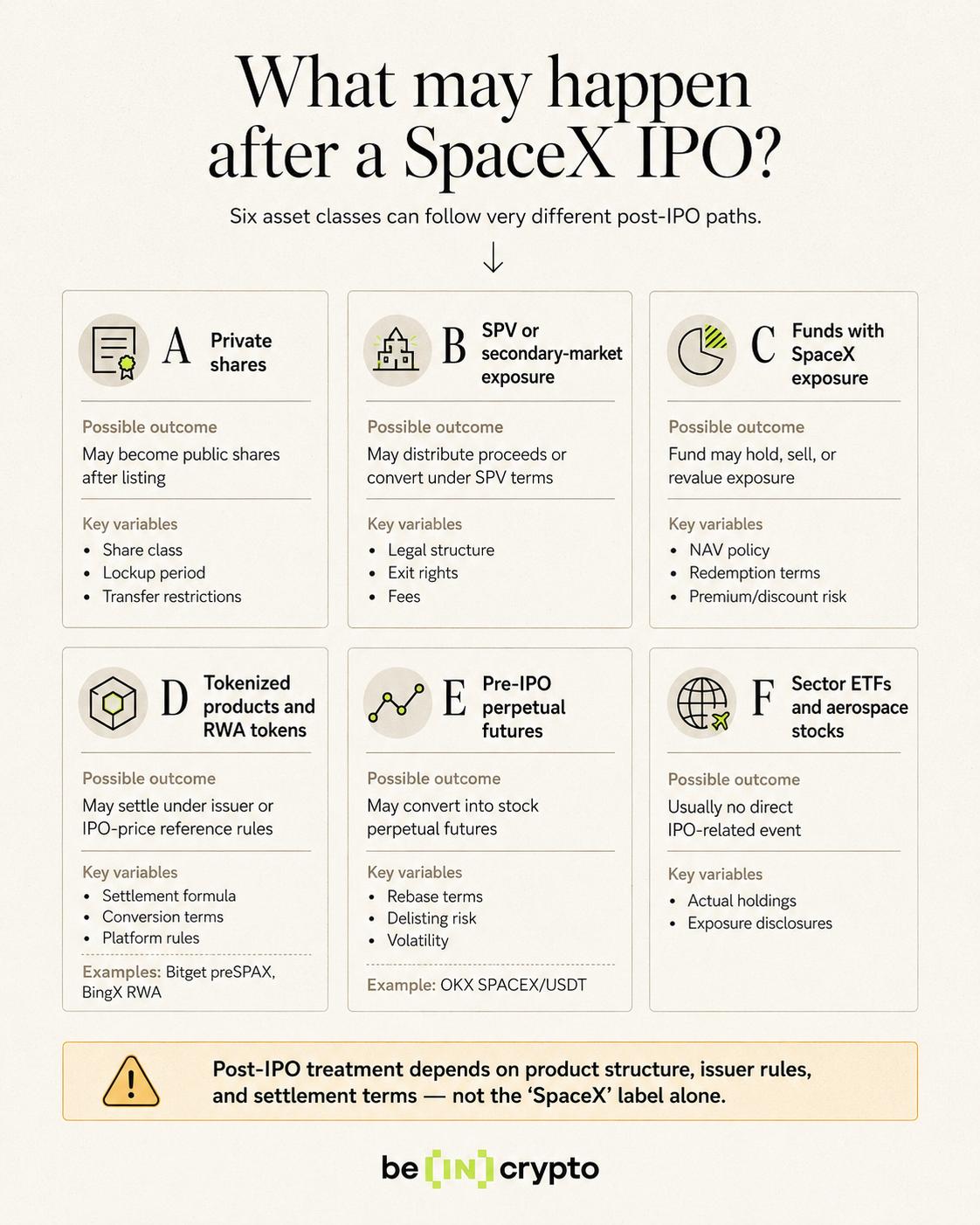 Post-IPO outcomes depend on product terms, not the SpaceX label: BeInCrypto
Post-IPO outcomes vary by product. Private shares may become public shares after listing and lockup rules. Tokenized products may settle in stablecoins, convert under issuer terms, or follow IPO-price reference rules. Pre-IPO perpetual futures may convert into stock perpetual futures. Funds may continue to hold or sell their exposure.
| Asset class | Possible post-IPO outcome | What affects the outcome |
|---|---|---|
| Private shares | May become public shares after listing | Share class, lockup period, transfer restrictions |
| SPV or secondary-market exposure | May distribute proceeds or convert under SPV terms | Legal structure, exit rights, fees |
| Funds with SpaceX exposure | Fund may hold, sell, or revalue exposure | NAV policy, redemption terms, premium/discount risk |
| Tokenized products and RWA tokens | May settle under issuer or IPO-price reference rules | Settlement formula, conversion terms, platform rules |
| Pre-IPO perpetual futures | May convert into stock perpetual futures | Rebase terms, delisting risk, volatility |
| Sector ETFs and aerospace stocks | Usually no direct IPO-related event | Actual holdings and exposure disclosures |
For instance, OKX’s product announcement notes that upon IPO completion, the pre-market perpetual contract converts to a standard stock perpetual contract, and a separate announcement will be published before conversion. Users who do not wish to hold a standard stock perpetual contract should close their position before the conversion effective time.
How to check if a SpaceX-linked asset is credible
A credible SpaceX-linked asset should clearly disclose the legal instrument, issuer, SpaceX relationship, ownership rights, settlement terms, fees, liquidity limits, jurisdiction restrictions, and risk factors. If a product hides the issuer, promises guaranteed IPO gains, or claims SpaceX approval without proof, treat it as high risk.
A useful checklist for evaluating any SpaceX-linked product follows.
- What is the legal instrument (equity, debt, token, SPV interest, fund share, or derivative)?
- Who issued the product, and is the issuer regulated or licensed?
- Does the product claim direct SpaceX shares or only exposure?
- Does it disclose whether SpaceX approved or endorsed it?
- Does it give voting, dividends, information, or shareholder rights?
- How does it settle after an IPO?
- Can you exit before an IPO, and under what conditions?
- Are there lockups, liquidity limits, OTC-only exits, or redemption caps?
- Does it restrict users in certain jurisdictions?
- Are there fees, spreads, funding rates, or liquidation risks?
- Is the information from an official platform page, not a random token contract or social post?
Which SpaceX-linked option makes the most sense?
Tokenized SpaceX products are only one route to pre-IPO exposure. They may suit users who understand issuer risk, liquidity limits, settlement rules, and the lack of shareholder rights. They are a poor fit for anyone who expects direct SpaceX ownership, voting rights, dividends, or automatic conversion into listed shares after an IPO.
Private shares are closest to actual SpaceX equity, but access is usually limited and liquidity can be poor. SPV exposure adds another layer between the investor and the underlying shares. Funds may offer broader private-company exposure, but fees, valuation marks, redemption rules, and market premiums or discounts can affect returns. Perpetual futures are derivative products, so leverage and liquidation risk can quickly amplify losses.
Overall, waiting for the IPO may be the simpler option if you want listed shares, public disclosures, and regular market pricing. That said, if you decide to go the pre-IPO token route, make sure to check the issuer, legal instrument, rights, fees, liquidity rules, jurisdiction limits, and post-IPO settlement terms carefully. If the product does not clearly explain what you own, that is a clear warning sign.
Frequently asked questions
Are tokenized SpaceX shares real SpaceX shares?
Usually, no. Tokenized SpaceX products typically provide economic exposure to SpaceX’s value or IPO outcome, but they do not usually grant direct equity ownership, voting rights, dividend rights, or shareholder rights. Bitget, for example, explicitly states that holding its preSPAX token does not mean owning SpaceX shares. Always check the product’s legal terms before treating a tokenized product as direct SpaceX equity.
Can someone buy SpaceX stock before the IPO?
SpaceX stock is not available on any public exchange before the IPO. Accredited investors may access private SpaceX shares through secondary marketplaces such as EquityZen, Forge, or Hiive, if shares are available and eligibility rules are met. Retail users may encounter tokens, funds, or derivatives, but those products are not usually direct shares. Access and availability are not guaranteed regardless of the route.
What SpaceX-linked assets exist before the IPO?
Publicly visible routes include private secondary shares, SPV-based exposure, tokenized economic exposure, tokenized debt-style products, RWA pre-IPO tokens, pre-IPO perpetual futures, private-company funds such as the Private Shares Fund, listed funds such as Destiny Tech100, and space-sector proxies. Each route differs in ownership structure, rights, liquidity, and settlement terms.
What is the difference between SpaceX stock and SpaceX exposure?
SpaceX stock means an ownership claim in the company, subject to share class and legal terms. SpaceX exposure means a product may track, reference, or benefit from SpaceX’s value without giving direct ownership. Many SpaceX-linked products on crypto platforms offer exposure rather than stock, meaning a buyer can gain or lose based on SpaceX’s perceived value without ever becoming a shareholder.
What happens to tokenized SpaceX products after the IPO?
The outcome depends on the product. Some may settle in stablecoins based on the IPO price. Some may convert under issuer-defined terms. Some derivatives may convert into standard stock perpetual contracts, as OKX has disclosed for its SPACEX/USDT contract. Private shares may become public shares subject to lockup rules. Reading the official product terms before buying is the only way to know what post-IPO outcome applies to a specific position.
Are SpaceX pre-IPO perpetual futures the same as tokenized shares?
No. Pre-IPO perpetual futures are derivatives. OKX states that its SPACEX/USDT contract lets users trade valuation changes, but users do not hold equity. That makes it derivative price exposure, not SpaceX stock ownership. The risk profile also differs significantly: perpetual futures carry leverage, funding rates, liquidation risk, and the possibility of delisting if an IPO is canceled.
How do you spot a fake or misleading SpaceX token?
Fake or misleading SpaceX tokens typically share several warning signs. They may claim SpaceX endorsement or affiliation without verifiable proof. They may promise guaranteed IPO gains or fixed returns. They may hide the issuer identity or lack any legal documentation. They may not disclose settlement terms, jurisdiction restrictions, or exit conditions. Cross-check any SpaceX-linked product against official exchange or platform announcements and verify that the issuer is named and the legal instrument is clearly described.