The ARC mainnet is expected to launch in the summer of 2026.
Written by: Mahe, Foresight News
On May 11th, Circle simultaneously released two major announcements: its Q1 2026 financial report and the pre-sale and white paper release of the ARC network's native token. The ARC token completed a $222 million pre-sale at a $3 billion valuation, led by a16z crypto, with an investor lineup including top institutions such as Apollo Funds, ARK Invest, BlackRock, Bullish, General Catalyst, Haun Ventures, Intercontinental Exchange, IDG Capital, SBI Group, and Standard Chartered Ventures.
The Q1 financial report data merely demonstrates that USDC already possesses sufficient scale and traffic as a foundation, while the ARC white paper outlines a clear technological path, token economics, and ecosystem vision. With the mainnet expected to launch in the summer of 2026, ARC will transform USDC's existing monetization and traffic infrastructure advantages into new counter-cyclical revenue sources such as network fee sharing, governance participation, and AI economic services. The significance of this transformation lies in the fact that stablecoins will no longer be merely "bridge tools" in the crypto world, but will become the foundational currency of internet finance, with ARC serving as the underlying operating system supporting this upgrade.
Reserve yield + on-chain settlement dual-engine
Circle's total revenue and reserve income reached $694 million in Q1 2026, a 20% year-over-year increase. Reserve income contributed $653 million, a 17% year-over-year increase. Despite a 66 basis point decline in reserve yields due to the interest rate environment, the average circulating supply of USDC increased by 39% year-over-year, directly offsetting yield pressures and becoming the main driver of revenue growth. Other revenue reached $42 million, an increase of $21 million year-over-year, primarily from subscription services and trading-related revenue.
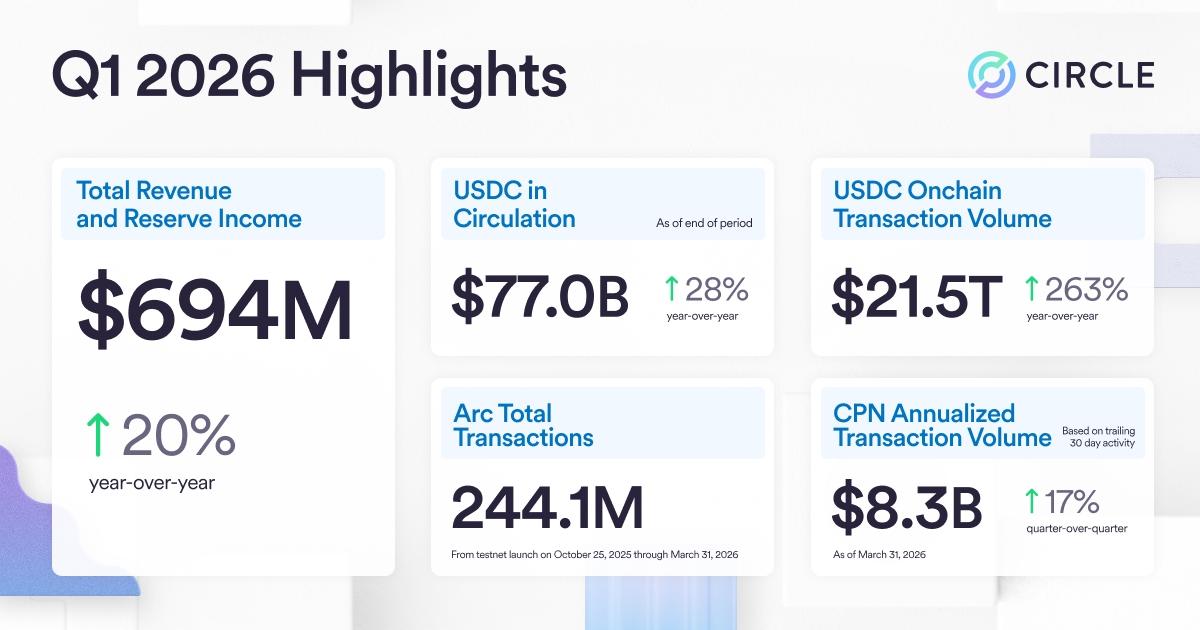
Operational metrics are even more compelling: USDC circulation remained stable at $77 billion at the end of the quarter, a year-on-year increase of 28%; on-chain transaction volume surged to $21.5 trillion, a year-on-year increase of 263%. According to Visa's on-chain analytics data, USDC accounted for 63% of stablecoin transaction volume during Q1. From its launch on October 25, 2025 to March 31, 2026, the Arc testnet has processed a total of 244.1 million transactions; CPN Annualized Transaction Volume reached $8.3 billion, a quarter-on-quarter increase of 17%.
Net income from continuing operations, primarily from profit sources, was $55 million, a 15% year-over-year decrease. However, adjusted EBITDA reached $151 million, a 24% year-over-year increase. Operating expenses rose to $242 million, a 76% year-over-year increase, mainly due to increased stock-based compensation and taxes following the IPO, as well as strategic investments in product, distribution, and operational infrastructure. Circle explicitly stated in its financial report that the decline in net income was a normal result of growth investments, while the strong EBITDA growth demonstrated the healthy cash flow generation capability of its core business.
These figures are not isolated performance highlights, but rather the most direct support for the implementation of ARC's strategy. Without USDC's 28% increase in circulating supply and 263% surge in trading volume, ARC's positioning as a "native Layer 1 stablecoin" would lack a real user base and liquidity. The financial report validates that Circle's dual-engine strategy of "reserve yield (monetization of existing assets) + on-chain settlement (traffic infrastructure)" has proven successful, which is precisely the core reason why ARC was able to attract top institutions with a high valuation of $3 billion.
According to the ARC white paper, Circle received 25% of the total supply.
The ARC white paper, released simultaneously on May 11, clearly defines the Arc network's positioning: it is a stablecoin-native Layer 1 blockchain built by Circle, aiming to become the "economic operating system of the internet." This fundamentally differs from most general-purpose public blockchains on the market—Arc's underlying architecture is deeply optimized around stablecoin-native financial activities, rather than simply adding stablecoin support to existing chains.
Specifically, Arc addresses key pain points in institutional and large-scale adoption scenarios. It offers predictable fees, deterministic settlement, compliance and privacy protection, and supports enterprise-grade contracts, governance mechanisms, AI agents, and USDC-driven value transfer. This design enables Arc to achieve truly native integration with Circle's full-stack products (USDC, CCTP, Gateway, etc.), significantly reducing friction costs for institutional users in compliance, cross-chain functionality, and settlement efficiency.

Circle CEO Jeremy Allaire emphasized in the earnings call that 60% of the initial supply of ARC tokens will be used for the ecosystem, including token sales, developer incentives, airdrops, and other network growth initiatives.
The initial supply of Arc is 10 billion tokens, with 25% allocated to Circle for operating validator infrastructure and earning staking rewards; 60% distributed to network builders and users; and the remaining 15% set aside for long-term reserves. The remaining 60% will be used for token sales, developer funding, network growth initiatives, and more. The ARC token has five core functions: staking, fee reduction, fee capture, and governance decision-making. The initial annual inflation rate is set at around 2-3%, primarily to incentivize validator participation in network security, and will subsequently decrease gradually through a programmatic mechanism.
ARC's greatest strategic value lies in its precise filling of the infrastructure gap for stablecoins in institutional scenarios. With the current regulatory environment becoming clearer and institutions showing strong willingness to enter the market, Arc's compliance module, deterministic settlement, and connectivity with RWA precisely address the shortcomings of traditional public chains in these scenarios.
Combined with Circle's concurrently launched Agent Stack, developers can use USDC to create, fund, and monetize AI agent activities on Arc. Arc's enterprise-grade contract capabilities and deterministic settlement provide a trusted and compliant execution environment for AI + blockchain economic activities. This closed-loop design makes Arc one of the most promising infrastructures for the integration of AI and blockchain.
Is a $3 billion valuation too high?
Since Circle released its financial report, its CRCL stock price has risen to $131.76, approaching the high point in March of this year. Its current total market value is $32.57 billion.
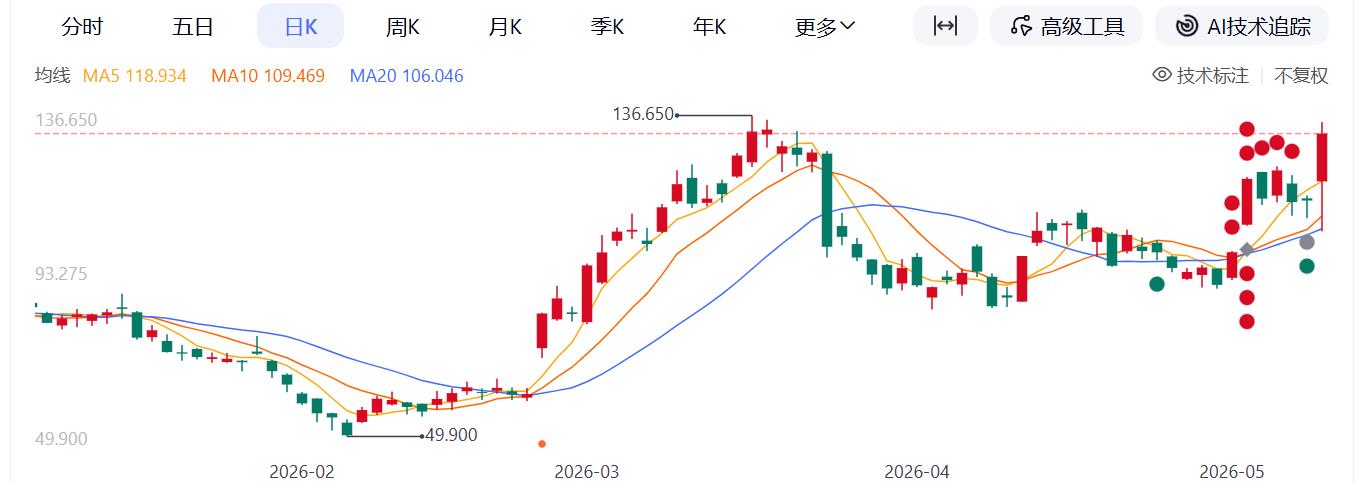
The capital market has shown interest not only in its US-listed counterparts, but also in the completion of a $222 million pre-sale of its ARC token, valuing the company at $3 billion. The collective entry of institutions such as a16z crypto and BlackRock is not simply a matter of capital chasing, but rather a deep recognition of Circle ARC's strategy.
These institutions are drawn to Arc's scarcity in the native stablecoin market. USDC's explosive 263% increase in on-chain transaction volume in Q1 has proven the existence of real demand, while Arc provides the underlying upgrade path for the supply side.
ARC's moat is particularly noticeable.
Compared to general Layer 1, Arc abandons the "all-rounder" approach and instead focuses on the ultimate optimization of native financial activities of stablecoins, forming a differentiated advantage in terms of fee predictability, settlement certainty, and compliance and privacy, making it particularly suitable for high-value scenarios such as institutional RWA, large-value payments, and AI agents.
Compared to Coinbase, Circle has built a complete closed loop of "issuance-circulation-infrastructure" through USDC+Arc; compared to Tether, Circle's years of accumulated compliance licenses and the transparency of USDC reserves make it easier for Arc to gain the trust of traditional financial institutions.
The involvement of traditional financial giants such as BlackRock and Apollo is essentially a bet that Circle is upgrading stablecoins from "bridges for crypto transactions" to "foundational currencies for internet finance," and ARC is the core vehicle for this upgrade.
However, whether its ARC valuation is too high or not remains a subject of considerable debate.
Plasma, backed by USDT, currently has a market capitalization of $1 billion, and ARC's pre-sale FDV is nearly three times that of XPL's current market FDV.
In absolute terms, ARC is indeed "expensive"—XPL has been running on mainnet for nearly 8 months (launching in September 2025), with a TVL exceeding $5 billion and processing massive amounts of USDT retail payments and cross-border transactions. Previously, XPL was highly anticipated, generating considerable wealth and creating a mythical effect. However, the feast must end, and someone has to pay the bill. High inflation combined with selling pressure from large-scale ecosystem unlocks has caused the price to fall more than 10 times from its peak.
ARC's $300 million FDV may not be a bubble, but rather a reasonable premium paid by institutions for "top players in stablecoin infrastructure." XPL, priced at approximately $1 billion FDV, represents a "proven retail payment public chain," while ARC, valued at 3 times, represents an "institutional operating system that is not yet launched but has a deeper moat and a clearer monetization path."
Whether the cryptocurrency secondary market will accept such a premium remains to be seen until this summer.