The U.S. Bureau of Labor Statistics (BLS) will release the CPI data for April on Tuesday.
This report is expected to show consumer inflation continuing to rise sharply after the surge in March, driven by higher oil prices due to escalating tensions between the US and Iran.
The monthly CPI is projected to rise 0.6%, following a 0.9% increase in March; while the annual index could reach its highest level since September 2023 at 3.7%, up from 3.3% in March.
Core CPI data, excluding volatile food and energy items, is projected to reach 0.4% month-on-month and 2.7% year-on-year .
From the outbreak of conflict in the Middle East (February 28, 2024) to the end of April 2024, the price of West Texas Intermediate (WTI) crude oil increased by more than 50%. Although crude oil prices adjusted downwards in the first week of May 2024, they are still about 40% higher than before the conflict between the US and Iran began.
Regarding inflation data forecasts, Jim Reid from Deutsche Bank commented: “Our economists predict overall inflation will rise +0.58% month-on-month, down from +0.9% in March but still at a relatively high level.”
“Conversely, core CPI is likely to accelerate to +0.39% year-on-month, up from +0.2%, indicating underlying price pressures remain high despite the easing impact of energy prices. The year-on-year inflation rate will shift from 3.3% to 3.8% for overall CPI and from 2.6% to 2.8% for core CPI,” Reid added.
What to expect from the next CPI report?
The April CPI data will clearly reflect the impact of persistently high oil prices on inflation. As this was anticipated, core inflation figures will help the market assess whether rising energy costs are spilling over into other goods and services.
If the monthly core CPI exceeds the market's forecast of 0.4%, it could increase concerns about persistently high inflation in the economy. Conversely, lower-than-expected data would somewhat alleviate fears of uncontrolled price pressures.
However, even in this case, investors can hardly feel secure because the crisis between the US and Iran shows no signs of abating, while the disruption of maritime activity in the Strait of Hormuz continues to pose a major risk to the global energy supply chain .
Minneapolis Federal Reserve President Neel Kashkari stated that if the Strait of Hormuz remains closed, this shock could increase inflation expectations and require stronger policy from the Fed.
St. Louis Fed President Alberto Musalem also emphasized that inflation remains above the Fed's target and suggested that policymakers need to pay particular attention to core inflation, tax policies, and oil price fluctuations.
How might the US CPI report impact the EUR/USD exchange rate?
Currently, the market estimates there is about a 73% chance that the Fed will keep its policy interest rate unchanged at 3.5%-3.75% by the end of the year, and the probability of a 25 basis point (bps) increase is only about 20%, according to the CME FedWatch tool.
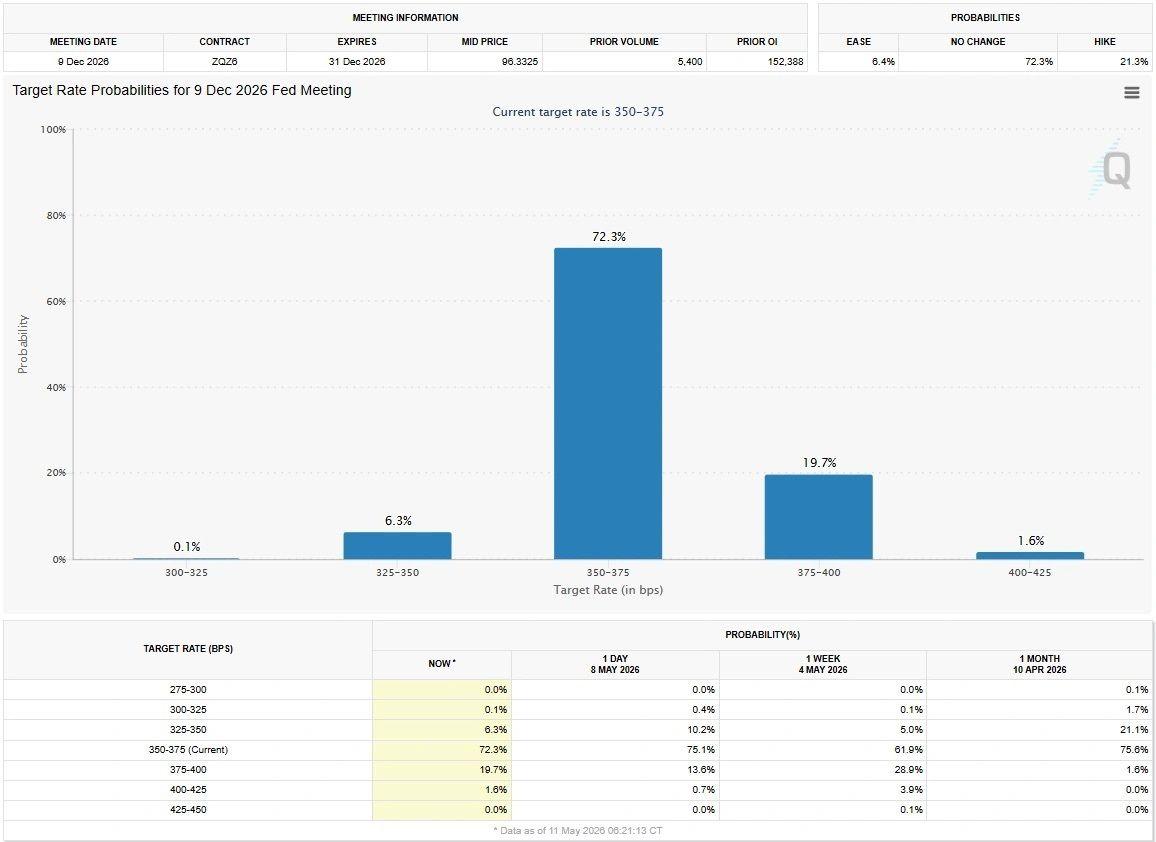 Source: CME Group
If the April core CPI exceeds expectations, investors may lean toward the possibility of a Fed interest rate hike in the near future, which could lead to an immediate strengthening of the USD.
Conversely, if this indicator is lower than forecast, the USD could weaken. However, unless there is a clear signal that the US-Iran conflict will end soon, the likelihood of a sharp decline in the USD is unlikely to last.
“Investors will remain highly vigilant, as the possibility of further delays or even the inability to cut interest rates in the second half of 2026 remains, especially if energy prices continue to rise due to escalating tensions or prolonged conflict in the Middle East,” said Alvin Liew from UOB Group.
"If oil prices rise and this spreads to many other items in the CPI basket, the outlook for controlling inflation will become more complicated, leading to the risk of the Fed postponing its interest rate cuts until 2027," Liew further analyzed.
Eren Sengezer, Europe analyst at FXStreet, Chia his short-term technical outlook for the EUR/USD exchange rate.
“The short-term technical outlook for EUR/USD is currently bullish but lacks a clear breakout. The Relative Strength Index (RSI) on the daily chart remains above 50 but has declined after touching 60, while the pair has not really broken far above the 20-day moving Medium (SMA) despite closing last week high above it.”
“If EUR/USD breaks through the resistance zone of 1.1800-1.1820 (which coincides with the upper Bollinger Bands and the 61.8% Fibonacci retracement level from the February-April decline), the next target will be the 1.1900-1.1910 zone (rounded mark, 78.6% Fibonacci retracement level) and then the psychological level of 1.2000.”
Looking south, a strong support zone appears to have formed in the 1.1730-1.1680 area (50% Fibonacci retracement, 100-day SMA, 200-day SMA). If EUR/USD falls below the lower limit of this zone and begins to act as resistance, technical selling pressure may emerge. In this case, 1.1660 (ascending trendline) could be XEM temporary support before the price reaches 1.1560 (23.6% Fibonacci retracement).