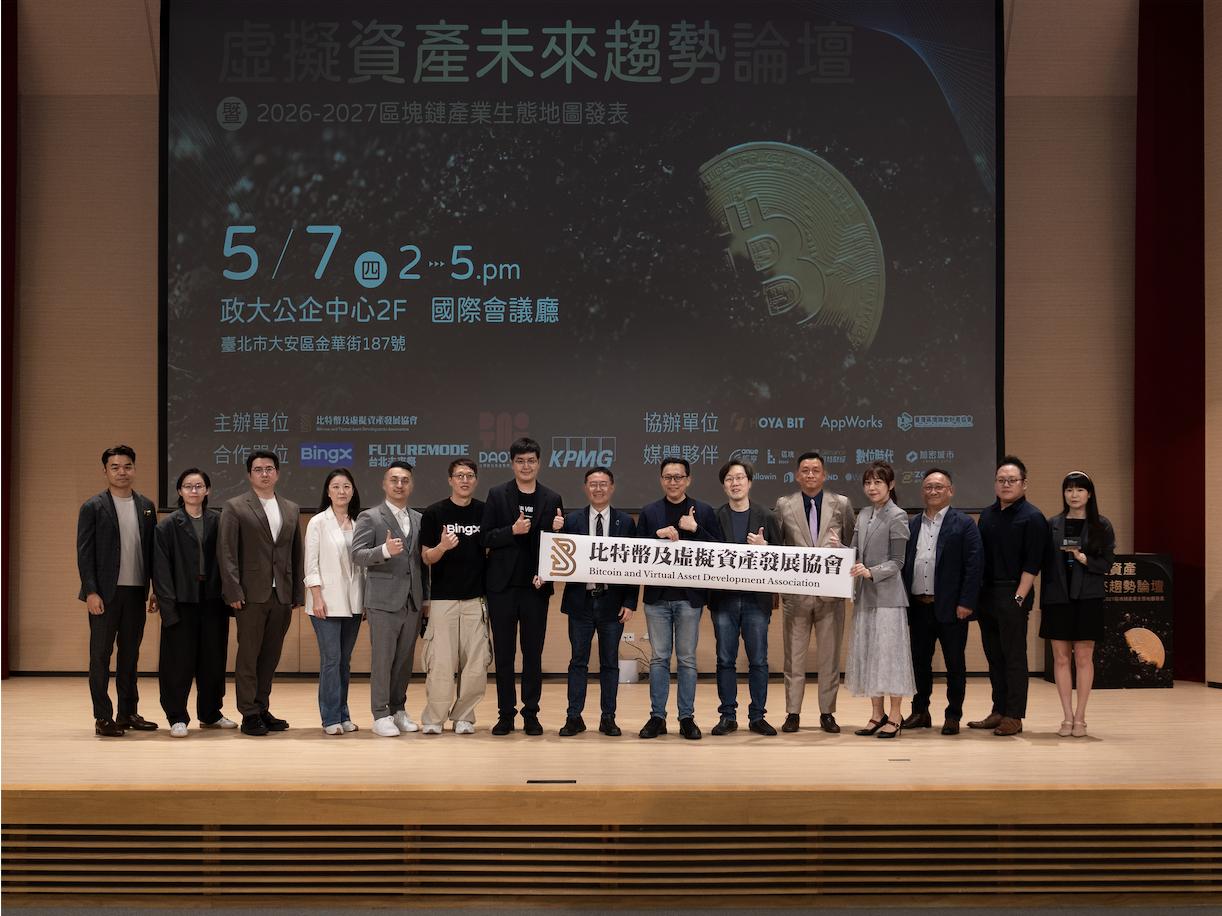
As the virtual asset market rapidly expands, the global financial system is undergoing structural changes. Taiwan, having previously been observing and experimenting, is now officially entering a new phase of legal construction and industry integration. The annual forum, hosted by the Bitcoin and Virtual Asset Development Association, will be held on May 7, 2026, at the International Conference Hall of the National Chengchi University's Public Enterprise Center. Nearly 200 industry representatives, regulatory bodies, financial institutions, technology companies, and investment institutions will gather to focus on Taiwan's Virtual Asset Services Act, stablecoins, digital payments, institutional adoption, and global market trends, witnessing a significant moment for Taiwan's blockchain industry as it moves towards the next stage.
In their addresses, Legislators Lee Kun-cheng and Ge Ru-jun pointed out that the Virtual Asset Services Act is a crucial foundation for the development of digital finance in Taiwan and a key bill that has garnered significant attention this year. The Executive Yuan has already submitted a draft bill, and various party caucuses and legislators have subsequently submitted different versions. The process of scheduling, negotiating, and reviewing the bill will continue. Both legislators emphasized that legal construction is not merely a regulatory tool, but also a key to building market trust. Clear rules will help reduce the negative associations that society has previously associated with virtual assets, such as fraud, money laundering, and speculation, providing a clear path for compliant businesses and allowing the public and financial institutions to participate in the new financial market with greater peace of mind.
At the panel discussion "The New Future of Stablecoins and Digital Payments in Taiwan," representatives from Taiwan's VASP industry, including Owlting, HOYA BIT, MaiCoin, and ZONE Wallet, focused on the application potential of stablecoins in cross-border payments, corporate settlements, merchant collections, and digital wallets. The panelists pointed out that stablecoins can reduce exchange costs, shorten clearing times, and improve the limitations of traditional finance in cross-border value transfer. If Taiwan Dollar stablecoins can be integrated with regulatory frameworks, bank partnerships, on-chain clearing, and local payment scenarios in the future, they have the potential to become an important interface for financial innovation in Taiwan, helping businesses improve the efficiency of fund allocation and extending digital payments from the consumer end to a wider range of commercial applications.
The global trends panel brought together representatives from international exchanges Binance and BingX to observe the next wave of virtual assets from the perspectives of the Asia-Pacific and global markets. Panelists pointed out that the Asia-Pacific region remains one of the most active virtual asset markets globally, with Taiwan exhibiting high investment participation. If the special legislation can be successfully implemented, it will help improve market clarity and increase the willingness of international exchanges to enter the market. Global regulatory trends are also gradually shifting from a focus on fraud prevention to compliance development and industry governance. While differences in jurisdiction still exist among national regulatory frameworks, the overall trend is towards greater consistency and maturity.
The participants also observed a shift in the structure of the virtual asset market. Previously, the market heavily relied on short-term retail trading; now, it's gradually shifting towards long-term institutional allocation, ETFs, OTC markets, custody services, and compliant financial products. As traditional financial institutions and corporate clients begin exploring virtual asset services, collaborations between exchanges, banks, custodians, and technology service providers will become a significant driver of market growth. While stablecoins remain predominantly USD-denominated, non-USD stablecoins that integrate with local payments, asset tokenization, corporate clearing, and digital sovereignty scenarios still have the potential to develop differentiated market positions.
The highlight of this event was the official release of the "2026-2027 Taiwan Blockchain Industry Ecosystem Map." This map comprehensively surveys over 100 ecosystem players across Taiwan, covering diverse fields such as exchanges, payments, wallets, custody, financial services, technology solutions, enterprise applications, and infrastructure. It showcases the achievements of Taiwan's blockchain industry in moving from single-point innovation to the construction of a complete ecosystem. Hsu Pei-ling, Chairperson of the organizing committee, stated that this map is not only an index of internal industry cooperation but also an important calling card to the international market, allowing overseas institutions, investors, and policy observers to more clearly see the full potential of Taiwan's Web3 and virtual asset industries.
At the "Taiwan Blockchain Industry Trends - Looking to the Future" speech, the heads of Taiwan's five major blockchain and virtual asset associations gathered to discuss new milestones in the industry's development. Chang Sen-hsiung, Secretary-General of the Virtual Currency Association (VASP), emphasized that as a self-regulatory organization, the association will play a crucial role in bridging communication between industry and government during the review process of the Virtual Asset Services Act. Kao Saki-chun, Chairman of the Blockchain Enthusiasts Association, advocated breaking down industry silos and promoting cross-sector collaboration and ecological development with a "shepherd dog" spirit. Cheng Hsueh-feng, Secretary-General of the Fintech Association, focused on the review of special laws and cross-border alliances in the Asia-Pacific region, and expressed optimism about the key role of stablecoins in the industry landscape. Chien Shu-yung, Chairman of the Virtual Asset Anti-Money Laundering Association, is committed to "de-demonizing" the industry through legal education and improving transparency by implementing the "Travel Rule." Finally, Peng Shao-fu, Chairman of the Blockchain University Alliance, shared the achievements of cultivating academic and industry-academia collaboration, emphasizing that talent cultivation is the cornerstone of the industry's stable development. The five parties reached a high degree of consensus, believing that with joint efforts in legalization, internationalization, and education promotion, Taiwan's blockchain industry will move towards a healthier and more sustainable development stage.
KPMG's special report, "A Review and Outlook of Taiwan's Virtual Asset and Blockchain Industry," examines the industry's development trajectory, tracing Taiwan's journey from early innovation, business registration, and association establishment to custody, stablecoins, and the advancement of specific legislation. KPMG points out that the core value of blockchain lies in enabling funds and assets to flow 24/7, always-on, improving financial efficiency and creating new business models. Facing the accelerated expansion of markets like Japan, Hong Kong, and Singapore, Taiwan should build upon "trust-based finance," integrating the legal compliance and customer base of financial institutions, the technological capabilities of blockchain companies, and real-world business applications to complete the puzzle of liquidity, clearing, and compliance.
This forum also invited representatives from the financial, telecommunications, and international custody sectors, including Taishin Financial Holdings, Taiwan Mobile, BitGo, and CTBC Group, to participate and explore opportunities for the integration of traditional finance and Web3. From enterprise adoption and virtual asset custody to payment applications and financial service upgrades, all parties agreed that for Taiwan to gain a foothold in the next wave of digital finance competition, it cannot simply focus on regulatory compliance; it also needs to establish implementable infrastructure, cross-industry cooperation models, and international mutual recognition mechanisms to enable local businesses to connect with the global market.
The organizers stated that the publication of the "2026-2027 Taiwan Blockchain Industry Ecosystem Map" symbolizes that Taiwan's virtual asset industry has moved from early, fragmented exploration to a new stage of integration, collaboration, and internationalization. As regulatory systems become clearer, the industry chain becomes more complete, and financial and technology companies begin to deepen their cooperation, Taiwan will no longer just be chasing the global virtual asset wave, but will have the opportunity to become an important participant in the construction of new financial infrastructure in the Asia-Pacific region.