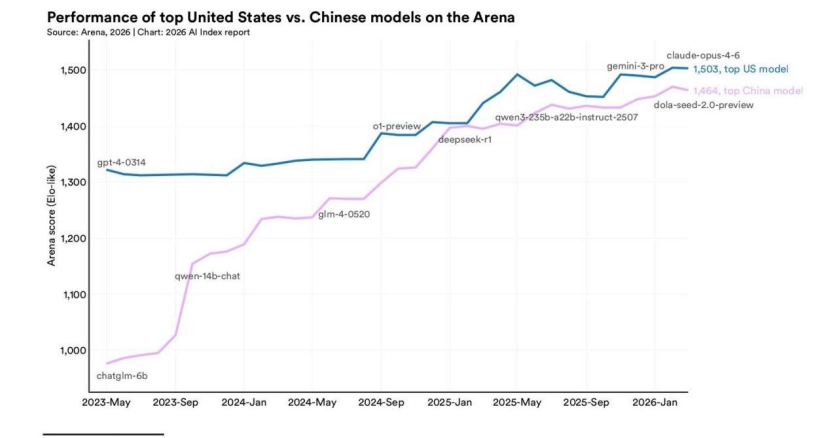
In the spring of 2026, Stanford University's AI Index report served as a stark mirror, reflecting the most realistic upheavals in the global artificial intelligence landscape. The number repeatedly mentioned in the report—2.7%—marked that the gap between the top models from China and the United States in Elo ratings had narrowed from a "technological gap" to a "close-quarters battle."
When Anthropic's Claude Opus 4.6 scored 1503 points, and China's DeepSeek followed closely with 1464 points, WEEX LABS, in its in-depth review of the dynamics of large-scale models globally, realized that the first half of the large-scale model race—an arms race simply about parameter scale and computing power accumulation—had officially entered a bottleneck period. The slight gap of 2.7% was no longer an insurmountable chasm, but a narrow ravine, with competitors on both sides "overtaking" at an unprecedented speed in different dimensions.
The Engineering Miracle Behind "Algorithmic Equality"
For a long time, the industry held an almost superstitious "leadership illusion" regarding large-scale models. However, the moment in February 2025 when DeepSeek-R1 briefly caught up with the top US models became a turning point. The Stanford report clearly points out that since the beginning of 2025, the performance gap between Chinese and American models has remained in the single digits.
The emergence of this "technology equality" is not simply imitation, but a victory for efficiency. WEEX LABS discovered that Chinese model vendors, despite not having an absolute advantage in computing power, have achieved a highly cost-effective evolution by "maximizing" the potential of model architecture and deeply refining Chinese corpora. When Elo scores are no longer an insurmountable barrier, the competition for model performance shifts from "who is smarter" to "who has greater practical value." This means that at the algorithmic logic level, China and the US have entered a truly "equal competition" era.
Misaligned Layout: The "Brain" of Single-Point Outbreaks vs. the "Nerves" of Distributed Penetration
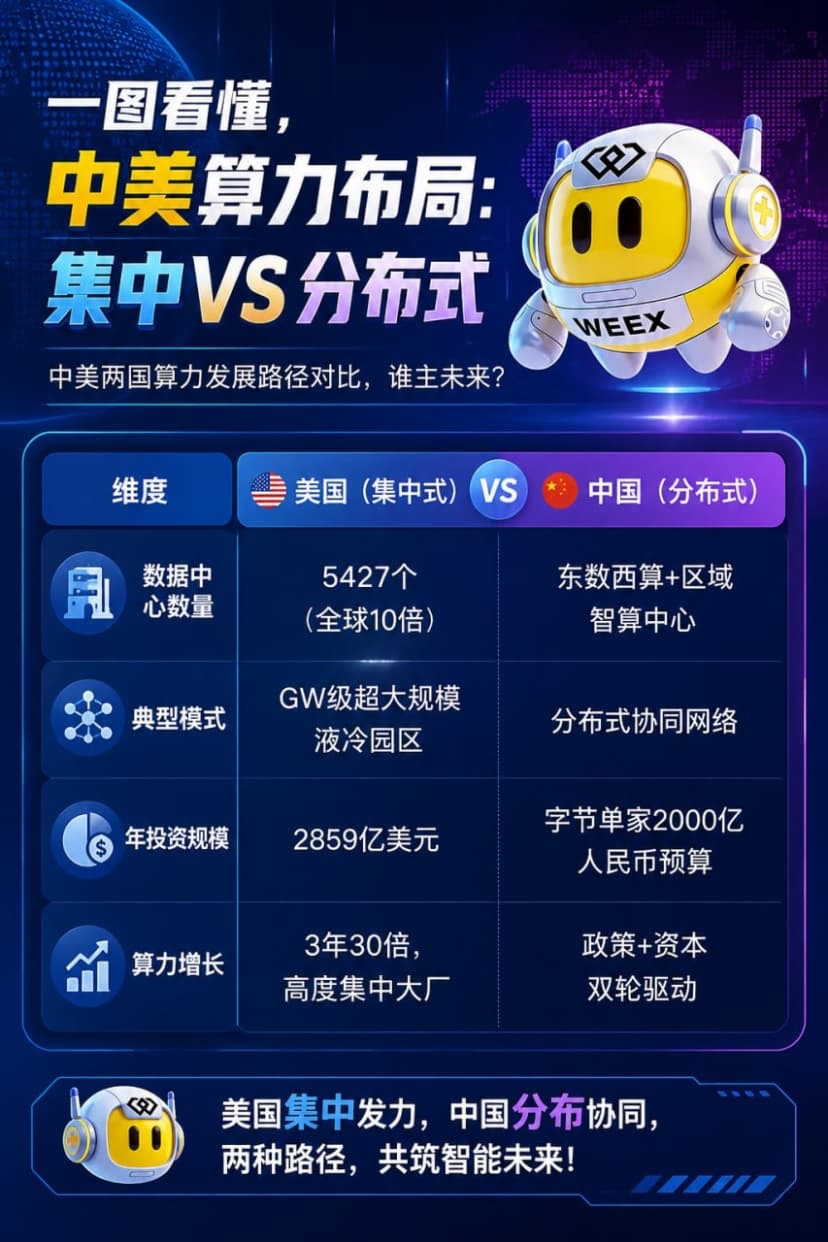
From the perspective of the underlying infrastructure, the evolutionary logic of the AI race between China and the US has diverged significantly. The US is investing heavily in building centralized computing power centered around NVIDIA and Microsoft's super campuses. This is a typical "elitist" approach, aiming to push the limits of AGI (Automatic Gaining Intelligence) through extreme computing density, attempting to produce a "super brain" capable of solving all problems.
In contrast, China has built a nationwide distributed computing power network based on the "Eastern Data, Western Computing" model. Based on WEEX LABS' long-term observation of industrial infrastructure , this approach resembles laying the groundwork for a "neural network" for industrial AI. China is not in a hurry to be number one in every single indicator, but rather is committed to ensuring that computing power, like electricity, flows through a nationwide dispatch network to factory production lines, smart city brains, and every digital government interface.
This misalignment in strategy will determine the focus of competition over the next five years: the United States is betting on "model height," while China is betting on "coverage breadth."
Commercial transitions: The "muddy battle" in the scene determines the final outcome.
Ultimately, the measure of whether a technology can become a civilization-changing variable lies in its performance on the balance sheet. A Stanford report reveals a trend that deeply alarms Silicon Valley: China's penetration rate in AI application scenarios is far ahead of the competition.
By 2025, China will account for 54% of the global installed base of industrial robots. Behind this figure lies the deep integration of AI into industrial vision, predictive maintenance, and flexible manufacturing. While American developers are still discussing how to make an LLM (Limited Learning Machine) tell a more interesting joke, AI in China has already entered mines, ports, and the entire recommendation system of Taobao. This application in trillion-level scenarios has put China 2-3 years ahead of Europe and the United States in terms of application.
WEEX LABS believes that the most significant difference in the AI competition between China and the US lies precisely in who can first establish a closed loop from "laboratory code" to "trillion-dollar industry monetization." The US has the advantage of defining global standards and monopolizing the ecosystem, but this also brings the risk of overvaluation bubbles; while China's path is application-driven and large-scale monetization. Although this logic still faces challenges in terms of originality, it has demonstrated extremely strong vitality in its self-sustaining ecosystem.
Anchor point for the next decade
The AI competition between China and the US is by no means a zero-sum game, but rather two different fast tracks leading to AGI. Once the 2.7% technological gap is closed over time, the real winner will be determined by who can enable AI to generate genuine productivity gains.
As a long-time observer of cutting-edge global technologies, WEEX LABS firmly believes that the best AI should not merely exist in sophisticated experimental data, but should also be reflected in the clicks of a billion users and the workflow in millions of factory workshops. In 2026, we bid farewell to the blind worship of Elo scores and ushered in a realistic era where application execution and the depth of the industrial ecosystem are key competitions. Who will reach the finish line first? The answer may not lie in the laboratory, but in the vibrant atmosphere of the vast market.