When a cryptocurrency project announces its tokenomics , the first thing people usually see is the supply distribution chart.
A typical announcement would allocate 25% of Token to the development team, 30% to validators , another portion to the community, and a separate portion to prepare for a potential Airdrop . Influencer channels often repost these figures, add a Token Lockup schedule, and present the project's economic model in a simple allocation table.
Many early founders learn about tokenomics through posts like these. They start to XEM tokenomics simply as Chia who receives Token and when Token are unlocked .
In fact, tokenomics has a much deeper meaning, reflecting the economic value behind that Token . It explains:
- Why does this Token exist?
- How do Token create value?
- Who really needs the Token?
- What can users earn from Token?
- How can investors divest Capital ?
- How the demand for the Token might grow after launch.
According to 8Blocks , founders often confuse Token distribution design with true tokenomics. A supply distribution table has value, but it's only a small part of a much more complex overall economic model.
Tokenomics has become a complete economic model.
In the early years of the cryptocurrency market, tokenomics were often very simple. A project only needed to announce a Token distribution plan, add conditions for unlocking Token Lockup, describe the basic features, and then proceed with the Token Sale.
The market is now much more mature. Investors, users, exchanges, and ecosystem partners all expect a deeper explanation of how Token function within the project.
Modern tokenomics can refer to Token usage, reward mechanisms, governance, Token Issuance, supply and demand balance, incentives for use, fund management, distribution methods, and secondary market behavior.
Ultimately, the purpose of tokenomics is to explain why that Token needs to exist.
Each part of tokenomics should contribute to answering the above question. If the Token provides access to the product, the model needs to clearly explain how that access works. If users can earn a profit by participating, it needs to clearly state where the rewards come from. If Token holders can participate in project governance, then the governance section must have specific processes and be closely linked to the project's operations.
Percentage figures only indicate ownership levels and do not reflect user needs, motivations, behavior, or the long-term growth potential of the project.
Founders should prepare tokenomics before launching a project.
Detailed tokenomics helps founders understand the product they are about to bring to market.
Many Token projects often begin with a product idea, then add Token at the end as a tool for Capital, community development, or growth. This can easily confuse the team. Product development, legal, marketing, business development, investor, and community managers may all interpret Token in very different ways.
A well-structured tokenomics document will help the project establish a unified economic foundation. All stakeholders will easily understand what the Token are used for, who actually needs them, why there will be demand, how the supply will be released to the market, and what the project plans for the period after the Token Sale.
A weak tokenomics model easily creates many vague assumptions. Consultants may offer inaccurate advice. Internal teams may expect a certain outcome, but the actual operation may differ. The marketing department may even advertise benefits that the economic model cannot guarantee.
Problems often become apparent after a Token Generation Event ( TGE ) takes place. Users receive Token and ask, "Why should I hold these Token ?" Investors look for opportunities to withdraw Capital. Market makers also face difficulties due to unclear demand. And the team has to make decisions under high pressure.
At this point, tokenomics became a "firefighting" measure rather than a comprehensive economic design from the outset.
Investors use tokenomics for fundamental analysis.
For investors, tokenomics is one of the most important tools for evaluating a project before deciding to Capital or buy Token.
A professional investor will need more than just a Token supply distribution table. They want to understand the unlocking pressure, expected demand, project revenue, user incentive policies, fund management, governance rights, Capital instructions, and many other factors. Additionally, they need to know if the Token plays a real Vai in the project or is primarily used for Capital .
Detailed tokenomics will help investors assess risk. They can predict when Token will be sold on the market, which groups are likely to sell, which phases will experience selling pressure, and whether there will be real demand for the Token in the future.
The Token Lockup schedule only indicates when the Token will be freely tradable, but rarely explains who the buyers will be, why users will continue to use it, or how the project plans to support its economic model during periods of sluggish market conditions.
That's why tokenomics can help differentiate between serious projects and those that are only short-lived. A well-structured tokenomics report helps investors understand whether the development team has truly thought through their economic outlook.
Performance in the secondary market begins before TGE takes place.
The most important test for tokenomics comes after the project officially launches.
A project might attract attention, get listed on an exchange, complete an Airdrop program, and generate initial momentum. But once the Token starts trading freely, the market will test XEM there is real demand for the Token beyond the initial sale phase.
If a tokenomics model revolves solely around Token distribution, the results are often weak. The team, investors, ecosystem, and community may all be clearly Chia , but demand after launch is usually lackluster. The project only talks about how the Token will enter circulation, but fails to give users, partners, or investors a reason to buy or hold the Token long-term.
A robust tokenomics model requires thorough research into secondary market activity prior to TGE. It must account for Token buybacks, revenue streams, reward balancing, actual usage demand, and scenarios that reduce the circulating Token . These mechanisms help mitigate unnecessary selling pressure, ensuring the Token has a reason to continue being used after the initial surge in attention.
Therefore, founders are forced to link Token to real-world business logic. A project without a clear revenue stream, specific utility, or limited user demand will find it very difficult to maintain its appeal once the initial excitement at launch has passed.
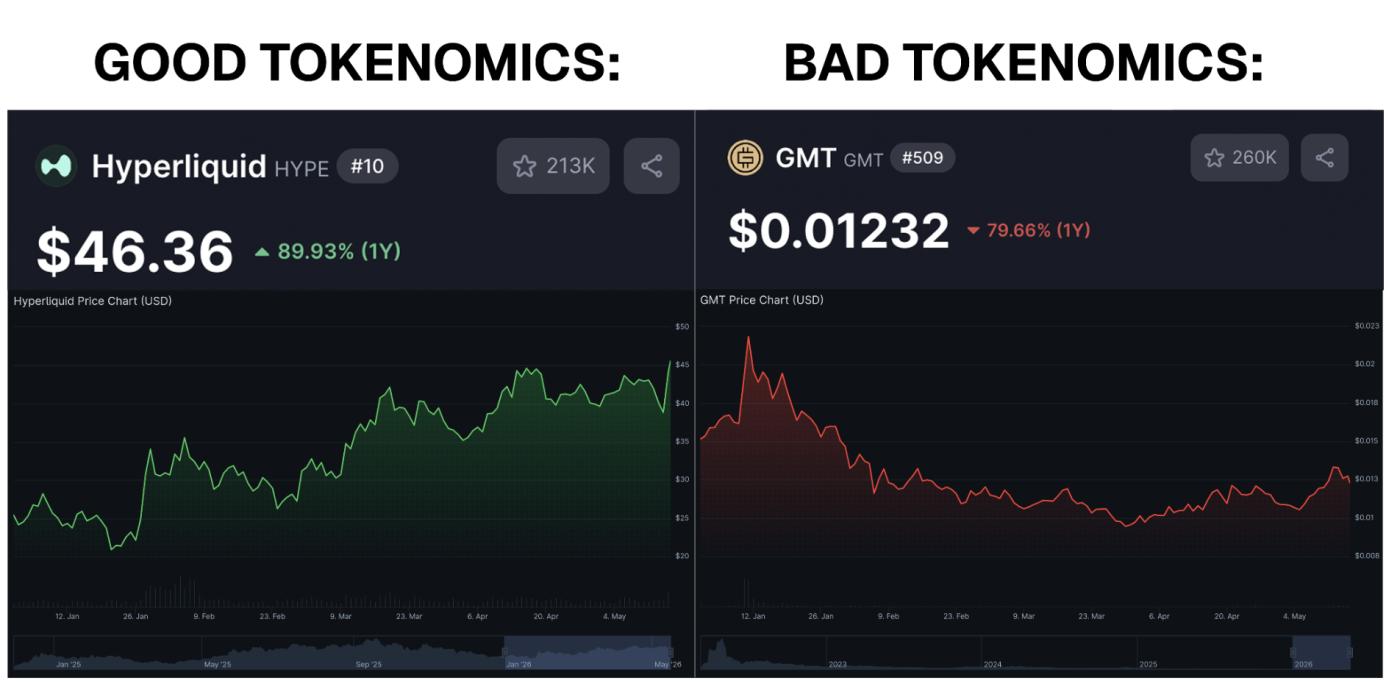
Many Token with fragile tokenomics often only last one to three months before losing momentum. Early buyers sell off, reward systems create significant selling pressure, and the project lacks a solid economic mechanism to regenerate demand.
Token need to have a clear purpose.
Applicability is a very common term in Token building.
Projects often mention that Token will be used to unlock services, get discounts, receive rewards, participate in governance, Staking , and join the ecosystem. This sounds powerful, but Token only truly have value when each function serves a specific economic Vai :
- The access benefit description should clearly state what the Token unlocks and why users need the Token to use it.
- The reward system must specify the source of the rewards and how the number of Token issued will always be balanced.
- The governing interests need to ensure that the holders actually have a voice, but within clear boundaries.
- The benefits of Staking should clearly state what Stake contribute to the protocol and why they receive rewards.
The most important issue is the true economic purpose. Each Token 's Vai must create additional demand, retain users, support operations, or help members move towards long-term value.
A Token with vague utility might be weak. A Token with few functions but each use clearly defined can build a more solid economy.
Solid tokenomics helps a project connect founders, users, and investors.
Strong tokenomics fosters consensus among all stakeholders in a project.
The founders understand the product they're creating. Investors see the risks and Capital conditions. Users know why the Token is useful to them. The community understands the value of participating. The team also recognizes the mechanisms that will sustain the economy after launch.
This consensus becomes even more crucial during challenging market conditions. Token prices can plummet, liquidation weakens, and user interest diminishes. Projects with clear tokenomics will be better able to cope, thanks to pre-prepared solutions rather than hasty reactions.
8Blocks argues that tokenomics should be integrated into the core design of a project, rather than being merely a decorative blueprint for investors.
The Token allocation table only shows who owns how many Token , and the unlock schedule indicates when the Token will be returned. However, the essence of tokenomics is to demonstrate why Token deserve to exist in the project economy and how they maintain their Vai even after official launch.