SpaceX's IPO prospectus does something unusual: it strips small investors of the power to dismiss the CEO. Even in the document, they warn that the CEO's departure could have serious consequences for the company.
This contradiction is structural, not accidental. The S-1 requires the market to Capital a single founder, while simultaneously accepting a compensation package that is only activated upon achieving what remains a projected goal.
SpaceX's IPO is tied to the risk of dependence on a single individual.
Elon Musk currently holds approximately 42.5% of SpaceX's shares but owns 83.8% of the voting rights through Class B shares, which have high voting power. According to the S-1, removing Musk from management positions requires a vote from Class B shareholders – and Musk has complete control over this group of shares.
Professor Lucian Bebchuk, a law professor from Harvard University, commented that this is an "unusual" structure. Normally, the board of directors would have the power to dismiss the CEO. But with SpaceX's structure, this power rests almost entirely in Musk's hands, creating a self-regulating loop.
The filing also clearly indicated on several pages that losing Musk would be a significant risk to the company. They listed Musk's other commitments at Tesla, xAI, X, Neuralink, and The Boring Company.
There is no clear succession plan, nor is anyone prepared to replace Musk.
Corporate feudalism is making a comeback on the stock market.
SpaceX, founded in Texas, requires mandatory arbitration and is exempt from certain regulations applied to publicly controlled companies. The company also sets a 3% threshold, or a minimum of $1 million, for proposals from shareholders. The prospectus itself states that the influence of minority shareholders will be limited or even eliminated.
Many pension funds have voiced their opposition. CalPERS, the New York State Department of Financial Conduct, and the New York City Financial Controller jointly signed a letter .
They argue that SpaceX's model is far removed from the standards that publicly traded companies should adhere to.
SpaceX argues that this structure helps the company protect its long-term goals, preventing pressure from minority shareholders pursuing short-term gains.
However, this doesn't solve the recall problem. Compared to Meta or Alphabet, the SpaceX founder's control is far superior.
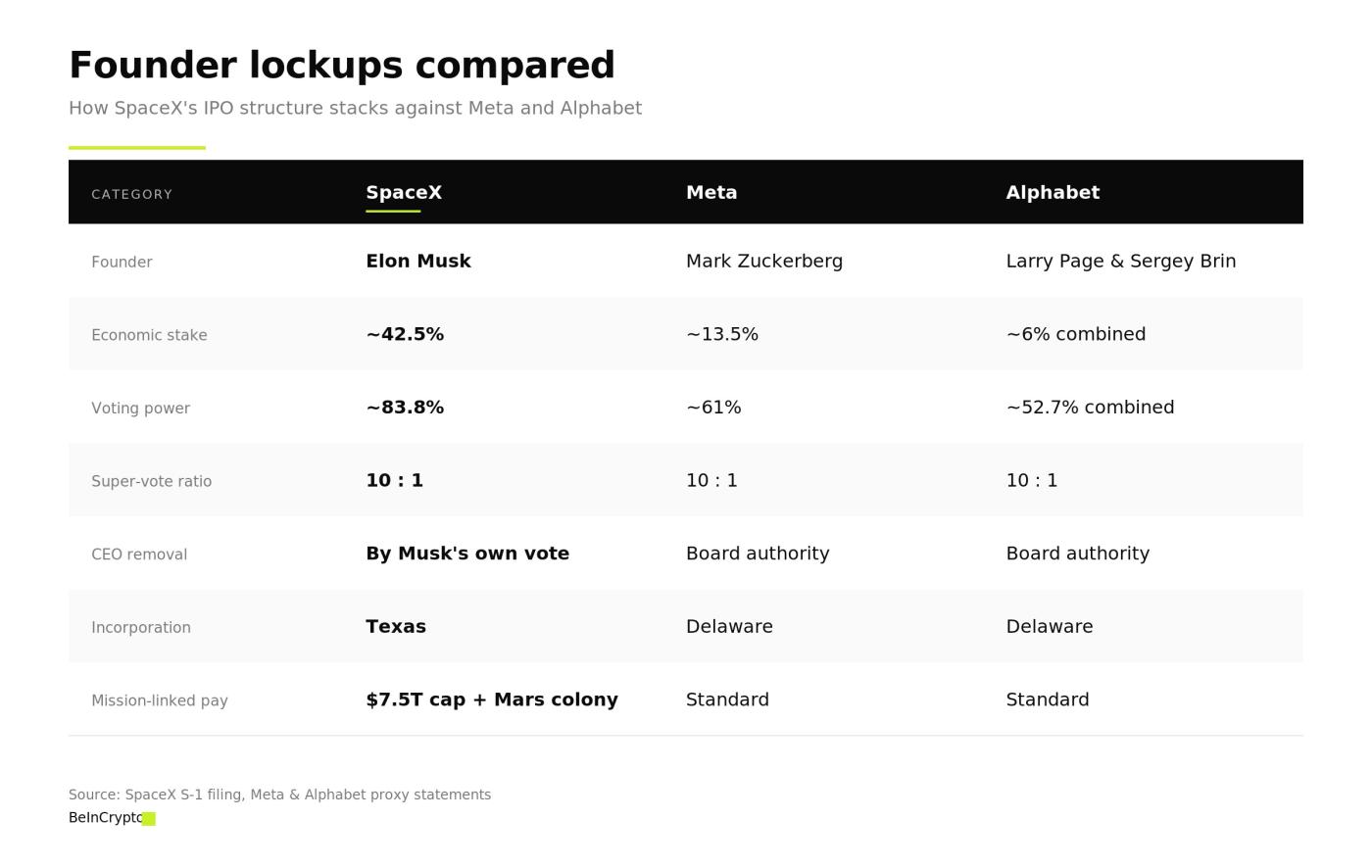 Restrictions on locking up shares in SpaceX, Meta, and Alphabet.
The $7.5 trillion valuation for Mars is not a true valuation.
The largest compensation package would award Musk up to 200 million Class B shares, but only if SpaceX reaches a market Capital of $7.5 trillion. A condition attached is the establishment of a permanent settlement on Mars with at least one million inhabitants.
This $7.5 trillion threshold is even higher than the combined market value of Apple, Microsoft, and Saudi Aramco. The conditions on Mars are also unprecedented, with no existing infrastructure or extraterrestrial legal framework to refer to.
These criteria fall entirely outside of conventional valuation methods.
The next incentive package is up to 60.4 million shares for building an orbital data center with a total capacity of 100 terawatts. This is similar to xAI's AI "race" on Earth . Even in S-1, the company acknowledged that these projects are not guaranteed to be profitable.
This is the price of handing over both control and ambiguous compensation design to one person. Small investors are forced to pour money into a company they have no influence over, with milestones that no valuation model can measure.
Ultimately, the only person who can mess up the “mission” is the one who is allowed to define it.