AI is rapidly impacting all industries. However, sometimes when you occasionally walk into a farmers' market, you feel like time has stood still.
Article author and source: 36Kr
The tech giants are no longer the reckless wrestlers battling vegetable vendors in the dirty, muddy fields; they have retreated to the cloud and are using algorithms to formulate strategies.
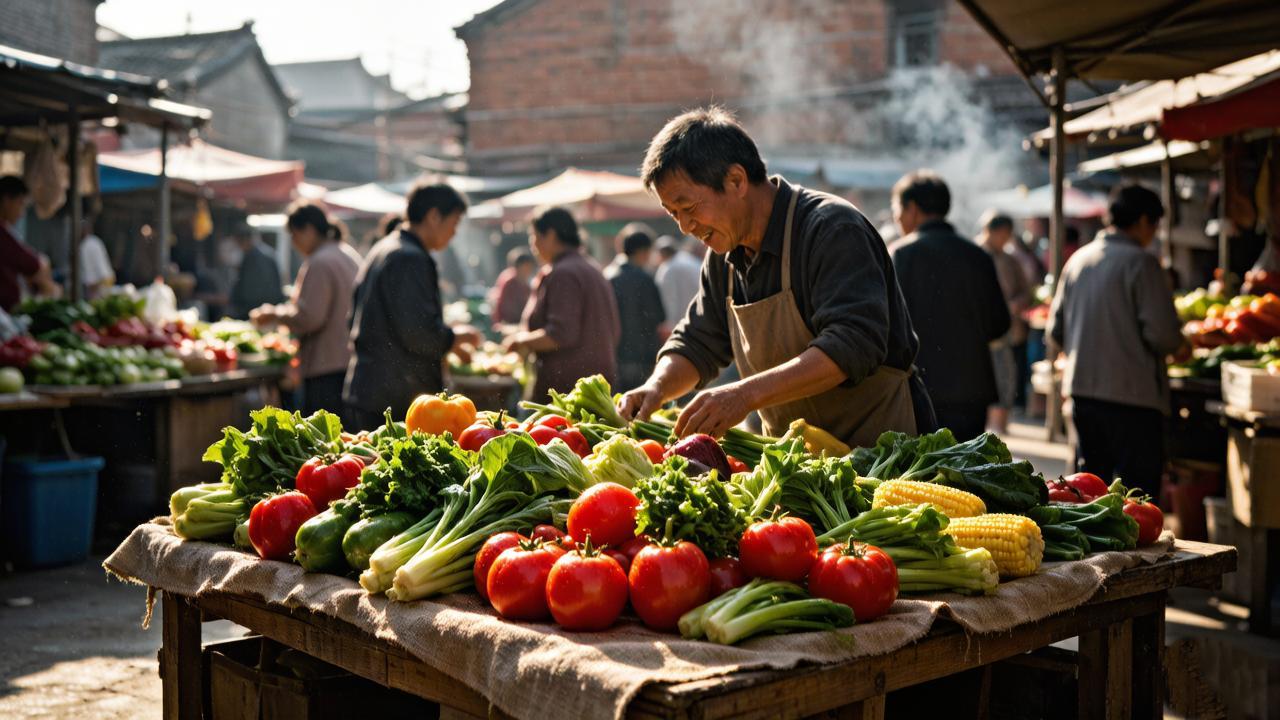
AI is rapidly impacting all industries. However, sometimes when you occasionally walk into a farmers' market, you feel like time has stood still.
Many vendors still use the precise touch they've honed over twenty years to handle vegetables, still chat with regular customers, and still slip a scallion into their bags before they leave. The air is filled with the smells of fish, the aroma of braised spices, and the sounds of bargaining.
All these sounds combined to create a "lively atmosphere" that sounds like a victory declaration for the internet giants.
Looking back at the period from 2020 to 2025, Meituan, Pinduoduo, and Didi entered the community group buying market with tens of billions of yuan, hoping to use capital and big data to disrupt the traditional wet market. In 2025, Taobao Maicai withdrew; shortly after the Spring Festival in 2026, Meituan acquired Dingdong Maicai for over $700 million—burning through hundreds of billions of yuan, and ultimately leaving behind several closure announcements.
The "cabbage war" ended in a collective defeat for major internet companies, and these internet barbarians seem to have finally met their match.
But this calm is more like the silence before a storm.
The rules of victory and defeat are already subtly changing. Those giants who have fallen in the front-line battles are turning their backs and donning a cold-blooded cloak of "AI artificial intelligence." A new round of encirclement has quietly begun in the unseen corners.
First, the giants will not withdraw.
Will internet giants really abandon farmers' markets?
The answer is no. The four underlying layers of logic dictate that they not only will not retreat, but must win this round in some way.
First, fresh produce is a fiercely contested market worth trillions of yuan; retreating means certain doom. In 2024, China's fresh produce retail market reached 6.57 trillion yuan, with community-based sales becoming the only high-growth engine at an annual rate of nearly 10%. Whoever controls the near-field entry point for fresh produce consumption controls the reason users open the app at least once a day. Giving up fresh produce is tantamount to relinquishing the strategic high ground of controlling users' daily lives.
Secondly, community group buying isn't dead; it's just changed its appearance. Many people declared community group buying a dead end upon seeing Meituan Youxuan close its warehouses, but data shows that by the end of 2025, Duoduo Maicai's annual GMV had approached 300 billion yuan, exceeding the combined total of Duoduo and Meituan, with self-pickup points covering 70% of administrative villages nationwide. This isn't failure; it's a formidable rebirth after "survival of the fittest"—profits are still growing on the tough nut of fresh produce.
Third, AI is rewriting the formula for the demise of community group buying. The core weakness of community group buying in the past was its outrageously high fulfillment costs—pre-positioned warehouses, cold chain logistics, and delivery—each order was a drain on resources. But AI's logic is based on fixed costs with marginal costs approaching zero. Meituan's R&D investment in 2025 is 26 billion yuan, with over 80% going towards AI; Alibaba will invest over 380 billion yuan in AI hardware over the next three years. When AI can reduce fulfillment costs by more than 30%, a profitable model will be established for the first time.
Fourth, farmers' markets are the foundation of the local lifestyle ecosystem. Fresh food consumption increases user stickiness and frequency of visits, which in turn fuels data to support high-profit sectors such as finance, local services, and cross-border retail. Abandoning farmers' markets is tantamount to dismantling the foundation of the entire local lifestyle landscape.
Once you understand these four layers of logic, you'll realize that the giants have never truly withdrawn. They are simply waiting for a technological revolution to bring about a "paradigm shift"—to escape the quagmire of burning money and, with the help of AI, make a comeback in a more ruthless and precise way.
II. The Hunt Never Ceases: The AI Experiments Underway
If you were to walk into a smart agricultural market transformation model in a first-tier city, you might not be greeted by the bustling vegetable vendors, but by AI cameras embedded in the ceiling that can identify 480 kinds of fruits and vegetables in 0.5 seconds, and AI-powered intelligent traceability electronic scales that prevent cheating by using deceptive scales.
This visible transformation of "smart farmers' markets" is just the tip of the iceberg. The real undercurrents lie hidden in the AI technology experiments that these giants have staked their entire fortunes on.
AI-driven pricing is shifting pricing power to algorithms. In the second half of last year, Shenzhen Haijixing and JD Technology launched a blockchain + AI dynamic pricing system, which revolutionized the traditional agricultural product pricing model with a 92% prediction accuracy and a 5-minute response time. Meituan's self-developed large-scale model has been iteratively running in the fresh produce category—whether the potatoes at your stall should sell for 2.8 yuan or 3.5 yuan, the algorithm can calculate faster than Grandma Wang, who has been running her stall for 30 years.
From unmanned warehouses and unmanned lockers to unmanned delivery, the "human" element in the retail-to-home scenario is gradually being eliminated. Whether it's Meituan or Alibaba, unmanned warehouses and unmanned delivery have fully transitioned from early technology verification to large-scale commercial use. Cainiao has achieved rapid expansion through deep integration with leading unmanned vehicle companies. Meanwhile, SF Express's subsidiary, Feng e Zushi, has its AI-powered intelligent agent managing 180,000 unmanned smart lockers, making hundreds of millions of decisions every day, approaching "Level 4 autonomous driving."
Intelligent supervision and traceability: data penetrates everything. In the transformation of smart agricultural markets across various regions, all the data collected by AI-powered customer flow analysis cameras and environmental sensors is constantly being fed back, becoming the precise fuel for the next pricing instructions and inventory management.
The tech giants are no longer the reckless wrestlers battling vegetable vendors in the dirty, muddy fields; they have retreated to the cloud and are using algorithms to formulate strategies.
In the past, community group buying failed because it was too cumbersome. Cold chain logistics, delivery, and group leader commissions—the marginal cost of each order was bleeding money. Once subsidies stopped, users turned around and went back to the wet market.
But AI works the other way around. A camera is installed once and used for five years; an algorithm is trained once and iterated countless times; a smart scale is bought to replace a cashier—all of these are fixed cost investments with marginal costs approaching zero.
When AI can reduce fulfillment costs by more than 30%, traditional vegetable vendors, aside from their meager human touch, have virtually no advantage. Faced with a screen that can calculate prices with an accuracy of 0.1 seconds, the efficiency of handwritten price tags seems like something from the Stone Age.
More importantly, the baton of consumption is being passed down through generations. Those born in the 1980s, 1990s, and 2000s are becoming the main consumers of fresh produce. They are accustomed to ordering through apps and having their orders delivered within half an hour. The bustling atmosphere of traditional farmers' markets doesn't feel "friendly" to them; rather, they "don't want to squeeze in the crowds." When AI-powered unmanned vending machines can meet daily purchasing needs, will the stalls that farmers have painstakingly built up over decades still be able to survive?
Every technological revolution inevitably benefits some people while causing others to lose their jobs.
There are over 30,000 farmers' markets across the country, involving tens of millions of vegetable vendors and their upstream and downstream workers. Economists might say that the replacement of horse-drawn carriage drivers by automobiles was an inevitable historical process, but have you heard the stories of those carriage drivers afterward? Not all of them found jobs as drivers; many simply disappeared. Today's vegetable vendors may very well be the same horse-drawn carriage drivers of yesteryear.
The logic behind capital is even more ruthless. In the internet age, burning money was about acquiring users and telling investment stories; in the AI era, the underlying logic for promoting automation is singular: one less person means less social security contributions and less money. No sentimentality or transformation plans are needed.
Of course, wet markets won't disappear overnight. The trust among neighbors, the experience of bargaining, and the freshness of "live fish being killed on the spot" are things that AI will indeed find difficult to replace in the short term.
But when those born in the 1990s and 2000s have never developed the muscle memory of "going to the farmers' market to buy vegetables", when AI-powered unmanned vending machines can meet 80% of daily purchasing needs, when algorithms determine who is qualified to sell vegetables, who sets prices, and who earns the money—how long can the last vestige of liveliness in the farmers' market continue to burn? This is probably a question that no one can answer with sentimentality and longing.
Perhaps in a few years, when we tell the next generation of children, "Mom used to go to the market to buy vegetables when she was little," will they be as curious as if they were hearing an old fairy tale? One day, will that narrative about "the warmth of everyday life" also become a black and white scene in a nostalgic art film?