Author: Claude, TechFlow TechFlow
TechFlow Dive: As Bitcoin rebounded to $80,000 in early May, exchange inflows saw the fastest growth since 2026, with perpetual futures open interest reaching $29 billion on May 5th. Binance alone accounted for 32% of the incremental funds, increasing stablecoin reserves from $49.9 billion to $53.1 billion. However, high leverage also created hidden risks, as BTC subsequently retreated to approximately $77,000 a week later, resulting in the forced liquidation of $657 million in long positions.
When Bitcoin surged toward $80,000 in early May, one phenomenon you might have overlooked was the most aggressive buying activity in the derivatives market this year.
According to CryptoQuant data , open interest in Bitcoin perpetual futures reached $29 billion on May 5th, the highest level since January 29th. The 30-day rolling increase reached $6.98 billion, also the fastest growth rate so far in 2026. While funds poured into exchanges, stablecoin reserves climbed in tandem, and Altcoin deposit trading volume surged to a four-month high.
CryptoQuant analyst Darkfost points out that the current increase in open interest has surpassed the expansion seen when BTC hit its all-time high in 2025, demonstrating the market's enthusiasm. However, he also warns that the large accumulation of long and short positions makes the market more vulnerable, and forced liquidation could amplify volatility should prices fluctuate sharply.
This warning was quickly proven true. On May 18, impacted by news of Trump's hints at military action against Iran, BTC plummeted from above $80,000 to below $77,000 in a single day, resulting in the forced liquidation of $657 million in positions. As of press time, BTC is trading at approximately $77,000, down about 6% from its monthly high.
Binance absorbed one-third of the incremental funds, and the concentration of the derivatives market continued to rise.
Binance's dominance has been further consolidated in this round of leverage expansion.
According to CryptoQuant data, Binance's open interest in Bitcoin reached $9.03 billion, 73% higher than the second-ranked exchange. Gate.io and Bybit followed with $5.3 billion and $4.7 billion, respectively.
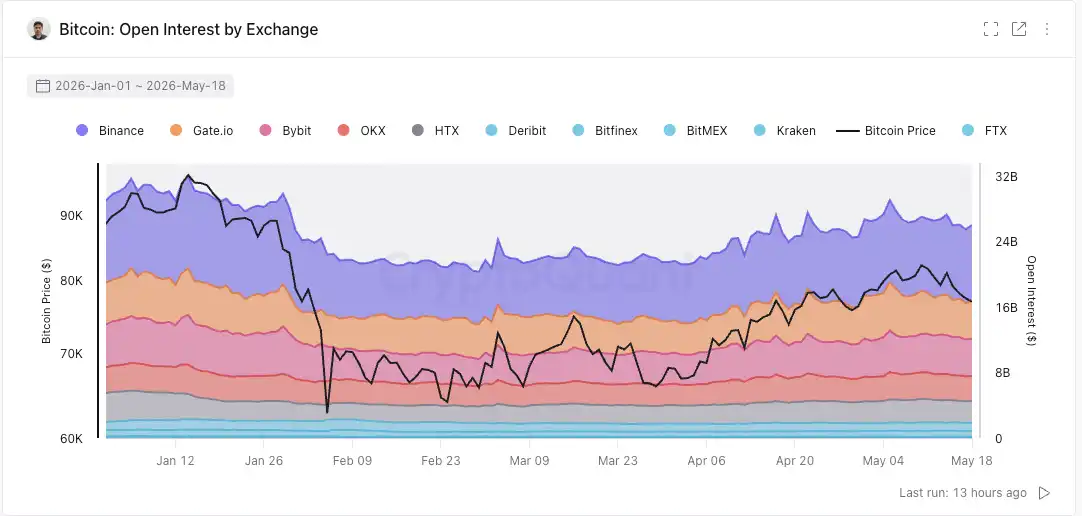
From an incremental perspective, the increase is more concentrated: Binance's 30-day open interest increased by $2.55 billion, accounting for 32% of the total market inflows during the same period. Gate.io increased by $1.7 billion, and Bybit increased by $1.1 billion. According to Bitcoinist, Darkfost pointed out in his CryptoQuant analysis that despite funding rates remaining negative for the past few weeks, open interest still recorded its largest increase since 2026.
Negative funding rates mean short sellers are paying for their positions, yet open interest has surged. This contradictory signal suggests that new funds are entering the market long the bearish consensus, betting on upside potential for BTC. In hindsight, this long pressure did push BTC to $82,855 at one point, but the subsequent pullback also demonstrated the vulnerability of high leverage.
Stablecoin reserves surge, exchanges have ample "ammunition depots".
The increase in derivatives positions is not an isolated phenomenon; liquidity in the spot market is also improving simultaneously.
According to CryptoQuant data, total USDT holdings on centralized exchanges increased from $49.9 billion on March 8 to $53.1 billion (ERC20 tokens). Binance's USDT holdings increased from $35 billion to $39.3 billion, a rise of approximately 12%.
Binance holds 67.02% of the stablecoin reserves held by exchanges, amounting to approximately $41 billion in USDT (including ERC20 and TRC20 tokens). OKX ranks second with 9.81%, while Coinbase Advanced and Bybit hold 7.45% and 7.4%, respectively.
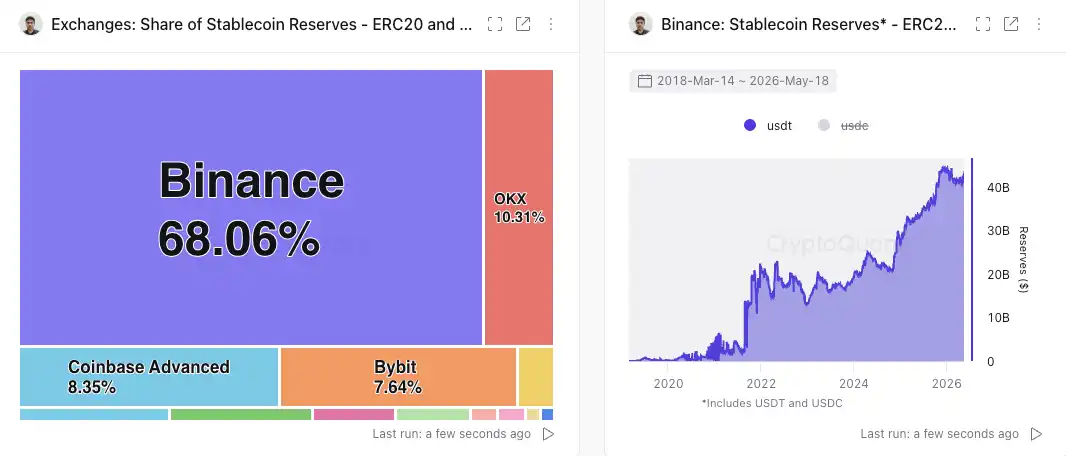
The growth of stablecoin reserves is often interpreted as the accumulation of "deployable funds." Funds are transferred from external wallets to exchanges and converted into stablecoins to await opportunities, which means that purchasing power is accumulating, not withdrawing.
Looking at the data from ETFs, US spot Bitcoin ETFs saw a net inflow of $2.44 billion in April, the strongest monthly performance since October 2025, with institutional and exchange-side funding signals aligned.
Altcoin flooding exchanges: a signal of selling pressure or a rotation of funds?
CryptoQuant data shows that on May 6, the number of Altcoin exchange deposit transactions reached approximately 57,000, the highest level in nearly four months. Binance attracted the most Altcoin deposits (approximately 16,400 transactions), followed closely by Coinbase (approximately 15,300 transactions).
A large influx of Altcoin into exchanges is intuitively a selling signal. Tokens transferred from wallets to exchanges usually indicate that holders are preparing to sell. However, considering other data points, this is more likely a rotation of funds rather than a general withdrawal:
The simultaneous increase in USDT reserves on exchanges indicates that funds have not left the market but have been converted into stablecoins. BTC open interest hit a new high for the year, with funds flowing from Altcoin to Bitcoin derivatives. Goldman Sachs completely liquidated its XRP and Solana ETF holdings at the end of Q1 and instead increased its Bitcoin call option positions, indicating that institutional funds are also making a similar "altcoin → BTC" switch.
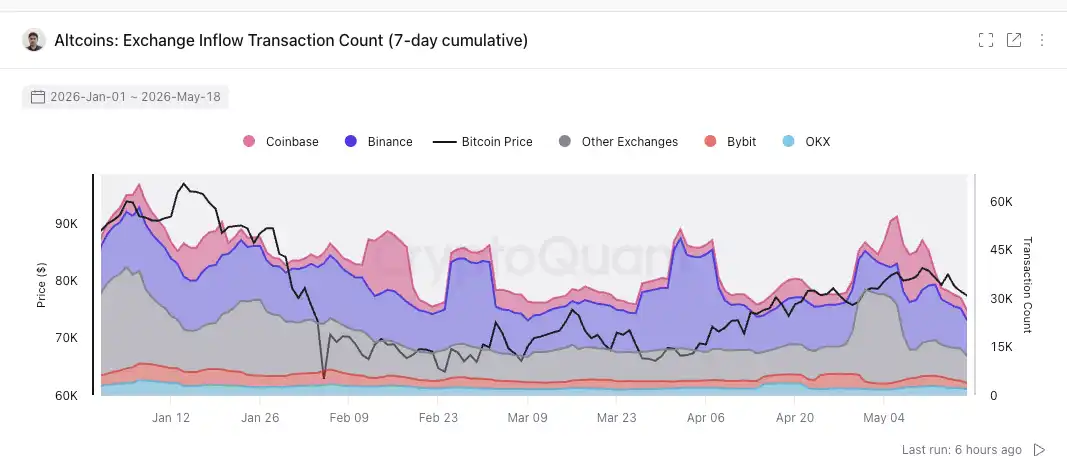
This pattern of behavior is common during strong Bitcoin rallies: investors cash in profits on Altcoin, reinvest in stablecoins or Bitcoin, and then redeploy their investments once the market direction becomes clearer. This puts short-term pressure on Altcoin, but for the overall crypto market liquidity pool, liquidity continues to circulate within the system.
The $80,000 Battle: Leveraged Expansion Encounters Geopolitical Risks
Looking back at the price movement in the first half of May, BTC surged from $78,000 to $82,855, driven by a triple force: continuous inflows into ETFs, accumulation of funds on exchanges, and increased holdings in derivatives. On May 1st alone, spot Bitcoin ETFs saw a net inflow of $630 million. Strategy further increased its holdings last week by approximately $2 billion, adding about 25,000 BTC, bringing its total holdings to approximately 844,000 BTC.
However, high leverage itself is a source of vulnerability. The pullback on May 18th proved this: after Trump hinted at possible military action against Iran on Truth Social, BTC fell from $81,070 at the start of the week to around $77,119, marking its worst weekly performance since February. The Fear & Greed Index fell to 28 (fear), and ETFs also saw a reversal, with the spot Bitcoin ETF experiencing a net outflow of over $1 billion in a single week.
Darkfost's earlier warning has been proven true: the rapid expansion of open interest has created a large number of liquidable positions in the market, and once an external shock triggers a price drop, the liquidation mechanism will amplify the decline.
Now, the $657 million long liquidation has objectively completed a round of leverage clearing, and the market structure is actually healthier than before the crash.
There are three indicators worth continuing to monitor:
First, there's the issue of stablecoin reserves held by exchanges. $53.1 billion in USDT remains on exchanges; the funds haven't left. The destination of this "dry powder" will determine the strength of the rebound: if stablecoins start flowing out of exchanges and back onto the blockchain, that would be a true bear market signal.
Secondly, there's the flow of funds into ETFs. April saw a net inflow of $2.44 billion, but this reversed last week to a net outflow of over $1 billion. If ETFs experience net outflows for more than two consecutive weeks, it indicates that institutional demand is weakening.
Third is Strategy's average holding price of $75,537. This is the closest psychological barrier for institutions. If it holds, the narrative of "buying on dips" will continue; if it falls below, the market will lose the most stable buying power in 2026, and the next support level to watch is the April low of $74,900.