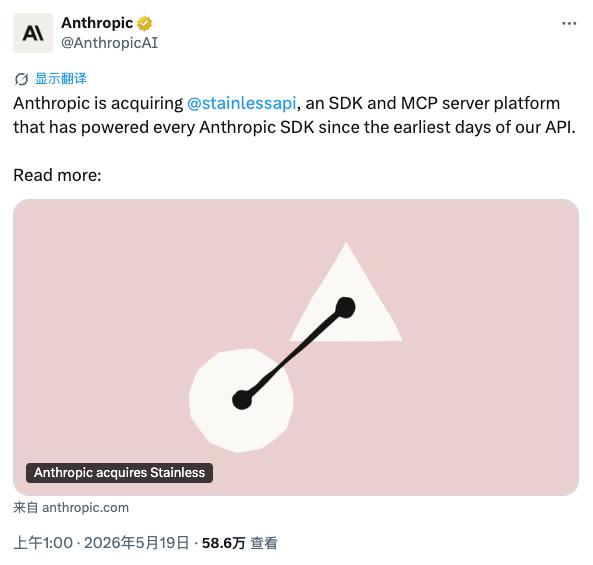
On May 18, Anthropic announced its acquisition of Stainless, a New York-based developer tools company, for over $300 million. Stainless serves leading AI companies such as OpenAI, Google, and Cloudflare, and its core business is automatically converting API specifications into SDKs for languages like TypeScript and Python. Anthropic simultaneously shut down Stainless's external SDK generation service, meaning competitors like OpenAI will no longer be able to use it. This acquisition reveals that AI competition is shifting from model capabilities to developer access and SDK standards. By controlling the connectivity layer infrastructure, Anthropic aims to gain a voice in the future AI agent ecosystem.
Article author and source: Leifeng.com
On May 18, Anthropic announced a seemingly "ordinary" acquisition: it bought Stainless, a New York-based developer tools company, at a valuation of over $300 million.
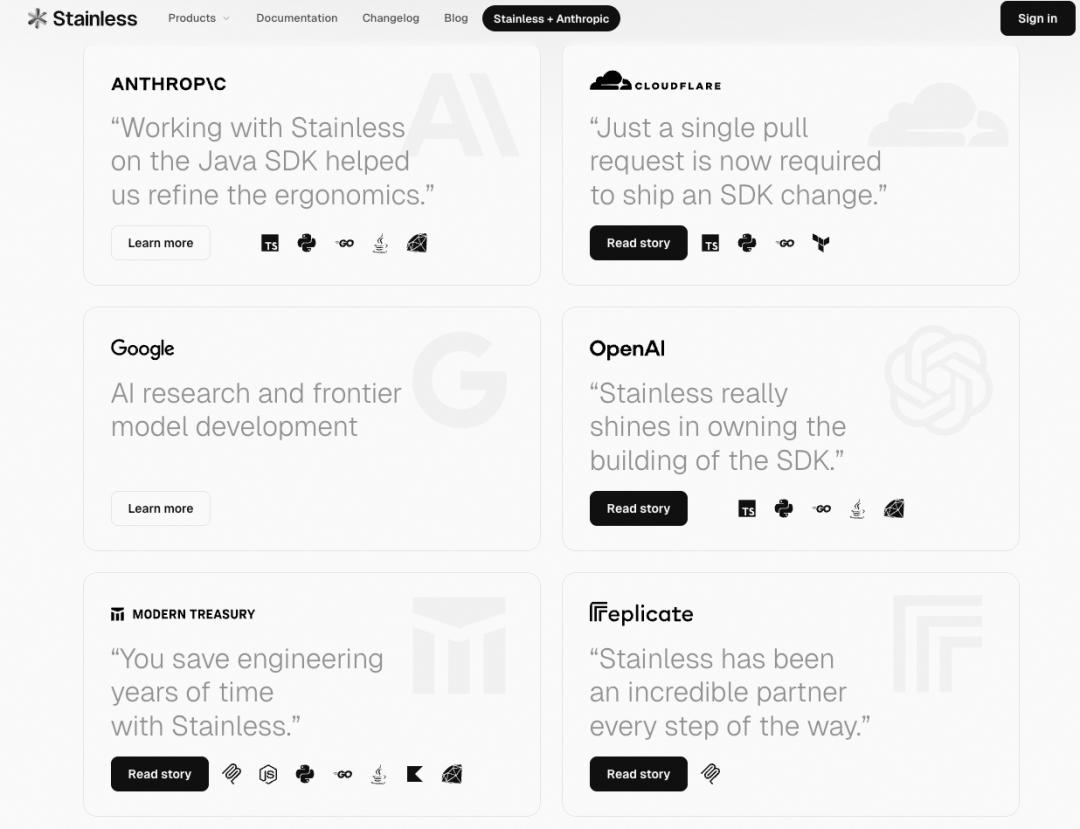
The acquired company, Stainless, is not an ordinary SaaS company. What makes it special is that it serves almost all the leading players in the AI industry. Its client list includes Silicon Valley giants such as OpenAI, Google, Cloudflare, Replicate, and Runway.
Stainless's core business might sound a bit dry: automatically converting structured API specifications into SDKs (Software Development Kits) for various languages such as TypeScript, Python, and Go. It also provides CLI tools and an MCP (Model Context Protocol) server platform.
Since the first day the Anthropic API was launched, Stainless has been providing underlying support for every official Anthropic SDK.
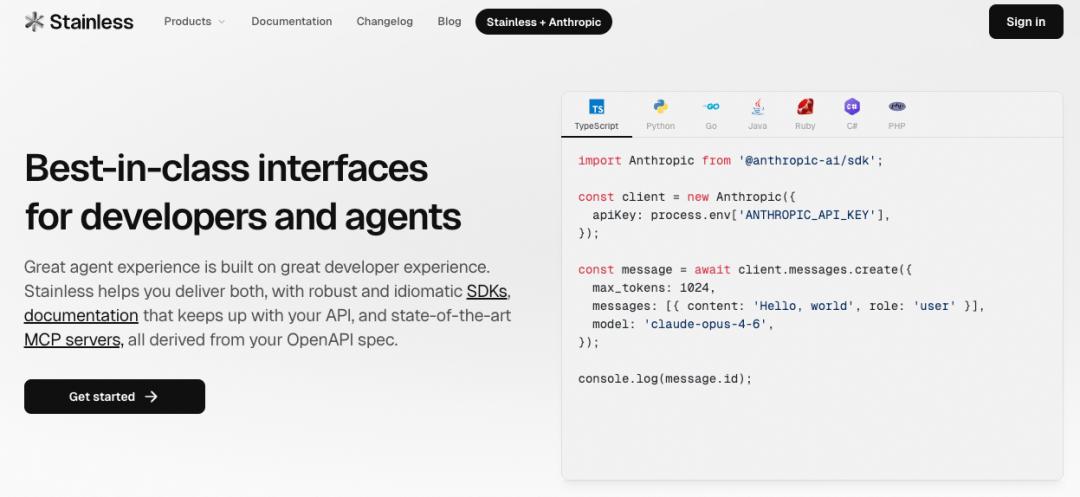
Alongside the acquisition announcement, Anthropic announced the closure of its externally hosted Stainless SDK generation service. Existing customers can retain their existing SDKs for modification, but this production line will no longer be open to competitors. The entire Stainless team has been integrated into Anthropic's platform engineering department to continue "making Claude Agent better connect to real software systems."
$300 million is enough to buy a mid-sized AI startup or build two super data centers. Instead, Anthropic used it to buy a team of human engineers dedicated to "translating API specifications into code."
This means that Anthropic has expanded its model competition from "whose model is stronger" to "who can control the distribution chain of developer access, SDK, documentation, and API." Anthropic's ecosystem development has taken another step forward.
$0.13 billion, Anthropic slapped itself in the face.
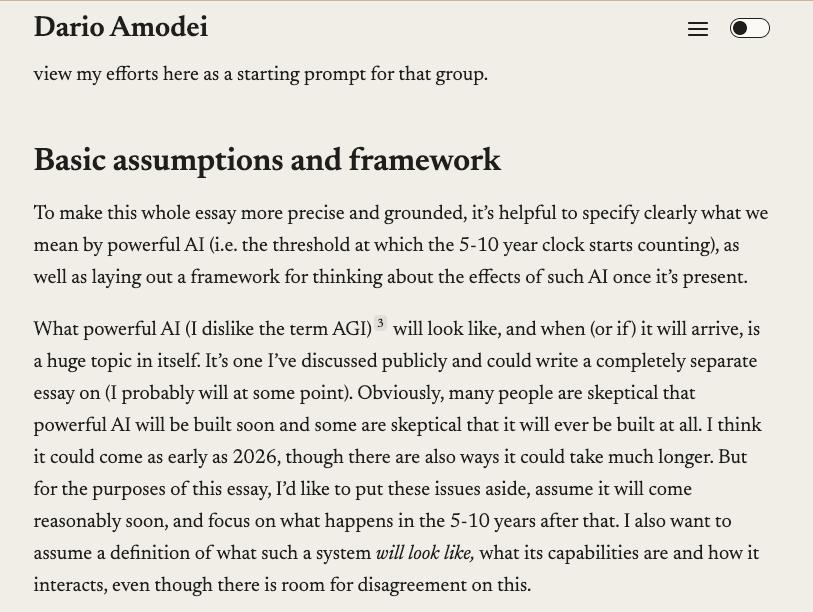
In his lengthy 2024 article, "Machines of Loving Grace," Anthropic CEO Dario Amodei asserted that "powerful AI will accomplish most cognitive tasks within the next few years," with the window of opportunity "as early as 2026."
He repeatedly emphasized that AI Agents will autonomously complete tasks that would otherwise take hours, days, or even weeks, and that their intelligence "surpasses that of most Nobel laureates in related fields," capable of absorbing information and generating actions at 10 to 100 times the speed of humans.
The problem is that this narrative encounters an awkward fact.
On Hacker News, a forum frequented by tech geeks, a highly upvoted comment hit the nail on the head: "If AI could really write a good SDK, Stainless wouldn't be selling for this price."
This is where the value of companies like Stainless lies: AI can simply write a basic, usable SDK, but a production-grade SDK is not just about wrapping an HTTP API in a layer; more importantly, it's about providing a continuous, reliable, and scalable engineering infrastructure.
Even more dramatically, Anthropic's arch-rival OpenAI happens to be one of Stainless's biggest customers.
Anthropic's strategy of "buying out, shutting down, and monopolizing" has sparked a frenzy of criticism from developers on the social platform X: "Anthropic's competitive strategy: compete with OpenAI → discover that OpenAI is using Stainless → buy Stainless → shut down the service."
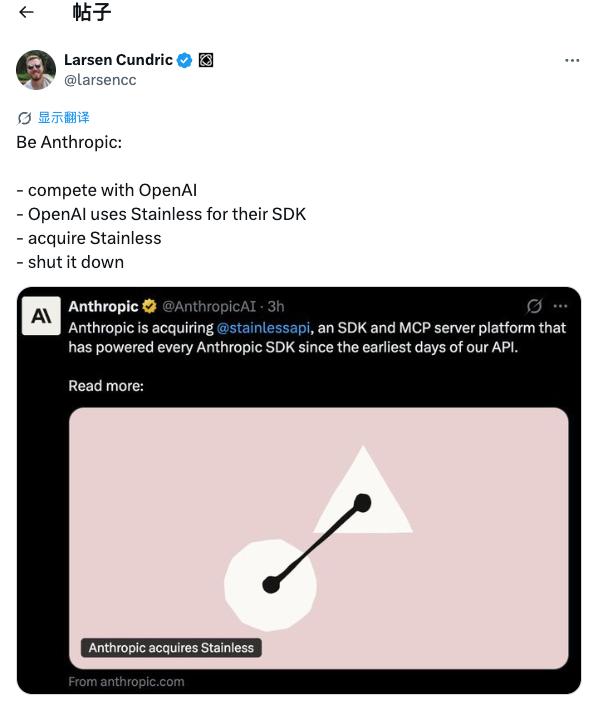
This seemingly "unethical" but shrewd move reveals a fundamental shift in the competition among large-scale models: the battlefield for giants has quietly expanded from simply competing on "whose model parameters are stronger and whose test scores are higher" to the strategic level, where "whoever controls the developer access, SDK specifications, and API distribution links will have overall control over the survival pipeline" and the commanding heights of the ecosystem.
02 The "Last Mile" of AI: Why is Stainless worth $300 Million?
Converting API specifications into code sounds like the perfect task for large-scale models. API documentation is highly structured, and there are plenty of templates available for code generation. Logically, feeding Claude a document should allow it to generate a perfect SDK in a second.
However, the real world is full of edge cases, such as strange naming conventions, inconsistent error handling, non-standard authentication processes, and differences in cross-language type systems. Handling these requires top-level engineering skills—the ability to "understand complex protocols and build stable underlying frameworks"—not just the ability to "write code."
Stainless is so robust that it can be bought by financial giants like OpenAI, Google, and even Blackstone, which have an almost obsessive need for stability. After all, in scenarios like financial services and enterprise applications, a wrong type definition or an oversight in exception handling can mean millions of dollars in losses.
As basic code is flooded by AI, top engineers who can handle edge cases, understand complex protocols, and build stable frameworks have become "strategic assets" that AI giants are vying for.
Anthropic acquired a top-tier engineering team for $300 million that had proven its ability to deliver stable SDKs in the most demanding environments.
03 Why Stainless: Anthropic's Elite Path Logic
Anthropic has always been a staunch advocate of the "elite route".
Unlike OpenAI, which attempts to cover a broad market ranging from individual developers to enterprise customers, Anthropic's target customers have always been very clear: top financial institutions such as Goldman Sachs and Blackstone, as well as enterprise users who require highly stable API interfaces.
To make money from these customers, besides intelligence, the model must have an extremely stable engineering interface.
What Stainless is doing is essentially defining an "industry standard for API delivery." The SDK generation specifications it defines are gradually evolving into the underlying protocol for AI agents to connect to external systems. And the core purpose of the MCP (Model Context Protocol) led by Anthropic itself is to unify the standard framework for "connecting AI with data, tools, and external services."
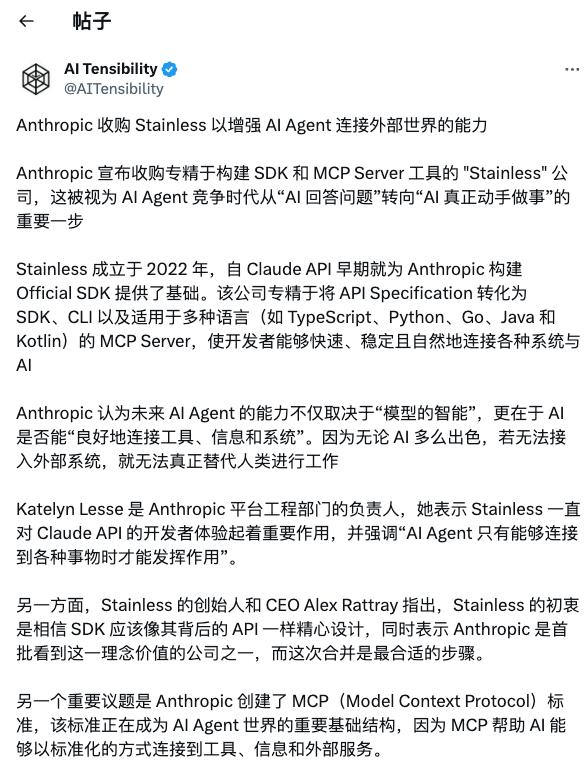
Acquiring Stainless means taking control of the engineering implementation standard for the MCP protocol.
The strategic intent behind this move is clear: by controlling the SDK generation standard and the MCP server platform, Anthropic has absolute say and can decide "which AI Agents can stably connect to external systems and which cannot."
While OpenAI was still using general model capabilities to penetrate the market, and Google was using TPU computing power to bind its ecosystem, Anthropic chose a narrower but deeper path: competing on "who can integrate AI into real business systems in the most stable and secure way."
As AI agents evolve from "answering questions" to "actually performing tasks," the importance of connectivity infrastructure will be no less than that of the model itself.
What Anthropic acquired for $300 million was the "connectivity standard-setting power" for the future AI Agent ecosystem.
04 From Volume Model to Volume Ecosystem: A "Survival Pipeline" Acquired for $300 Million
Anthropic's major acquisition of Stainless has ruthlessly shattered the illusions that have been prevalent in the large model industry.
This $300 million valuation, on the surface, is a premium pricing of the last value of top engineers before the arrival of AGI, but in essence, it is a strategic bet that Anthropic is making to overcome the trap of "model homogenization".
As the models of major players become increasingly similar in benchmark tests, simple "volume parameters" are no longer sufficient to create a real competitive advantage. The key to winning the AI race is shifting counterintuitively to the back end. Whoever controls the access tools, defines the SDK standards, and monopolizes the developer toolchain holds the only ticket to the future Agent era.
This is precisely the brilliance of Anthropic's ecosystem strategy: it not only invested heavily in acquiring the engineering perfectionism of human experts to patch up the mountains of code in the real world, but also conveniently cut off its competitors' ecosystem supply lines on the eve of AGI. (Leifeng.com)