Author: Lawyer Liu Honglin
In the past two days, many friends who have bought Hong Kong and US stocks have been sharing the same news.
On May 22, 2026, the China Securities Regulatory Commission (CSRC) announced that it had launched an investigation into Tiger Brokers, Futu Securities, Changqiao Securities, and related domestic and foreign entities for illegally operating securities businesses within China, and issued a prior notice of administrative penalties. It's important to clarify one detail: this is not the final penalty decision; the parties involved still have the right to make statements, defend themselves, and request a hearing.
On the same day, eight departments, including the China Securities Regulatory Commission (CSRC), also issued the "Implementation Plan for Comprehensive Rectification of Illegal Cross-border Securities, Futures, and Fund Operations." The focus of this plan is not simply to punish a single internet brokerage firm, but rather to comprehensively rectify the entire chain of unauthorized business operations by overseas securities, futures, and fund institutions targeting domestic investors. According to the plan, regulators will address both the marketing, account opening, receiving or processing of trading instructions, and fund transfers by overseas institutions within China, as well as the support provided by domestic entities for such businesses, including website and trading software development and operation, and customer service. The plan also sets a two-year concentrated rectification period, during which existing businesses will, in principle, only be allowed to conduct one-way sales and fund transfers.
Many ordinary users used to understand this as simply choosing which app to use to buy Hong Kong and US stocks. However, the regulator's focus is not on which trading app a user has installed on their phone, but rather whether that app is providing securities services in mainland China without approval. Once a de facto closed loop is formed in the processes of acquiring customers in mainland China, processing trading orders, operating the system, providing customer support, and facilitating the inflow and outflow of funds, it is no longer just a matter of an ordinary internet product.
So after the news came out, some people have asked me: Since the traditional cross-border brokerage path is getting narrower and narrower, is it possible to trade Hong Kong and US stocks on the blockchain?
This question doesn't surprise me.
Last year, I went to Singapore and chatted with some investment friends. One of them, who hadn't been very interested in cryptocurrencies before, started paying attention to Web3 last year. It wasn't because of Bitcoin's price surge or any public chain's new narrative, but because of on-chain US stocks. His thinking was straightforward: if in the future assets like Apple, Nvidia, Tesla, and S&P ETFs can be held, transferred, settled, and even incorporated into DeFi portfolios using on-chain accounts, then blockchain will no longer be just an asset game within the crypto world, but could potentially become a new interface for global financial assets.
This is a very interesting phenomenon.
On-chain US stocks make Web3 easier for traditional investors to understand because it doesn't require them to believe in a completely new and unfamiliar asset. Instead, it places familiar stocks, ETFs, and index products within the context of wallets, stablecoin settlements, and smart contracts. For some investors, this is much more intuitive than listening to a bunch of explanations about public chain performance, consensus mechanisms, and ecosystem incentives.
However, this matter is not as simple as everyone imagines. For mainland Chinese investors, on-chain US stocks are not a "cure" for circumventing regulations. If someone simply wants to replace the account opening, deposit, trading, and holding processes they previously completed in a cross-border brokerage app with wallets, USDT, and on-chain tokens, then the risks may not be lower.
A more accurate statement would be: On-chain US stocks solve the problem of "how traditional assets can be put on the blockchain and how qualified users can access US stock exposure through on-chain methods"; it does not solve the problem of "whether domestic residents can bypass securities, foreign exchange and virtual currency regulations to buy US stocks".
For compliant institutions and technology service providers, this is an infrastructure sector worth serious consideration. For ordinary investors who are simply looking for a new avenue to invest, it's advisable to remain cautious for now.
Where does the demand for on-chain US stocks come from?
Why are on-chain US stocks emerging? Traditional securities markets are very mature, but for many non-US investors, buying US stocks isn't as simple as opening a page and clicking buy. Preparing account opening materials, transferring funds, handling tax documents, and communicating with whom to contact if an account is flagged for risk—these steps are familiar to professional institutions, but for ordinary users, each step involves dealing with banks, brokerages, and compliance processes. When the experience isn't smooth enough, the market naturally seeks new entry points.
For crypto users, this gap is even more pronounced. They're used to wallet transfers, on-chain settlements, and 24/7 fund flows. But if they want to allocate some funds to stocks or ETFs, they have to go back to bank accounts, brokerage accounts, and traditional clearing systems. It's not that on-chain assets and traditional assets are completely incompatible technically, but rather that the connection experience is very disjointed.
The appeal of on-chain US stocks lies here: it attempts to turn the economic exposure of US stocks or ETFs into on-chain credentials. What users see is a stock token, such as an on-chain version of a particular US stock or ETF; behind it may be issuers, brokers, custodians, market makers, oracles, smart contracts, and distribution platforms. Products with relatively complete disclosures and higher compliance requirements typically emphasize underlying asset backing, segregated custody, accredited investor restrictions, redemption arrangements, and legal documentation.
It can be viewed in two layers: what we see on the chain are accounts, tokens, and transaction entry points, while what is truly determined off-chain are the underlying assets, custody arrangements, legal documents, user access, and exit paths.
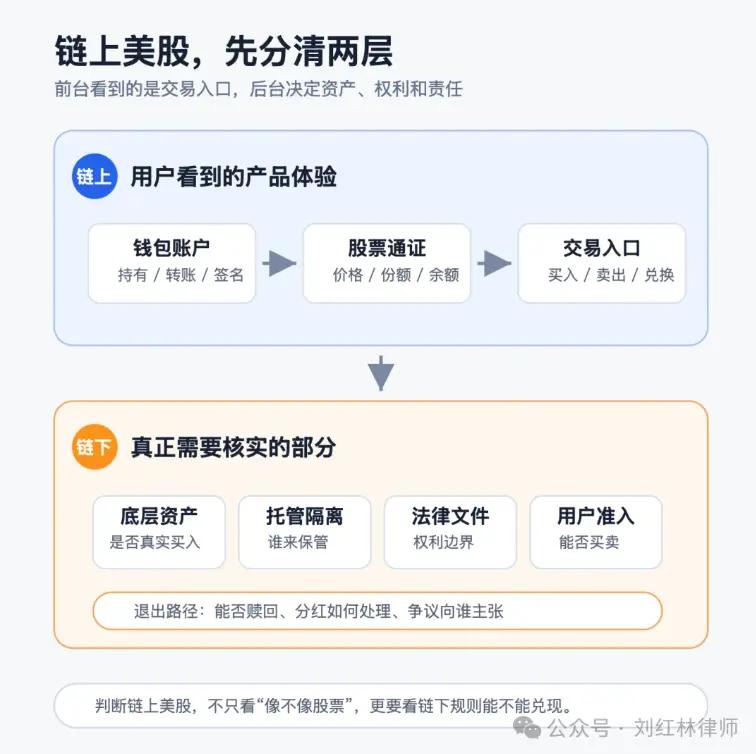
To evaluate an on-chain stock product, you can't just look at whether its name includes Apple, Nvidia, or Tesla. You need to look further down the chain to see if the underlying assets have actually been purchased, who is in custody of the assets, what the issuance documents are like, whether users are eligible to buy, and whether they can redeem, sell, or assert their rights later.
This is also the most easily misunderstood aspect of on-chain stocks. It doesn't necessarily mean that you directly own one share of a US-listed company.
There are roughly two types of paths that can be seen in the industry now.
One type involves issuers creating on-chain financial certificates based on underlying stocks or ETFs. For example, Backed's xStocks, officially described in legal documents as an on-chain transferable security, specifically a "tracking certificate"—a structured product that tracks the price of the underlying stock or ETF. It emphasizes that each xStock tracks a publicly traded stock or ETF on a 1:1 basis and is fully collateralized by the corresponding underlying assets, but also clarifies that holders do not acquire voting rights or shareholder rights of the underlying stock. In other words, you receive a financial certificate backed by underlying assets, not a direct shareholder of a listed company.
Another type involves large platforms using stock tokens as an investment gateway for users in specific regions. For example, Robinhood launched US stock and ETF tokens for EU users in 2025, focusing on giving qualified European users exposure to US stocks within the app, and supporting dividends and a longer trading experience. When Ondo Global Markets launched in 2025, it also focused on bringing more than 100 US stocks and ETFs onto the blockchain, targeting non-US qualified users. What they have in common is not that "anyone can buy," but rather that they are all trying to put their products into a specific compliant distribution framework.
The on-chain stock market is also growing. According to CoinGecko's 2026 RWA report, the market capitalization of on-chain stocks grew from approximately $2.09 million on June 30, 2025, to approximately $487 million on March 31, 2026; the spot trading volume of on-chain stocks in the first quarter of 2026 was approximately $15.1 billion, which has already exceeded the total trading volume in the second half of 2025.
However, this should not be misinterpreted as "on-chain US stocks have replaced traditional brokerages." The same report also cautions that even though leading on-chain stocks have been integrated into multiple centralized exchanges, their trading volume relative to the real US stock market remains small. This trend is growing rapidly, but it is not yet the mainstream securities market itself.
I prefer to see it as an ongoing infrastructure experiment rather than a proven investment shortcut.
What should investors pay attention to?
For individual investors, the biggest concern with on-chain US stocks isn't the technical jargon, but rather the misleading impression created by the "page looking very much like a stock exchange." Many products display stock codes, real-time prices, percentage changes, and buy/sell buttons on the front end, easily leading users to mistake them for traditional US stock trading through a brokerage firm. However, legally, what you're buying could be a certificate backed by underlying stocks, a structured product, a synthetic asset, or even just a price exposure within the platform's internal ledger.
The first thing to consider is the rights. Does it have redemption rights? How are dividends handled? Does it have voting rights? What happens to the underlying assets if the issuer goes bankrupt? Who can you contact if the custodian institution runs into problems? These questions aren't addressed in the token's name, but rather in the legal documents and product structure. If a project only emphasizes that it's "tradeable" and that its price follows US stocks, but fails to explain the underlying assets, custody, and exit arrangements, investors should be extremely cautious.
The second point is to consider identity and geographical restrictions. Most relatively transparent on-chain US stock products on the market clearly state which regions they can and cannot use, and what identity verification or qualified investor checks users need to undergo. Many products emphasize targeting non-US users, but "non-US" does not mean "anyone in the world can buy," much less "residents of mainland China can buy directly through their wallets." If users bypass platform restrictions using false identities, nominee identities, VPNs, overseas phone numbers, or other methods, they may seem to be able to enter the market in the short term, but they often face two problems later: the platform may freeze, restrict, or terminate their accounts after discovery; and in the event of a dispute, it will be difficult for users to claim full protection based on an access path that was already non-compliant.
The third point is to examine the source of funds. Domestic individuals purchasing foreign exchange must have a genuine and legal transaction basis. The application form for individual foreign exchange purchases clearly states that the funds cannot be used for overseas real estate purchases, securities investments, or other capital projects that are not yet open. If someone was previously unable to legally use their individual foreign exchange purchase quota to buy overseas stocks, and now instead converts it to stablecoins before buying on-chain US stocks, simply adding an extra layer of wallet processing does not make the use of funds compliant.
China's regulation of virtual currencies has been continuously tightened. On February 6, 2026, eight departments, including the People's Bank of China, issued the "Notice on Further Preventing and Handling Risks Related to Virtual Currencies" (Yinfa [2026] No. 42). It reiterates that virtual currencies do not have the same legal status as legal tender, and that activities such as exchanging legal tender for virtual currencies, exchanging virtual currencies among themselves, token issuance financing, and trading virtual currency-related financial products within China are strictly prohibited and must be banned according to law—illegal financial activities. Furthermore, overseas entities and individuals are prohibited from illegally providing virtual currency-related services to domestic entities in any form. It also incorporates the tokenization of real-world assets into the regulatory framework, clarifying that related activities and the provision of intermediary and information technology services within China, without specific consent, also face the risk of illegal financial activities. In the context of on-chain US stocks, if a domestic user uses stablecoins to access overseas stock tokens, the risk is not simply "buying an overseas asset," but may simultaneously involve securities investment, foreign exchange use, virtual currency trading, anti-money laundering, and cross-border disputes.
Besides the issues mentioned above, there are many other issues that investors need to pay attention to regarding on-chain US stocks.
First and foremost are price and liquidity. Traditional US stocks have an opening, closing, centralized auction, market making, regulatory, and clearing system. On-chain tokens can be transferred 24/7, but the underlying stock market isn't open 24/7. During non-trading hours, how is the on-chain price anchored? Who makes the market? To what extent is price deviation acceptable? During periods of high market volatility, will redemption and arbitrage mechanisms function? If these questions aren't clearly addressed beforehand, users may not be buying stable exposure to US stocks, but rather an on-chain trading instrument whose price appears similar to US stocks.
Stock trading involves a host of back-office processes, including dividends, stock splits, mergers, delistings, takeover bids, and tax withholding. Traditional brokerages typically handle these tasks for their clients. If on-chain US stock trading is to be sufficiently standardized, it must also answer these questions: How are dividends distributed? How are stock splits adjusted? What happens to certificates after delisting? Who provides the tax documents? Do users bear any additional reporting obligations? Otherwise, while users may superficially gain "US stock exposure," they may find their rights are blurred when actual corporate actions occur.
There's also the issue of dispute resolution. On-chain transfers may seem clear, but the legal relationships aren't necessarily. The issuer might be in one jurisdiction, the custodian in another, the distribution platform in a third, and the user might be located in mainland China. If problems arise, deciding which country's law applies, where to file a lawsuit, whether asset proof can be obtained, and whether custodian assets can be recovered—these are all things that a blockchain explorer can't solve for you.
Therefore, the on-chain environment is merely the foreground; the true determinant of security lies in the entire set of off-chain rules governing the underlying assets, custody arrangements, issuance documents, user access, redemption mechanisms, audit disclosures, and dispute resolution. Without this framework, no matter how compelling the narrative of putting stocks on-chain may be, it will be difficult to attract genuine buyers.
What Web3 entrepreneurs should pay attention to?
For entrepreneurs, on-chain US stocks are certainly worth paying attention to, but they should not be interpreted as "traditional brokerages are being squeezed by regulators, so on-chain opportunities have emerged."
The most noteworthy aspect of this crackdown on cross-border securities firms is not just that Futu, Tiger Brokers, and Changqiao were named and shamed, but rather the entirety of illegal cross-border operations. While overseas institutions themselves are certainly subject to regulation, their domestic affiliates, partners, illegal intermediaries, internet platforms, social media, account opening tutorials, experience sharing, marketing and traffic generation, trading software, customer service, and fund transfer support may also come under regulatory scrutiny.
This serves as a direct reminder for entrepreneurs starting businesses in the blockchain-based US stock market: if you are promoting blockchain-based US stocks to domestic investors, guiding them to open accounts, teaching them how to deposit funds, offering commission rebates to attract users, providing Chinese customer service, organizing community investment advisors, helping users process trading orders, or providing trading software, website operation, customer service, and marketing support to overseas platforms, even if the entry point changes from a brokerage app to a wallet, and the settlement currency changes from USD to stablecoins, the nature of the risk will not automatically change.
A more realistic entrepreneurial position is not to create a "new channel for retail investors to buy US stocks," but rather to take a position that is more B2B-oriented, more infrastructure-oriented, and more compliance-oriented.
Issuers need underlying asset custody and asset certification, independent auditing and reserve disclosure, user identification, anti-money laundering, and sanctions list screening, on-chain address risk scoring, oracles, transaction monitoring, abnormal price alerts, corporate action handling systems, tax reporting, and user reconciliation tools. Trading platforms and wallets also need compliant distribution capabilities, such as how to display products in different regions, how to determine access for different users, which assets require additional risk disclosure, which operations trigger suspicious transaction monitoring, and which on-chain addresses cannot interact.
These jobs may not sound as exciting as "buying US stocks on the blockchain," but they are closer to a business that can be run in the long term.
If a licensed overseas securities firm, asset management institution, custodian, or fund platform wants to explore securities tokenization, it may not necessarily understand on-chain wallets, smart contracts, security audits, on-chain data, cross-chain bridges, asset proof, and stablecoin settlement. If a startup team can provide clear technical modules and avoids handling user funds, transaction matching, marketing to the domestic public, and making profit promises, its compliance space will be much larger than if it directly enters the market to create a C-end trading channel.
On-chain solutions are not a panacea.
Returning to the initial question: Is on-chain stock the new solution?
If the so-called solution is to provide mainland investors with a new way to circumvent cross-border securities, foreign exchange, and virtual currency regulations, then the answer is clear: no. It is not only not a solution, but it may also turn what was originally a securities account issue into a complex problem involving securities, foreign exchange, virtual currencies, anti-money laundering, and cross-border disputes.
But if we look at it from another angle, could on-chain US stocks become an important entry point for global financial assets to be uploaded to the blockchain? I think so.
Market demand is real. Global users want less friction to access US assets, crypto users want stablecoins to go beyond just trading and payments, and traditional financial institutions are looking for more efficient ways to issue, clear, and distribute them. US stocks and ETFs are already among the most widely accepted assets globally, and making them into on-chain interfaces is easier for ordinary investors to understand than creating a new token out of thin air.
The dividing line isn't whether or not to go on the blockchain, but rather "what is the purpose of going on the blockchain." If going on the blockchain is to circumvent identity verification, foreign exchange controls, securities licenses, or investor suitability, this path won't lead to long-term success. If going on the blockchain is to make the issuance, custody, transfer, auditing, settlement, and risk control of compliant assets more transparent, automated, and global, then it is infrastructure worth building in the long term.
For ordinary investors, the most important thing is not to mistake "like stocks" for "actually stocks," nor to mistake "on-chain" for "unregulated." For entrepreneurs, the opportunity lies not in "helping retail investors find loopholes to buy US stocks," but in providing business services such as legitimate funding, qualified users, compliant issuance, clear custody, verifiable reserves, restricted distribution, risk disclosure, transaction monitoring, corporate action handling, and taxation.
Market demand will not disappear because of regulatory documents, but demand will not automatically turn into compliant business.
On-chain US stocks have value, but they are not a new solution to old problems. The real test is whether technological innovation can re-align with financial regulation once real-world financial assets are on-chain.
If handled properly, it could be a crucial step in putting financial assets on the blockchain; if used as a detour, it could become the next risk hotspot.