The Russian Ministry of Finance has just approved new regulations requiring network IP addresses to be recorded in official cryptocurrency mining registries. This new regulation allows the government to exercise tighter technical control over legitimate mining operations.
A government resolution formalizing this change was published following an announcement from the Ministry of Finance. The registry system, administered by the Russian Federal Tax Service (FTS), was Capital a mandatory requirement for all legally operating entities acting as miners or operators of mining infrastructure in Russia.
Extended IP data requires technical disclosure.
The Federal Tax Service maintains separate registers for miners and mining infrastructure operators. Only a select group of organizations are permitted to access the data, including state agencies, courts, the Central Bank of Russia, and grid operators. This system is completely confidential and not publicly accessible.
Adding IP addresses expands the scope of mandatory technical declarations. Previously, registers primarily collected information identifying businesses. Requiring IP address recording provides regulatory authorities with a track record of each entity's network activity, making it easier to compare declared information with actual online operations.
Since Russia's digital asset law legalized mining in 2024, the country has struggled to bring informal Miners under control. However, estimated tax losses from informal mining have reached $122 million, indicating that many operators remain outside the legal registration system.
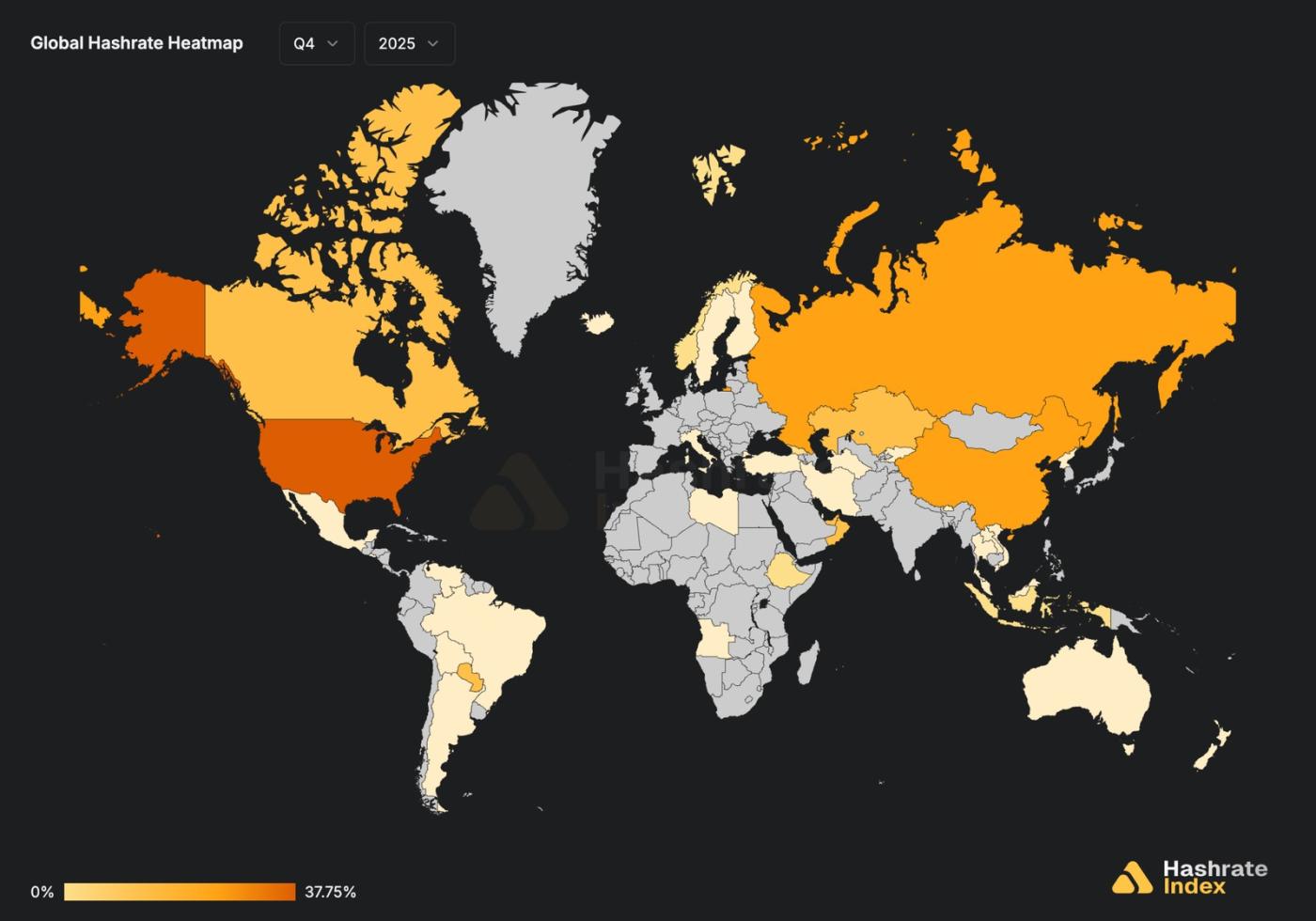 Russia ranks second in mining with an estimated 16.4% (~175 EH/s) share of the global Hash rate market | Early 2026 – Source: Hashrate Index
Violators will be removed from the register in Russia.
Organizations found to have provided false data, violated antitrust regulations, or committed other legal violations will be immediately removed from the register. Upon removal, the operator or infrastructure operator loses its legal right to operate. Under Russian law, all unregistered mining activities are prohibited.
The Ministry of Finance stated that the new regulatory framework helps to better control financial risks, legal compliance, and electricity consumption related to mining operations. Grid operators also receive this registration data, as cryptocurrency mining places significant pressure on regional power systems.
In addition, Russia has imposed a ban on cryptocurrency mining in 10 areas with strained power grids. The Ministry of Finance's continuous amendments have further tightened the space for informal mining activities since the new law was passed.
Registry data remains closed to the public.
This registration system is designed to severely restrict access. Only government agencies with legitimate needs are allowed to request XEM to the data. This means that monitoring of mining activities only takes place through official channels.
The effectiveness of requiring new IP addresses from a large number of unregistered entities will be a major test of Russia's ability to comprehensively control the cryptocurrency mining industry.