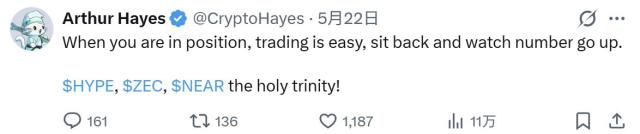
Hyperliquid (HYPE) surged nearly 10% to above $63, after its $1.16 billion buyout fund caught a wave of ETF inflows and renewed discussions about Hyperliquid potentially overtaking Binance.
This surge has pushed Hyperliquid's market Capital past $15 billion, propelling the Token to 11th place globally, outperforming most other major Token over the past 7 days.
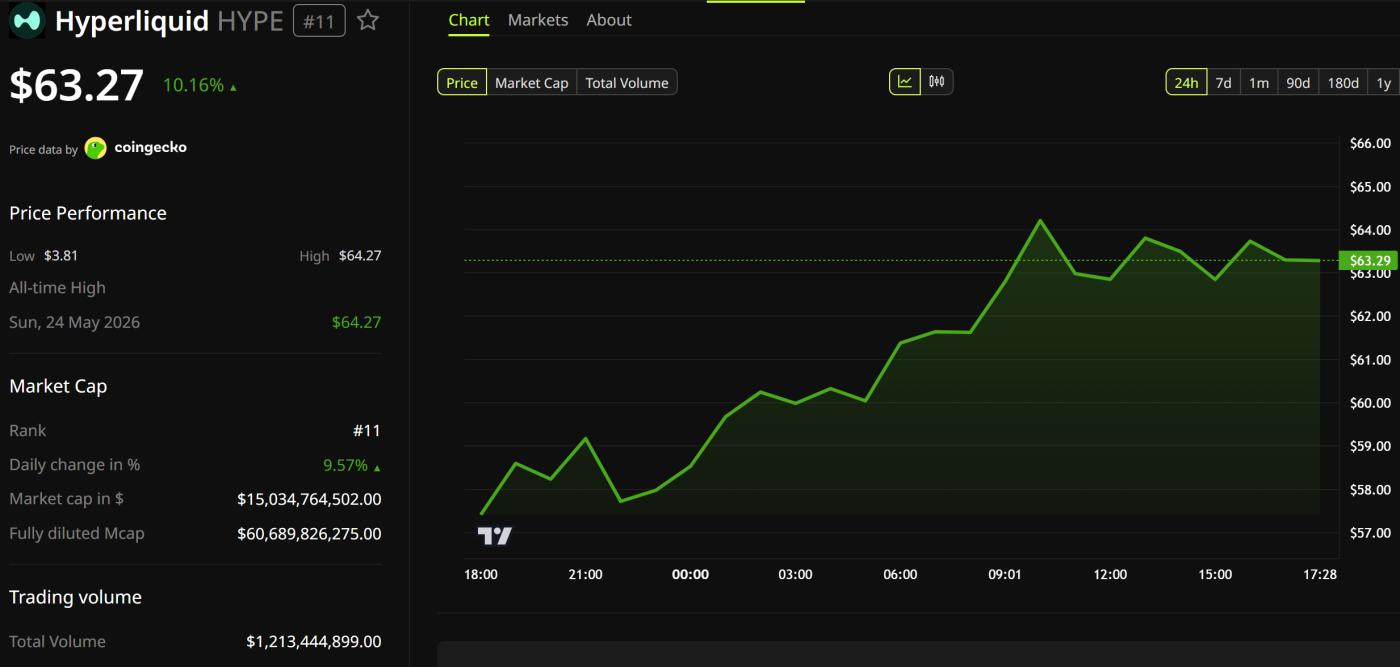 Hyperliquid (HYPE) price chart. Source: BeInCrypto
The buyback fund is the driving force behind HYPE's price stability.
The Support Fund played a central Vai in HYPE's efforts to maintain its price, as Hyperliquid used almost all of its transaction fee revenue — over $1.16 billion — to buy back HYPE on the market .
“Hype’s recent price surge has little to do with ETF expectations, but is primarily due to Hyperliquid’s automated buyback mechanism. From its initial launch, Hyperliquid has spent almost all of its transaction fees — over $1.16 billion — on buying back HYPE through its Support Fund,” WuBlockchain Chia , citing Forbes author Zennon Kapron.
Almost all revenue from Spot Trading fees and Futures Contract is used to buy back HYPE on the market. This mechanism helps the market absorb selling pressure whenever the Token is unlocked and is the driving force behind the recent surge in HYPE that has attracted much attention from traders.
Follow us on X for the latest breaking news.
Bloomberg ETF analyst James Seyffart said that since their launch in May 2024, approximately $53 million has been invested in two ETFs: THYP from 21Shares and BHYP from Bitwise.
These cash flows also coincide with the growing demand for ETF investments from institutions seeking access to HYPE. However, Kapron emphasizes that this model is heavily dependent on volume. If the market experiences a sharp decline, the price of HYPE will also be difficult to maintain because the buyback fund's activity will weaken.
Analysts predict Hyperliquid could surpass Binance.
Blockchain analyst Simon Dedic argues that Hyperliquid's potential lies more in its structural breakthroughs than just its price. He envisions a decentralized exchange (DEX) that could replace Binance as "the most powerful and profitable institution in the crypto industry."
“The day HYPE surpasses BNB will be the day this industry proves its ability to remove the barriers holding it back. Perhaps that moment is closer than people think,” he Chia .
Dedic argues that Hyperliquid's public and transparent trading model is a major differentiator from Binance's BNB . This view is also supported by many analysts when discussing Hyperliquid's breakthrough in Derivative volume , directly competing with large exchanges like Binance and Coinbase.
According to data from Artemis, Hyperliquid recorded approximately $2.6 trillionin nominal volume in the first half of this year alone, nearly double Coinbase's $1.4 trillion. This indicates an extremely large volume of transactions taking place on Hyperliquid.
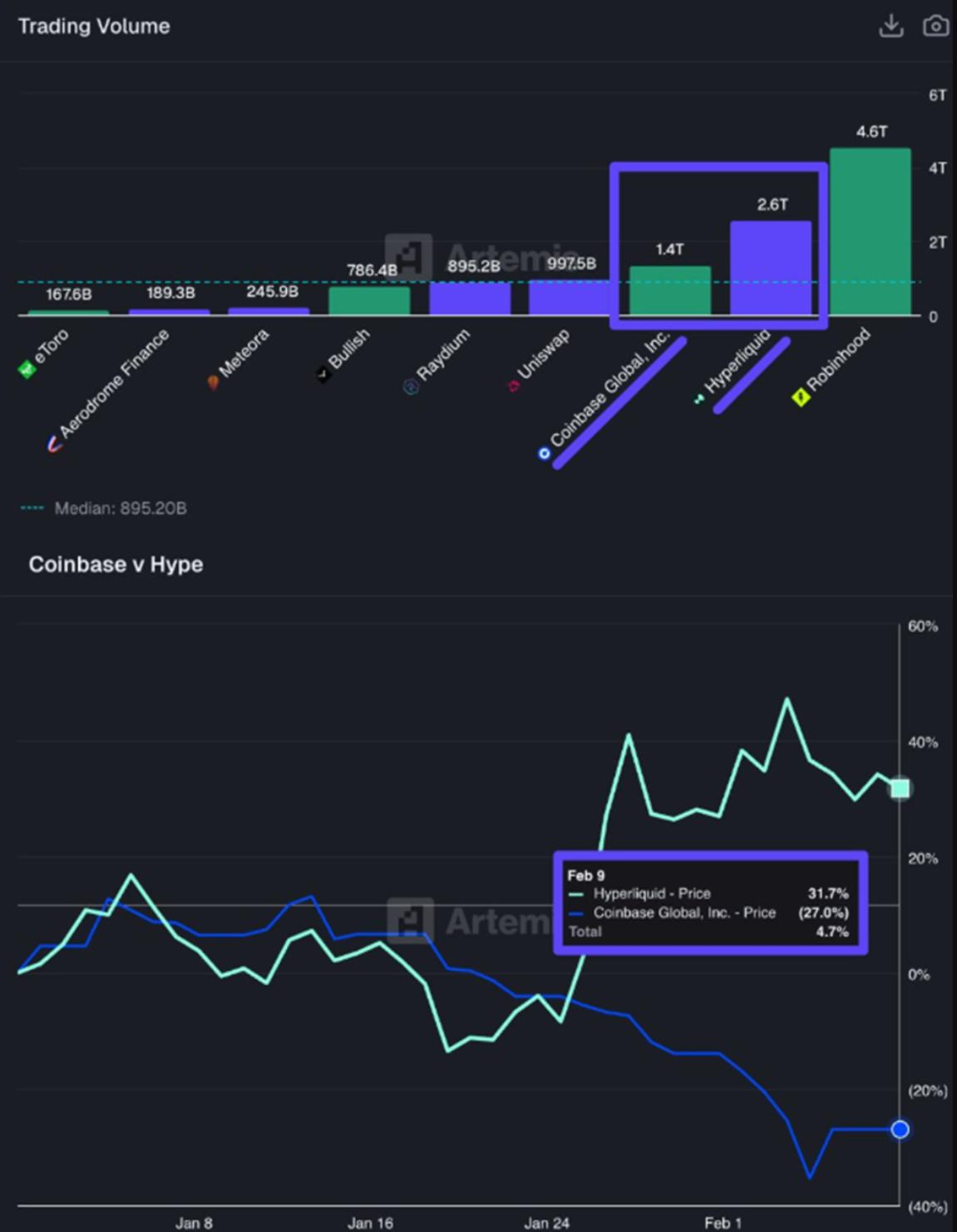 Comparison of volume between Coinbase and Hyperliquid. Source: Artemis
This milestone has sparked debate: Are decentralized trading platforms large enough to compete with and replace centralized exchanges?
“Hyperliquid is quietly overtaking Coinbase. (Nominal) volume : Coinbase: $1.4T, Hyperliquid: $2.6T. That's almost double Coinbase's, and it's from an on-chain exchange. And the market has started to take notice,” Artemis asserted .
Why are acquisitions successful with HYPE but fail with PUMP?
HYPE's buyback story has also been compared to Pump.fun (PUMP), whose Token is currently trading around $0.0018, down more than 80% from its peak in September 2023 despite the fund spending over $350 million on buybacks. This shows that not all buyback models are effective without strong market consensus.
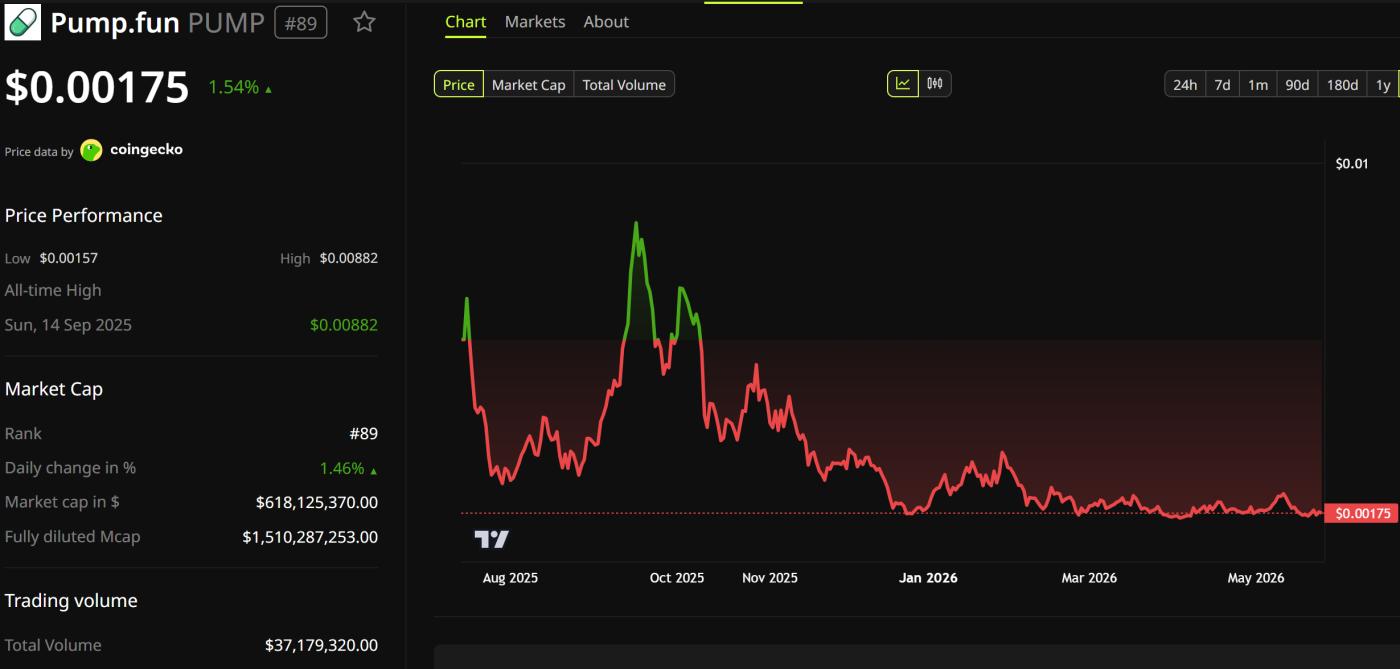 Pump.fun (PUMP) price chart. Source: BeInCrypto
BeInCrypto previously reported on the shortfall in Pump.fun's buyback program , as dilution and selling by "whales" significantly reduced buying pressure.
The difference lies in the quality of the revenue stream. Hyperliquid's perpetual transaction fees, bolstered by its trillion-dollar perpetual volume milestone, are a recurring revenue stream tied to a professional user base.
Pump.fun's revenue is dependent on meme coin cycles, which significantly weakens their Token buyback program when interest wanes.
However, the question remains whether this system can withstand a deeper crypto market downturn, given that indicators such as on-chain revenue, ETF Capital , and the rationale for a change in leadership are all pointing toward the same scenario.
Subscribe to our YouTube channel to XEM experts and journalists Chia their insights on the market.