Vitalik Buterin, co-founder of Ethereum (ETH), has just revealed a strategic shift at the Ethereum Foundation, confirming that his personal influence on the board will continue to diminish, while the organization will also sell less ETH and narrow its mission scope.
Buterin stated that the Ethereum Foundation is now just one link in a larger ecosystem, not the central coordinating body it once was. He also mentioned that Aya Miyaguchi – the current chair – is handling much of the transition, which is expected to stabilize in the coming months.
Ethereum Foundation withdraws from central coordinating Vai .
Buterin Chia that the Ethereum Foundation has gradually withdrawn from Vai role as the "center of power" that the community had expected. This shift is partly due to criticism from the community itself.
Many have pointed out that the actions of the Ethereum Foundation do not truly align with the ideals of decentralization and privacy that Buterin had previously championed publicly.
Buterin stated that the Ethereum Foundation holds only about 0.16% of the total ether supply on the market – a figure even smaller than some individuals. Meanwhile, rival chain foundations typically hold between 10% and 50% of their coin supply.
He also added that the Foundation's original main mission in 2014 was completed in 2022 when Ethereum launched all its phases such as Frontier, Homestead, Metropolis, and Serenity.
Ms. Miyaguchi is largely responsible for this transition. The Foundation is also expanding its board of directors so that no one – including Buterin – has too much influence.
This shift follows a leadership restructuring plan previously announced by the Foundation, aimed at simplifying decision-making and reducing the concentration of power.
Ethereum Foundation reduces ETH sales, focuses on developing cropps.
After redefining its direction, the Ethereum Foundation is now focused on several key objectives – which Buterin calls CROPS. This stands for censorship resistance, openness, privacy, and security.
Follow us on X for the latest news updates.
Buterin argued that Ethereum shouldn't compete with rival chain solely on processing speed, as those networks Capital have an advantage in throughput.
Instead, the Foundation will focus on techniques that other blockchains struggle to develop. The policy of selling fewer ETH also helps to conserve resources for these long-term plans.
“Currently, the Foundation is choosing to use its remaining resources to serve long-term sustainability goals instead of expansion (and yes, this means we will be selling less ETH ),” Buterin explained .
The main priorities include:
- Building Ethereum with no verification flaws – through AI-powered formal validation.
- Developing optimal consensus solutions that ensure security even when the network is subjected to attacks up to 49% or experiences synchronization failures.
- Minimize reliance on intermediaries – as through proposals such as FOCIL and EIP-8141.
Buterin also mentioned projects like Kohaku, which aim to reduce reliance on third-party servers.
Previously, the Foundation explained its reasons for selling ETH , prioritizing long-term reserves. A Staking program for the reserve fund also helps alleviate the pressure to sell ETH directly.
External organizations will fill the void left by the Ethereum Foundation.
By narrowing its focus, the Foundation expects outside teams to take over work that they no longer prioritize. According to Buterin, this includes supporting the ETH cryptocurrency – currently priced at $2,100 at the time of writing.
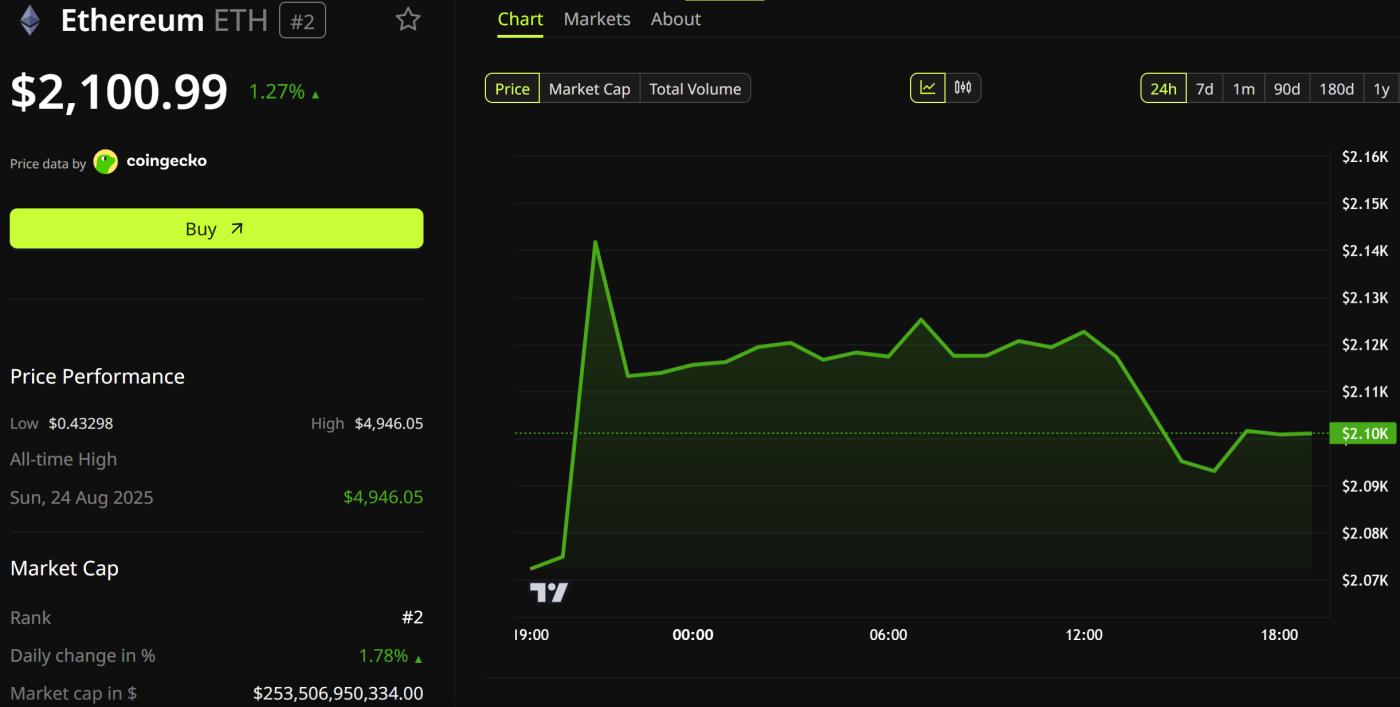 Ethereum (ETH) price performance. Source: BeInCrypto
These activities fall outside the scope of direct funding from the Ethereum Foundation.
Buterin also revealed that nearly 90% of his net worth is held in ETH . The remainder is invested in open-source projects related to biotechnology, software, and hardware.
The Foundation will provide initial support to the organizations that take over the work they are ceding, but details of the collaboration have not been disclosed.
A report on the Ethereum Foundation's reserve fund released earlier this year showed that 99.1% of the fund's assets are still in ETH.
The transition period is expected to last several months. After that, the new mission will be maintained long-term for the Foundation.
Meanwhile, the Ethereum 2026 vision will be central to the next development plan.