HYPE hit a new high of $62, not because it's an ETF, but because Hyperliquid used almost all of its profits to buy back its own shares.
Written by: Zennon Kapron, Foebes
Compiled by: AididiaoJP, Foresight News
Hyperliquid uses almost all of its transaction fees to buy back its own HYPE tokens. This built-in mechanism has a far greater impact on price than the newly launched spot ETF.
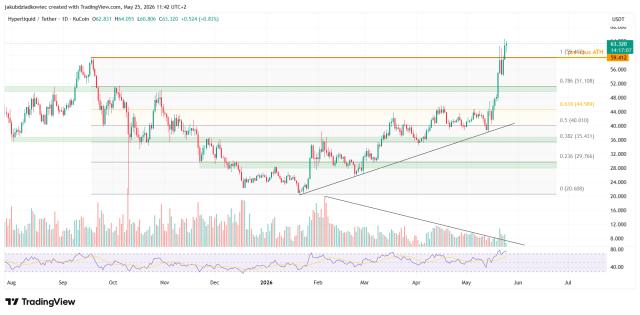
On May 21, the price of HYPE broke through $62, setting a new all-time high. The market's explanation was as always: institutional funds had arrived. The first batch of Hyperliquid spot ETFs in the United States had just started trading a few days earlier, and HYPE's fully diluted valuation once exceeded that of Solana, prompting financial media to tell the story of "Wall Street finally discovering decentralized derivatives exchanges."
However, this story is incomplete and can even mislead our understanding of this surge. The real reason for HYPE's price increase is that Hyperliquid used almost all of its earnings to buy back its own tokens. This buyback mechanism is written into the protocol and runs automatically continuously, almost unrelated to whether external investors are bullish on the project. The difference between viewing the current price as "the market's final judgment on the project" and "the result driven by the mechanism" lies in truly understanding how this buyback works.
The real buyer is the Assistance Fund.
Hyperliquid operates a mechanism called the "Assistance Fund." According to DefiLlama data, 99% of the transaction fees from exchange perpetual contracts and the spot market flow into this fund, which then uses these funds to directly buy HYPE on the open market. No board of directors can vote to suspend it; buybacks are the default behavior of the protocol's revenue model and are executed in every block and every market environment.
The amounts are large enough to independently drive up the price. Since its launch, Hyperliquid has accumulated over $1.16 billion in revenue, almost entirely used to buy back its own tokens. In the third quarter of 2025 alone, the protocol repurchased $316.76 million worth of HYPE. Few publicly traded companies return capital to shareholders at this pace, and those companies are required to make quarterly deliberate decisions. Hyperliquid simply eliminates this decision-making process—the buybacks just happen.
There are also two continuous buying orders supporting the price from below.
The protocol itself isn't the only programmatic buyer. Hyperliquid Strategies (listed on Nasdaq via a reverse merger, ticker symbol PURR) was founded solely to accumulate and hold HYPE, currently holding approximately 20 million tokens. The company recorded a net profit of $152.5 million last quarter, almost entirely from unrealized gains on its HYPE holdings. This "treasury company," whose earnings fluctuate with the price of its held tokens, constitutes a second, continuous buying force in the market, and this buying pressure intensifies as the price rises.
The third funding stream comes from the stablecoin layer. Once USDC became Hyperliquid's official quoted asset, the protocol returned up to 90% of the USDC reserves held on the platform for buybacks and ecosystem incentives. The platform constantly holds billions of dollars worth of USDC, and the interest generated from these balances creates another nine-figure buying opportunity annually. All three channels point to the same token.
The underlying business logic is indeed very solid.
If the underlying business is weak, buybacks are just empty talk, so the fundamentals deserve serious consideration. Hyperliquid has already captured a dominant share of the on-chain perpetual contract trading space, a sector that is growing rapidly as traders seek venues outside of centralized exchanges. Its cumulative perpetual trading volume has reached trillions of dollars, with transaction fees flowing into the Assistance Fund coming from real trading activity.
This distinguishes Hyperliquid from a large number of previous crypto projects—those that relied on incentivizing users with their own inflated tokens to create artificial activity. Hyperliquid earns nearly $1 billion a year from genuine customer activity, and returning that money to token holders is more honest than most projects in the industry. The point here isn't that Hyperliquid is a fragile company, but rather that the company and the token are two different things, and the market currently prices the token as if they were exactly the same thing.
How much did ETFs actually contribute?
Compare buyback machines to media headlines. Bitwise and others launched the first batch of US HYPE spot ETFs in May, attracting tens of millions of dollars in inflows in the first week. This is indeed genuine institutional money and a testament to the credibility of young assets, which is commendable.
However, the scale is relatively limited. The agreement repurchases hundreds of millions of dollars each quarter, while ETF inflows are only in the tens of millions. The ETF launch made headlines because it fits the familiar narrative of traditional "Wall Street-certified crypto assets." But what truly determines the price is the Assistance Fund, which operates steadily even on weeks without ETF news.
The key difference lies in their behavioral patterns. ETF demand reflects the option for external investors to sell at any time; repurchase agreements, on the other hand, are the accounting result of perpetual contract transactions. As long as trading volume remains, repurchase agreements will continue at full speed even if all ETF holders suddenly lose interest overnight.
The practical significance of buybacks for holders
The term "buyback" carries the assumptions of the stock market and doesn't fully apply to tokens. When a listed company buys back its own shares, it reduces the number of outstanding shares with cash, allowing shareholders to sell and receive dollars.
The Assistance Fund, however, does not return anything. It converts protocol revenue into HYPE tokens, which are then held by the protocol, thereby reducing circulation and supporting the price. HYPE holders cannot redeem or claim shares from the fund; the value created by the fund is reflected only through one channel—the market price of the token, which is itself supported by continuous buying. Simply put, the asset owned by HYPE holders is valued by continuous buying, the size of which is determined by trading volume each quarter.
The flywheel rotates in both directions (risk).
This dependence is precisely where the structural risk lies. Buybacks driven by transaction fees can never exceed the limits allowed by trading volume, which is highly cyclical. Protocol data itself demonstrates this effect: quarterly buyback amounts decreased from $316.76 million in Q3 2025 to $255.05 million in Q4, and then to $192.25 million in Q1 2026. While HYPE reached new highs, this supportive buying shrank by approximately 40%.
Price and momentum are moving inversely, which is precisely what the "institutional money in" narrative overlooks. In a true crypto bear market, perpetual contract trading volume shrinks dramatically, buybacks decrease accordingly, and support disappears precisely when holders need buying power most. This mechanism amplifies gains during rallies and withdraws support during downturns. Currently, only the first half has been fully validated on a large scale.
Solana's comparison actually overestimates HYPE.
The claim that HYPE "outperforms Solana" also needs to be examined in the same light. This "outperformance" occurs with a fully diluted valuation, meaning it includes all future tokens. However, in terms of metrics reflecting actual circulating market capitalization, HYPE remains significantly lower than Solana because a large portion of the HYPE supply has not yet entered the market.
The unlocking schedule is crucial for buybacks. As locked supply gradually enters circulation, the Assistance Fund must absorb increasing potential selling pressure to prevent price declines. The flywheel needs to continuously accelerate in the face of an ever-growing circulating supply. If a slowdown in trading volume and an increase in circulating supply occur simultaneously, the pressure will be compounded.
How do you price a token that "buys itself"?
Hyperliquid remains one of the most profitable projects in the crypto space, with revenue levels that most Layer 1 public chains struggle to match. Using these revenues for buybacks is a reasonable way to reward holders. Arthur Hayes has set a target of $150 for August, which, from a mechanistic perspective, is self-consistent. Technical analysts believe the token is overbought, which also aligns with the mechanistic logic.
The most honest statement is: the bullish and bearish reasons for HYPE are essentially the same thing. Its price is mechanically tied to Hyperliquid's trading volume—volume generates buybacks, and buybacks support the price. Investors buying HYPE at its all-time high are essentially leveraged betting on a single variable: whether the exchange's perpetual contract trading volume can continue to rise.
This is far narrower than betting on the entire DeFi sector, and even narrower than betting on a general-purpose public chain like Solana. The all-time high chart looks like the market has reached a conclusion, but for this token, what the market is seeing is largely its own reflection.