2026 marks the moment Vietnam officially enters the regional financial map with an unprecedented model: an International Finance Centre (IFTC) operating on the principle of "one center, two destinations"—located simultaneously in Ho Chi Minh City and Da Nang. This is not simply about building a geographical area dedicated to financial activities, but rather an effort to create a unique institutional ecosystem where international Capital , financial technology, and high-quality human resources converge under a legal framework superior to that of the general economy.
The center's legal framework is established through two key documents: Resolution No. 222/2025/QH15 issued by the National Assembly on June 27, 2025, and Decree No. 323/2025/ND-CP of the Government on December 18, 2025, establishing the International Finance Center in Vietnam. The Government assigns responsibility to the People's Committees of Ho Chi Minh City and Da Nang to ensure the center's formation and operation during the 2025-2026 period, including allocating sufficient resources and personnel, and completing key infrastructure projects to serve as a foundation for connectivity.
The core of the orientation is that from 2026 onwards, agencies and organizations under the center will be responsible for leading and coordinating with ministries and ministerial-level agencies to propose and develop specific mechanisms and policies according to a suitable roadmap, in order to attract Capital, technology, modern management methods, high-quality human resources, and major international financial institutions and investors.
Strategic orientation: two destinations, two Vai
The “two-destination” model is not a random allocation but reflects the unique strengths of each locality. Ho Chi Minh City, as the country's largest economic center, is positioned as a gateway connecting global Capital flows, focusing on Capital markets, banking, insurance, and fintech. Meanwhile, Da Nang aims to attract investment funds, technology companies, innovative startups, and especially to conduct controlled testing (sandbox) for new models such as digital assets, cryptocurrencies, and digital payments.
The strategic vision is clearly demonstrated through the quantitative targets set by the Government. Ho Chi Minh City and Da Nang must immediately implement a sandbox mechanism for new financial products; propose breakthrough incentive policies to attract investment from at least 50 international financial institutions in the first three years; and digitize 100% of procedures with competitive costs for investors. The ultimate goal is to make the center a key factor contributing substantially to the development of the country and the two cities.
At the World Economic Forum in Davos 2026 (January 2026), Vice Chairman of the Ho Chi Minh City People's Committee Hoang Nguyen Dinh presented the development orientation for the center in the context of increasingly deep competition and linkages among financial centers worldwide. Accordingly, the city aims to form a modern, transparent, and integrated financial-tech ecosystem, in which science and technology, data, artificial intelligence, and financial technology are identified as key pillars. Deputy Minister of Foreign Affairs Le Anh Tuan emphasized Vietnam's consistent stance in attracting global financial institutions not only as investors, but also as strategic partners to participate in creating a center based on a new generation model.
Executive Board structure and stakeholders
The center's governing body is organized at the highest level. Deputy Prime Minister Nguyen Hoa Binh serves as the Chairman of the International Finance Centre's Executive Council. At the launch ceremony in Ho Chi Minh City, the core institutions were simultaneously announced, including the Executive Authority, the Specialized Court, and the International Arbitration Centre — three institutional pillars ensuring financial operations, dispute resolution, and arbitration according to international standards.
A notable aspect of the personnel model is that both Ho Chi Minh City and Da Nang plan to hire foreign CEOs with experience working and managing in leading global financial centers. This is a pragmatic approach aimed at leveraging practical operational experience from centers such as London, New York, Dublin, Hong Kong, or Dubai.
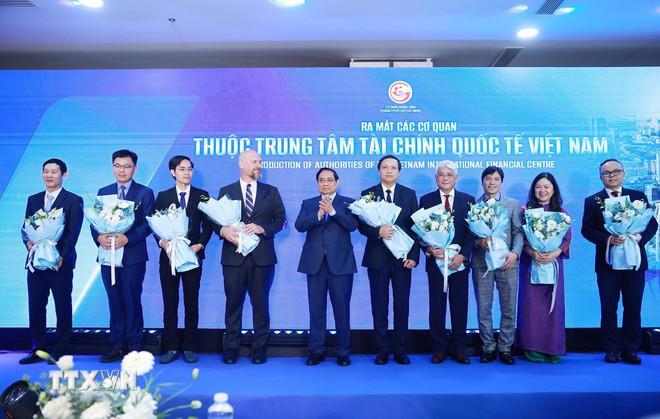
Regarding membership, the list of strategic members in Ho Chi Minh City shows significant diversity between the traditional financial sector and technology. This group includes Nam A Commercial Bank (Nam A Bank), Ho Chi Minh City State Financial Investment Company, Ho Chi Minh City University of Economics, on-chain economy alliance, Gemadept Group, and TikTok. The presence of a global technology platform like TikTok alongside traditional financial institutions and an on-chain economic alliance accurately reflects the center's direction of integrating finance with digital technology.
Professional human resources have also been systematically prepared. The University of Finance and Marketing (UFM) has seconded eight outstanding associate professors, PhDs, researchers, and top-performing bachelor's degree holders to work at the Executive Office in Ho Chi Minh City. In Da Nang, the city has established a preparatory committee, a support team, and an advisory council comprising leading domestic and international experts in economics, finance, and technology. The support team consists of seconded staff from various departments, agencies, and commercial banks, many of whom hold bachelor's and master's degrees from developed countries.
The events that took place: key timeline
The process of forming the center can be depicted through a chain of consecutive events in the latter half of 2025 and the first few months of 2026.
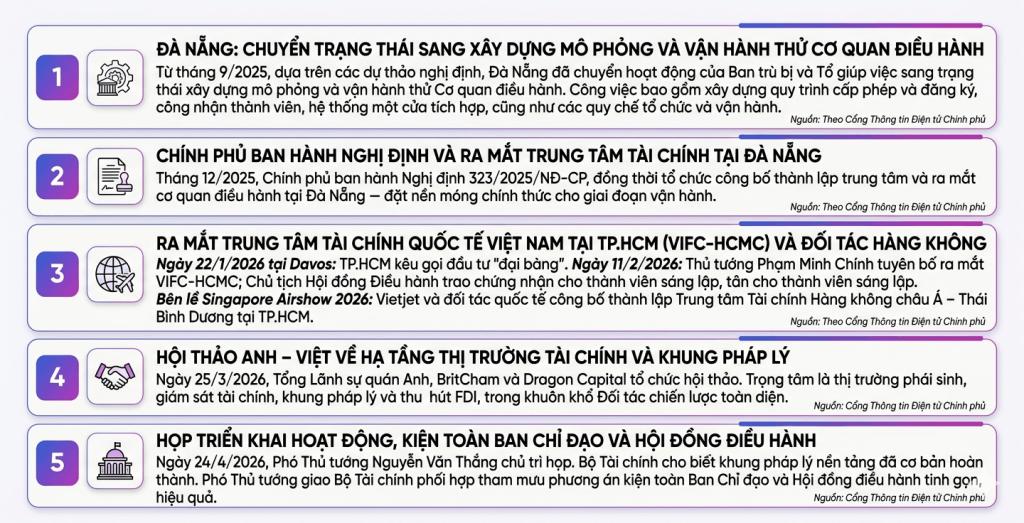
- From September 2025 , based on draft decrees, Da Nang has shifted the activities of the Preparatory Committee and the Support Team to a state of building a simulation and conducting trial operations of the Executive Agency. This includes developing licensing and registration procedures, membership recognition, an integrated one-stop system, as well as organizational and operational regulations.
- In December 2025 , the Government issued Decree 323/2025/ND-CP, and simultaneously announced the establishment of the center and launched the operating agency in Da Nang — officially laying the foundation for the operational phase.
- On January 22, 2026, in Davos , Ho Chi Minh City invited major investors to the city center, positioning the city as an emerging financial and technology destination in the region.
- February 11, 2026, marks a significant milestone: Prime Minister Pham Minh Chinh, on behalf of the Government, officially launched the Vietnam International Finance Centre in Ho Chi Minh City (VIFC-HCMC). The Chairman of the Executive Board presented certificates to the founding members. Simultaneously, on the sidelines of the Singapore Airshow 2026, Vietjet, along with international partners, announced the establishment of the Asia-Pacific Aviation Finance Centre in Ho Chi Minh City, with the support of Boeing, Airbus, Pratt & Whitney, CFM, Rolls-Royce, and the International Air Transport Association (IATA). This is concrete evidence of the potential for integration between new financial institutions and global value chain .
- On March 25, 2026 , the British Consulate General in Ho Chi Minh City, the British Chamber of Commerce in Vietnam (BritCham), and Dragon Capital jointly organized the UK-Vietnam Seminar on the International Financial Center 2026, themed “Financial Market Infrastructure”. Key topics included Derivative commodity markets, financial supervision, the legal framework, and attracting foreign investment – all considered core elements for creating a modern and competitive financial center. The seminar took place within the framework of the Comprehensive Strategic Partnership between the two countries.
- On April 24, 2026 , Deputy Prime Minister Nguyen Van Thang chaired a meeting with ministries, agencies, Ho Chi Minh City, and Da Nang regarding the implementation of the center's operations. Deputy Minister of Finance Nguyen Thi Bich Ngoc stated that the fundamental legal framework has been established, creating an important prerequisite for moving to the operational phase. The Deputy Prime Minister assigned the Ministry of Finance to coordinate and advise on a plan to streamline the Steering Committee and the Executive Council, aiming for greater efficiency and promoting the proactive Vai of the two cities.
Upcoming milestones and events
Entering the second quarter of 2026, the focus will shift from institution establishment to substantive operation and infrastructure improvement.
Regarding the supervisory framework, before May 15, 2026, the Ho Chi Minh City People's Committee, in coordination with the State Bank of Vietnam and relevant ministries and agencies, will establish a supervisory body for the center and report to the Government as directed in Notice No. 111. This is a crucial Shard in ensuring the center operates safely, transparently, and in accordance with international standards.
In May 2026, Gemadept Group plans to open the International Maritime Finance Center in Ho Chi Minh City, following approval from the city's People's Committee. This event expands the center's scope to include maritime finance – a direction that leverages the logistics and port strengths of the southern region.
Regarding physical infrastructure, in the second quarter of 2026, Da Nang is expected to complete the investment in a 20-story building along with a storage system, smart monitoring and operation infrastructure at Software Park No. 2, with a construction floor area of over 27,000 m². This project is linked to the function of attracting investment funds, technology companies and conducting controlled testing of digital asset models, cryptocurrencies, and digital payments.
During the 2026-2027 period, Da Nang will continue to promote investment in infrastructure and develop a financial center ecosystem on a clean coastal land area of approximately 18 hectares, while simultaneously accelerating investment in digital infrastructure including 5G projects, terrestrial satellites, semiconductors, and artificial intelligence. Regarding the Executive Council, the 2026 tasks include the Ministry of Finance presiding over the review of the development strategy and work program/plan, and reporting to the Chairman of the Council for consideration and issuance.
One of the key differentiating features of the center compared to traditional economic zones is its central placement of data and technology in its strategy. Science and technology, data, artificial intelligence, and financial technology are identified as key pillars for the entire operational model.
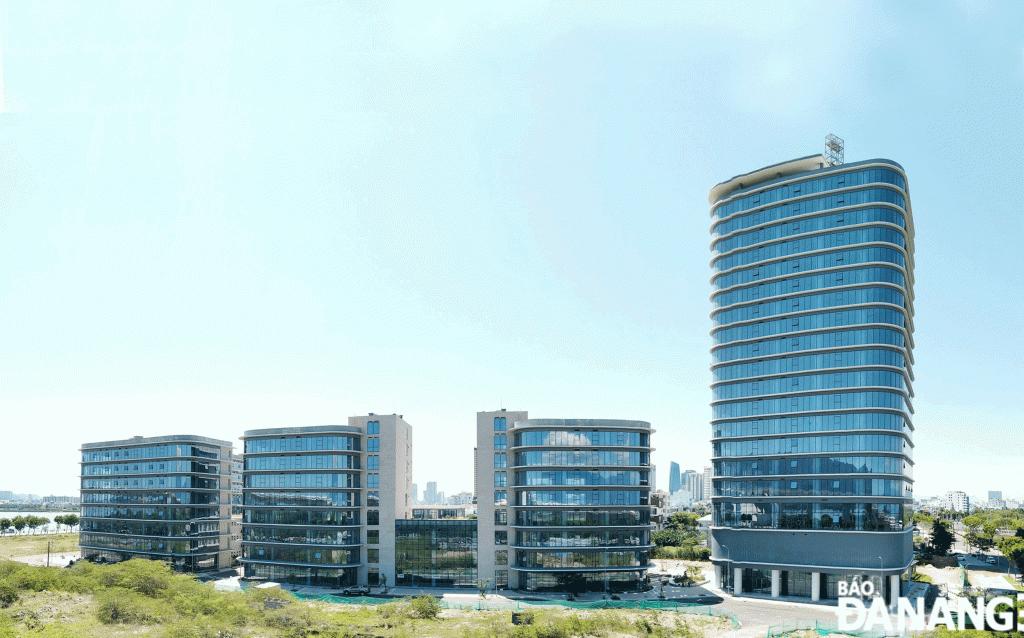
Image source: Da Nang Newspaper
Regarding infrastructure achievements, in Da Nang, the headquarters of the Executive Office at Software Park No. 2 has been completed with over 4,000 m², ensuring full internet infrastructure, 5G network, and data systems and servers for members. 5G coverage in planned areas has been completed, creating a foundation for modern financial and fintech operations.
Opportunities and challenges ahead
The establishment of this center is considered a particularly significant opportunity for Vietnam, but the success of the model depends on building the right foundation from the outset. Lessons from other international financial centers show that the decisive factors lie not only in tax incentives or infrastructure, but also in the quality of the legal framework, supervisory capacity, and transparency of the trading environment.
By May 2026, the center will be in a crucial transitional phase: from having essentially completed the legal framework and launched core institutions, to the actual operational phase involving attracting members, perfecting the supervisory body, and putting physical infrastructure into use. The commitment of large corporations like SOVICO to connecting international Capital flows, implementing new financial models, investing in digital transformation, green finance, and inclusive finance demonstrates that the domestic private sector is placing significant expectations on this model.
The road ahead requires synchronized coordination between policy, technology, infrastructure, and human resources. The goal of attracting at least 50 international financial institutions within the first three years will be the most concrete measure of the success of the Vietnam International Finance Centre in establishing its position on the regional and global financial map.