Original article by Odaily Odaily(@OdailyChina)
Author|Wenser (@wenser 2010)
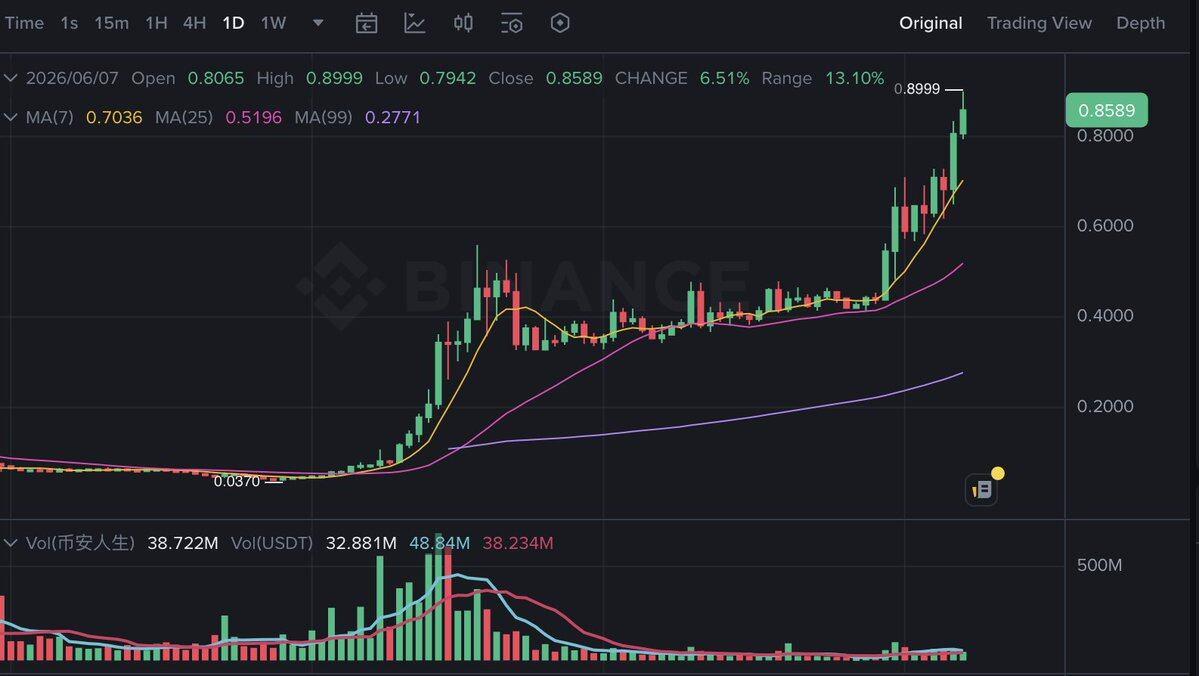
While the broader market plummeted, Binance Life continued to hit new all-time highs. However, this price surge failed to generate much discussion in the crypto market. On one hand, this indicates that most people no longer hold or pay attention to Meme coin, whose market capitalization once exceeded $880 million. On the other hand, the somewhat cruel and unfortunate truth may be that the liquidity-scarce crypto market has gradually become a stage for market manipulators to perform their own tricks. This is a tragedy for the Meme coin sector, and indeed, for the entire crypto market.
The three surges in Binance's stock price reflect the waning popularity of Meme coin.
Looking back, Binance has experienced at least three waves of explosive growth.
Binance's market capitalization surged three times: $500 million, $700 million, and nearly $900 million.
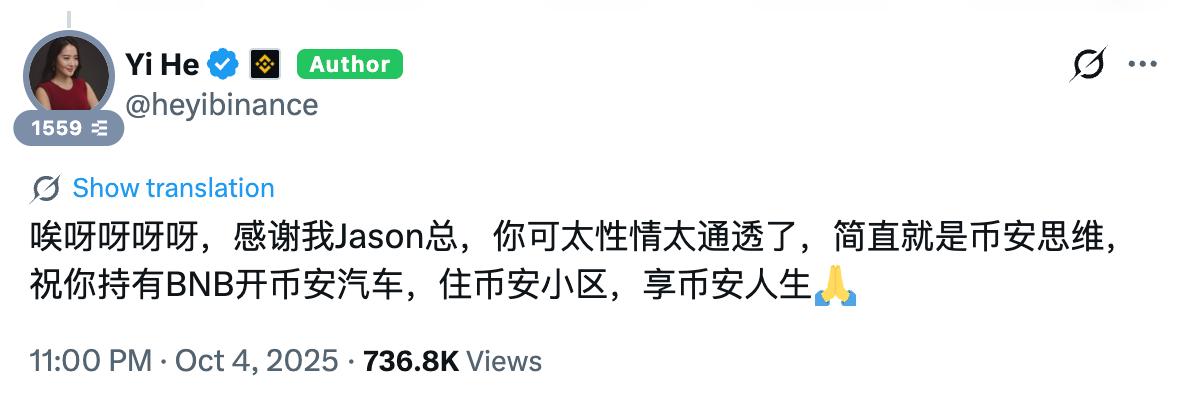
Last October, with Binance co-founder He Yi reply on X, "Wishing you a Binance life," the eponymous Meme coin quickly stood out from the Chinese Meme coin craze, with its market value soaring to $500 million at one point. Many people gained more than 1,000 times their initial investment, with over 100,000 wallet addresses participating in the trading, and 70% of traders making a profit. This directly drove the Meme craze in the BSC ecosystem.
In April of this year, after approximately two months of accumulating tokens, the manipulators behind Binance Life resumed their maneuvering. Coinciding with the release of CZ's new book on April 8th, Binance Life's market capitalization surged from less than $100 million to over $530 million by April 18th. In less than two weeks, its price rebounded by approximately six times. Behind this surge, the addresses suspected of controlling Binance Life held a staggering 147 million tokens, representing 14.67% of the total token supply.
The most recent surge began on June 1st. On that day, one address invested $5 million to buy 8.1 million Binance Life tokens at an average price of $0.61, increasing its holdings to 0.81% and placing it among the top 20 holders. Hours later, Binance Life's market capitalization briefly exceeded $700 million . Subsequently, more addresses joined the buying frenzy, successfully propelling its market capitalization to over $880 million on June 7th, setting a new all-time high. Unlike previous rallies, this wasn't a general rebound in the Meme coin sector, but rather a "one-man show by a major player."
The "Market Manipulation Show" Behind Binance's Success: A 2-Month "20x Pump and Dump" Strategy
According to on-chain analyst Yu Jin, the manipulator behind Binance Life's "20-fold increase in 2 months" is highly likely to be Garrett Jin, the "insider whale" behind last year's "October 11th." Last year, he exchanged tens of thousands of BTC for over 900,000 ETH; in February of this year, his long positions on Hyperliquid suffered liquidations, resulting in losses reaching $230 million. Specifically, the evidence is as follows:
- Since February, a certain address cluster has accumulated 288 million Binance Life tokens (approximately $237 million) through Binance and on-chain purchases, accounting for 28.8% of the total Binance Life supply. Including tokens in the CEX, this address cluster should control a large proportion of Binance Life, resulting in a "20-fold surge" in its price from $0.04 to $0.85.
- The strongest evidence is the deposit addresses. Multiple addresses that transferred large amounts of Binance Life tokens out of Binance shared the same Binance deposit address that Garrett Jin used six months ago; and the wallet address that has been buying large amounts of Binance Life tokens on-chain in the past few days shared the same Bybit deposit address that Garrett Jin used in the last five days.
As of now, this address cluster has purchased 61.09 million Binance Life tokens in the past week, worth $42.77 million, at an average price of approximately $0.70.
The relevant wallet address is as follows:
- 0x82C0DA65f3bE5fd4EE102337A5c560E2ae52ebD1
- 0xad946798685b3443eb3795df466b028abf907aaf
- 0x115552c3BE04dE5b031A1ffd3cC881A9107a069a
- 0xE60c0b900CdfE57FB1E1eA690708e120d91fDb22
- 0xB7C987EAd50DE301b4B3CB9db7c24091F2E1D2bb
- 0x3E3A47c5Fd611D515A27E123fD3a447F47aC2780
Two more interesting recent stories about Garrett Jin are worth mentioning:
- Firstly, there was a recent heated debate between him and "White-Haired Stock God" Serenity regarding the A-share robotics stock "Greenland Harmonic," with Serenity arguing that the current price was at a high point and not a good entry point. However, the reality is that after Serenity shill the stock, it surged 20% that day, triggering the daily limit, and then surged again by over 20% after opening today, triggering the daily limit once more.
- Secondly, ZEC's price halved last week due to a potential issuance vulnerability, prompting Garrett Jin to open a 3x leveraged short position in ZEC . However, as the ZEC price rebounded to above $400, he was forced to close the short position and cut his losses. Combined with his 5x leveraged long position in BTC, his overall portfolio is currently showing a floating loss of $17.925 million.
In the volatile market, even whale are sometimes just large-scale韭菜 (a metaphor for retail investors who are easily exploited). In the current crypto market, compared to the Meme coin sector where large investors can manipulate prices arbitrarily, the US stock market and prediction markets might be a more suitable choice for most people.
Finally, looking at the trading data, the buy volume for Binance Life is dismal. According to crypto KOL Danny, the gap between Binance Life's price and trading volume is particularly pronounced. It's clear that "few are biting the bait thrown out by the big players."
Whether we admit it or not, judging from the current market trends, community activity, and liquidity, the Meme coin craze belonging to the Solana, Base, and BSC ecosystems has become a thing of the past.