Despite the turbulence, the token's technical picture remains broadly bullish, and traders are now watching a key resistance level that could determine where $WLD heads next.
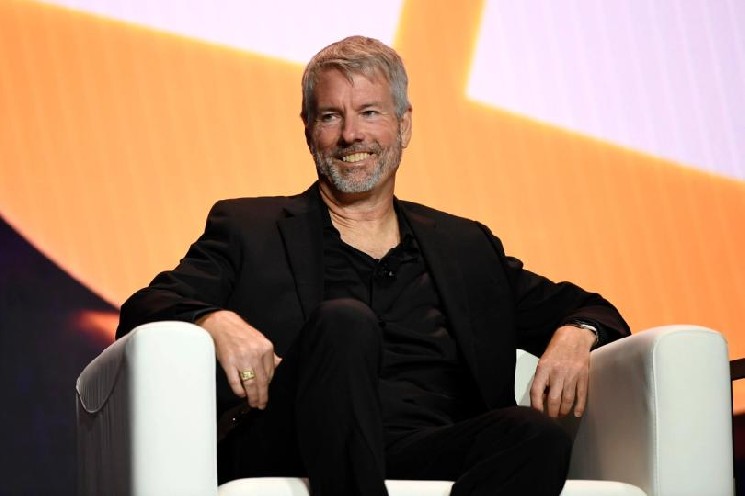
Arthur Hayes dumps all his $WLD
The drama kicked off on Wednesday, June 4, when Maelstrom researcher Lukas Ruppert published a bullish investor note calling Worldcoin an "overlooked" bet on the wave of AI mega IPOs.
Ruppert put a $5 price target on $WLD by August, a more than 900% move from where it was trading at the time. The note did spark a quick rally, pushing $WLD up to $0.60 by Friday.
Then, just two days later, Maelstrom co-founder Arthur Hayes reversed course entirely.
On Saturday, Hayes posted on X that he had sold his entire $WLD position, writing "this chart is going in the wrong direction" alongside a chart of the SpaceX pre-IPO perpetual futures contract, which had dropped sharply.
"Dumped $WLD. I'm out," he added.
The exit caught many off guard, particularly because Hayes had said just days earlier that he planned to hold $WLD through the SpaceX Nasdaq IPO, which is expected this coming Friday. The timing drew public criticism, including from on-chain analyst ZachXBT.
$WLD dropped back from $0.60 to around $0.40 following Hayes' announcement, but it has since recovered to $0.4746, up 6.8% in the past 24 hours and up 24.8% over the past seven days.
The 24-hour trading volume stands at $563.8 million, which is a substantial figure reflecting active participation despite the negative headlines.
Notably, this isn't the first time Hayes has done something like this.
In March, Hayes publicly predicted that Hyperliquid ($HYPE) would reach $150 by August. On June 1, he doubled down, saying $HYPE would outperform every other top-ten crypto through year-end.
Three days later, he sold everything. He also sold his Zcash ($ZEC) holdings on June 5 after a critical vulnerability was discovered in its privacy protocol, having previously said $ZEC would reach 10% of Bitcoin's price.
What makes the $HYPE situation even more interesting is that a wallet linked to Hayes bought back roughly 33,978 $HYPE, worth around $2 million, shortly after selling, following a 26% price drop.
$HTX pulls $USD1, complicating the $WLD picture
Adding to the developments around Worldcoin is a separate but related development involving crypto exchange $HTX.
In an official announcement, the $HTX exchange has delisted the $USD1 stablecoin, the stablecoin issued by World Liberty Financial ($WLFI), the DeFi project tied to the Trump family, after $WLFI froze several $HTX-linked blockchain wallet addresses.
On its part, $WLFI said the freeze was part of a sanctions compliance review, pointing to UK sanctions against Huobi Global S.A., an entity associated with the $HTX brand, over alleged facilitation of financial services benefiting the Russian government.
$HTX rejected this explanation, arguing the freeze came without legal grounding, advance warning, or any opportunity to respond.
In response, $HTX suspended $USD1 deposits and conversions and removed trading pairs including $USD1/$USDT, BTC/$USD1, ETH/$USD1, and $WLFI/$USDT.
Users holding $USD1 on the platform will have their balances automatically converted to Tether ($USDT) at a 1:1 ratio.
The conflict between $HTX and $WLFI also has a backstory.
$HTX adviser Justin Sun had previously filed legal proceedings against $WLFI, claiming his tokens were frozen without justification.
$WLFI countered with a defamation lawsuit against Sun, alleging false statements and breach of the $WLFI token sale terms.
The delisting of $USD1 is the latest escalation in what has become an increasingly bitter dispute.
What the charts say
Despite the negative news flow, $WLD's technical setup remains constructive.
According to analysts, out of 23 indicators, 14 are currently bullish, none are bearish, and 9 are neutral.
Moving averages alone show 12 buy signals against zero sell signals.
On the daily chart, $WLD is trading above all five key exponential moving averages, the 10, 20, 50, 100, and 200-day EMAs, with each one now sitting below price as dynamic support.
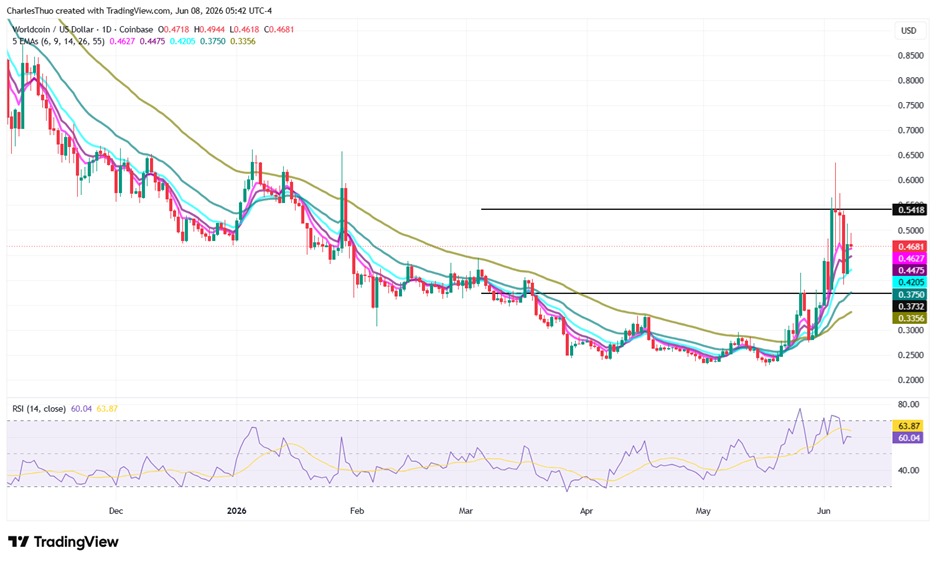
Trading above the 200-day EMA is generally seen as a sign that the broader trend structure remains intact.
The RSI(14) is currently at 60.70, which puts it in neutral territory. It hasn't pushed into overbought territory above 70, suggesting the recent rally hasn't been excessively stretched.
The key level to watch on the upside is $0.5418. $WLD needs to close above that level on the daily chart to confirm a continuation of the uptrend.
That level is close to the $0.60 high reached after Maelstrom's bullish note was published.
On the downside, support sits at $0.3732. A daily close below that level could open the door to further losses.
For added context, $WLD hit an all-time low of $0.2303 on May 18, 2026, just 21 days ago, and has since gained more than 105% from that bottom. It remains, however, 96% below its all-time high of $11.74, which was set in March 2024.
Whether $WLD can push past $0.5418 and revisit the highs from earlier this week will likely depend on broader market conditions and whether the SpaceX IPO narrative, which Maelstrom used to frame its bullish thesis, continues to drive interest in AI-adjacent crypto assets.