Google officially released Gemini 3.5 Live Translate, which features "near real-time" voice-to-voice translation and supports automatic recognition of 70+ languages.
Article author and source: 0x9999in1
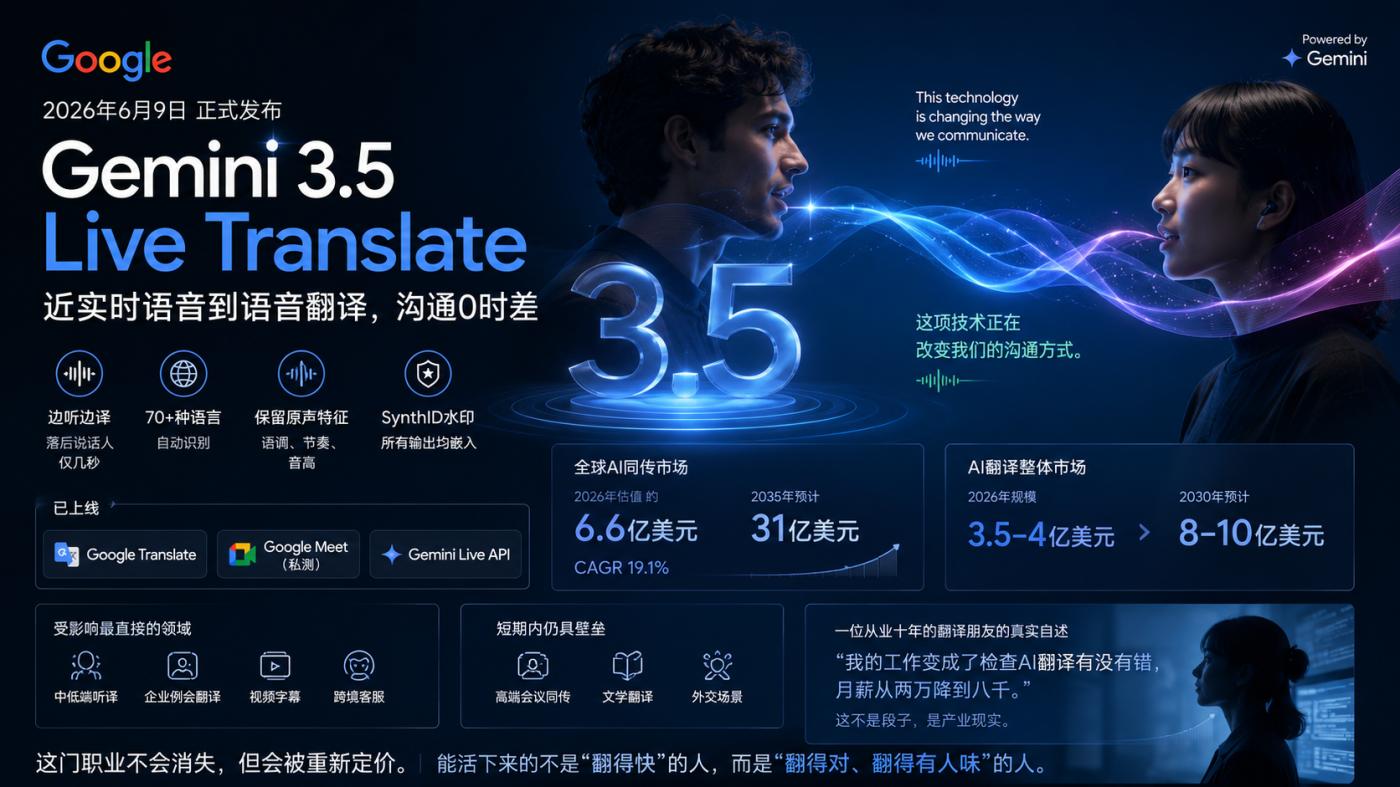
TL;DR
- On June 9, 2026, Google officially released Gemini 3.5 Live Translate, which features "near real-time" voice-to-voice translation and supports automatic recognition of 70+ languages.
- Its biggest disruption is not in accuracy, but in abandoning the "rotational" translation paradigm —no longer waiting for you to finish a sentence before translating, but translating while listening, lagging behind the speaker by only a few seconds.
- The model preserves the original speaker's intonation, rhythm, and pitch, and all outputs are embedded with SynthID watermarks; it has been launched on Google Translate, Google Meet (private testing), and Gemini Live API.
- The global AI simultaneous interpretation market is valued at approximately $660 million in 2026 and is projected to reach $3.1 billion by 2035, with a CAGR of 19.1%. The overall AI translation market is estimated to be in the range of $350-400 million in 2026 and is expected to approach $800-1 billion by 2030.
- The most directly impacted sectors are low- to mid-level interpreting, corporate meeting translation, video subtitling, and cross-border customer service; high-end conference interpreting, literary translation, and diplomatic scenarios can still hold up in the short term.
- A true account from a translator friend with ten years of experience has been widely circulated: "My job has become checking AI translations for errors, and my monthly salary has dropped from 20,000 to 8,000." This is not a joke; it's the reality of the industry.
- This profession won't disappear, but it will be revalued. Those who survive won't be the ones who "flip quickly," but those who "flip correctly and with humanity."
1. What exactly did Google release this time?
Let's first clarify the facts.
On June 9, 2026, Google published an article on its official blog, The Keyword, with the title: Fluid, natural voice translation with Gemini 3.5 Live Translate.
Its core is not "more accurate". It's "earlier".
Traditional machine translation, including past versions of Google Translate, Microsoft Translator, and most simultaneous interpretation apps, operates on a turn-by-turn logic —it waits until you finish a sentence or a semantic segment before translating. This leaves awkward silences in between. In a face-to-face conversation, the flow is abruptly interrupted. Everyone feels awkward.
The Gemini 3.5 Live Translate is different. It's streaming .
Listen, turn the pages, and speak at the same time.
The speaker was "just a few seconds behind." Google itself stated "within a few seconds," while domestic media cited data indicating a delay compressed to within 5 seconds.
More importantly, it preserves the original speaker's intonation, pacing, and pitch.
What does this mean? Traditional TTS delivers a standard, mechanical, emotionless female or male voice after translation. Gemini 3.5 doesn't do that anymore. It tries to make the translated voice sound "like you"—not a voiceprint clone, but a transfer of emotional nuances.
Your anger was reflected in the tone of your translation.
If you hesitate, its English output will also be hesitant.
If you speak with a smile, its French version will also have a smile on it.
This is a paradigm shift, from "information transformation" to "contextual transmission."
In which specific products will it be implemented?
Three entrances, fast pace:
First, on the developer side: The Gemini Live API is in public preview and can be directly called in Google AI Studio. The model code is called gemini-3.5-live-translate-preview . Real-time audio and video infrastructure such as Agora, LiveKit, Pipecat, and Fishjam are already in the first wave of integrations.
Second, on the enterprise side. Google Meet opened private testing to some Workspace enterprise customers this month. The number of languages has surged from the original 5 to 70+, and the language combinations in meetings have expanded from "English only" to 2000+ combinations .
Third, on the consumer side. The Google Translate app has been updated globally for Android and iOS. The Android version has added a very thoughtful feature – "Earpiece Listening Mode": you don't need to wear headphones, just hold the phone to your ear, like making a phone call, and the translation comes directly from the earpiece.
No Pixel Buds needed. No dedicated hardware required. One phone, one app.
One partner worth mentioning is Grab in Southeast Asia—they are using this model to enable drivers and foreign passengers to converse in real time during pick-up and drop-off. Grab generates over 10 million voice calls per month through its platform. This is a real-world, massive-scale application scenario.
What has Google done regarding security?
All generated audio files are watermarked with SynthID, the same technology used by Google DeepMind.
The watermark is embedded in the waveform and cannot be heard by the naked ear, but the machine can detect it.
There is currently no way to remove it.
Why emphasize this? Because you'll understand soon enough what kind of abuse risks come with an AI translator that can mimic your tone, rhythm, and emotions. Google has already laid a line in the sand.
II. Why is "I don't have to wait for you to finish speaking" a nuclear-level change?
Technically, this step may seem small, but it is actually a critical point that the simultaneous interpretation industry has been waiting for for decades.
Let's start by clarifying a fundamental concept: simultaneous interpreting involves "listening and speaking simultaneously." This is the fundamental difference between simultaneous and consecutive interpreting. Consecutive interpreting waits until you finish speaking, takes notes, and then reviews them. Simultaneous interpreting—the kind done with headphones in a conference room—outputs almost simultaneously with the speaker, with a delay typically between 2 and 6 seconds.
There's an unwritten rule in the industry: human simultaneous interpreters can only last a maximum of 20 to 30 minutes in a single session before needing to be replaced. This is because the cognitive load is off the charts—simultaneously listening to the source language, translating it in their minds, outputting it in the target language, and monitoring what they just said. This is one of the most cognitively demanding jobs on Earth.
Machines couldn't do that in the past.
Because the machine needs to "wait." It needs to wait for a complete semantic unit before it can confidently translate.
The Transformer architecture essentially requires seeing the complete context to output the optimal solution.
The Gemini 3.5 Live Translate step relies on a streaming generation architecture —reading and outputting tokens simultaneously, and introducing a dynamic "wait-translation" trade-off: when to wait a little longer to ensure quality, and when to immediately jump out and keep up with the pace, the model makes its own judgment.
It found an engineeringly acceptable sweet spot between efficiency and quality.
A delay of less than 5 seconds is sufficient for non-diplomatic scenarios such as meetings, customer service, live streaming, and teaching.
Sufficient means replacement.
Why is this product positioning so aggressive?
Let me give you some data. According to Google itself, "more than one trillion words" are processed through Google Translate every month, reaching billions of users.
The sheer size of the platform is a barrier to entry. It's easy for any startup to create an AI simultaneous interpretation demo, but achieving the scale, stability, language coverage, and noise robustness of Google is extremely difficult.
Moreover, Google's approach this time is very "full-stack": APIs for developers, Meet for businesses, apps for individuals, and Listening Mode for everyone without headphones. All entry points are laid out without leaving any gaps.
This is not releasing a model. This is releasing a "translation infrastructure".
Third, let's do the math on the market: How big is the pie, and how should it be sliced?
Before discussing the impact, we must first understand the market. Otherwise, it's just empty talk.
AI Simultaneous Interpreting Market : According to a 2026 report by Business Research Insights, the global AI Simultaneous Interpreting market was valued at approximately $660 million in 2026 and is projected to reach $3.14 billion by 2035 , representing a CAGR of 19.1%. North America accounts for approximately 40% of the market share, Asia Pacific 30%, and Europe 25%.
AI translation software market : According to combined data from textunited, CSA Research, and Slator, the AI translation market is expected to be worth between $3.5 billion and $4 billion in 2026 , and is projected to reach $8 billion to $10 billion by 2030 .
The entire language services industry : According to Nimdzi's 2025 report, the global language services market size was $71.7 billion in 2024. Mordor Intelligence predicts it will reach $64.99 billion in 2026 (note: different metrics), and grow to $97.65 billion in 2031, with a CAGR of 8.44%.
Traditional simultaneous interpretation services : The global simultaneous interpreter market is valued at $2.15 billion in 2025 and is projected to reach $3.99 billion in 2032 , with a CAGR of 9.2%. The remote simultaneous interpretation (RSI) market is expected to reach approximately $1.2 billion in 2026 , with a CAGR of 15.8%.
Have you figured it out?
The overall language services market is still growing. However, the growth rate of AI-based translation is far higher than that of human translation . AI translation has a CAGR of over 20%, while human simultaneous interpretation has a CAGR of 9%. The gap is widening.
Even more alarming is this data: According to a CSA Research survey in early 2026, 95% of businesses are already using AI or machine translation. Gitnux data shows that 72% of translation agencies have integrated AI tools internally, and the average cost of word translation has fallen by 28% in the past few years , dropping to $0.07 per word.
With prices falling and demand rising, who absorbed the squeezed-out production capacity?
AI.
Whose salary has been cut?
Mid-to-low-level translators.
IV. The Real Impact on the Translation Profession: Layered Disintegration, Not a One-Size-Fits-All Approach
I must state this upfront: I do not believe that AI will "eliminate" the translation profession .
That's too lazy to say. And it's inaccurate too.
But AI is reshaping the pyramid structure of this profession. Starting from the bottom, it eats up layer by layer.
First layer: Subtitles, video transcription, batch audio and video conversion
The battle on this floor is basically over.
Premiere Pro, CapCut, and DaVinci Resolve all have built-in AI subtitle generators. Accuracy is over 95%.
Automatic multilingual subtitles have become standard on Bilibili and YouTube.
Companies that specialize in video translation, such as HeyGen, can provide lip-syncing and multilingual dubbing.
How drastically will the prices drop? In 2020, the market price for a typical English-Chinese subtitle was about 8-15 yuan per minute, but by 2026 it will drop to 1-3 yuan per minute, with free trials available .
At this level, people are basically only left with the function of "proofreading". The stories of monthly income dropping from 20,000 to 8,000 mainly happen at this level.
Second layer: Company meetings, cross-border customer service, live-streaming e-commerce
The Gemini 3.5 Live Translate's biggest flaw lies in this area.
Previously, when companies held cross-border meetings, they had to hire simultaneous interpretation companies, with prices starting at 2,000-5,000 yuan per hour and capped at 8,000-15,000 yuan for half a day.
Google Meet now embeds it directly and charges a subscription fee.
For a heavy-duty platform like Grab, with 10 million driver-passenger calls per month—you expect humans to translate that data? Absolutely not. This has been an AI market from the beginning, but the accuracy wasn't sufficient before; now it is.
AI takes over 99% of the "high-frequency, low-threshold, and real-time" scenarios such as customer service, e-commerce, and live-streaming sales.
Third tier: Business meetings, industry summits, and technical seminars
This floor is the main battleground.
AI can achieve a score of 80. But are customers willing to pay for that final 20 points?
It depends on the occasion and the people involved.
Legal, medical, and M&A negotiations—clients dare not skimp on these.
Internal sharing, product demonstrations, and technical workshops – customers start saving money.
This is currently the "comfort zone" for a large number of mid-level translators, and they will be severely squeezed in the next 3-5 years. A Sina Finance report at the end of 2025 provided the following data: about 40% of translation jobs will be replaced by AI , junior translators' income will be halved, and corporate translation costs will decrease by 40%-50%.
This is not a prediction; it has already happened.
Fourth tier: High-end simultaneous interpretation, diplomacy, literature, and film/television dubbing
This floor is currently safe.
But the word "currently" is very important.
In diplomatic situations, the margin for error is zero; AI's understanding of political and cultural contexts is still insufficient.
Literary translation involves metaphors, rhymes, and cultural translation. AI always provides "correct" translations, but not "good" ones.
Top-tier simultaneous interpreters do more than just translate; they complete semantics, enhance emotional expression, and handle impromptu situations. AI, for now, cannot learn to smooth things over for its superiors.
However, in the medium to long term, this layer will also shrink. This is because the market's definition of "high-end" is being raised by AI—things that AI can do are no longer valuable. What will be valuable are things that AI cannot do, and AI can do more and more.
V. How much will the skill of transcribing still be worth in the future?
Let me state a few points. Be sharp.
First, "translation" will not disappear, but "translator" will be redefined.
The translation profession in the future will most likely split into two categories:
One type is AI translation quality inspectors/post-editors , who have low hourly wages, high volume, can work remotely, and have low barriers to entry, but have been severely impacted by the competition.
One type is the Cross-cultural Communication Strategist. They not only translate languages, but also context, intent, and business logic. They are highly paid, but few in number.
The middle zone disappeared.
Second, a new period of opportunity will emerge in the hardware sector.
Google's inclusion of Listening Mode in the phone's earpiece is a signal in itself—AI translation is becoming wearable and ubiquitous . Meta's Ray-Ban smart glasses, Apple Vision Pro, and various AI headphones—the next battleground is "seamless translation hardware."
This will not only impact translators, but also translation device manufacturers (such as iFlytek, Youdao, and Time Kettle). With Google integrating this capability directly into the Android system layer, how will third-party hardware companies sell their products?
Third, the "accuracy anxiety" of AI translation will be taken over by the "watermark anxiety".
Google's use of SynthID watermarking was visionary.
Because what you will see next is: politicians' speeches being translated and edited by AI, taken out of context; one party using AI translation to "distort" the other's meaning in business negotiations; and criminals using voice cloning and real-time translation to commit cross-language fraud.
Watermarks are a line of defense, but they are not a panacea.
Fourth, Chinese translators may be among the relatively benefited groups from this wave of impact.
Why? Because the semantic complexity, cultural load, and political sensitivity of Chinese are the most difficult aspects for current AI models to grasp. No matter how powerful Gemini is, its understanding of Chinese political semantics such as "concerned by the leadership," "in principle," and "to study" still lags behind that of humans.
This is the moat protecting Chinese translators for the next five years. But it's only a matter of time before that moat is filled in.
VI. To wrap things up
Returning to that widely circulated true account:
"My current job is to check AI translations for errors, and my monthly salary has dropped from 20,000 to 8,000."
That's heartbreaking. But it's not actually AI's fault.
This is the norm in technology cycles.
Typists, telephone operators, film developing technicians, taxi dispatchers—each wave of technological revolution dies out a batch of professions.
What makes Gemini 3.5 Live Translate special is that it's the first time you've felt that "translation" no longer requires "waiting . "
And "waiting" is precisely the only buffer of dignity for human translators.
Wait until you finish speaking, wait to think, wait to organize your thoughts.
The buffer was reduced to 5 seconds, then to 3 seconds, and then to almost imperceptible.
The machine caught up.
What about that person?
The answer is actually quite old-fashioned: do things that machines can't do.
Do things with sound judgment.
Do things that have a clear stance.
Do things that have warmth in them.
The art of transcribing will not die out.
But the good old days of earning 20,000 yuan a month with it are probably gone forever.
When the tide comes in, it's not the people standing on the beach who get their shoes wet first.
It is a person standing in the sea.
Source cited
- Anuda Weerasinghe, Tony Lu. "Fluid, natural voice translation with Gemini 3.5 Live Translate." The Keyword, Google Blog, June 9, 2026.
- Ryan Whitwam. "Google announces Gemini 3.5 Live Translate for instant voice-to-voice translation." Ars Technica, June 9, 2026.
- Abner Li. "Gemini 3.5 Live Translate rolling out to Google Meet and Translate." 9to5Google, June 9, 2026.
- Google releases Gemini 3.5 Live Translate: Delayed simultaneous interpretation, accurate audio reproduction, and automatic multilingual recognition. AITOP100, June 10, 2026.
- Business Research Insights. "AI Simultaneous Interpreting Market Size, Dynamics, 2033." Published 2026.
- Mordor Intelligence. "Translation Services Market Size, Drivers & Opportunities | 2026 - 2031."
- Voxbooster. "Machine Translation Statistics (2026): 55+ Data Points on Market Growth." 2026.
- Sina Finance. "40% of translation jobs will be replaced by AI; how can labor-intensive countries restructure the language division of labor in the global value chain?" December 26, 2025.