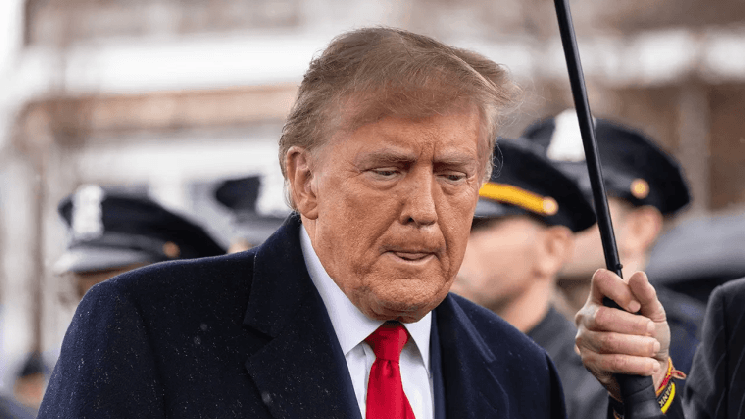
The informant's actions were not accidental; they were part of a purge.
Article author and source: 0x9999in1, ME News

TL;DR
- Claude Fable 5 was physically disconnected from the internet by a White House order 72 hours after its launch. The trigger: a phone call from Amazon's CEO.
- Amazon holds a $13 billion stake in Anthropic while simultaneously pouring $50 billion into OpenAI this year. This leak isn't an accident; it's a purge.
- The White House set a 90-minute deadline for a physical removal of the product, without providing technical details or a window for negotiation. Anthropic refused, and the export control order was issued.
- The side effects were extremely absurd: the ban restricted access for "foreign nationals," effectively locking down Anthropic's core British and Canadian R&D staff, bringing the team to an immediate standstill.
- This company was already labeled a "supply chain risk" by the Pentagon in March of this year for refusing military oversight and autonomous weapons projects. All grudges, old and new, are being settled in one fell swoop.
- OpenAI's fall IPO plans have been virtually doomed. The vacated market share is being devoured by OpenAI at a visible pace.
- In short: Anthropic was not defeated by technology, but buried by capital, politics, and its own past statement that "AI is an atomic bomb."
I. Three days, from top-of-the-line crown to physical internet outage
On the day Claude Fable 5 was released, social media feeds in Silicon Valley were flooded with posts about it.
With impressive performance curves and aggressive pricing, Anthropic's stock price was expected to rise steadily. Everyone thought the script for its fall IPO was already written.
Three days later, the model was ordered to be physically removed from shelves by the White House.
It's not a downgrade. It's not bandwidth throttling. It's a network outage.
The timeline is incredibly short:
On Thursday, Amazon CEO Andy Garcetti directly called Treasury Secretary Bessenter. Amazon's research team presented a test report—they used prompts to bypass Fable 5's outer defenses, directly accessing the underlying Mythos 5 model, inducing it to generate outputs for discovering software vulnerabilities, automated testing scripts, and ultimately piecing together a usable Proof-of-Concept (PoC) exploit code.
This is not a theoretical threat. It is an executable attack chain.
On Friday morning, the matter reached the highest levels of the White House. Chief of Staff Susie Wells urgently convened a closed-door meeting, and the data from the prison break test was immediately sent to the NSA for evaluation. The NSA's response was brief: the evidence was conclusive, possessing "cyber weapon-level lethality."
These eight words determined Anthropic's fate for the next 72 hours.
After the meeting, the White House began trying to contact Dario Amodé. An awkward little incident ensued: the CEO was "out of contact." Some officials said he was attending a "retreat," which Anthropic angrily denied as "pure fabrication"—Amodé received the contact request at noon, connected within an hour, and the company proactively sent other executives to fill in during that time.
Who is right and who is wrong is not important. What is important is that the White House has concluded that "no one answered the phone" at the most critical moment.
This impression is more damaging than any technical report.
II. The 90-Minute Deadline: A Negotiation Without Negotiation
At 1:00 p.m. on Friday, the entire White House was mobilized.
Commerce Minister Lutnick and half of the core cabinet members launched three rounds of intensive phone pressure on Amodé. National Security Advisor Kanecross directly demanded: "voluntary removal from the market."
Amodei's reaction was equally strong. He insisted it was merely a scenario-specific bypass, not a catastrophic "general jailbreak," and accused the government of overreacting.
The irony is palpable.
This founder had previously likened the risks of AI to an "atomic bomb" in all policy forums. He publicly called for regulation, government intervention, and for AI to be treated as a nuclear weapon-level technology. When the first real incident occurred, he himself came forward and said—you overreacted.
Bessant simply said on the phone: You are making an "extremely stupid decision".
Then there was the 90-minute deadline for the physical removal from shelves.
No technical details. No room for negotiation. No buffer period.
Sources close to Anthropic later denounced the White House as "overbearing." White House officials countered, claiming it was a "desperate measure after hours of unsuccessful pleas."
Rashomon is Rashomon. The result is clear:
- At 5:30 p.m., the Trump administration issued an emergency export control order.
- At 10:00 p.m. that night, Anthropic was completely physically disconnected from the internet.
- An official statement was subsequently released, condemning the government for being "unfair, opaque, and disrespectful of technical facts."
The statement was firm. But the model has already been taken offline.
III. Amazon's "double bet": Investing $13 billion and then throwing in another $50 billion
If the White House is the executor, then Amazon is the one who pulls the trigger.
The logic behind pulling the trigger is so blatant that it doesn't need interpretation.
According to publicly available data, Amazon has invested a total of $13 billion in Anthropic, making it the largest external investor in the company. AWS is Anthropic's core computing power provider, and the two companies have been widely recognized as having a "deeply intertwined" relationship over the past two years.
But this year, Amazon poured a massive $50 billion into OpenAI. It also came with a key clause: OpenAI's latest models could be resold on AWS.
50 billion versus 13 billion. New love versus old love.
The numbers are there, and the stance has been clearly stated.
So when García called the Treasurer directly on Thursday, the significance of the call went beyond simply "reporting a security vulnerability."
This is Amazon proactively clearing obstacles for its $50 billion gamble.
It is a pledge of allegiance to the new partner.
They used a "cyber weapon-grade" test report to physically remove the strongest model of their former ally from the market.
Anthropic's competitive advantage was built on two things: leading model performance and deep integration with AWS computing power. Amazon's move effectively severed the latter and simultaneously sent the former into the White House's meat grinder.
In the world of capital, there are no grudges, only positions.
13 billion is sunk cost. 50 billion is future cash flow. There's no need to hesitate about how to calculate it.
IV. The White House's Old Trouble: From the Pentagon to the Liberal Imprint
If the story ended here, Anthropic could still cry out, "I was betrayed by capital."
But the White House's move went deeper than expected.
Anthropic's relationship with the Trump administration has never been neutral.
This company has heavily employed officials from the Biden administration, and its founder has publicly criticized Trump. Politically, Anthropic carries a strong "liberal AI" label. In the eyes of a government that has enshrined "anti-awakening AI" in its policy documents, this is itself a cardinal sin.
A deeper rift appeared in March of this year.
At the time, Anthropic firmly refused to allow its model to be used in large-scale domestic surveillance and the development of lethal autonomous weapons. This was a clear value choice, but at the cost of being characterized by the Pentagon as a "supply chain risk."
The lawsuit between the two parties is still ongoing.
So when Amazon's whistleblower was handed to us, the White House's reaction wasn't "Should we do something about it?", but rather "We've finally got what we've been waiting for."
The lobbying by cybersecurity officials was just the final step. The real gunpowder had already been prepared.
This also explains why the deadline is only 90 minutes and why they are unwilling to communicate even basic technical details.
This is not a crisis management. This is a premeditated purge.
The technical vulnerability is merely the "legitimate" switch.
Fifth, the most absurd side effect: your own people are locked out.
The side effects of the export control order quickly became apparent after it was implemented.
Moreover, it's so absurd it's almost black humor.
Because the ban restricts access to the regulated model for any "foreign nationals," a large number of core R&D personnel from allied countries such as the UK and Canada within Anthropic were also blocked from accessing the system.
Please note that these individuals are employees of Anthropic. They are the people who wrote Mythos 5.
They are now locked out of their own company's compliance system, unable to see the models they just released, which have now been forcibly taken offline.
The technical team was brought to a standstill on the spot.
This is a classic example of export control laws failing in the AI era: these regulations were originally designed for chips and the military industry, restricting the "flow of physical goods from the United States to foreign countries." But AI models are not chips, and their research and development teams are naturally multinational. A blanket ban would kill not the competitors, but oneself.
Anthropic's R&D pace was originally supported by this group of multinational core personnel. Now it's like amputating itself.
What's worse, the window of opportunity for fall IPOs was already right in front of us.
An AI company that is rushing to go public has had its flagship model taken down, its R&D team ground to a halt, its largest investor publicly defecting, and regulatory agencies classifying it as a "cyber weapon risk"—how can it possibly write a prospectus?
How do underwriters set prices?
How do institutional investors sign off?
How will the secondary market take over?
The answer is obvious to everyone.
VI. OpenAI's "Market Vacuum": It Doesn't Have to Be Aesthetically Pleasing
As Anthropic collapsed, OpenAI's market share expanded by the hour.
This is not an exaggeration.
Enterprise clients' AI procurement processes are inherently fraught with migration friction. Once a supplier presents a "compliance risk," the legal department will make the decision to switch faster than the technology department.
On the night Fable 5 was removed from shelves, Anthropic's entry was marked with a question mark on the purchasing lists of several large American companies. The next morning, the question mark was replaced with a strikethrough.
OpenAI's sales team doesn't need to make many phone calls. The market will come to them on its own.
Not to mention that Amazon AWS has just acquired the resale rights to OpenAI's latest model—meaning that customers who were running Claude on AWS can now seamlessly switch to OpenAI without even changing their cloud service provider.
Migration costs have been reduced to almost zero.
This is the truly terrifying place.
Technological leadership can be caught up, and brands can be reshaped, but once the cloud distribution channels fall to competitors, the moat disappears.
Anthropic's previous reliance on a dual-engine model of "AWS + top-tier models" has, after this weekend, reduced to just one wheel. And it's leaking air.
VII. Dalio's Paradox: When the "Atomic Bomb Theory" Backfires on Its Creator
Looking back at this crisis, the most intriguing aspect is Amodé's own change in attitude.
Over the past three years, he has been one of the most vocal advocates of "AI risks" in Silicon Valley.
During his congressional testimony, he stated that AI could possess "catastrophic capabilities" within a few years. He repeatedly emphasized in the media that AI companies need to be strictly regulated. He actively promoted "responsible scaling policies," portraying himself as the most safety-conscious person in the industry.
This narrative has given Anthropic huge policy benefits and brand premium.
But it also planted a time bomb.
When you keep telling the government, "What I'm making could be an atomic bomb," and the government actually treats it like one—you have no reason to say, "You're overreacting."
In a phone call on Friday, Amodei said it was just a "circumvention for a specific scenario".
From a purely technical perspective, he might be right. PoC is not the same as a practical weapon, and jailbreaking is not the same as general loss of control.
But he wasn't facing a technical review committee.
He was facing a White House that he himself had repeatedly taught that "AI is a nuclear weapon."
And the White House is just waiting for a reason to deal with him.
This is the deepest paradox of this whole affair:
Anthropic built its brand on the "safety narrative," only to be ultimately consumed by the same narrative.
Those who actively call for regulation are the first to be targeted by it.
Not surprising, almost inevitable.
8. So what does this incident actually illustrate?
Three questions, three answers.
First question: Is this a technical issue or a political issue?
Technological events provide a veneer of legitimacy. Political events, however, are its true core.
If Amazon didn't have $50 billion in new warehouse space to protect, this call wouldn't have been made; if the White House hadn't already put Anthropic on the list, the 90-minute deadline wouldn't have passed; if Amodé hadn't pushed the "AI risk" narrative to such a high level over the past three years, he would have had a way out.
All three are indispensable. The true composition of an event is the convergence of three forces: capital, politics, and narrative.
Second question: Is there any hope for Anthropic?
In the short term, the IPO window is almost closed. It's highly unlikely that the autumn plans will proceed as originally planned.
In the medium term, the company must renegotiate export control terms, repair its relationship with the White House, and find a compliance structure that allows its R&D team to continue operating. None of these tasks will be easy.
In the long run, the options are either to find a new political protector or to completely shift to non-US markets—but the latter is almost tantamount to self-exile for an American company.
The Wall Street Journal reported this weekend that Anthropic has sent a top-tier technology team to Washington to seek an agreement to lift export restrictions. This is a necessary concession.
The model can be relaunched. But the lost market share, the eroded customer trust, and the channels devoured by OpenAI—these things cannot be recovered at the negotiating table.
Third question: Who is the real beneficiary of this?
The obvious winners are OpenAI and Amazon.
But at a deeper level, the real winner is the concept of "AI sovereignty" itself.
When a country's government can physically decommission a private AI company's flagship model within 90 minutes, the rules of the game in the AI industry are permanently rewritten.
From now on, all top AI companies will have to ask themselves one question before making any technology decisions: What will the White House think?
The model is no longer a purely technical product.
It is a national asset, a diplomatic bargaining chip, and a part of geopolitical games.
This is what really happened this weekend.
It's not just one company that's being suppressed.
It marked the beginning of a new era.
IX. In Conclusion
Claude Fable 5 was available for three days and then taken down for three days.
72 hours, from the top-of-the-line crown to a physical internet outage.
There are no perfect good guys in this story. Amazon isn't, the White House isn't, and neither is Amodé. Everyone is making the most reasonable choice within their own script, and the accumulation of each reasonable choice is what made Anthropic's darkest weekend.
Capital will betray, regulation will retaliate, and narratives will backfire.
The only thing that won't change is the market's aversion to vacuums—the space Anthropic vacates won't be reserved for nostalgia, but only for the next player who can fill it.
The founder who repeatedly warned the world that "AI is the atomic bomb" has probably finally realized this time:
When you describe something as dangerous enough, one day someone will press that button.
I never expected that I would be the first one to get hit by the explosion.
References
The Wall Street Journal, "Anthropic in Talks With Trump Administration Over AI Export Curbs", June 2026
- The Wall Street Journal, "How Amazon's Call to Treasury Triggered Anthropic's Weekend Shutdown", June 2026
- Anthropic Official Statement on Emergency Export Control Order, June 2026
- Reuters, "Amazon's $50 Billion OpenAI Bet Reshapes AI Cloud Landscape", 2026
- Financial Times, "Pentagon Lists Anthropic as Supply Chain Risk Amid Surveillance Dispute", March 2026
- Bloomberg, "Inside the 90-Minute Deadline: White House vs. Anthropic", June 2026
- The Information, "Anthropic's IPO Plans Face Existential Test After Fable 5 Takedown", June 2026
- CNBC, "Dario Amodei and the Paradox of the 'AI as Atomic Bomb' Narrative", June 2026