Editor's Note: This article uses a "year-by-year projection" approach to predict the structural changes that may occur in the crypto industry from 2026 to 2029.
Rather than continuing to discuss a particular Altcoin narrative, a certain public blockchain ecosystem, or whether AI x Crypto will explode, the author is more concerned with a more fundamental question: when crypto is no longer just an asset class, but begins to become a private asset trading platform, on-chain settlement, and traditional financial back-office infrastructure, where will the real value of this industry flow?
The article's core judgment is that the main theme of the crypto market in the next few years will shift from "token narratives" to "real asset entry points." In 2026, pre-IPO perpetual contracts on platforms like Hyperliquid , involving SpaceX, OpenAI, and Anthropic, may become the entry point for the market to pursue high-quality private assets; most AI x Crypto directions will be disproven, with the only truly viable crossover scenario perhaps being prediction markets. By 2027, public blockchain foundations will be forced to reposition themselves between casino-style retail trading and institutional-grade compliant infrastructure. Stablecoins, tokenized private lending, and fund shares will continue to grow, but their pace will be constrained by political and regulatory variables.
The real turning point may occur after 2028. The author argues that as the threshold for qualified investors is lowered and the secondary market for private securities becomes more transparent, real private company equity will begin to replace unanchored synthetic perpetual contracts as the core asset of the new bull market. In other words, the boom in pre-IPO perpetual contracts is not the end game, but rather a substitute for the market in the absence of legitimate private asset channels. Once real equity can be traded more widely, synthetic assets will shift from being the main focus to being secondary.
By 2029, the crypto industry may become more "boring," but also more important: stablecoins and on-chain settlements will become part of the traditional financial back-end, and ordinary users may no longer care whether the underlying infrastructure runs on a public chain; truly valuable tokens must correspond to real cash flow, enforceable rights, or a clear value capture mechanism, while those tokens without underlying assets, claims, or revenue loops will no longer undergo a long clearing process, but will directly lose their trading significance.
The most noteworthy aspect of this article isn't whether it accurately predicted every year, but rather that it raises a clear variable for consideration: the key to the next bull market in the crypto industry may not be technological bottlenecks, but rather legal pathways. If, by the end of 2028, retail investor demand for private companies can still only be expressed through offshore synthetic perpetual bonds and packaged products, then the author's judgment needs to be reassessed; however, if private assets truly begin to enter the broader market in a compliant manner, the core narrative of the crypto industry will be rewritten.
The following is the original text:
You are sitting in the face of the biggest upheaval in crypto history. If you want to stay in this industry, you must take a serious look at what is happening right now.
This industry currently faces three core issues:
What makes a token valuable?
How can we translate different cutting-edge technologies onto the blockchain?
What will happen when crypto ceases to be an asset class and becomes the infrastructure of traditional finance?
I can discuss each issue in an abstract way. Many people do this every day, and these arguments never reach a conclusion.
So I want to try a different approach. I'll write down what I believe will actually happen in this industry from now until 2029, organized by time period. I'll provide names, numbers, and dates, specific enough that you can come back three years later to check if I'm right. This is just one of many futures, and some of them will definitely be wrong. But vague judgments about the future cannot be disproven, and judgments that cannot be disproven are worthless. I'd rather be specific and wrong than vague and safe.
This prediction stems from my position: I'm at the intersection of crypto startups, regulation, and venture capital, and I speak with alternative asset managers and capital allocators weekly. This certainly doesn't mean I'm always right, but it does mean my judgment is priced in within real-world constraints.
Mid-2026: The only good asset is not tokens
By mid-2026, before everyone reached a consensus on "how much a token should be worth," the pre-IPO perpetual contract market had already found a product-market fit.
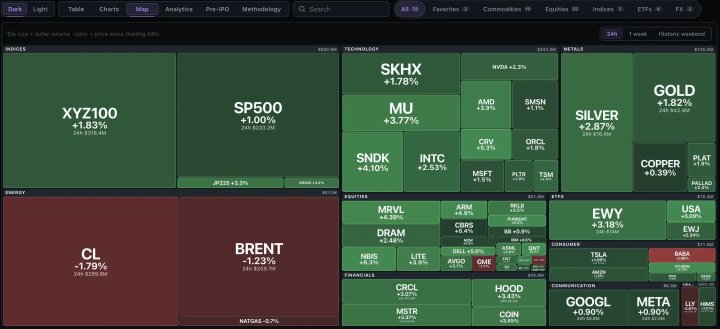
It started with Hyperliquid. SpaceX's pre-IPO perpetual contracts, initially ridiculed for a massive ventures liquidation manipulation scandal, subsequently became one of the most closely watched price signals in both private and public markets. By July, banks and hedge funds were referencing it to value their private holdings, and consumer apps like Robinhood used it to calibrate post-IPO pricing. In the weeks leading up to every major IPO, these perpetual contracts converged to the opening price with embarrassing accuracy—not embarrassing for the market, but for the underwriters who charged seven-figure fees and ended up with the same number. OpenAI and Anthropic's perpetual contracts attracted even larger open interest. For a brief period, a crypto-native exchange became the closest place to real-time prices for the world's most important private companies.
Meanwhile, retail investors are asking a more fundamental question: why is there anything else on-chain worth trading? For the past eighteen months, the Altcoin market has been bleeding, with founders and funds exiting through DAT and TWAP sell-offs, while $HYPE, the only token with an effective value capture loop, has outperformed everything. The market has proposed over a dozen value capture mechanisms, but most haven't truly taken off because they share the same flaw: these mechanisms are attached to worthless companies. The industry has first solved "how tokens capture value," but hasn't yet acquired any assets worthy of having their value captured.
This inversion is the quiet engine behind the pre-IPO market boom. Demand has never been for perpetual contracts themselves, but for high-quality assets. And in 2026, the only high-quality assets available on-chain are synthetic stakes in companies completely unrelated to crypto.
End of 2026: AI will not need encryption.
Anthropic and OpenAI have reached the technology escape velocity, and the battle for fundamental models has begun to prematurely price AGI in the market. One consequence is that everyone working in this field, except for the core companies developing fundamental models, is starting to lose money. Capital is beginning to price AGI as something on a company's balance sheet, rather than a capability that can be commoditized and benefit everyone around it.
In this environment, AI × Encryption died quietly. Not because the proposition was refuted, but because no one had the time to refute it. The x402 payment track went live, but no payers could be found; the Agent economy, supposedly requiring on-chain currency, never materialized on a large scale; and the few truly existing Agents, like all previous software, settled in USD via APIs. At this point, the most honest sentiment in the venture capital world was: AI doesn't need encryption, and venture capitalists finally stopped pretending it did.
Currently, the only AI × crypto product that has truly found a product-market fit is the prediction market. Predictions based on underlying models are experiencing escape velocity because they have become the most accurate financial tool for expressing the question of "who will have the strongest model a month from now," and this question itself is attracting the largest amount of capital.
Beyond the market movements, something less exciting is happening. After the CLARITY Act passed the Senate in mid-2026, most traders considered it "unaffected" because the market didn't immediately react. But by the end of 2026, tokenization projects were accelerating. Large asset management firms were quietly moving from pilot to production environments because "discretion" was precisely the responsibility of their compliance departments: money market funds, private lending, and those less glamorous but crucial intermediaries on their balance sheets. They didn't trade, didn't have price charts, and no KOLs on CT were passionately sharing some transfer agent filing.
By the end of 2026, the crypto industry had morphed into two almost mutually exclusive economies. One was noisy, responsible for pricing the AI race; the other was quiet, being absorbed into the financial system through filings. Almost everyone was watching the first one.
Early 2027: Foundations Take Sides
General-purpose public blockchains can no longer maintain an ambiguous state.
For years, every major foundation has been telling two stories simultaneously: one about consumer adoption on stage, and another about institutional readiness in the data room. These two stories never needed to meet head-on. But by early 2027, they did.
The consumer narrative is highly concentrated at the transaction level: the only retail product that truly identifies demand concentrates transaction volume in a few venues. Meanwhile, the institutional narrative is the only story that truly binds paying customers. Thus, one after another, foundations began to take clear positions, mostly moving in the same direction: corporate sales teams, compliance support, a comprehensive compliance SDK for tokenized transfer agents and brokerage licenses, Wall Street relationships, and privacy features.
Every shift is interpreted by the media and CT in the same way: it's a choice—institutions take precedence over consumers, and serious clients take precedence over casinos.
But within the foundation, almost no one truly believes in this framework. They're essentially reinforcing consumer-grade crypto from a different perspective. The accredited investor threshold has been easing for years, and the eligible population continues to expand. This means that the "institutional products" the foundation is building the track for are simply delayed consumer offerings, though these consumers aren't yet labeled as such. Those laying the track know this, but no one puts it in the announcements. The teams building the compliance infrastructure talk about banks because they're the ones paying right now.
But by the end of 2026, that quiet economy had gained something it had never had before: future retail customers. Two economies that barely recognized each other now shared a thin veil—the accredited investor vetting process.
Mid-2027 to End-2027: Triple Ceiling
A new generation of companies has reignited the frenzy in the private market. Bio × AI, Physical AI, humanoid robots—funding rounds are oversubscribed, valuations are skyrocketing, and each of these companies is still years away from a public listing. Perpetual contract platforms will launch them within weeks; some companies with virtually no revenue have seen record synthetic open interest. The 2026 pattern is repeating itself with even higher stakes: the world's most coveted assets are in the private market, and the only version you can access comes with funding rates that run every eight hours.
The real assets already exist and are growing in the usual way for the private market: compounding quarterly through proven channels, invisible in an information flow that only reacts to vertical lines. The gap between this and the growth rate of perpetual contracts has a clear reason: private securities cannot be publicly solicited in general. Therefore, the only distribution engine the crypto industry has ever truly mastered—someone posts a chart, and a crowd flocks in—cannot legally access this asset class. Meanwhile, perpetual contracts themselves have their own ceiling, and it's structural: perpetual contracts require a catalyst that is close enough to be priced, which limits synthetic assets to late-stage companies on the verge of going public. Earlier-stage assets, such as mid-stage funding rounds, bio × AI and robotics companies, names with exits years away, simply don't have a viable synthetic representation. For most of the private market, regulated ownership is not a slow alternative; it's the only tool that can exist. It's just that it's not yet allowed to publicly introduce itself.
Stablecoins have hit another ceiling. Supply continues its slow, uninterrupted rise, but expansion plans are quietly shrinking. The midterm elections have altered the committee landscape, the 2028 presidential lineup is taking shape, and some of the loudest voices are campaigning against private dollar issuance. Laws passed in 2025 and 2026 remain in effect, but are enforced by the government. Every bank treasury head modeling a ten-year settlement system must now price in a potentially hostile scenario for the next administration. No one has cancelled the project. They've simply extended deadlines, scaled back pilots, and are waiting for November 2028. The speed at which dollars are on the blockchain is precisely equal to the speed at which political certainty is emerging; and in mid-2027, political certainty is low.
The same caution has spread to other parts of the quiet economy. Tokenized private lending and fund shares continue to roll out, and continue to fall into the same trap: production-grade, compliance-approved, and deliberately small-scale, because nobody wants to be a case study at next year's Senate hearings. The pattern is perfectly consistent across the three lines, though for different reasons: the product is effective, the demand has been proven, but the throttle is in the hands of something beyond the industry's control.
Looking at any chart outside the crypto industry, 2027 would be a strong year. It's just that this industry has spent a decade training itself to read any linear growth as a failure.
2028: Licenses will no longer be scarce
From here on, the resolution decreases. The earlier periods in this paper are predicted quarterly; the following sections are predicted annually, and the margin of error widens accordingly. Here, we clarify an assumption: this scenario assumes the Democratic candidate wins in November 2028. Under an alternative outcome, the timing of subsequent events will change, but the overall structure will remain largely the same.
The casino has completed deflation, and almost no one has pinpointed a specific date. The extraction machine has become so efficient that it can no longer sustain itself: each new liquidity storm in 2026 and 2027 is smaller than the last, drained faster by fewer, more concentrated participants. There is no identifiable crash. Meme coin storms will still occur, charts will still spike vertically in an afternoon, but sometime in the first half of 2028, the casino will quietly cease to be the industry's center of gravity. Its trading volume will become a statistic, not a culture. Some traders will migrate to prediction markets, which will inherit that energy; some will remain in the ever-shrinking pools; and a staggering number will do something in the past year that no one in 2026 could have predicted: pass accredited investor screening.
The fading of political fear, like its arrival, was a year-long repricing. Potential candidates took industry funding and, in different accents, said the same thing: regulation, not prohibition. Those who viewed the previous administration as a window to exploitation began facing investigations, and the industry slowly realized that the cleanup itself was a bullish signal, not a bearish one: a government that could distinguish between exploitation and infrastructure was a prerequisite for secure infrastructure financing. Bank treasury heads who planned to scale back pilot programs in 2027 began quietly expanding projects again before November. By the time the results were in, most of the fear premium had vanished.
The real lesson of the year came from a market visible to everyone. In early 2028, on a major trading venue, a position large enough to drive the mark price began to be liquidated in the most crowded pre-IPO perpetual contracts. The cascading effect that this structure had been foreshadowing since Ventures had finally arrived on a massive scale. Billions of dollars in open interest were wiped out within hours, positions were automatically deleveraged, losses were socialized, and winners' gains were paid off at a discount. Post-mortem analysis never reached a consensus on whether it was manipulation or an accident, and this ambiguity itself was the conclusion: in a market without an anchor, there is no true price to deviate from, so manipulation cannot even be defined, let alone proven. Perpetual contracts for publicly traded stocks are constrained by their underlying spot market. But there is nothing beneath pre-IPO perpetual contracts. The real stock does exist and trades quietly in a regulated venue, but it cannot be widely distributed or referenced on a large scale, so every mark price is a guess of the trading venue, and guesses can be moved. That cascading effect was not a synthetic market failure, but rather the synthetic market operating exactly as designed in the absence of a real market.
For a decade, the ban on public solicitation has been defended as investor protection. The ruins prove that it has kept people away from executable versions of trading, leaving them alone with leveraged, unanchored versions. The truly important dividing line is never between synthetic and real, but between executable and unexecutable.
When the subsequent easing of tensions arrived, it looked less like a reform and more like a market pipeline project: regulatory guidelines allowed public solicitation for the resale of private securities—a secondary market, not primary financing—targeting a proven and growing pool of accredited investors. The logic was almost tedious: synthetic markets need an anchor, and the cheapest anchor is a real market that people are allowed to know exists. A ninety-year-old rule of speech was narrowed in an afternoon as a derivatives fix.
The first week resembled a repeat of the Meme coin launch, except the charts corresponded to real companies. Resale orders were posted, screenshotted, and disseminated, and for the first time in the history of this asset class, it was legal. The discourse immediately split: one half hailed it as a new primitive, while the other questioned whether retail investors had simply become exit liquidity for venture capitalists. The latter half's intuition was correct, but wrong in its time—this question was indeed valid when assets were merely tokens attached to nothing. But now, these were rights to real companies, and the perpetual contract market had proven over two years that everyone wanted them. The initial flow of funds ignited was precisely the direction the synthetic market foreshadowed: late-stage companies everyone knew about, and then—because ownership has no funding rates and needs no catalyst—spreading outwards to mid-stage frontier companies that perpetual contracts could never reach. Perpetual contracts won't die; they will become a late-stage appendage in a market where they no longer need to perform all the functions.
By December, the industry had entered its bull market, driven by one of the oldest primitives in finance: something that is now finally allowed to introduce itself.
2029: The market is the only thing still visible.
The first full year of this bull market is unlike any previous cycle, and the difference itself is key. The assets that are rising vertically are real companies that are truly building real things and genuinely benefiting humanity. The new primitive for ordinary people to trade is private companies: biotech companies already in their third round of clinical trials, robotics companies whose demos everyone has seen, AI labs that traded their perpetual contracts in 2026 and can now finally actually hold their shares. The gradual relaxation of accredited investor regulations over the past decade has quietly created a retail class that can buy assets that were only accessible to institutions five years ago, and most of them would never have thought of these things as "crypto."
The token system has split along the line outlined at the beginning of this article. Chains that become the new market settlement and issuance infrastructure capture real cash flows, and their tokens trade like claims on those flows. Everything else faces a market that has become extremely literal: a token without enforceable equity or a viable value capture loop won't bleed slowly for eighteen months—it simply won't trade. The value capture debate of 2026 wasn't won by some mechanism. It was directly eliminated by the arrival of a batch of assets that never needed such a debate.
Stablecoins did what they've done every year in this scenario in 2029: meaningful compound growth, but without a hockey stick-like explosion. By the end of the year, the supply had roughly doubled from mid-2027—a consistent 20% annual growth rate. The ceiling limiting its growth beyond this pace wasn't market failure, but rather the ongoing policy choices made by both parties in different terms: private dollar issuance would grow at a rate that remained useful without competing with sovereign balance sheets. Dollars were being on the blockchain at a pace of political certainty, a certainty that would be moderate and permanent by 2029.
Casinos still exist. They operate in the corner left after their own deflation, occasionally stirring up storms, their importance roughly equivalent to any other corner of the entertainment economy. Their old members are scattered across prediction markets, new secondary markets, and—something no one anticipated in 2026—accredited investor filings.
The third question in this article, concerning crypto becoming traditional financial infrastructure, is solved in the only possible way: it becomes a question that can no longer be asked. No events occur. Settlement exists somewhere—a dedicated track, a public blockchain, or some combination that no one outside the external operating team can clearly define—that ordinary participants neither know nor care about, just as no one knows which clearinghouse is behind their brokerage account. The absorption process, which began with a series of filings at the end of 2026, is ultimately completed by disappearing from sight. Infrastructure wins by becoming boring. What remains visible is what the industry has actually been building beneath each cycle of pretending to be doing something else: a market.
Therefore, the three questions at the beginning of this article can be answered using the scenario presented here.
What gives a token value? The answer is the same as it has always been: an enforceable claim to real things, and now enforced by a market so ruthless that it can wipe out all assets without claims.
How are cutting-edge technologies translated onto the blockchain? Through private markets. Cutting-edge companies never need tokens; what they need are trading venues. And once these venues allow for public discourse, the cutting edge itself becomes publicly traded.
What happens when crypto becomes the infrastructure of traditional finance? Nothing happens. It will be abstracted away, and this question will cease to hold true.
Part of this will definitely be wrong. This is an agreement made at the beginning. The main thread of the entire article will be broken down by one observation: if by the end of 2028, retail investors' demand for private companies still has not found a legal channel, there is no regulatory easing, no expansion of access, and offshore synthetic perpetual contracts and packaged products still carry the main flow of funds, then the core judgment of this article—that the bottleneck is in the law rather than the technology—is wrong, and you should also consider everything built on it at a discount.
Focus on this one variable. Assess the rest in 2029.
I'd rather lose concretely than win vaguely.
This article's style is inspired by "AI 2027".