Author: Joseph Chalom
Compiled by: Jia Huan, ChainCatcher
I just returned from Asia, where I spent some time with Ethereum developers and ecosystem leaders. Special thanks to Nonce Classic, Four Pillars, and DSRV in Seoul, our friends in SNZ, and the recently opened Ethereum Community Center in Hong Kong. This center is the first long-term, physical Ethereum community space in Asia, supported by the Ethereum Foundation.
What impressed me most was not just the vibrancy of the place, but also the rigor and ambition of the builders. The high-quality projects, experimental spirit, and long-term thinking emerging in the global Ethereum ecosystem have deeply inspired me.
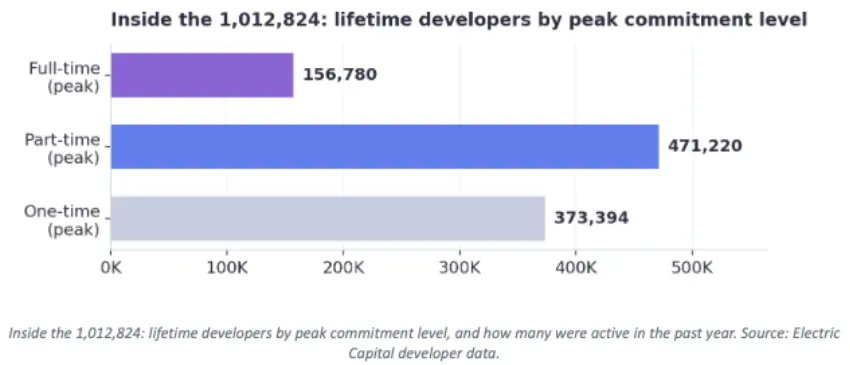
This brings to life a string of numbers: Electric Capital data shows that the total number of Ethereum's historical developers has now surpassed one million, with 1,012,824 individuals contributing to the ecosystem. No other ecosystem in the crypto space can compare.
A milestone worth noting
One million is a round number, and round numbers can sometimes seem empty. But this number is anything but. Behind it lies the largest pool of technical talent ever assembled around an open, permissionless blockchain network. More importantly, this talent pool continues to grow and expand.
Of these one million developers, approximately 232,000 have remained active in the past twelve months.
Why Ethereum: The Really Important Question
For years, discussions in the crypto industry have revolved around speed, fees, and throughput. Every new chain claims to be "faster than Ethereum." But the core question in the crypto space has never been which chain is the fastest, but something else entirely:
Where do the best builders choose to build long-term projects?
Ethereum maintains a clear advantage on this issue. This advantage is not only reflected in the technology; it is a comprehensive manifestation of institutional, cultural, economic, and ecological structures. It is the result of a decade of continuous development in developers, infrastructure, standards, tools, liquidity, research, applications, and social coordination, which no other ecosystem can replicate.
Ethereum has become the default operating system for programmable finance and internet-native capital formation.
What are these million builders constructing, and why will it reinforce the moat?
The significance of these million builders lies in what they are currently doing. The focus now is on the most challenging and riskiest issues in the industry: the scalability, privacy, and quantum resistance of core protocols, and the intelligent agent systems that will run on them.
The Glamsterdam Upgrade: Innovation without compromising core principles. The Glamsterdam Upgrade, slated for 2026, demonstrates how Ethereum can continue to advance while upholding its core values. Key changes include built-in proposer-builder separation (ePBS) and block-level access lists (BALs), unlocking parallel execution and higher throughput, and potentially increasing the gas cap, thus significantly boosting Layer 1 capacity.
Expanding to meet future needs while upholding credibility, neutrality, security, and MEV fairness is itself an evolving moat.
Synchronous composability: Making numerous Rollups function like a single chain. Composability has always been a powerful capability of Ethereum; the next leap is extending it to Layer 2. Native Rollups and Based Rollups, combined with synchronous composability, solve this problem. A contract on one Rollup can call contracts on the mainnet or another Rollup in a single atomic transaction, without bridging or waiting.
Linea, the Ethereum Economic Zone, Gnosis, Zisk, and the Ethereum Foundation are working together to combine this design with Proof-of-Live. The result is that dozens of Rollups no longer function as isolated networks but begin to operate as a unified chain. This is a direct response to criticisms of fragmentation.
Quantum resistance: Ethereum's most significant advantage. No other mainstream ecosystem is better prepared for the post-quantum era. The "Lean Ethereum" roadmap, the Ethereum Foundation's post-quantum security team established in early 2026, pq.ethereum.org , and more than a dozen client teams already running weekly post-quantum interoperability development testnets all contribute to a coordinated open-source migration aimed at around 2029.
When quantum risks become a reality, institutions holding trillions of dollars in assets will only care about one thing: which blockchain is the first and most thoroughly prepared.
Beyond the developer's moat: composability, standards, and trust
The aggregation of developer talent generates a compounding effect, thanks to the way Ethereum is built. Its deepest network effect is not liquidity, but the depth of composability: various applications are like interoperable financial Lego bricks.
Lending, stablecoins, exchanges, wallets, tokenized assets, oracles, and Layer 2 rollups—all interact through shared standards, so developers never have to start from scratch. The EVM is the application layer for the crypto industry, and Solidity skills are universally applicable to Base, Arbitrum, Optimism, Polygon, zkSync, Scroll, Linea, and hundreds of other networks.
Learning the Ethereum technology stack means maximizing your choices, which in turn drives a flywheel effect: more developers, more tools, more liquidity, and more institutions attract even more developers to build composable protocols and assets. Liquidity breeds liquidity, and composability breeds composability.
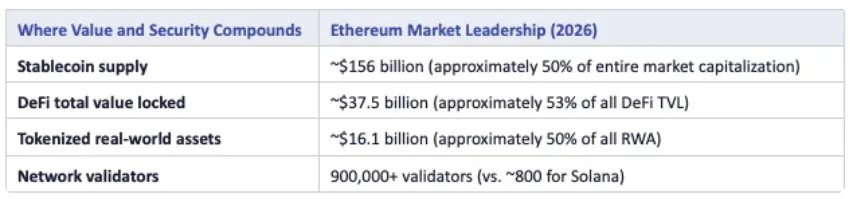
Moreover, Ethereum dominates where value is truly realized, not just where it has the most hype:
Three forces have solidified this leading position.
Trustworthiness and neutrality : Ethereum is secured by over 900,000 validators, while Solana has only about 800. Large institutions highly value this degree of decentralization and platform neutrality.
Modularity : Rollups like Base, Arbitrum, and Optimism do not fragment Ethereum, but rather extend it into an increasingly interconnected modular internet economy while inheriting the security of the mainnet.
Culture : Ethereum attracts far more top researchers, cryptographers, and EIP standard drafters than any other ecosystem, setting the direction for the entire industry. This is an advantage that is most difficult for other ecosystems to replicate.
There is only one Ethereum in the world.
There is a fundamental difference between generating on-chain activity and becoming a long-term coordinating layer for internet-native finance. The latter means becoming a layer trusted by the world's largest financial institutions.
Ethereum has firmly established itself in the minds of large asset holders, who prioritize trust, security, and liquidity. I witnessed this firsthand during my time at BlackRock, sitting right in the front row.
In the tech market, ecosystems evolve over time around standards, liquidity, and developer engagement. This is Ethereum's moat.
After connecting with these developers, builders, and ecosystem leaders in Seoul and Hong Kong, I am more convinced than ever of Ethereum's competitive advantage. I met the talent building the next generation of financial infrastructure—the founders of our industry's future and the architects of smart agent finance. It is these people and teams that will change the world.
The future of Ethereum is unfolding.