As the large-scale model enters its third year of burning money, the issue of "founder control" is being rewritten into the terms of the deal.
Article author and source: 0x9999in1, ME News
TL;DR
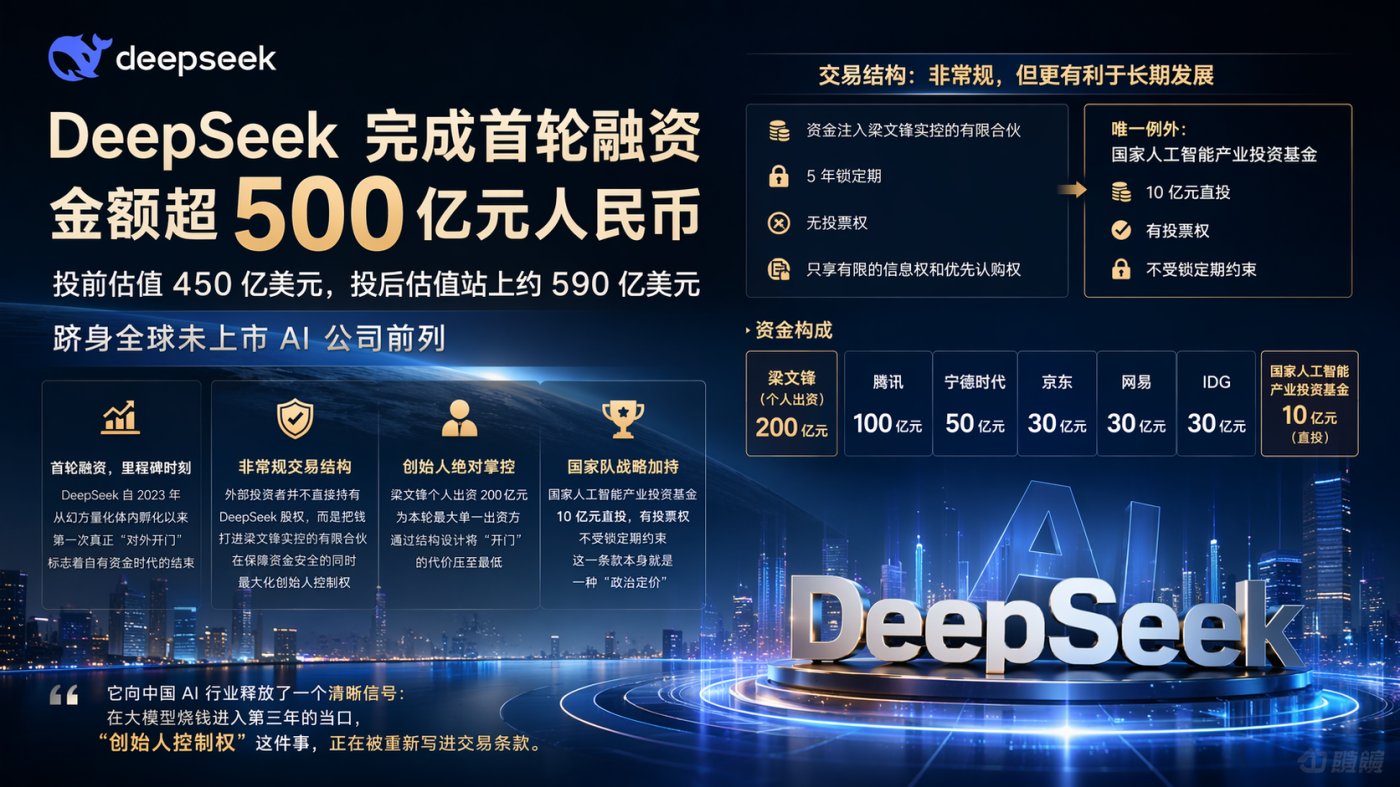
- DeepSeek has completed its first round of financing, raising over 50 billion yuan (approximately 7.4 billion US dollars). Its pre-money valuation was 45 billion US dollars, and its post-money valuation reached approximately 59 billion US dollars, placing it among the top unlisted AI companies globally.
- The transaction structure is unconventional: external investors do not directly hold DeepSeek equity, but instead deposit money into a limited partnership controlled by Liang Wenfeng, with a 5-year lock-up period, no voting rights, and only limited information rights and preemptive rights.
- The only exception is the National Artificial Intelligence Industry Investment Fund, which invests 1 billion yuan directly, has voting rights, and is not subject to a lock-up period—this clause itself is a kind of "political pricing."
- In terms of funding composition, Liang Wenfeng personally invested 20 billion yuan, Tencent 10 billion yuan, CATL 5 billion yuan, JD.com, NetEase, and IDG each 3 billion yuan, and state-owned enterprises 1 billion yuan. The founder is the largest single investor.
- This is the first time DeepSeek has truly "opened its doors" since it was incubated within Magic Square Quant in 2023, marking the end of the era of self-funded operations. However, Liang Wenfeng used structural design to minimize the cost of "opening the doors".
- This sends a clear signal to China's AI industry: as the burning of cash in large-scale models enters its third year, the issue of "founder control" is being rewritten into the terms of the deal.
A financing that doesn't look like financing
First, lay out the numbers.
The post-investment valuation is 50 billion yuan, 7.4 billion US dollars, or approximately 59 billion US dollars.
What do these three numbers mean in the context of June 2026?
This means that DeepSeek has jumped to become one of the highest-valued pure AI companies in China, closely following Zhipu, Dark Side of the Moon, and MiniMax. It also means that with OpenAI reportedly approaching $500 billion and Anthropic's valuation reaching $170 billion, China finally has an AI lab whose valuation can be seriously compared with international peers.
But what's truly unusual about this money isn't the amount, but its structure.
External investors do not directly hold shares in DeepSeek. They invest their money in a container called a "limited partnership," whose general partner (GP) is Liang Wenfeng himself.
In other words, the 10 billion from Tencent, the 5 billion from CATL, and the 3 billion each from JD.com, NetEase, and IDG, according to business registration records, did not go into DeepSeek, but rather into the LP shares managed by Liang Wenfeng.
This is not financing. It's more like a "trust-based equity investment".
You provide the money, I manage the money, the company belongs to me, don't touch it for five years, and don't say anything more.
Who would accept such terms? The answer is: everyone did.
Why did everyone sign?
The normal logic of venture capital is to exchange money for shares, trading seats, exchanging information, and changing exit strategies.
In this round, DeepSeek almost completely eliminated the last three items.
- There are no board seats.
- They have no voting rights.
- The right to information has been reduced to "specific financial information".
- He was locked out for five years after quitting.
- The only remaining benefit is the right of first refusal for subsequent financing.
This is unimaginable in Silicon Valley. Which firm—a16z, Sequoia Capital, or Founders Fund—would accept a 5-year lock-up period and 0 voting rights?
But the Chinese LPs accepted it. Why?
Because what they bought wasn't equity, but an entry ticket.
In the 2026 Chinese AI arena, the window to bet on DeepSeek will be a scarce commodity. After R1 shook Silicon Valley overnight in early 2025, DeepSeek subsequently released V3.x, upgraded versions of R1, and V4 Pro/V4 Flash, which will debut in mid-2026, solidifying the "open source, high performance" path from a slogan into an industry landscape. V4 Pro has pushed the parameter scale of open source models to 1.6T and the context window to 1M, and has been the first to achieve full adaptation on Huawei Ascend and Cambricon chips. The cumulative downloads of the DeepSeek series on Hugging Face have consistently ranked among the top open source large model downloads, and many domestic cloud vendors and SaaS vendors use DeepSeek as one of their default platforms.
In this situation, if Tencent doesn't invest, Alibaba will; if CATL doesn't invest, BYD's affiliates will.
The admission ticket itself has a price, and the price is "giving up regular shareholder rights".
Liang Wenfeng was well aware of this, which is why he dared to ask for this price.
The truly clever part is that he put his 20 billion at the very beginning.
The fact that the founder invested 20 billion is itself a pricing mechanism.
Note a detail.
In the entire 50 billion yuan scheme, the largest investor is not Tencent, nor the state-owned enterprise, but Liang Wenfeng himself – 20 billion yuan, accounting for 40%.
What does this mean?
As a leading quantitative private equity firm in China, Huanfang Quantitative has demonstrated remarkable annualized performance and assets under management over the past few years. Around 2021, at the industry's peak, Huanfang's assets under management approached 100 billion RMB. Even after the overall decline in China's quantitative industry and tightening regulations following 2022, Liang Wenfeng's personal cash reserves accumulated through Huanfang over the years still allowed him to commit 20 billion RMB in this round of financing.
This 20 billion is not paper wealth in a valuation game; it's money that the GP paid out of his own pocket.
It delivers a three-layered signal.
The first layer is to reassure external investors: I'm all in, more so than any of you, what are you afraid of?
The second layer solidifies the legal basis for control: I am the largest single investor and the GP, so the control structure is impeccable.
The third and most crucial layer redefines the role of the "founder" in the Chinese AI game.
The founder is no longer someone waiting for VCs to save their life, but a resource integrator who is on equal footing with capital, or even has the upper hand over capital.
This is a stance rarely seen in the stories of Chinese internet startups over the past decade. From Didi to Meituan to ByteDance, the founders have defended their control through dual-class shares, different voting rights for different shares, and Cayman Islands-style structures.
DeepSeek is different this time. It doesn't rely on sophisticated legal structures; it relies on the simplest power: "I have more money than you, and my business is more irreplaceable."
Simple, but effective.
That 1 billion yuan from the national team was the most expensive sum of money in the entire event.
Of the 50 billion yuan in the fund, the National Artificial Intelligence Industry Investment Fund only allocated 1 billion yuan.
It accounts for 2%.
But it is the only one that is directly invested, has voting rights, and is not locked up.
This 1 billion is much more "expensive" than Tencent's 10 billion.
How should we understand this?
The China National Integrated Circuit Industry Investment Fund, commonly known as the "Big Fund," is the most important policy-driven capital for China's semiconductor industry over the past decade. Its first, second, and third phases have accumulated a scale exceeding one trillion RMB, covering almost all key nodes in the entire industry chain, from SMIC to Yangtze Memory Technologies to Changxin Memory Technologies.
The National Artificial Intelligence Industry Investment Fund is a policy-driven capital fund with a similar positioning in the AI field. Its presence on a company's shareholder list carries significance far exceeding the 1 billion yuan figure.
It means two things.
First, DeepSeek has been officially included as a core node in the national AI industry map. The implicit benefits of this "certified" asset in terms of subsequent computing power procurement, overseas licenses, and industry access far exceed the monetary value itself.
Second, the national team will not accept a 5-year lock-in, nor will it accept zero voting rights. This is the bottom line. No policy-driven capital can relinquish even the minimum governance rights over a strategic AI laboratory.
Liang Wenfeng clearly knew where this boundary was.
He channeled all market capital into "quiet money," but reserved a unique and irreplaceable position for the national team. This was a very sophisticated approach.
Not every founder can grasp this balance.
From "a side business of magic cubes" to "a calling card for Chinese AI"
Three years ago, in May 2023, DeepSeek was still an AI research team within Magic Square Quantization.
At that time, its public statement was: "We are developing AI not to make money, but to understand intelligence."
It sounds like a literary statement, but it was true at the time. Magic Square had a stable cash flow from its quantitative business, while DeepSeek didn't need to worry about revenue, commercialization, or the pace of financing. The team size remained at around 100 people for a long time—a size that is almost abnormal in the R&D systems of major Chinese AI companies, which often have thousands of people.
It is precisely this "small but specialized" approach that has enabled DeepSeek to accomplish several things.
In early 2024, DeepSeek-V2 was released, providing an open-source version of the MoE architecture for Chinese scenarios that could rival top-tier domestic models at the time. V3, released at the end of 2024, boasted 671 billion parameters, with a training cost of approximately $5.57 million according to its technical report, far lower than the training cost of leading US models of the same generation. The R1 series, released in January 2025, offered inference capabilities comparable to OpenAI o1, but its open-source nature, low cost, and commercial applicability triggered a dramatic reaction in the US tech sector at the end of January, with Nvidia losing approximately $600 billion in market value in a single day, a moment dubbed the "DeepSeek moment" in the AI industry.
In 2026, the release of the V4 series pushed this curve forward again. 1.6T parameters, 1M context window, MIT license, and full compatibility with Huawei Ascend and Cambricon chips—these keywords together are tantamount to declaring that "China can run a cutting-edge open-source model without relying on NVIDIA's H-series high-end cards."
After R1, DeepSeek's role changed.
It is no longer a side business of Magic Square; it has become a calling card for Chinese AI.
Business cards cannot be maintained solely with one's own funds.
We have no choice but to seek financing, but we can't just raise funds haphazardly.
Why is it necessary to raise funds at this point in 2026?
Three reasons, listed in order of importance.
First, there's the issue of computing power. The estimated cost of training the next generation of basic models after V4 has already reached billions of RMB per training session. Even though DeepSeek is known for its "engineering efficiency for computing power" approach, the computing power threshold for cutting-edge models globally is still rising at a rate of 4-5 times per year. No matter how strong Magic Cube's cash flow is, it can't sustain an AGI-driven company indefinitely.
Second, the talent war. Starting in the second half of 2025, major domestic companies generally offered core AI researchers salaries ranging from several million to tens of millions of RMB before tax, while overseas giants offered even higher packages to top Chinese researchers. DeepSeek's team has long maintained a low profile and its compensation system has been marketed based on its "research atmosphere," but after two years of talent poaching, it needs more convincing incentive tools—and stock options and long-term incentives essentially require a clear capital structure to support them.
Third, the commercialization window. The open-source approach brought influence, but no direct cash flow. Starting in the second half of 2025, DeepSeek successively launched paid API tiers and enterprise-level private deployment solutions, and established deep partnerships with multiple cloud vendors. After the launch of the V4 series, API prices continued to decline, further opening up the willingness of enterprises to access the platform. Once commercialization begins, the capital market's need for a "valuation anchor" emerges. A formal round of financing paves the way for future capital operations.
With these three things pressing together, the financing window must open between the end of 2025 and the beginning of 2026.
But Liang Wenfeng's choice was to open the window but not the door.
Let the money in, but don't let the people in.
That's why, starting in April, DeepSeek has been rigorously investigating the LPs behind every potential investor—it's not picking money, it's picking "quiet money."
Funds with state-owned backgrounds and clear industrial strategic intentions will be invested.
Money of dubious origin that may be resold on the secondary market should be avoided.
For any money that might interfere with corporate governance in the future, make it clear before negotiating terms that there will be a 5-year lock-up period and 0 voting rights—those who can accept this can stay, and those who cannot can leave.
This stance is rare in the Chinese venture capital market. Most founders don't have this kind of bargaining power in Series C and D rounds.
DeepSeek has this feature because its assets are scarce, non-replicable, and the time window is closed to everyone.
The most counterintuitive aspect of this deal
Many people, upon seeing this structure, immediately think: "Isn't this disadvantageous to investors?"
In the short term, yes.
In the long run, that's not necessarily true.
Looking at the 5-year lock-up period and the preemptive right to subscribe to subsequent financing together leads to a different conclusion.
If DeepSeek's valuation doubles within the next 3–5 years—which isn't an aggressive assumption in the current AI industry—then the "paper profits" of this round of investors during their lock-up period will become very substantial. The preemptive rights also allow them to continue investing in the next round at a certain discount.
This structure essentially exchanges "governance rights" for "long-term compound interest".
Who is it suitable for?
Suitable for strategic LPs, not suitable for financial VCs.
Tencent wants access to a large-scale ecosystem and collaborative spaces within WeChat, QQ, and document scenarios. CATL wants the industrial application of AI in the new energy industry. JD.com wants an intelligent foundation for its supply chain, customer service, and e-commerce search. NetEase wants AI for gaming and education. IDG, a long-established USD/RMB dual-currency fund, seems to be "positioning" itself, betting on a future IPO or equity transfer window.
Behind every sum of money that comes in lies a "non-financial motivation".
So "zero voting rights" doesn't really sting them—what they wanted in the first place wasn't voting rights.
This indicates that DeepSeek's latest round of financing has quietly shifted from "VC funding" to "strategic financing".
This is a very crucial paradigm shift.
What does this mean for China's AI industry?
Zoom out.
DeepSeek's valuation of approximately $59 billion comes after China's AI large model industry underwent a brutal reshuffle in 2024–2025.
Zhipu, Lunar Dark Side, Zero One Everything, Baichuan, and MiniMax—the "Six Little Tigers of AI"—have taken completely different paths over the past 18 months. Some have shifted to B2B tools, some have bet on B2C apps, some are struggling to survive in overseas markets, and some have been embroiled in complex equity relationships with major companies.
After the R1 moment, the industry landscape has been quietly converging: in the open-source high-performance base model category, DeepSeek and Alibaba's Tongyi Qianwen Qwen series have secured their positions in the first tier; in the closed-source application category, more "product-oriented" players such as ByteDance Doubao, Tencent Hunyuan, Baidu Wenxin, and Kimi are competing.
DeepSeek's valuation of approximately $59 billion essentially sets the capital price for its "open source + top-tier research + Chinese foundation" strategy.
What happened next was almost predictable.
Qwen will be revalued by Alibaba in some way—possibly reflected in Alibaba's financial statements' breakdown of its AI business. Qwen's influence in the overseas open-source community, coupled with Alibaba Cloud's computing infrastructure, makes it fully qualified to be compared to DeepSeek in terms of industry value.
The next round of financing for Zhipu and MiniMax will be forced to accept the "DeepSeek anchor." They will either align with this valuation range or convince the market with clearer commercialization data.
The issue of founder control will be re-examined by all founders in the Chinese AI community.
Not everyone can replicate Leung Man-Fung's story – you need to have 20 billion in real money first.
But you can learn one thing from this scenario: in the AI industry, which heavily relies on the founder's judgment, control is not "talked out," it is "fought for."
The Stubbornness of a Quantitative Boss
Finally, let me say something unrelated to the main topic.
Leung Man-fung is a person who is difficult to categorize.
He's not a serial entrepreneur, not a Stanford graduate, and not a former VP of a major company. He's a graduate of Zhejiang University, with a background in quantitative finance, and the kind of person who's so low-key that he almost never attends industry conferences.
At the peak of China's quantitative finance industry in 2021, Magic Square Quantitative was one of the most technologically advanced private equity firms in the country, which they described as "doing quantitative finance in the way of doing AI".
Later, the statement was reversed: they used quantitative methods to develop AI.
What is meant by quantification?
They don't believe in narratives, only in data; they don't chase trends, only focus on one or two real problems; they use engineering efficiency to reduce costs, relentlessly pushing training unit costs to a fraction of the industry average; they don't pursue scale, but rather the "marginal return per dollar of computing power".
When this methodology is applied to large models, the result is the "small-scale, high-performance" training cost curve seen in models like V3, R1, and V4.
When this methodology is applied to financing, the result is the structure we see today: every clause is calculated to the extreme, and the ownership and cost of every penny are clearly defined.
It's not pretty.
It's even a bit "anti-Silicon Valley aesthetic".
The Silicon Valley story emphasizes "founder's charisma + Sequoia Capital's backing + valuation rocket curve," while this DeepSeek version tells the story of "founders investing 20 billion + strategic capital queuing up + 5-year lock-up period + no talking too much."
Which one is more correct?
have no idea.
However, at this juncture in 2026, against the backdrop of tense geopolitical competition, soaring computing costs, and intense talent mobility, Liang Wenfeng's stubborn insistence on "fixing control" does seem more prudent than "betting on speed with VC money."
At least DeepSeek is still doing research, still releasing models, and still open-sourcing its technology.
Meanwhile, the story in Silicon Valley has taken many turns in recent years—OpenAI's repeated governance crises, Anthropic's increasingly close ties with Amazon, the Inflection team being "taken away" by Microsoft, and Stability AI in complete disarray.
It's no news that capital can distort things.
This time, DeepSeek, however, included the possibility of distortion in the contract beforehand.
Am I smart? Yes, I am.
Is it cold-hearted? Yes, it is.
But getting involved in AGI is not something you can do by treating someone to a meal.
That's the kind of drive I'm looking for.
References
- "DeepSeek Raises Over 50 Billion Yuan in Funding, Breaking Valuation Record for Domestic Large-Scale Models" - Sina Finance, June 4, 2026
- "National Integrated Circuit Industry Investment Fund Leads DeepSeek's First Round of Funding, Valuation at $45 Billion Pre-Investment" — 36Kr, June 2026
- DeepSeek Raises $7 Billion in Series A Funding, Valued at $59 Billion – Sina Finance, June 11, 2026
- "50 Billion Yuan, Liang Wenfeng 'No Longer Following' Ren Zhengfei's Example" - Huxiu.com, June 2026
- "Tencent's Computing Ecosystem, CATL's Computing Meters: DeepSeek's Funding Conceals a Double Calculation" - 36Kr, June 2026
- "DeepSeek V4 Launches with 1M Context Window; Huawei Ascend and Cambricon Chips Achieve Full Compatibility" - Gate News, 2026
- "DeepSeek-V3 Technical Report"——arXiv:2412.19437
- "DeepSeek-R1: Incentivizing Reasoning Capability in LLMs via Reinforcement Learning"——arXiv:2501.12948