As HYPE breaks records, does anyone still notice that ecosystem projects are going out of business one after another?
Written by: Sanqing, Foresight News
On June 16, HYPE reached 76.965 USDT, setting a new all-time high with a single-day increase of approximately 10%, triggering short liquidations of over $11.5 million. Meanwhile, according to SoSoValue data, the three US spot HYPE ETFs attracted a cumulative net inflow of approximately $180 million in their first month, indicating continued institutional investment.
However, the situation is quite different within the Hyperliquid ecosystem. From May to June, several protocols in multiple areas, including lending, NFTs, stablecoins, and DEXs, announced their shutdowns.
HYPE is an "application stock".
Hyperliquid injects approximately 97% of its protocol fees into the Assistance Fund, which continuously buys back HYPE tokens on the open market and permanently burns them. According to Buildix data, it currently buys back approximately 34,000 HYPE tokens daily (approximately $2.57 million), with an annualized buyback volume of approximately $940 million, annualized protocol revenue of approximately $976 million, a P/E ratio of approximately 73, and a buyback yield of approximately 5.6%.
According to DefiLlama data, Hyperliquid's trading volume exceeded $240 billion in the past 30 days. This is the fuel driving the buyback machine, and HyperCore's perpetual contract trading layer boasts a highly diversified revenue structure. Crypto perpetual contracts (BTC, ETH, SOL, etc.) contribute approximately 55% of daily fees, commodities (crude oil, gold, silver) approximately 22%, stock indices (S&P 500, Nasdaq) approximately 12%, and spot trading approximately 6%.
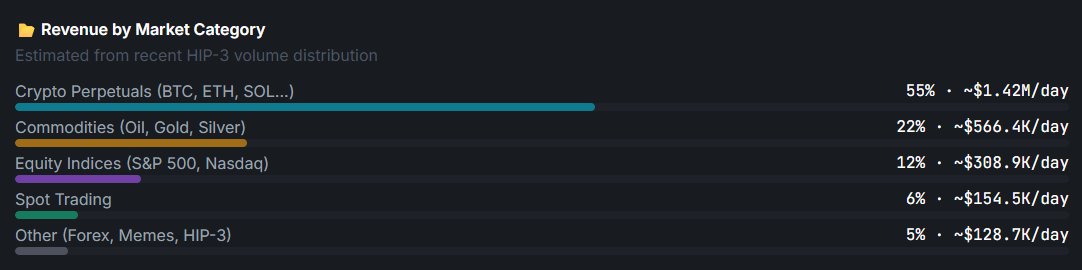
This means that HYPE is more like an "application-based stock" than a "concept token" in the traditional sense. Its value capture is anchored to HyperCore transaction fees, and has almost no direct relationship with HyperEVM's TVL or the number of surviving DeFi protocols.
This is completely different from the value logic of ETH. ETH's pricing is based on the premise that a thriving ecosystem drives gas consumption, which in turn drives up the token price. Therefore, the demise of any ecosystem project is a negative signal for ETH.
However, HYPE's fee structure is almost entirely unrelated to HyperEVM. Whether the HyperEVM project survives or fails, it doesn't change HyperCore's trading volume or affect the Assistance Fund's buyback schedule. Investors holding HYPE are exposed to the operational risks of "the Hyperliquid perpetual contract trading business," not the risks of any particular DeFi protocol.
Five announcements
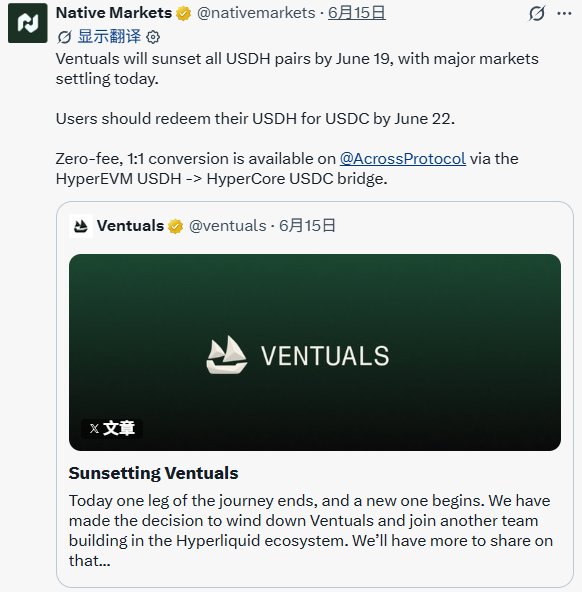
Ventuals (June 15th) saw its cumulative trading volume exceed $650 million, serving over 11,000 traders. The announcement garnered 470,000 views. The team wrote, "Today, one chapter of the journey has ended, and a new chapter begins." The shutdown process was extremely orderly, clearly outlining the settlement times and pricing mechanisms for 11 markets, including OpenAI and Anthropic. Users received a full 1:1 refund of their HYPE.
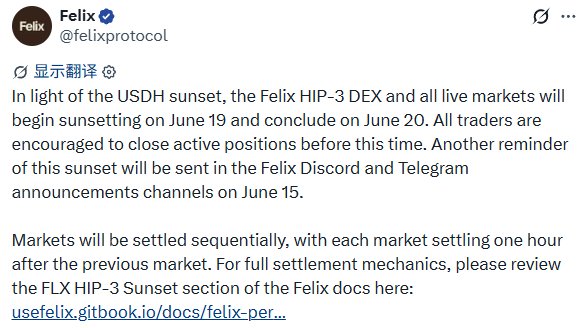
Felix (announced on June 8, to be terminated on June 20) announced: "In view of the discontinuation of USDH, Felix HIP-3 DEX and all active markets will be discontinued starting June 19 and ending on June 20."
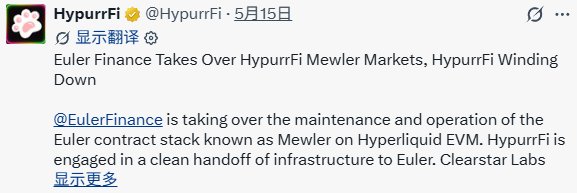
HypurrFi (May 15th), formerly HyperEVM's leading lending protocol with a peak TVL exceeding $300 million, announced: "No security breaches. No exploits. No emergencies. This was a well-considered operational decision." The brand exited, infrastructure was transferred to Euler Finance, and the Pooled marketplace completed its final settlement on July 15th.
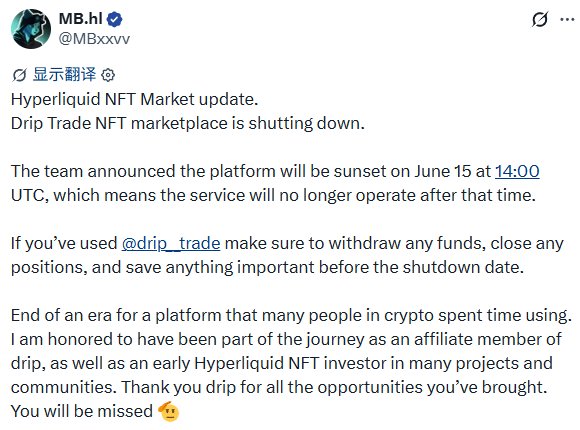
Drip.Trade (June 15th) is the only NFT exchange on HyperEVM. Hyperliquid ecosystem KOL @MBxxvv relayed the official announcement: "The platform will be offline at 22:00 on June 15th, and the service will cease operation thereafter."
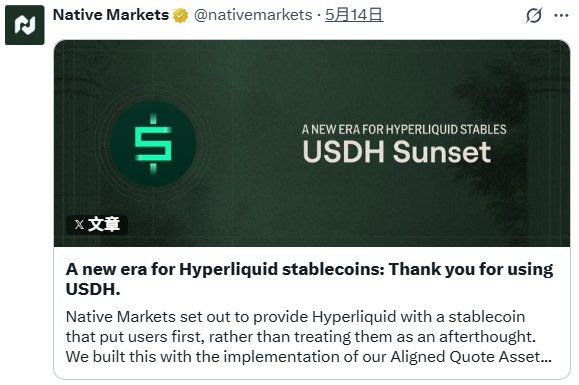
On May 14th, Native Markets announced that it would transfer the stablecoin branding rights of USDH to Coinbase, making Coinbase the official USDC deployer on Hyperliquid.
These five projects cover five tracks: lending, NFTs, stablecoins, RWA private market, and DEX, almost representing the main categories of DeFi infrastructure on HyperEVM. They are not fringe projects, but protocols that had real users and real transaction volume in the ecosystem at the time.
The stronger the core, the harder it is for the ecosystem to survive.
If the rise in HYPE and the demise of ecosystem projects were merely two separate trajectories, then this crisis would simply be "the failure of peripheral projects themselves," nothing worth delving into. But upon closer inspection, these two events did not simply occur in parallel.
Hyperliquid's design philosophy is minimalism: providing the chain and infrastructure without intervening in operations.
Since its launch in February 2025, HyperEVM has attracted deployments from over 170 projects, but from the outset, it has lacked official grants, coordinated market-making arrangements, and liquidity support. It faced a fully competitive secondary market from the outset. The core team rarely publicly participates in collaborations with other HyperEVM projects, and these projects are implicitly expected to be self-sufficient.
When on-chain products are scarce, any working protocol comes with its own user base. However, the market in 2026 was already saturated. The survival of new protocols wasn't a technical issue, but a cold start problem. Without official endorsement and liquidity guidance, the vast majority of projects simply couldn't survive the cold start phase.
In addition, the HIP-3 mechanism allows anyone to directly deploy a perpetual contract market on HyperCore, which was originally intended as an outlet for excess liquidity, but it is also taking away the attention and user traffic of protocol projects.
TradeXYZ, the leading project on HIP-3, already holds approximately 97% of the market share in its category, leaving virtually no room for newcomers. This means that protocol projects are not only competing with external rivals but also with Hyperliquid's own liquidity-siphoning effect.
The more successful HyperCore becomes, the more traffic and funding it attracts, making it increasingly difficult for projects on HyperEVM to gain a share. This isn't a failure of HyperEVM technology, but rather because HyperLiquid's business model inherently reserves the best resources for the core layer, structurally compressing the survival space for peripheral projects.