Brent crude oil was trading at $79.46 per barrel on June 18, 2024, down approximately 30% from $112.93 a month earlier. Although the Strait of Hormuz had reopened and shipping had begun again, many expected prices to fall further. However, this proved to be the case.
The reason lies in the underlying factors that are helping to keep oil prices from falling too sharply, even as supply is gradually recovering.
Opening the doors doesn't mean goods will flow freely.
Approximately 500 commercial vessels remain stranded inside the Persian Gulf, according to maritime analytics firm Kpler . The narrow strait cannot accommodate all the ships simultaneously. The volume of traffic through the Hormuz remains only a fraction of pre-conflict levels, with many captains, insurance companies, and shipowners awaiting confirmation that mines have been removed and international shipping lanes are safe before resuming operations.
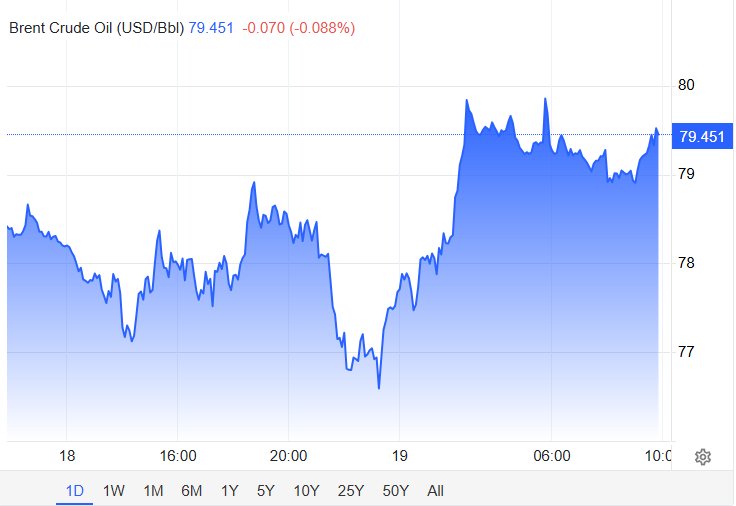 Oil prices even rose when news broke that the strait had reopened. Source: Trading Economics
A June 2024 report from the U.S. Energy Information Agency ( EIA ) suggests that the Hormuz pipeline will remain largely closed for much of this summer, and that oil shipments may not return to pre-conflict levels until early 2027.
The producers also have their own schedules.
Restarting oil fields that have been shut down for more than three months cannot be done overnight. Claudio Galimberti, chief economist at Rystad Energy, made this very clear in an interview with the Associated Press.
“Market sentiment has improved significantly. But sentiment is not the same as supply. Boosting production, restoring logistics operations to normal, and eliminating price discrepancies caused by potential risks will still take time.”
Economists at Capital Economics estimate that energy shipments may only reach 80% of pre-war levels by September 2024. Iraq, in particular, due to more severe disruptions, may need nearly a year to fully recover.
The market is also factoring in the possibility that the deal with Iran may not go as planned. The continued presence of the US Navy in the Gulf, along with uncertainty about whether Iran will comply with its commitments, means traders are hesitant to completely rule out geopolitical risks. This risk is Vai as the Dip of oil prices.