This article will rationally analyze the "evolution of this top-level summit" and its underlying business logic from hard-core dimensions such as event history, industry influence, key events, and business closed loop.
Article author and source: ME News
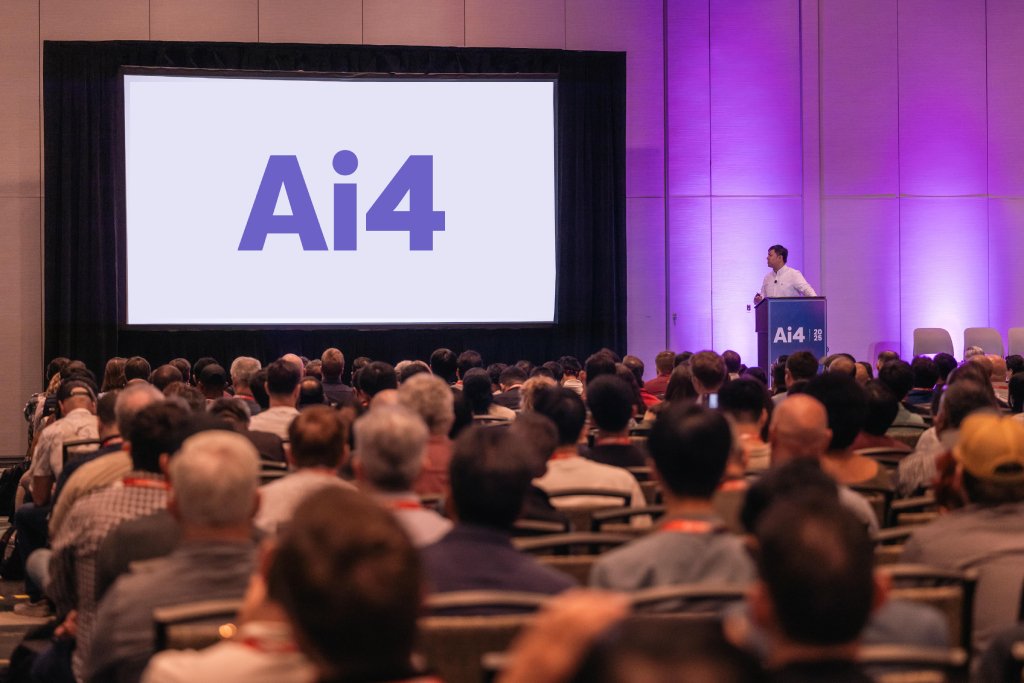
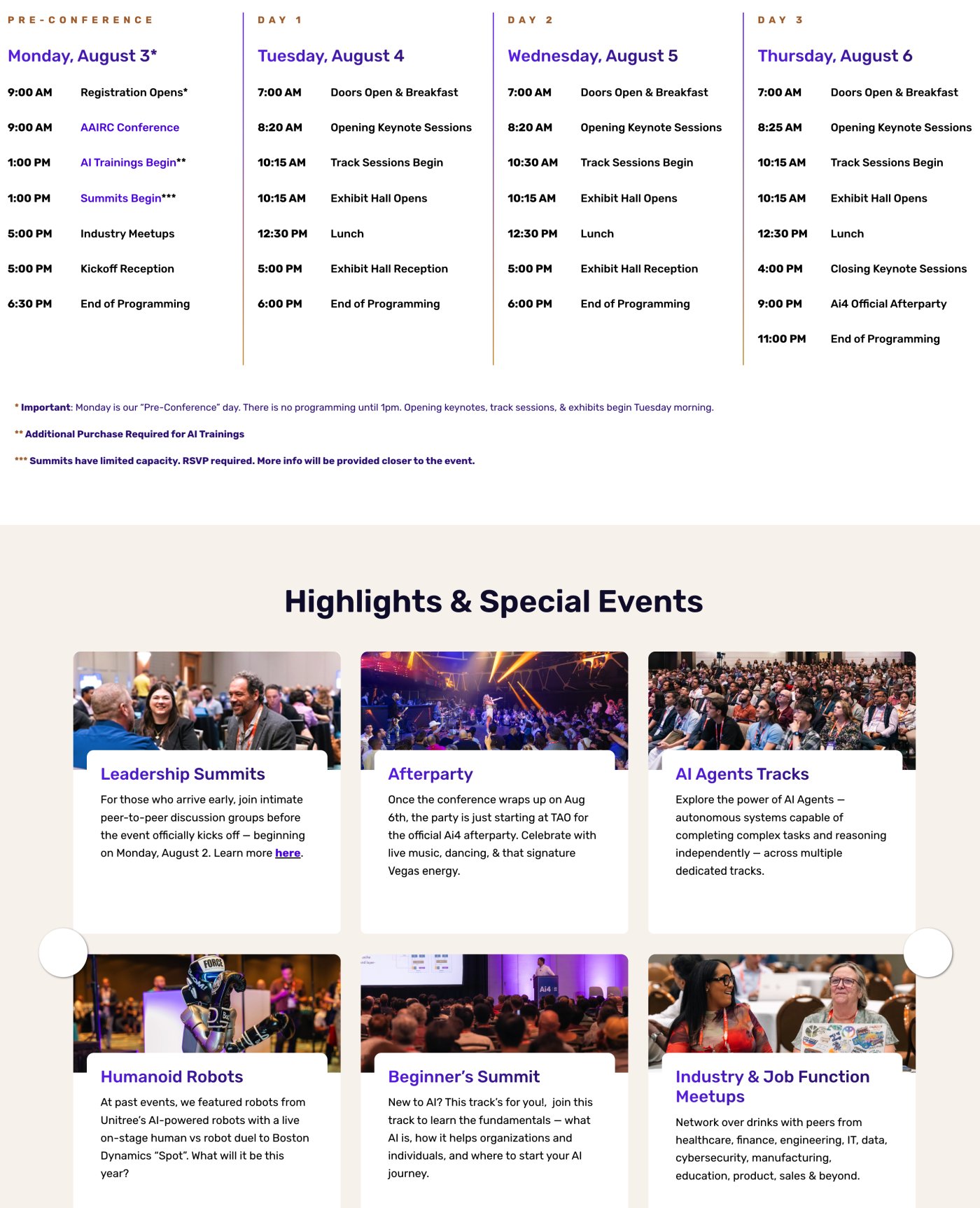
While tech exhibitions are generally experiencing a downturn, the upcoming AI4 Global Artificial Intelligence Conference in Las Vegas, scheduled for August, has bucked the trend and experienced a remarkable surge in activity. With 12,000 attendees, thousands of speakers, and over 400 exhibitors, it has even been hailed as the "Best AI Conference of the Year."
How did a young brand founded in 2018 manage to defeat a host of established trade shows in just a few years and firmly pin the core budgets and attention of the top 500 American giants at the Venetian Macao in Las Vegas?
Leaving aside all the glamorous official press releases, this article will rationally dissect the "evolution of this top-level summit" and its underlying business logic from the hard-core dimensions of event history, industry influence, key events, and business loop.
I. Event History: From "Vertical Salon" to "Industry Trendsetter" - A Comeback Story
The birth of any top-tier conference is not achieved overnight; the rise of Ai4 is a textbook example of evolution that precisely timed the cyclical changes of the era.
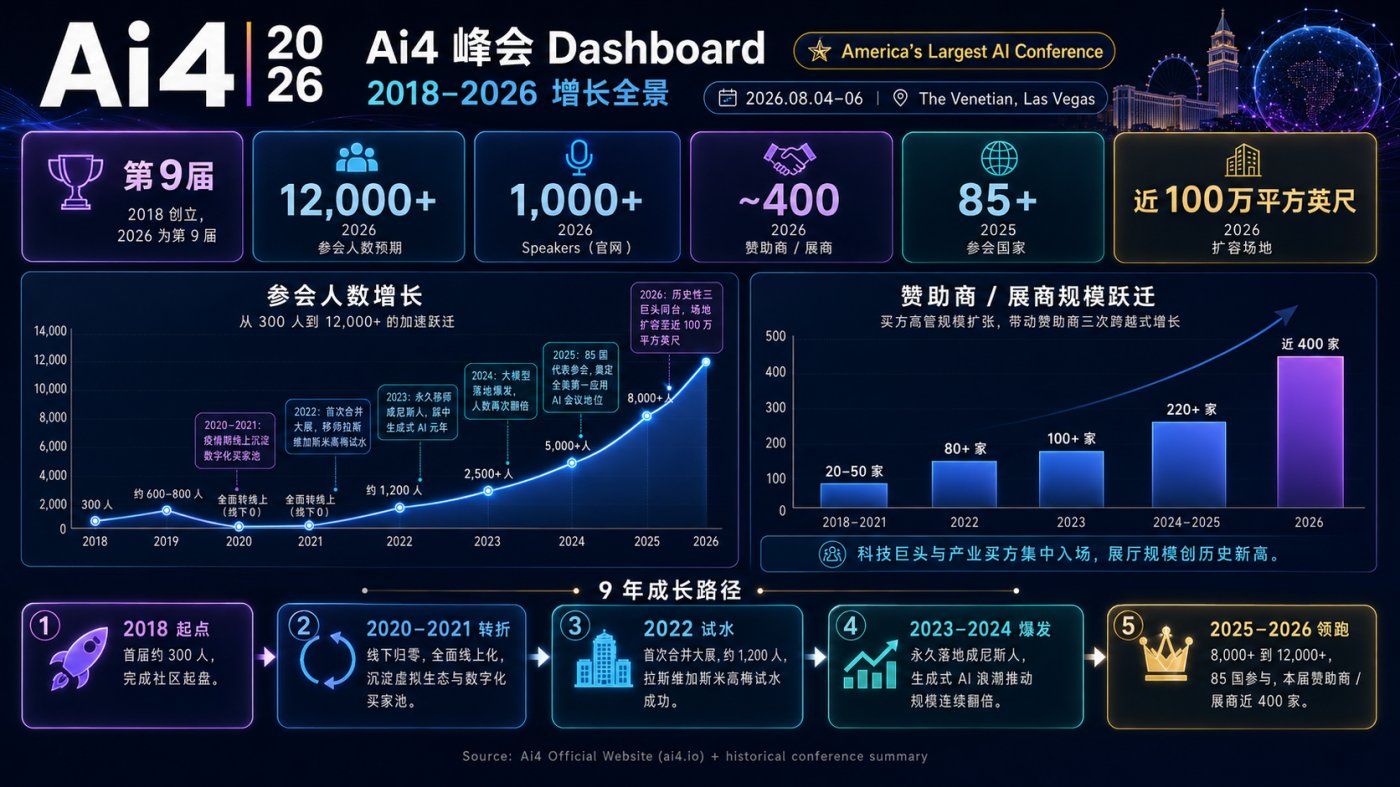
- 2018-2019 (Incubation Period): Born in New York. At that time, Ai4 was just a small, vertical forum focusing on "the application of artificial intelligence in specific traditional industries (such as finance and healthcare)". Instead of blindly pursuing a grand narrative, the organizers adopted a salon model with multiple forums running in parallel, quietly accumulating the underlying data of the first batch of enterprise-level technology buyers.
- 2020-2021 (Online Accumulation Period): Faced with the impact of the global environment, many traditional exhibitions came to a standstill. Ai4 quickly took drastic measures to survive, cutting all physical projects and fully transitioning to a purely online virtual meeting model. It was this two years of pure online accumulation that helped them to unify and gather executives from traditional companies in finance, healthcare, and other sectors, who were originally scattered in various locations, into a single digital buyer pool.
- 2022 (Strategic Transformation Period): With the industry recovery, the organizers rejected the mediocre compromise of online-offline integration and went straight back to a purely physical event model. They made a crucial breakthrough decision: completely abandoning their original New York headquarters and relocating the entire conference ecosystem to the MGM Grand Resort in Las Vegas. This offline restructuring immediately reversed the slump, with in-person attendance rebounding to 1,200 people, directly setting the stage for the explosive growth of generative artificial intelligence the following year.
- 2023-2024 (Explosive Growth Phase): Riding the global wave of generative artificial intelligence, the conference astutely moved its permanent venue to Las Vegas, the entertainment and convention capital. Its scale doubled consecutively, officially establishing its absolute position as North America's largest applied AI exhibition.
- 2025-2026 (Peak Period): AI4 2026 was named "Best AI Conference of the Year" by authoritative institutions. It has evolved from a simple technology launch event into a top-level bridge connecting global technology giants, traditional enterprise buyers, and policymakers.
II. Number of Participants and Scale: An "Exponential" Growth Curve Drawn by Data
Whether a summit is declining or making history depends solely on its attendance and data. AI4's quantitative data is extremely powerful:
- The total number of participants has surged: from a few hundred people in the early closed-door salons, to 4,000 people when it moved to the Venetian Macao in 2023, and then skyrocketed to 10,000 people in 2024. This year's Ai4 2026 is expected to attract more than 12,000 participants from more than 90 countries around the world , setting a new record.
- A super lineup on the supply side: The event brought together more than 1,000 industry leaders and technology experts to share their views, while the exhibition hall was packed with more than 400 top global exhibitors, including tech giants such as Microsoft, Google, and Amazon, as well as hundreds of unicorns in vertical industries.
- The sheer volume of content has exploded: the conference featured over 70 sub-themes and hosted hundreds of breakout sessions over three days. This scale of data demonstrates that it has undergone a qualitative transformation from a "single conference" to an "industry ecosystem marketplace."
III. Key Events in Each Session: Memorable Moments from Every Key Technological Node
To trace the major events of Ai4 is essentially to trace the milestones in the global commercialization of AI over the past few years:
- 2023: Moving to the Venetian, bidding farewell to grassroots. For the first time, the conference was permanently held at the Venetian Macao Resort Hotel in Las Vegas, and the number of attendees exceeded 4,000 for the first time. This strategic shift marked its official entry into the ranks of mega-events, bidding farewell to its past role as a regional forum.
- 2024: Building Industry Compliance and Application Alignment. Faced with the chaos brought about by the explosion of large-scale models, the conference focused on "Compliance and Real-world Implementation of Enterprise-level Large-Scale Models." Attendees surged to 10,000 that year, successfully helping traditional enterprises clarify their technological boundaries amidst the frenzy.
- 2026: A historic moment with the "Big Three" appearing together and capital breaking through boundaries.
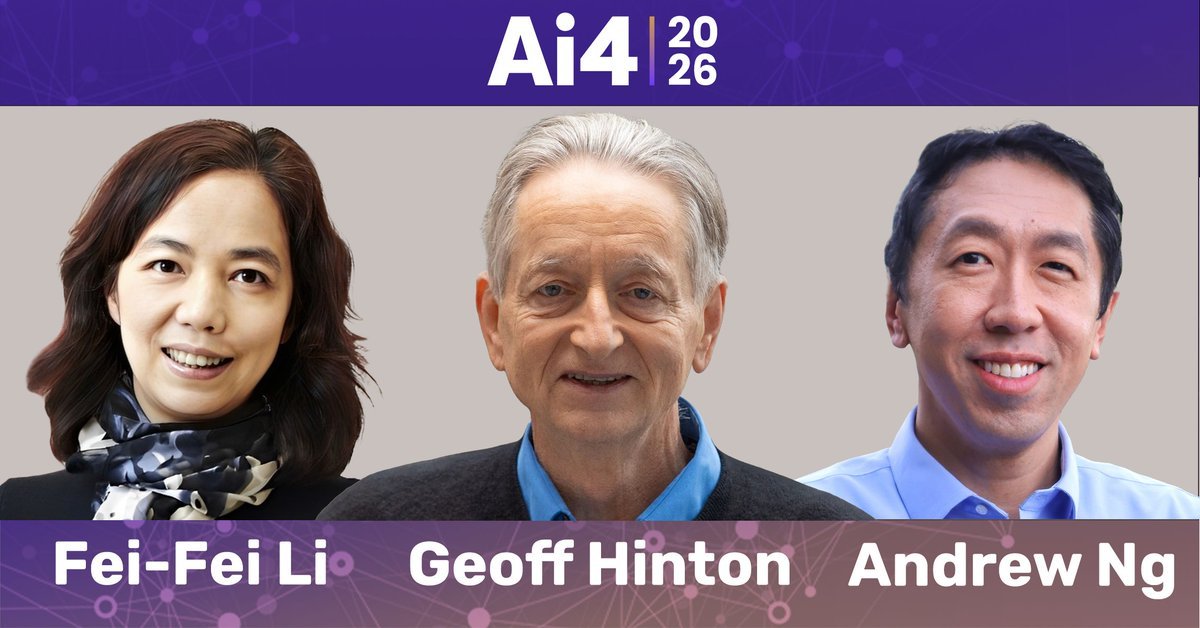
- A clash of technological icons : Geoffrey Hinton, Andrew Ng, and Fei-Fei Li, hailed as the "godfathers of artificial intelligence," will share the stage for the first time at Ai4 2026, delivering a historic keynote address. This joint appearance exposes the harsh reality: artificial intelligence has moved beyond the scientific stage of simply competing on algorithms; it is now an industrial game about "finding commercial applications and maintaining a chance of survival."
- A signal amplifier for cross-border capital : The high-profile appearances of celebrities such as basketball superstar Russell Westbrook as investors in artificial intelligence have released a clear macro signal: the investment logic has broken through the early "traditional Silicon Valley venture capital betting on underlying infrastructure" and spread to pan-entertainment, sports capital and traditional industry giants.
- Sponsors' real money: Who is paying for these "famous moments"?
- The surge in sponsors is essentially a direct gamble by capital on these prestigious technological events. In the inaugural 2018 event, with technology still in its early stages of vertical exploration, only a paltry 20 sponsors participated. In 2023, coinciding with the dawn of generative AI, computing giants like Microsoft and Google joined forces for the first time, pushing the number of exhibitors past 100. In 2024, with Hinton's entry and the industry's focus on real-world applications, infrastructure upstarts like NVIDIA and Snowflake joined in, more than doubling the number to 220. And in 2026, the landmark event saw the three giants on stage together, with cross-industry capital expanding its reach, resulting in a record-breaking nearly 400 exhibitors. These substantial figures demonstrate that each prestigious technological event is a frenzy of capital queuing up for a prime spot.
IV. Industry Influence: The Ultimate "Buyer-Driven" Ecosystem Strategy
From a professional perspective on event operations, Ai4's formidable industry influence is almost a textbook example of "supply and demand game control".
- Extreme screening mechanism for high-net-worth audiences: The biggest taboo in exhibition operations is "low effective traffic." Ai4 did not blindly pursue participation from the general tech community. Instead, through a rigorous real-name endorsement and verification mechanism, it ensured that attendees included a large number of CIOs, CDATA Officers, and CAI Officers from Fortune 500 companies. This "high-level executive density" transformed the venue into a highly refined enterprise-level networking ecosystem, with over 70% of decision-makers at the VP level or above, directly addressing the pain point of "not being able to find key figures in the decision-making chain" in enterprise sales.
- Precise alignment with vertical scenarios: Instead of the traditional "technology classification method," such as dividing the agenda into large model areas and computer vision areas, the conference adopted an "industry classification method"—dividing into more than 20 traditional industry vertical sub-venues, including healthcare, retail, finance, supply chain, and defense. The brilliance of this design lies in its ability to force technology providers (sellers) to shed empty technical jargon and use business language that traditional industries can understand, such as ROI, compliance, and efficiency improvement, to communicate with industry pain point stakeholders (buyers) in the same context, greatly shortening the trust chain in business transactions.
V. Business Closed Loop: Using sellers' hard-earned money to fuel buyers' appetites
At its core, any top-tier summit is a ruthless business of monetizing traffic and space. Ai4 has taken the "double standard ticket leverage" and "forced binding of rights" to the extreme of the business mechanism.
- The "Seller-Frugal, Buyer-Pampered" Double Standard: To maintain a 70% concentration of executive buyers, the organizing committee employed a strategy of "targeted invitations, free admission, and even sponsor-subsidized accommodations at the Venetian Macao in Las Vegas" for executives from traditional large corporations, effectively binding them to the event. Conversely, the committee charged tech companies and AI startups exorbitant prices of $2,500 to $3,500 (approximately RMB 18,000 to 25,000) per ticket. Even knowing this was a "high entry tax," these executives couldn't resist the allure of sharing a room with the largest group of buyers in the US.
- Sky-high premiums and bundled marketing: The Venetian Macao in Las Vegas is one of the world's most expensive venues in terms of both rental and on-site setup costs. The organizing committee's clever business model lies in its bundled sales of "booth space," "main venue speaking seats," "closed-door roundtable hosting rights," and admission tickets to official joint technical training sessions , creating a sponsorship tiered system worth hundreds of thousands of dollars. Manufacturers here aren't buying space; they're buying a competitive edge in the industry, ensuring they aren't squeezed out by their rivals. This is an extremely closed-loop, highly profitable model that perfectly covers operating costs with massive corporate marketing budgets.
VI. Precise Trend Indicator: Analysis of the Core Themes and Directions of the Ai4 Series Summits
Looking at the more than 70 core topics and sub-topics tracked by Ai4, it doesn't adopt the "technology categorization method" commonly used by academia or pure technology giants. Instead, it firmly adheres to the two red lines of "scenario monetization" and "engineering implementation." The thematic direction of its entire series of summits can be precisely extracted into the following three core areas:
1. From “Language Dialogue” to “Physical World Perception”: The Rise of Spatial Intelligence and Physical Simulation
Core Theme: After the frenzy of the past two years, the marginal benefit of basic models has begun to diminish, and multimodal generation based on text and images has entered a phase of competition for existing market share in the enterprise sector. This year's Ai4 conference saw a clear generational shift in technological trends, with core discussions leaning entirely towards generative video, digital twins, industrial simulation, and spatial intelligence.
- Application scenarios include using synthetic data to train unmanned autonomous systems, endowing robots with more advanced physical movement capabilities through physical intuition and "common sense," and directly converting text into complex, highly fault-tolerant industrial scenario simulations. This means that AI is rapidly moving beyond simple virtual chat boxes and truly entering the physical world, such as factories, workshops, and power grids.
2. Cost Reduction and Efficiency Improvement in Traditional Industries Under Strong Regulation: Core Engineering in Finance and Healthcare
Core theme: Ai4’s strength lies in targeting the two most expensive and most regulated industries in the United States—finance and healthcare. These two vertical sessions represent the real purchasing trends of Fortune 500 executives.
- Financial Trends: This year's conference completely abandoned abstract concepts, focusing instead on using Natural Language Processing (NLP) for precise market sentiment analysis, automated stress testing for risk modeling, full automation of middle and back-office compliance processes, and the extremely stringent interpretability and auditability requirements of financial AI.
- Healthcare trends: The focus is shifting to clinical auxiliary diagnosis, extreme optimization of hospital internal management workflows, using virtual digital twins for computer simulation clinical trials, and how to enable AI to conduct decentralized patient recruitment and drug development target discovery while complying with the highest global privacy laws.
3. National Security and Compliance Governance: Institutional Implementation of AI Roadmap Alignment
Core theme: This is no longer a mere academic and ethical discussion, but a hard threshold that determines whether traditional giants should cut their AI budgets this year and whether manufacturers can secure orders.
- Key topics: The discussion revolves around the global AI policy framework, risk management of third-party vendor models, and evolving regulatory responses, such as compliance transparency and prevention of algorithmic bias.
- National Defense and Public Security: A dedicated session on national defense and public affairs was established, focusing on discussions of autonomous drone swarm management, AI-based real-time threat detection, battlefield intelligence analysis, and simulated live-fire exercises in complex environments. This demonstrates that artificial intelligence has become deeply integrated into national-level security and defense infrastructure.
Conclusion
By examining AI4's path to legendary status, its historical evolution, and its successful synergy, we see not only the operational logic of a successful commercial exhibition, but also the true state of global AI commercialization. Technology never develops in a vacuum; it must rely on the most realistic factors: capital returns and supply-demand control.
Only by understanding Ai4's methodology can you discern whether the digital budgets of those giant corporations are driving a genuine industrial revolution or simply paying for a meticulously designed business scheme.