Introduction: When Forex Giants Meet Cryptocurrency
This article is based on an in-depth interview with David Mercer, CEO of LMAX Group, by The Block. LMAX is not your average crypto startup, but a financial giant that dominates the traditional foreign exchange (FX) market. It processes up to $70 billion in trading volume daily, serving the world's top 50 banks, top asset management firms, and hedge funds.
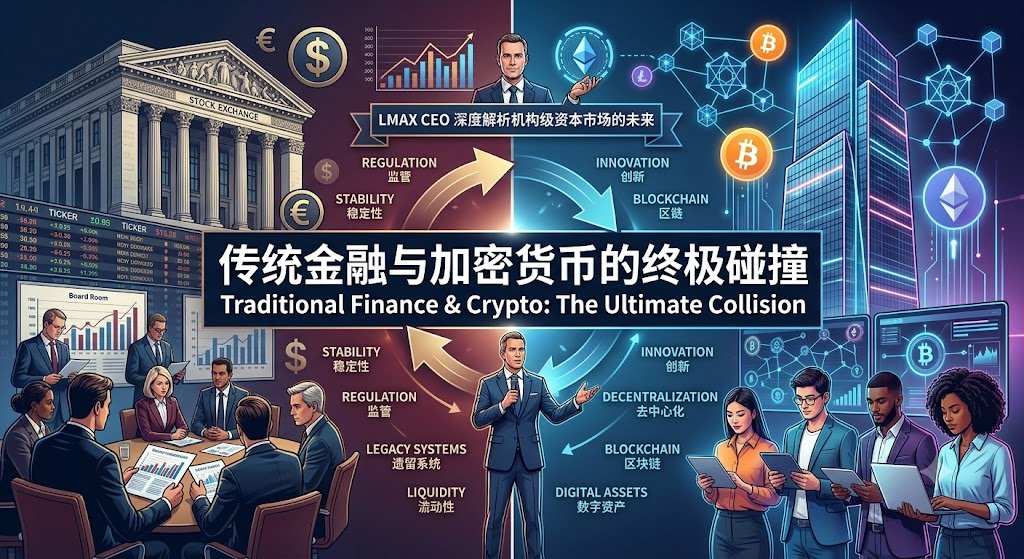
However, it was this very giant, deeply versed in the rules of traditional finance (TradFi), that launched the first institutional-grade cryptocurrency exchange in 2018—LMAX Digital. David Mercer, standing at the crossroads of traditional finance and cryptocurrency, offers a unique perspective on how these two previously separate worlds are undergoing their "ultimate collision."
This article will dissect this interview in great detail, exploring how crypto technologies (such as 24/7 trading, stablecoins, and asset tokenization) are reshaping traditional capital markets, and how traditional finance (such as credit intermediation, clearing mechanisms, and compliance regulation) will in turn tame the wild crypto market.
Chapter 1: The Devastating Impact of the Foreign Exchange Market and the Breakthrough of Crypto Payments
At the start of the interview, Larry Cermak posed a very pointed question: Why are top cryptocurrency exchanges like Coinbase or Binance able to easily launch stock trading products, yet almost none of them venture into the traditional foreign exchange (FX) market?
1.1 The "Low Profit" Barrier in the Foreign Exchange Market
David Mercer's answer demonstrates the absolute confidence of traditional financial giants. He points out that the foreign exchange market is the world's largest and most efficient market, with a daily trading volume of $7 to $8 trillion (30 times that of the stock market and 10 times that of the fixed-income market).
In cryptocurrency or stock markets, exchange fees are typically calculated in "basis points" (BPS) (1 BPS equals 0.01%). However, in the institutional forex market, competition is brutally fierce. LMAX earns only a few cents per million dollars of trades it processes.
This extremely low spread and low-profit model is something that crypto exchage accustomed to earning high fees during crypto bull markets simply cannot adapt to. The forex market requires extremely large trading volumes, extremely low latency (nanosecond level), and extremely complex liquidity management capabilities, which constitute an insurmountable technological and commercial barrier.
1.2 The Real Need for Encrypted Payments: From Speculation to "Delivery"
Since crypto exchage are struggling to penetrate the traditional foreign exchange market, where are the real-world applications of cryptocurrencies?
David believes that although the crypto market is currently dominated by speculation, what retail users ultimately want is "delivery"—using their crypto wealth to buy real-world goods such as real estate, vacations, or everyday consumer goods.
To this end, LMAX launched LMAX Kiosk and the Omnia exchange. Its core concept is "pay any asset with any asset." For example, a Bitcoin holder wanting to buy a house in Europe can pay directly with Bitcoin, and LMAX will instantly complete the fiat currency conversion in the background, allowing the seller to receive Euros directly. This seamless cross-asset payment experience is precisely the disruptive impact that stablecoins and crypto technology have on traditional payment systems.
Chapter Two: How Cryptocurrencies Are Forcing Traditional Finance to Operate 24/7
One of the biggest shocks that cryptocurrencies have brought to traditional finance is their 24/7/365 (no holidays) trading model. Wall Street, accustomed to weekends off and market closures on holidays, is facing unprecedented challenges.
2.1 The pain point of "weekend shutdown" in traditional finance
In the past, the IT architecture of traditional financial systems was extremely outdated. Every weekend, the servers of banks and exchanges needed to be shut down for maintenance, restarts, batch settlements, and software updates.
However, the world doesn't stop turning over the weekend. It would be utterly absurd in a modern financial system if a major geopolitical event occurred on a Saturday and investors were unable to trade foreign exchange or hedge risks.
2.2 The remarkable effect of Bitcoin's "triangular arbitrage"
How did LMAX break this deadlock? David shared an incredibly clever story: LMAX pioneered weekend forex trading seven years ago. How did they price their services without bank liquidity?
The answer is: Use Bitcoin.
Since Bitcoin continues to trade over the weekend, LMAX creatively used Bitcoin's price in different fiat currencies (such as BTC/USD and BTC/JPY) and, through the mathematical model of triangulation, reversed the weekend's USD/JPY exchange rate! This can be considered a classic case of crypto assets contributing to traditional financial pricing mechanisms.
2.3 Irreversible Trends
Driven by LMAX, approximately 50% of brokers have now adopted weekend trading (compared to just 7% a decade ago). David confidently predicts that by the end of this year (2030), this figure will reach 95% or even 100% . 24/7 trading will become standard for all financial assets.
Chapter 3: Stablecoins and Collateral: A Cross-Asset Liquidity Crisis
In discussing the practical applications of cryptocurrencies, the interview delved into a core pain point: the fragmentation of collateral and the liquidity crisis .
3.1 Stablecoins: The Most Successful PMF in the Crypto World
Namik noted that stablecoins are one of the very few applications in the crypto space that have truly achieved Product-Market Fit (PMF). David strongly agrees. He believes that stablecoins were created to solve problems related to settlement, payments, and collateral liquidity.
3.2 The Gold Price Surge and the Dilemma of the Crypto Market
To illustrate the pain points of collateral fragmentation, David cited a real-world example that occurred in the first quarter of this year.
In Q1 of this year, gold prices surged due to safe-haven demand triggered by geopolitical tensions. On the LMAX platform, gold trading volume once accounted for 40% of total trading volume.
However, many cryptocurrency investors watch opportunities slip away during this process. Why? Because their funds (collateral) are locked in centralized crypto exchage(such as Binance or Kraken). If they want to buy gold, they must first sell their cryptocurrency, withdraw the fiat currency to their bank account, and then transfer it to a traditional precious metals broker. This process can take several days, by which time the opportunity will have passed.
3.3 The Future of Cross-Asset Margin Pools
LMAX's advantage lies in its dual offering of traditional forex/precious metals and crypto services. They allow clients to trade gold or forex directly on the same platform, using their existing Bitcoin or Ethereum holdings as collateral .
This "unified margin pool," which breaks down asset class barriers, greatly improves the efficiency of capital utilization. David believes that future capital markets must be built on this seamless cross-asset liquidity, and stablecoins and tokenization technology are the infrastructure foundation for achieving this goal.
Chapter Four: The Real Progress of Institutional Entry — Everything is Ready, Only Regulation is Lacking
The crypto community keeps shouting "Institutions are coming," but what's the truth? David from LMAX, which directly serves top global banks, reveals the truth with extremely detailed data.
4.1 Internal survey data from the top 50 banks
LMAX conducted an in-depth survey of the world's top 50 banks (with a response rate as high as 60%). The results are encouraging:
• 100% of the surveyed banks are interested in cryptocurrency/digital asset trading.
• 45% of the surveyed banks have already ventured into the custody of digital assets.
• 36% of the surveyed banks are actively researching tokenized real-world assets (RWA).
• Only 8% of banks said they are not taking any action at present.
•Most importantly: Nearly 60% of respondents (about 40% of the top 50 banks) explicitly stated that they plan to officially start trading digital assets by the end of 2027.
Currently, LMAX has 12 active bank partnership projects underway. This means that the entry of traditional financial giants is not just empty talk, but a timetable that is being executed intensively.
4.2 Two major obstacles preventing institutional entry
Since everyone wants to get in, why is the process so slow? David pointed out two fatal obstacles:
1. Regulatory uncertainty (especially in the United States)
David likens traditional finance to a "state" and cryptocurrency to a "church." Traditional finance is highly regulated, while the crypto market originated from anarchist beliefs.
Currently in the United States, regulators are unable to even define whether certain crypto products are financial derivatives or fall under the category of "gambling" (such as prediction markets mentioned later). Until a clear regulatory framework (such as the MiCA Act in Europe, but lagging behind in the US) is fully established, large banks entrusted with managing public funds will not dare to act rashly.
2. Lack of institutional-level credit intermediation and clearing mechanisms
This is the biggest conflict between the crypto market and traditional finance in terms of underlying logic.
• Crypto Mode (Fully Pre-funded) : When trading on a crypto exchage, you must deposit 100% of your funds or tokens into the exchange first. This is extremely inefficient and carries a huge risk of the exchange running away with your money (such as the FTX incident).
• Traditional financial model (credit intermediation) : Large banks trading $1 billion in foreign exchange on LMAX do not need to deposit $1 billion in advance. They rely on credit lines provided by Prime Brokers and only need to perform net settlement after the transaction is completed.
David emphasized that the crypto market must establish independent clearers and institutional-grade credit mechanisms to accommodate the trillions of dollars in funds from Wall Street.
Chapter 5: Tokenization, Perpetual Contracts, and Prediction Markets
After exploring the macro structure, the interview moved on to analyzing specific crypto-native financial products.
5.1 Tokenization: Derivatives of this millennium
David spoke highly of asset tokenization, calling it "the derivative of this millennium."
The explosion of the derivatives market in the 1990s greatly enriched financial instruments. Today's tokenization technology, by eliminating transaction friction, enabling asset fragmentation (making it possible for ordinary people to afford a small piece of Manhattan real estate), and 24/7 trading, will trigger a revolution of equal or even greater scale.
He boldly predicts that by the end of this year (2030), nearly 10% of assets in traditional financial markets will be tokenized, potentially reaching a scale of $30 trillion (far exceeding Citibank's forecast of $5.5 trillion). He asserts: "All securities will eventually be tokenized."
5.2 Perpetual Contracts: A Story of Self-Correction
Perpetual contracts (Perps) are a unique derivative product in the crypto market (with no expiration date). David demonstrates the candor of a top entrepreneur here: he admits he misjudged the market.
“Five years ago, I thought perpetual contracts were a short-lived, terrible product, only for retail investors,” David admitted. But the market taught him a lesson. Seeing the huge success of perpetual contracts in the crypto market, LMAX quickly adjusted its strategy, not only launching perpetual contracts for Bitcoin and Ethereum, but even introducing them into gold trading !
He now firmly believes that the trading volume of perpetual contracts will eventually far surpass that of the spot market, becoming the mainstream tool in the capital market.
5.3 Prediction Markets: Why is LMAX not involved in them yet?
Larry mentioned Polymarket, a prediction market platform that has become extremely popular this year (users can place bets on election results, sports events, etc.).
David praised the innovation, believing it greatly enriches the market's hedging tools. However, when asked if LMAX would launch a similar product, he gave an extremely cautious answer: "Absolutely not before 2026."
The reason returns to regulation. The prediction market currently exists in an extremely dangerous gray area: is it a financial derivative or sports betting? As a strictly regulated traditional financial institution, LMAX would never cross the line that could lead to the revocation of its license for short-term traffic. This once again confirms the traditional financial sector's bottom-line mentality of "compliance first."
Chapter Six: The Institutionalization Challenges of Retail Exchanges
At the end of the interview, Larry raised a crucial question about the competitive landscape of the industry: retail crypto exchage giants like Coinbase and Kraken are desperately transforming into institutional businesses. As a native of the institutional space, how does LMAX view this cross-industry competition?
David's answer was very insightful; he pointed out three almost insurmountable fundamental barriers that retail exchanges face when transitioning to institutional markets:
1. A completely different technology stack
Retail exchanges are designed to handle concurrent access from millions of retail investors (such as the surge in traffic after a Super Bowl ad), and their latency requirements are not stringent (hundreds of milliseconds or even seconds are acceptable). Institutional trading (especially high-frequency trading), however, demands deterministic, ultra-low latency . LMAX's matching engine latency is in the nanosecond range (1 millisecond = 1,000,000 nanoseconds). The underlying architecture of retail exchanges is simply inadequate to meet the needs of Wall Street's high-frequency quantitative funds.
2. The Gap in Customer Relationship Management (CRM)
Retail exchanges are accustomed to automating customer account opening, KYC (Know Your Customer) processes, and customer service tickets via apps and websites. However, serving a top-tier hedge fund or multinational bank requires extremely complex, customized services, in-depth compliance due diligence, and a dedicated one-on-one account manager. This is a completely different business service model.
3. Lack of credit models
As mentioned earlier, retail exchanges operate on a "fully pre-funded" model. Institutional exchanges, however, require complex credit assessments, margin deposits, and netting. Retail exchanges lack the experience and infrastructure to assess and manage systemic credit risk.
David summarized: "Transforming from retail to institutional is like asking a fast-moving consumer goods company that produces mass-market consumer products to suddenly start manufacturing extremely sophisticated aircraft engines. It's not just a matter of funding, but also a matter of DNA."
Chapter 7: Summary and Action Recommendations
This nearly half-hour in-depth interview painted a grand picture of how traditional finance and cryptocurrency are moving from separation to integration.
7.1 Review of Core Conclusions
1. Integration is an inevitable historical trend : The future capital market will no longer distinguish between TradeFi and Crypto, but will be a unified market built on the foundation of crypto technology (24/7, tokenization, stablecoins) and following traditional financial rules (credit, clearing, regulation).
2. The moat of the foreign exchange market : Crypto exchage are unlikely to disrupt the traditional foreign exchange market because the latter's low-spread profit model and high-frequency trading technology have extremely high barriers to entry.
3. Collateral liquidity is key : Allowing the use of crypto assets as collateral to trade traditional assets (such as gold and foreign exchange) is a core pain point in breaking down capital barriers.
4. Countdown to institutional entry : Nearly 40% of the world's top 50 banks plan to officially trade digital assets by the end of 2027.
5. Tokenization and Perpetual Contracts : Asset tokenization will become the next derivatives revolution with a scale of $30 trillion; perpetual contracts will become the mainstream tool for cross-asset trading.
7.2 Action Recommendations
• For crypto entrepreneurs : Stop trying to reinvent the wheel. The next big thing in the crypto market requires building independent clearers and credit intermediation services that can connect to traditional finance. Solving the inefficiency of "full upfront funding" is key to attracting trillions of dollars from Wall Street.
For traditional financial institutions : They must accelerate the phasing out of outdated IT infrastructure that does not support 24/7 trading. Those unable to provide liquidity and trading services on weekends will inevitably be left behind.
For investors : Closely monitor the infrastructure development of the RWA (Real-World Asset Tokenization) sector. At the same time, understand that the entry of institutional funds is a slow process constrained by regulation and compliance; do not be swayed by short-term market sentiment.
Chapter 8: Deepening the Scope — A Deep Dive into the Underlying Logic of the Integration of Crypto and Traditional Finance
Having summarized the core content of the interview, we need to move beyond the video itself and delve deeper into the underlying logic of this "ultimate clash." Why are traditional financial giants so eager to embrace crypto technology? And why must the crypto market compromise with traditional finance?
8.1 Traditional Finance's "Technology Anxiety" and Crypto's "Compliance Desire"
This is actually a two-way journey where both parties get what they need.
The pain point of traditional finance lies in its inefficiency . As David stated, the underlying IT architecture of traditional finance is mostly built on mainframe systems from the 1970s and 80s. Cross-border payments require multiple intermediaries through the SWIFT system, taking several days and incurring high costs; securities transactions typically have a T+2 settlement cycle (two business days after the transaction is actually settled). In the internet age, such delays are unacceptable. The blockchain technology underlying cryptocurrencies (distributed ledger, smart contracts, instant settlement) is precisely the remedy for these pain points.
The pain point of the crypto market lies in its "scale ceiling." Although the crypto market has experienced several bull markets, with its total market capitalization once exceeding $3 trillion, this is still insignificant compared to the vast ocean of traditional finance (the global bond market alone exceeds $130 trillion). For the crypto market to break through its existing scale ceiling, it must attract genuine "old money" such as pension funds and sovereign wealth funds. The prerequisites for these institutional funds to enter the market are extremely stringent compliance regulations, a robust credit clearing mechanism, and the security of bankruptcy remoteness.
8.2 Bankruptcy remoteness: The lifeline for institutional entry
In the interview, David repeatedly emphasized the importance of traditional financial mechanisms. One concept that has not been fully explored but is extremely crucial is bankruptcy remoteness .
In the FTX collapse of 2022, many institutions and retail investors suffered heavy losses. The root cause was that crypto exchage often commingled customer funds with company operating funds. Once an exchange went bankrupt, customer assets were treated as the company's bankruptcy estate, facing a lengthy and unlikely liquidation claim.
In traditional finance, client assets must be held in bankruptcy remoteness by an independent third-party custodian. Even if a brokerage firm or exchange goes bankrupt, client assets are absolutely safe, and creditors have no right to access them.
LMAX, as a traditional financial institution, understands this well. If the crypto market cannot achieve a complete separation of powers and bankruptcy isolation between trading, clearing, and custody at the underlying architecture level, the massive amounts of money from Wall Street will never truly flow in.
8.3 Sociological Impacts of “All-Weather Capitalism”
The 24/7 trading model mentioned in the interview is not just a technical issue, but also a profound sociological one.
On the positive side , it completely eliminates "weekend risk exposure." In the past, if a sudden event occurred on a Saturday (such as the outbreak of war or the release of major policies), investors could only watch the risk unfold until Monday's opening, often facing a significant price gap. A 24/7 market makes risk pricing more continuous and precise.
On the negative side , this "24/7 capitalism" will significantly increase the psychological pressure and workload of financial professionals. The traditional financial system of "weekends off" was originally a form of institutional protection against the alienation of capital. When markets never sleep, human greed and fear will also never rest. This requires future financial institutions to rely heavily on AI algorithms and automated trading programs, with human traders gradually relegated to the background, becoming supervisors of the algorithms.
8.4 Stablecoins: A digital extension of the dollar's hegemony?
The interview highly praised the product-market fit (PMF) of stablecoins. We need to understand the geopolitical significance of stablecoins on a deeper level.
Currently, the dominant stablecoins in the market (such as USDT and USDC) are almost entirely pegged to the US dollar, and their issuers invest the vast majority of their reserves in US Treasury bonds. This means:
1. Digital Dollarization : Stablecoins are actually helping the dollar penetrate into countries around the world with underdeveloped financial infrastructure and highly unstable currencies (such as Argentina, Turkey, and Lebanon) at an unprecedented speed.
2. Hidden Buyers of US Treasuries : Stablecoin issuers have become one of the largest holders of US Treasury bonds. Against the backdrop of the Federal Reserve's balance sheet reduction and the pressure on US Treasuries to be sold off, stablecoins have inadvertently become an important force supporting the dollar system.
Therefore, the attitude of US regulators towards stablecoins is extremely delicate: on the one hand, they are concerned that they may trigger systemic financial risks, while on the other hand, they welcome the consolidation of the dollar's global hegemony. This explains why legislation targeting stablecoins has been slow to materialize, as it involves an extremely complex interplay of national interests.
8.5 Conclusion: The Handshake Between the Old and New Worlds
The interview with LMAX CEO David Mercer provides us with an extremely rare "cross-industry" perspective.
Crypto purists often dream of completely disrupting and destroying the traditional financial system; while the arrogance of traditional finance views cryptocurrencies as worthless tulip bubbles. David's wisdom lies in recognizing the complementarity between the two.
The future financial landscape will not be a cryptocurrency utopia, nor a resurgence of traditional finance. It will be a "hybrid capital market" with blockchain as the underlying ledger, stablecoins as the settlement medium, smart contracts as the execution logic, and subject to strict national regulation and relying on mature credit clearing mechanisms.
In this ultimate clash, there are no absolute winners or losers. The only winners will be those financial innovators who are able to bridge the cognitive gap first and perfectly integrate the two genes.