Original source: BanklessDAO
Compilation of the original text: Bai Ze Research Institute
For the past 15 years, the internet has been dominated by a handful of powerful companies. In order to access and use their proprietary platforms, we gradually give up our privacy, lose control over our data, and become vulnerable to censorship and manipulation.
That's why computer scientists, cryptographers, and mathematicians are working tirelessly to combine different technologies (such as cryptography, peer-to-peer networks, and digital currencies ) to reimagine the way we connect and exchange value in the digital world.
After decades of research and development, these innovators have given us the tools to tackle centralization of authority — blockchain and cryptocurrencies. Collectively known as "Web3," these tools are enabling developers to improve the Internet and financial systems.
Although Web3 is broader than cryptocurrency, the term "Crypto" is often used interchangeably with Web3. Cryptocurrencies are a huge "gray area", an ungovernable public domain. To understand its true potential, we should understand where it came from, its principles, and the underlying value proposition upon which it was developed.
“A lot of times, people who have the potential to disrupt other industries don’t have a solid understanding of what they’re trying to disrupt. This is definitely the case with cryptocurrencies and the current financial system. Taking the time to pause and become familiar with cryptocurrencies and the blockchain is more important than ever. A lot of history is really worth it so you can understand why we got to where we are, what got us here."
—Andy Tudhope (Kernel)
Cypherpunks and predecessors of Bitcoin (1980-2005)
Cryptography as a means of protecting individual rights to privacy and freedom of expression, and thus the roots of cryptocurrencies and Web3 - was initiated by a group of people known as "cypherpunks". The strange name is a combination of the words cryptography, encryption, and cyberpunk (a dystopian science fiction genre) that represents those who develop anonymous transaction systems to protect individual rights from state and corporate surveillance. threatening person.

The Internet in the early 1990s was a wild place, mostly used by hackers and nerds. The foresight of the cypherpunks is that they clearly know that once the Internet is popularized, there will be a few people who will hold more power. To prepare for that moment, and ensure Internet freedom, they started a forum called a "mailing list" to discuss and develop encrypted digital infrastructure.
"If we want to have any privacy, we must defend our own privacy. We must come together and create systems that allow anonymous transactions...Technology of the past did not allow strict privacy protection, but electronic technology can."
— E. Hughes, The Cypherpunk Manifesto
Some of the names of the people on the mailing list you may have heard before:
Jacob Appelbaum, Tor Developer
Julian Assange, founder of WikiLeaks
Adam Back, creator of Hashcash
Bram Cohen, creator of BitTorrent
Nick Szabo, creator of BitGold
Wei Dai, creator of B-money
Hal Finney, Creator of Repeatable Proof of Work
John Gilmore, Founder, Electronic Frontier Foundation
Eric Huges, founding member of the cypherpunk movement
Timothy May, chief scientist at Intel and author of The Crypto-Anarchist Manifesto
Over time, the cypherpunks realized that encryption alone was not enough to liberate the internet. Central bank control of monetary policy has grown by leaps and bounds since the end of Bretton Woods, demonstrating the need for a native digital currency in order to build a truly free internet. This is what prompted them to lay the groundwork for Bitcoin.
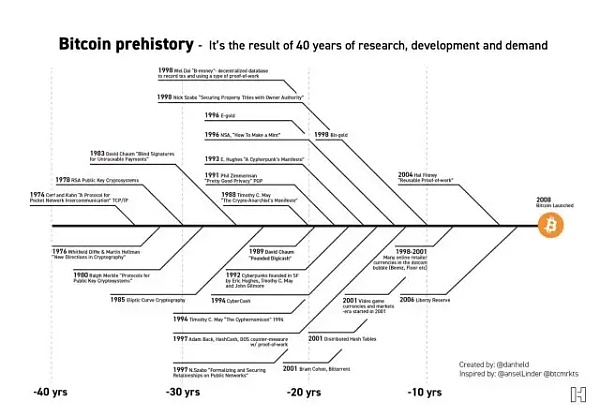
Bitcoin: A Revolution of Trust (2009)
As the global financial crisis of 2008 brought trust in the banking system to a freezing point, cypherpunk skepticism took hold again. After years of technological development, in January 2009, Satoshi Nakamoto launched the Bitcoin network as an alternative to the opaque financial system at the time.
"The fundamental problem with traditional money is the trust it takes to make it work. We have to trust central banks not to debase the currency, we have to trust banks to hold our money and move it electronically, but they are in waves Lending money in the credit bubble of the wave with little to no reserve. We have to trust them with our privacy and trust that they won't let hackers steal our accounts. The huge processing fees they charge make micropayments impossible send."
— Satoshi Nakamoto, founder of the Bitcoin network
As noted historian Yuval Noah Harari wrote in his 2014 book Sapiens, more than 90% of the world's currency exists only on computer servers, making it a "de facto" digital currency. Therefore, the subversive value proposition of Bitcoin is not the invention of digital currency, but the invention of a method that can guarantee the credibility of digital currency. Using advanced cryptography and blockchain technology, Bitcoin enables network participants to create and maintain a single monetary system without the need for trusted intermediaries, laws and governments.
That’s why it’s not just a technological revolution, but a sociopolitical one: no longer is a single entity able to determine the validity of the money supply and transaction history, but the entire community of the network.
We are all Satoshi Nakamoto
In order to grow, the Bitcoin network requires the voluntary commitment of participants who receive Bitcoins as an incentive to maintain the network for their own benefit and that of others. This is what Bitcoin is about: a decentralized payment system with a decentralized incentive structure.
"For the first time in history, we don't need to fight against the "brute force law enforcement" that floods the Internet. We can abandon the Internet for a publicly verifiable Bitcoin network, and we accept Bitcoin voluntarily. This is because, running automated execution code is far more powerful than holding elections."
——Kernel
Ethereum: A Collaborative World Computer (2013)
After researching and writing about blockchain and Bitcoin for a while, young programmer Vitalik Buterin realized that the cypherpunk ideas of privacy, property freedom, and open source development could be extended to many other applications beyond payment currencies. Following his vision, he launched the Ethereum network with a small group of programmers: a peer-to-peer, community-governed blockchain that can be used to code and trade almost anything.
Compare Bitcoin and Ethereum:
Bitcoin is a payment network that can be used to transfer value between any two people, anywhere in the world, without an intermediary.
Ethereum is an open source platform and infrastructure on which anyone can write smart contracts and decentralized applications.
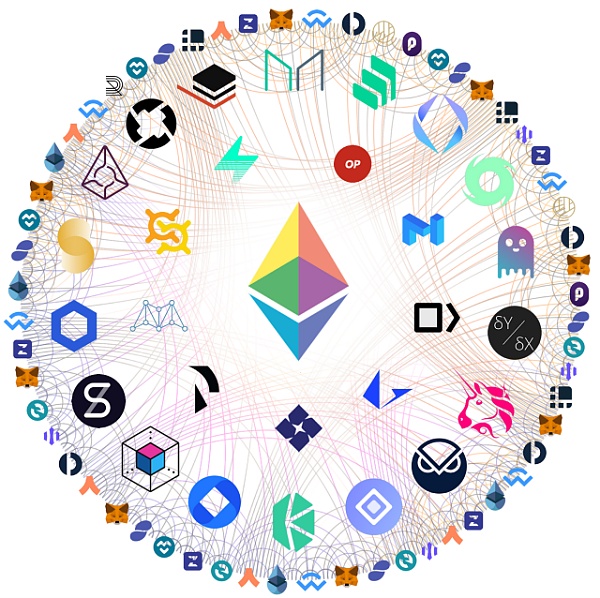
Think of Ethereum as a diverse ecosystem of individuals and organizations that are building and growing alongside decentralized applications designed to facilitate human coordination. No one person or entity could have made it what it is today, its evolution was collectively determined so it became more vibrant and diverse.
Due to its decentralized nature, open-source standards, and interoperability, Ethereum has benefited from a great deal of bottom-up innovation and active participation. This has led to the rapid growth of the Ethereum network and has become the most popular blockchain for building and using DeFi , NFT and DAO.
Web3: A Trustless Internet
What brings us to Web3 is the work of decades of research and development by cypherpunks who want to make the Internet more fair, open, and decentralized. Cryptocurrencies were born from shared values and principles of privacy, not from a desire to conquer money and power. Many of the revolutionary promises it made so far are still being developed, making it an easy target for disillusioned, cynics and pessimists alike. However, it must be admitted that cryptocurrencies have come a long way so far.
Over the past few decades, more and more people have discovered the power of community collaboration and have begun to explore new organizational structures with inclusive, shared governance mechanisms; professionals and users voluntarily contribute to the growth of different projects, Then the rewards are shared instead of the benefits going to the founders only.
With blockchain, we can now make institutions more transparent. Furthermore, by transforming into a digital asset, currencies, stocks, bonds, ID cards, and real estate can all be combined with smart contracts and become programmable so that they can be managed in a more definite and efficient manner.
Different blockchain applications have emerged, and developers have designed protocols rather than platforms to transparently proxy our data and money. Perhaps this has been sidelined in advanced economies, but for those living in hyperinflation countries with more limited access to the financial system, cryptocurrencies have become their "lifeline".
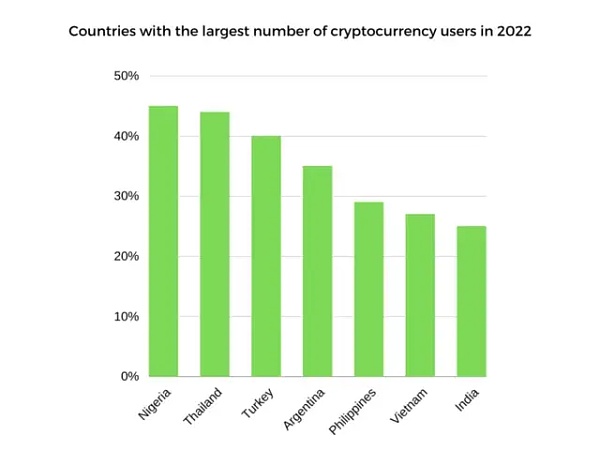
If you live in the US, UK or Singapore, cryptocurrencies are more likely to be a speculation for you. However, if you live in Nigeria, Argentina or Afghanistan, it represents a way that people can survive and express dissent amidst corruption and excessive censorship.
Cryptocurrency is currently the only solution that combines the advantages of digitization with respect for individual privacy. It’s no surprise, then, that the countries with the highest rates of cryptocurrency adoption are those that use cryptocurrencies for their original purpose (to combat tyranny and secure property freedom).
The venerable cryptocurrencies to date are those networks and applications that have been truly designed to stay true to their core principles of decentralization, privacy, openness, and transparency. And everything else is just old stuff running on the blockchain.
As with any major innovation, cryptocurrencies have no shortage of challenges to overcome, and very few are truly decentralized. However, a negative, demeaning or passive attitude will not improve our current situation. If we care about the future of Web3, the future we work for, we should understand the societal impact of our participation in Web3.
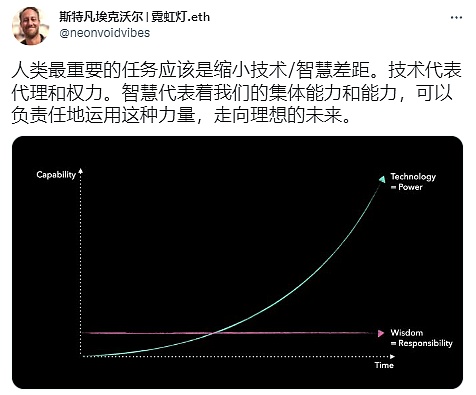
Rather than making more obvious efforts, it's time to realize now that we have the power to reframe the Internet as a public realm where companies and institutions are no longer protagonists, but people are protagonists, and everyone is a protagonist.
"People have to work together to deploy and run these systems for the common good. We can't expect governments, corporations, or other large, faceless organizations to grant us privacy out of their good faith."
—E. Hughes, "The Cypherpunk Manifesto"
We are all "pioneers"
Thanks to the collaborative and composable innovations of cryptocurrencies, blockchain and Web3, we are proving that collective intelligence can be used to find answers to problems. What we need now is not superb technology, but the active participation of more people. Web3 by itself does not empower each of us. We, as users and builders, have a responsibility to understand its true potential and use it accordingly, co-creating institutions that center longevity, prosperity, and mutual well-being.
risk warning:
According to the "Notice on Further Preventing and Dealing with the Risk of Hype in Virtual Currency Transactions" issued by the central bank and other departments, the content of this article is only for information sharing, and does not promote or endorse any operation and investment behavior. Participate in any illegal financial practice.