Original text: " Project Research 丨 ZK Track Potential Project Scroll Research Report "
Editor: YuanShan@Web3CN.Pro
Table of contents
1. Project Introduction
2. Project Vision
- Empowerment starts from blockchain developers and users
- Build with an open community at the center
- Fighting for decentralization and censorship resistance
3. Features and advantages
4. Development history
5. Team background
6. Financing information
7. Development achievements
- Launch of Pre- Alpha Testnet
- Alpha testnet goes live on Goerli
- Implementing a new three-layer aggregated circuit prototype
8. Economic Model
9. Fundamental analysis
10. Risks and opportunities
- opportunity
- risk
1. Project introduction
Scroll is a zkRollup based on zkEVM on Ethereum, which is used as a Layer 2 solution to solve the congestion problem of Ethereum. Scroll was founded in 2021 and is committed to creating an EVM (Ethereum Virtual Machine) equivalent zk- Rollup for better compatibility.
2. Project vision
Making the platform completely decentralized and owned by the community is what the Scroll project values. Starting from this concept, Scroll's vision is:
- Empowerment starts from blockchain developers and users
For most people around the world, the current state of the Ethereum market is that high-risk applications (such as DeFi and NFT transactions) are crowding out non-financial applications, making it inaccessible to ordinary users with less capital. What Scroll is doing is harnessing the potential of ZK technology to increase transaction throughput and significantly lower fees to unlock the potential of new users and applications. Serve billions of users by scaling the blockchain.
For example, Scroll allows existing applications and developers to migrate tools without in-depth modification or rewriting by building an equivalent EVM (Ether Virtual Machine); adding experimental features to extend the EVM to make the user experience richer.
- Build with an open community at the center
Based on the vision of complete decentralization, Scroll is designed to be community-centric and fully open-source. "We believe that such an important technology should be open to all to understand and audit. When building a platform that can define the ownership of financial assets, the ability to publicly audit and verify the code is critical." Such a design will bring To be more secure and design a better Scroll system.
In addition, open source and openness have also brought an essential level of trust to Scroll. Anyone can check the progress of the project, and the project is always responsible and transparent to the community.
- Fighting for decentralization and censorship resistance
While building greater blockchain scalability, the Scroll team believes it is critical to retain the core attributes of Ethereum - decentralization and censorship resistance. They serve as the ultimate goal of Scroll, aiming to achieve the same level of decentralization and censorship resistance as base layer Ethereum.
Finally, in the official blog, the Scroll team stated that their ultimate vision is to push Ethereum to scale to "zk-SNARK everything".
3. Features and advantages
Since Scroll is committed to creating an EVM (Ethereum Virtual Machine) equivalent zk- Rollup, that is, infinitely close to Ethereum, it is completely consistent with the EVM specification and achieves maximum compatibility with EVM. The biggest feature and advantage of the Scroll project is to achieve zkEVM compatibility at the ByteCode level. Its bytecode compatibility means that Solidity, Vyper and Huff work out of the box without re-auditing, most existing tools are inherited, almost the same UX and DevX as Ethereum.
The EVM equivalence is a reflection of the nature of Scroll being considered "native". Compared with other Layer2 ZK projects, the advantages of Scroll can be seen more clearly.
- Scroll VS. Zksync and Starkware
Zksync and Starkware only achieve language compatibility, and Scroll is achieving "native" compatibility. Although Zksync and Starkware have begun to support some common functions, they are not yet compatible with EVM in terms of development languages (Starkware uses Cario language, and although Zksync achieves solidity compatibility, the underlying layer still uses different virtual machine).
The architecture of the two requires a special compiler to compile the smart contract code into a new zk-friendly IR, which means that this method only achieves language compatibility rather than native EVM compatibility.
4. Development history
At the beginning of 2021, the three co-founders of Scroll met in the Ethereum community and founded the Scroll project.
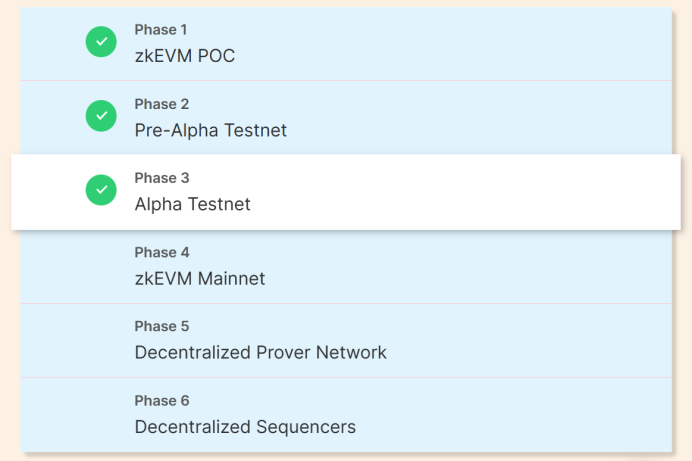
On July 19, 2022, Scroll released a pre- Alpha testnet for external testers to quickly gain community feedback.
On November 24, 2022, Scroll reached a partnership with zCloak , a Zero-knowledge Proof privacy DID project, to develop a W3C-compatible trusted DID system based on Ethereum L2.
On February 1, 2023, Scroll stated that it has deployed the front-end of Uniswap V3 on the test network, and developers and users can participate in the experience.
On February 28, 2023, Scroll released the testnet version of the Ethereum Layer 2 network on the Goerli testnet, transferring zk-EVM from pre- Alpha to the Alpha testing stage, which is the final stage before the Mainnet.
On March 8, 2023, Scroll was invested by OKX Ventures to support Scroll to improve the performance of Ethereum.
On April 4, 2023, Zada Finance, a cross- Rollup Order-book DEX based on Scroll, announced the launch of the Scroll testnet, which supports account abstraction wallets. This is the first native open source cross- Rollup DEX on Scroll.
On April 10, 2023, Sandy Peng, the co-founder of Scroll, said at the "FORESIGHT 2023" annual summit that a partner plan to stimulate ecological development may be launched in the near future, and the Mainnet will be launched in the next three to four months.
5. Team background
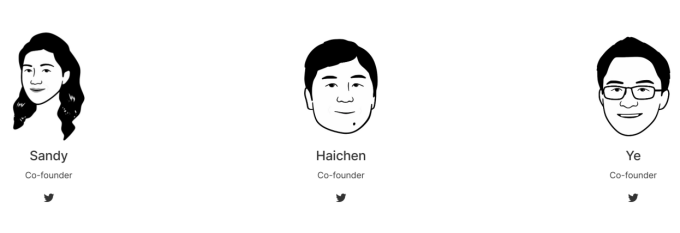
Scroll was founded in early 2021 by Ye Zhang, Sandy Peng and Haichen Shen.

Zhang Ye studied at Peking University as an undergraduate. Since 2018, he has been working on ZK proofs, mainly researching zk proof hardware acceleration and the principle of zk cryptography algorithms. The doctoral stage is also in the direction of zk. After he understood that the inefficiency of ZK-proof can be solved at the cryptography and hardware levels, he met two other co-founders in the Ethereum community in early 2021. The three decided to use ZK technology to build the future of Ethereum expansion.
Haichen studied in Yaoban, Tsinghua University as an undergraduate, and graduated from the University of Washington with a Ph.D. His research direction is biased towards the field of underlying systems. After graduation, he worked on building machine learning systems at Amazon. He has strong engineering capabilities and is good at putting theory into practice.
Sandy graduated from Cambridge University and worked in the research field of the Hong Kong Securities Regulatory Commission. In 2017, he started to get involved in the field of Web3 project investment. He also worked on games and product projects before. Currently in the team responsible for non-technical work, familiar with the brand operation of the start-up team.
Scroll attaches great importance to technical fundamentals. In 2022, the team size will be more than 40 people, of which more than 30 are ZK or blockchain researchers and developers. It can be said that the entire team is still relatively technical, and there are relatively few non-technical members responsible for ecological operations.
In addition, the team is relatively "decentralized", with members scattered in China, the United States, Singapore, Europe and other parts of the world.
6. Financing information
On April 21, 2022, Scroll completed its $30 million Series A round of financing, led by Polychain Capital, angel investors including Bain Capital Crypto, Robot Ventures, Geometry DAO, Ethereum Foundation Ying Tong and Carlos Aria, and Anthony Sassal and Ryan Adams And Santiago Santos Ethereum community members participated in the voting.
In March 2023, Scroll announced that it had raised $50 million from investors including Polychain Capital, Sequoia China, Bain Capital Crypto, Moore Capital Management, OKX Ventures, Variant Fund, Newman Capital, IOSG Ventures and Qiming Venture Partners. This round of financing will be used for product development, launching the Mainnet and expanding the ecology, and plans to increase the team size from 60 to nearly 100.
This round brings the Scroll project’s valuation to $1.8 billion, and with about $3 million in financing from angel investors, its total funding has reached $83 million.
7. Development achievements
- Launch of Pre- Alpha Testnet
In August 2022, Scroll launched the Pre- Alpha testnet, supported by a community of over 100,000 users. Processed over 15.4 million transactions and attested 1.8 million blocks to date. There are more than 641,000 batches submitted as proof of validity and finalized by Scroll's Rollup contract on L1.
- Alpha testnet goes live on Goerli
On February 27, 2023, the Scroll team announced that the Alpha testnet has been launched on Goerli, marking an important moment in the development of Scroll, which means that developers do not need permission to deploy applications on the Scroll network, and anyone can try to use Scroll technology and push it to the limit.
- Implementing a new three-layer aggregated circuit prototype
In the ZK field, Scroll implemented a new three-layer aggregation circuit prototype, reducing the gas cost of the Solidity verifier contract.
8. Economic Model
Scroll has not yet released the Token economic model.
9. Fundamental analysis
Currently, the Scroll project is in the Alpha Testnet stage and is expected to enter the Mainnet stage in three to four months.
To analyze the fundamentals of the Scroll project, it is necessary to understand the two clear goals of the Scroll project, one is EVM equivalence, and the other is comprehensive decentralization.
EVM equivalence has been discussed above, that is, it achieves Byte (byte) level compatibility with the Ethereum L1 network, and the EVM operation of Scroll is close to the same as the Ethereum L1 base layer. This means that a developer's code will execute the same on Scroll as on Ethereum.
Comprehensive decentralization means not only the decentralization of the prover (Prover), but also the decentralization of node operators, developers and user communities. This is all to allow more people to participate in the Scroll ecology. Any ordinary user can become a Scroll believer, which fits the value of Ethereum's "decentralization".
In this regard, the comparison of Scroll with Zksync and StarkNet can more clearly see the advantages of this point.
The Sequencer and Prover of Zksync and StarkNet are both operated by the official team. Block generation, verification, and packaging are all in charge of the project party. The code is not open source, nor is there a decentralized miner node built, so the community cannot participate. One problem caused by the centralized mode of the two is that all computing power is controlled by the team itself, which means that the team has to rent machines to continue to bear this part of the cost.
From the perspective of project operation, the greater the degree of decentralization, the better the project itself. Because the more nodes are added, the greater the computing power, the lower the cost, and the more efficient the operation. Realize smaller economic cost and higher work efficiency,
EVM equivalence and full decentralization are what Scroll is doing.
10. Risks and opportunities
- opportunity
When ZK Rollups (ZKRs) technology operates at a large scale, the encryption ecosystem and even the entire world will gain substantial progress based on this technology. Rollup is currently a large-scale expansion technology of Ethereum, and the huge ecological value based on Ethereum will inevitably be extended to Layer 2 projects. The advantages and characteristics of Scroll's EVM equivalent and full decentralization will inevitably make it the preferred choice for value.
Taking the cooperative project Intmax choosing Scroll as an example, Intmax believes that zkRollup, which combines high scalability and customizable privacy, is stateless (the verifier does not retain any data to achieve decentralization of sorting), and has its own VM ( In the case of virtual machines), being able to integrate with Scroll's zkEVM Rollup provides an advantage to the ecosystem.
- risk
The application value of the Leyer2 project has yet to be verified by the market, and the large-scale application of ZK technology also needs to be tested in practice. This is an unclear situation that Scroll and other Layer2 projects are facing together.
Compared with zkSync and StarWare, the ecological deployment of the Scroll project is still relatively rare, which also means that in terms of ecological project cooperation, more third-party projects choose the former, and agree with the former in terms of infrastructure construction, capital volume and relatively complete ecological chain This is the shortcoming of Scroll, and it is also one of the reasons why everyone should choose this project carefully.
refer to:
https://www.chaincatcher.com/article/2078499
https://scroll.io/blog
Disclaimer: web3 Chinese edited works, the content only represents the author's position, and does not constitute investment advice, please treat with caution, if the article/material is infringing, please contact the official customer service.