Author: Colin Li, Researcher at Mint Ventures
1. Research points
1.1 Core investment logic
With the deepening of the LSD narrative, the call for developing more complex DeFi tools based on LSD, paying attention to and deducing the bond market narrative has gradually increased, including Pendle, which has begun to be recognized by the market and explores new trading strategies.
From the perspective of the transaction model, in the V2 version of Pendle, based on the AMM model proposed by Notional Finance, the reconstructed AMM has significantly improved the transaction efficiency;
From the perspective of underlying assets, Pendle has gradually built four fixed-income markets with different risk levels, which can basically meet the needs of four different user roles: low-risk investors, arbitrageurs, liquidity providers and yield speculators;
With the introduction of the Ve model, PENDLE tokens gradually have stronger value capture capabilities. As business indicators such as TVL continue to improve, PENDLE may have entered the observation range of some stable investors.
1.2 Main Risks
Contract risk : If such an event occurs, it will have a significant impact on the normal operation of the project and the capture of token value. This risk is not limited to Pendle itself. Since Pendle’s underlying assets come from other DeFi projects, any contract risk in other projects will also implicate Pendle.
Strategic risk : If you do not select the assets and the public chain where the assets are located, you may be left behind by competitors in the next stage of competition. The project team needs to figure out what kind of underlying assets should be selected, and have an accurate understanding of the brutality of public chain competition.
Market risk : If the market falls sharply during the operation of the project, causing the underlying assets to fall, this may not be friendly to U-based investors.
1.3 Valuation
Judging from the indicator of "total market value/locked volume", the current valuation of PENDLE is lower than the other two projects that have already issued coins in the same track.
2. Basic information of the project
2.1 Project business scope
Based on the income tokenization market, Pendle splits the interest-earning assets into principal token PT (principle token) and income token YT (yield token) after the lock-in period, which satisfies users' low-risk liquidity management and also provides Some traders who can keenly grasp the volatility of yields provide tools to earn high returns.
Regarding the interest rate market in the encrypted business world, the author wrote two special articles not long ago, discussing the business logic and development deduction behind the encrypted interest rate market, namely:
Interested readers can read further.
2.2 Past Development and Roadmap
In March 2021, the name was changed from Benchmark to Pendle, and the testnet was launched that month;
In June 2021, the Pendle mainnet will be launched on Ethereum;
In November 2021, Pendle will be deployed in Avalanche;
In March 2022, the Project Permissionless plan was proposed, that is, anyone can open an asset pool on it;
In November 2022, the V2 version will be launched;
In March 2023, Pendle is deployed in Arbitrum.
2.3 Team situation
2.3.1 Overall Situation
According to LinkedIn data, the Pendle team has a total of 13 employees, mainly composed of engineers and BD personnel.
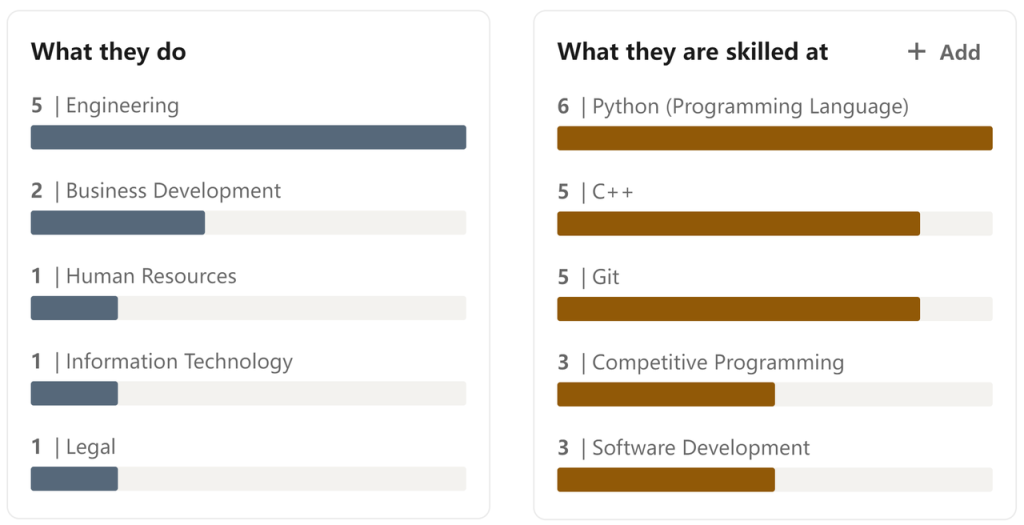
Source: https://www.linkedin.com/company/pendlefinance/people/
2.3.2 Founders

TN Lee is the founder of Pendle. Before founding Pendle, he founded the data analysis company DSR, and entered the blockchain industry in 2017, becoming a member of the founding team of Kyber Network, responsible for market and business development. Served as a RockMiner mine consultant in 2019. In the same year, TN Lee founded Pendle and Dana Labs, which is a research and development company focusing on FPGA.
2.3.3 Core members
Long Vuong Hoang: Head of Smart Contract Development at Pendle, graduated from the National University of Singapore. Prior to this, he worked as a trainee software development engineer at Jump Trading.
Jeffrey Soong: Head of front-end development, before that Jeffrey worked as an engineer in several Internet companies.
2.4 Financing situation
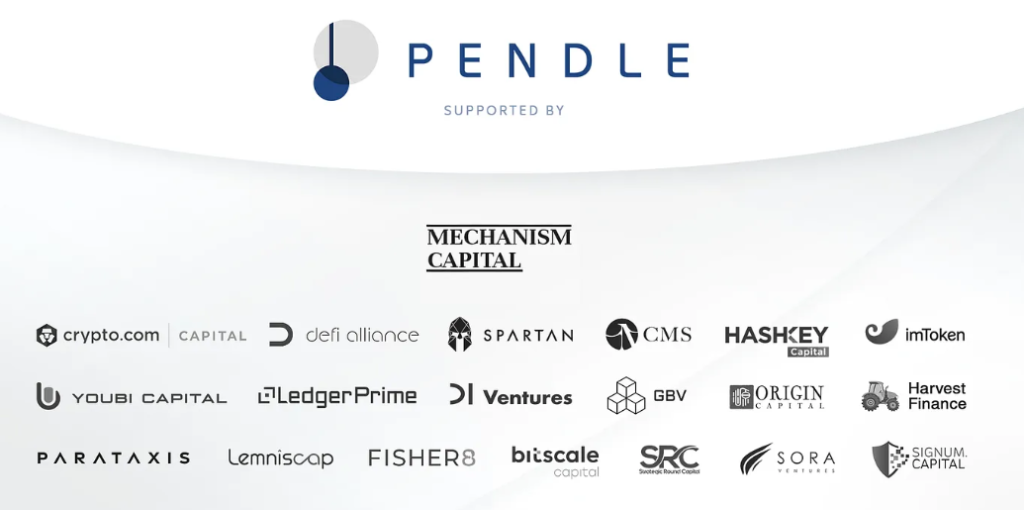
In April 2021, Pendle announced that it had received US$3.7 million in financing, led by Mechanism Capital, and other well-known institutions including Hashkey Capital, Spartan Group, etc.
In April 2023, Bixin Ventures announced to invest in Pendle through OTC. The specific transaction price and amount were not disclosed.
3. Business analysis
3.1 Service object
Pendle can provide corresponding product services for four different investment groups: low-risk investors, interest rate traders, liquidity providers and arbitrageurs.
Low-risk investors can purchase principal tokens (PT, principle token) to earn fixed income. PT is similar to zero-coupon bonds, that is, bonds that do not pay interest during the holding period and are sold at a discount. approaching, the price will rise, and the payment will be made according to the face value after maturity;
Interest rate traders can buy yield tokens (YT, yield token), and when the yield rises as scheduled, they can earn high returns;
Liquidity provider (Liquidity provider), if the expected rate of return does not fluctuate too much, you can choose to provide liquidity, earn transaction fees, underlying asset income and incentives;
Arbitrageurs, when the rate of return does not match, or when the changes in the underlying assets have not yet been transmitted to the pendle, they can buy different asset classes for arbitrage.
3.2 Business Classification
Since its launch, Pendle has been focusing on revenue tokenization. So far, there have been two versions, V1 and V2. Through the changes in the underlying assets of the two versions, we can see the adjustment of Pendle's business strategy.
In the early days of the V1 version, Pendle chose to focus on the deposit certificate of lending DeFi, and the underlying assets were "stable coins + public chain tokens". For example, on the Ethereum chain, the underlying assets are Aave and Compound’s stablecoin lending assets as interest-earning assets: aUSDC and cDAI; on Avalanche, Trader Joe’s xJOE, BenQi’s qiUSDC, qiAVAX, etc. are selected. Such target selection is in line with the narratives of "entry of institutional investors" and "management of treasury funds" at the time: the big bull market opened in 2020 has attracted many traditional investment institutions to the encryption market. With the expansion of market size, some projects The DAO treasury is also filled with a large amount of funds. It can take into account the categories familiar to traditional investors and how to better make the DAO treasury funds earn more income, which has become the focus of some investors and entrepreneurial teams. For example, in October 2021, Multicoin Capital began to discuss interest rate management tools for such a vision. At the same time, cooperate with Rari Capital and Olympus to expand the application scenarios of some tokens.
From the late version of V1 to the current version of V2, Pendle has made adjustments, shut down the business on Avalanche, and began to deploy on Arbitrum. At the same time, the target is no longer limited to public chain tokens and stable coins, but has mainly become four directions. Among them, Ethereum involves three directions:
On the Ethereum chain, liquid pledged derivatives LSD are used as the main underlying assets, such as stETH, ankrETH, etc.;
Expand tokens with high staking returns and relatively popular tokens, such as APE and LOOKS;
For relatively popular tokens, provide peripheral services, such as APE Compounder, provide reinvestment services for holders of these tokens, and introduce corresponding revenue token pools.
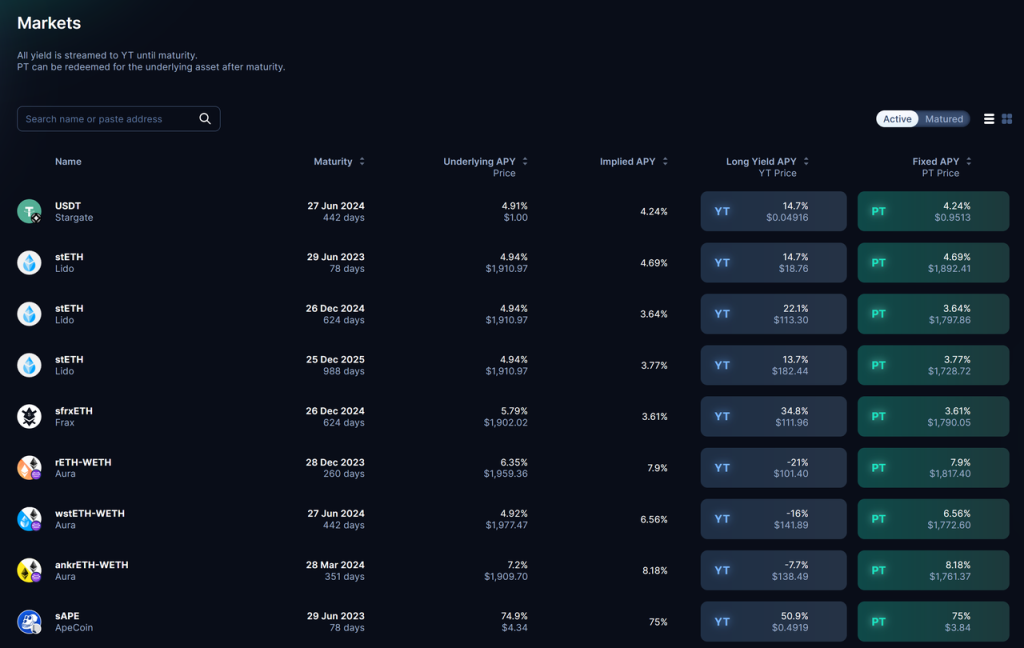
Source: https://app.pendle.finance/pro/markets?utm_source=landing&utm_medium=landing
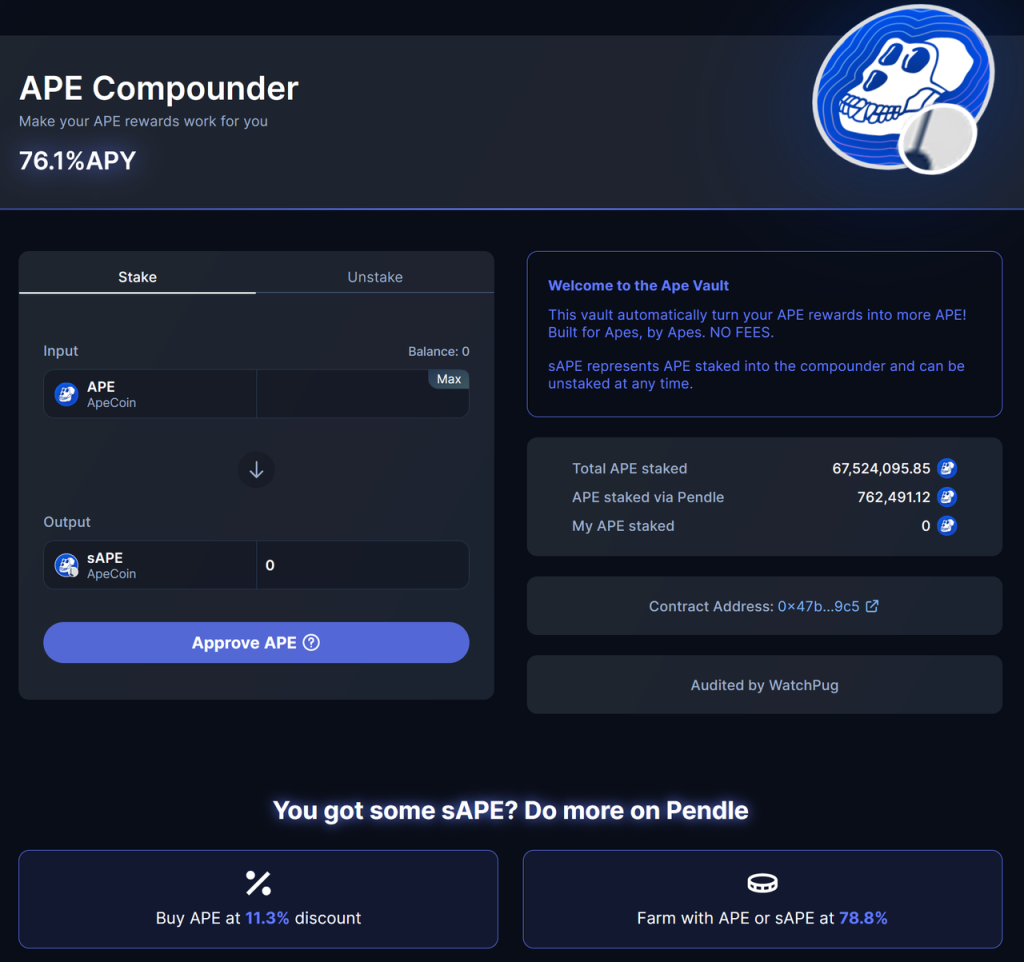
Source: https://app.pendle.finance/utilities/ape
Pendle’s business on Arbitrum involves the fourth direction: Incorporate other targets with higher returns and not too high risks, such as GLP and gDAI. GLP and gDAI are the liquidity tokens of derivative projects GMX and Gains Network respectively. GLP is composed of about 50% stable currency, 28% ETH, 20% WBTC and some other mainstream assets. Liquidity providers enter or exit the market by minting or burning GLP. The composition of gDAI is DAI. Both GLP and gDAI can earn handling fees, liquidation income, etc.
Source: https://app.pendle.finance/pro/markets?utm_source=landing&utm_medium=landing
So far, Pendle has not expanded the application scenarios of its own tokens, such as inviting other DAOs to manage treasury funds. This may be because Pendle hopes that users come here to directly use its services.
The previously estimated PP (Project Permissionless) plan, although affected by the closure of the partner Rari Capital and the strategic adjustment, has not been interrupted: a new token standard that can encapsulate most interest-earning assets: ERC-5115 has been launched to solve It solves the problem of LP tokens that were difficult to be packaged and tokenized in the past.
In addition, the cross-chain solution LayerZero and the decentralized exchange Kyber Network are also integrated to support products with higher yields that may appear on other chains.
3.3 Business Details
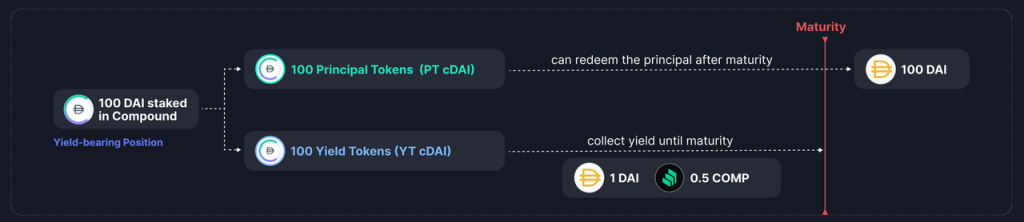
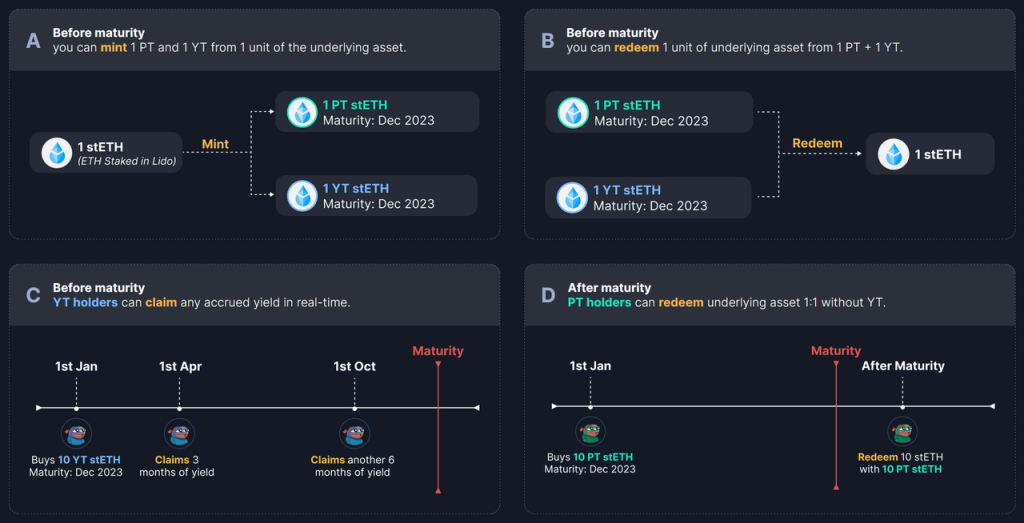
Pendle's income tokenization business, simply put, is to split the interest-bearing tokens into two parts: cost and income.
Taking DAI as an example, when the user deposits 100 DAI into Pendle, Pendle will first deposit the DAI into the compound to become 100 cDAI. Then, Pendle will package 100 cDAI into a standardized yield token sy-cDAI ( Standardized Yield , abbreviated as sy), and then split it into 100 principal tokens (principle token, abbreviated as PT) PT-cDAI and 100 Yield token (yield token, abbreviated as YT) YT-cDAI. Among them, each principal token PT-cDAI can be exchanged for one DAI after expiration; each YT-cDAI can be exchanged for cDAI income during the holding period.
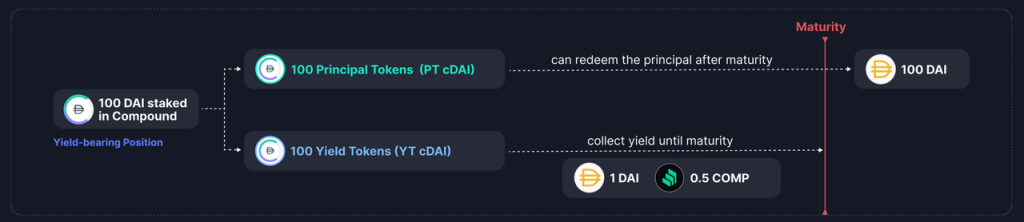
Source: https://app.pendle.finance/pro/learn?level=1
We can think of the principal token PT as a zero-coupon bond. The closer the expiration date is, the closer the price of PT is to the face value; the income token YT will obtain any income during the holding period. For example, YT-cDAI has loan income during the holding period, and also has the COMP incentive provided by Compound.
It is worth noting that in the above steps, YT+PT=SY.
From the perspective of business process, after the user deposits assets in Pendle, there will be several changes in total. Here we take the asset deposited by the user as ETH as an example:
The user deposits ETH, and in the "Zap" mode, Pendle will automatically exchange ETH for stETH through Kyberswap;
Pendle encapsulates stETH into sy-stTH. Standardized Yield (abbreviated as sy) is a token under the ERC-5115 standard, which can encapsulate most of the interest-earning assets. The token agreement is also the token standard designed by the Pendle team;
If the user chooses the "zero price impact mode", Pendle will split half of sy-stTH into yield token YT-stETH and principal token PT-stETH in the third step, and Combine PT-stETH and the other half of sy-stTH to form LP and put it into the pool, and the income token YT-stETH is stored in the user account; if the user does not choose the "zero price impact mode", Pendle will combine PT-stETH with When the other half of sy-stTH is combined into LP and put into the pool, YT-stETH is automatically sold, and the funds obtained are used to buy more PT-stETH. If the user selects "manual", the above steps need to be manually operated by the user.
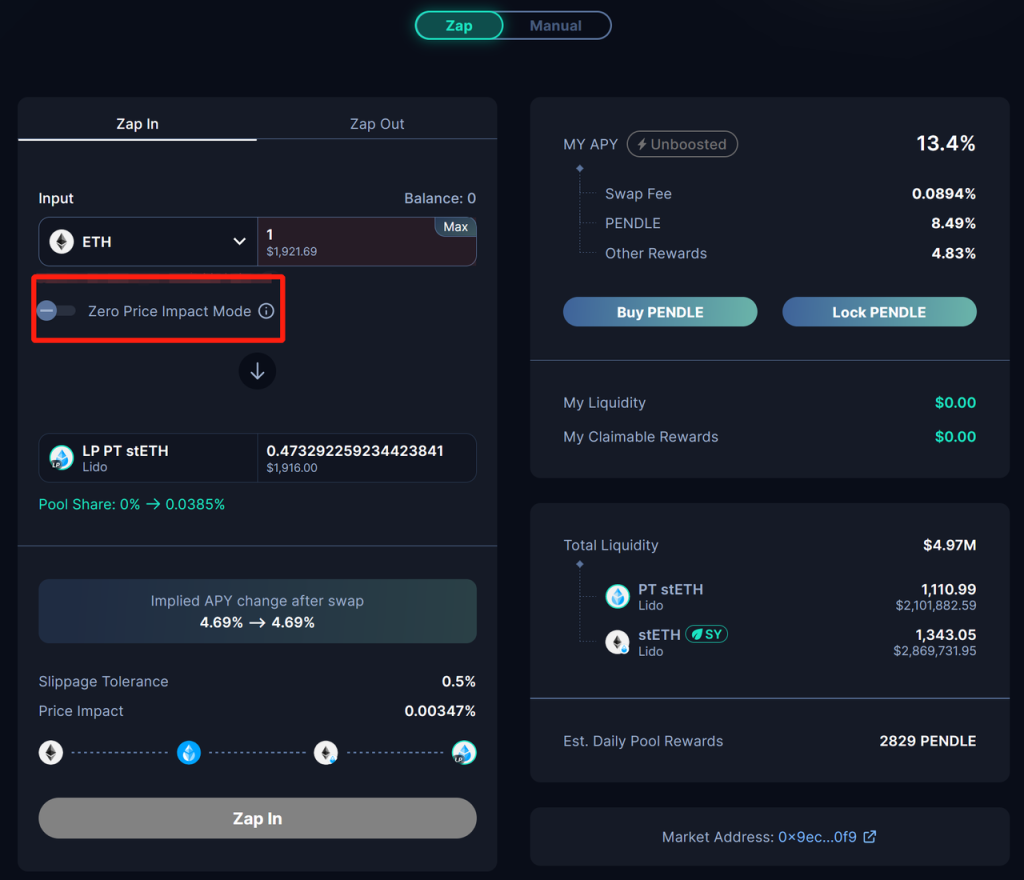
Source: https://app.pendle.finance/pro/pools/0x54e28e62ea9e8d755dc6e74674eabe2abfdb004e/zap/in
In addition to directly depositing assets to form LPs, users can also purchase PT and YT directly through Pendle.
Pendle uses the AMM mechanism to trade PT and YT, but this AMM mechanism needs to consider the PT, SY prices, and interest rate levels under the passage of time, which is different from the traditional Uniswap AMM mechanism.
In the V2 version, Pendle has improved the AMM mechanism and borrowed the AMM model of another fixed-income project—Notoinal Finance. The reason for this change is that Pendle found that the Notional Finance model has higher capital efficiency and less impermanent losses for users under the same liquidity conditions (the red curve in the figure below is the Notional Finance model; the black curve is The AMM model in the Pendle V1 version; the blue curve is the AMM model of other fixed-income projects, such as Element Finance and Sense Finance).
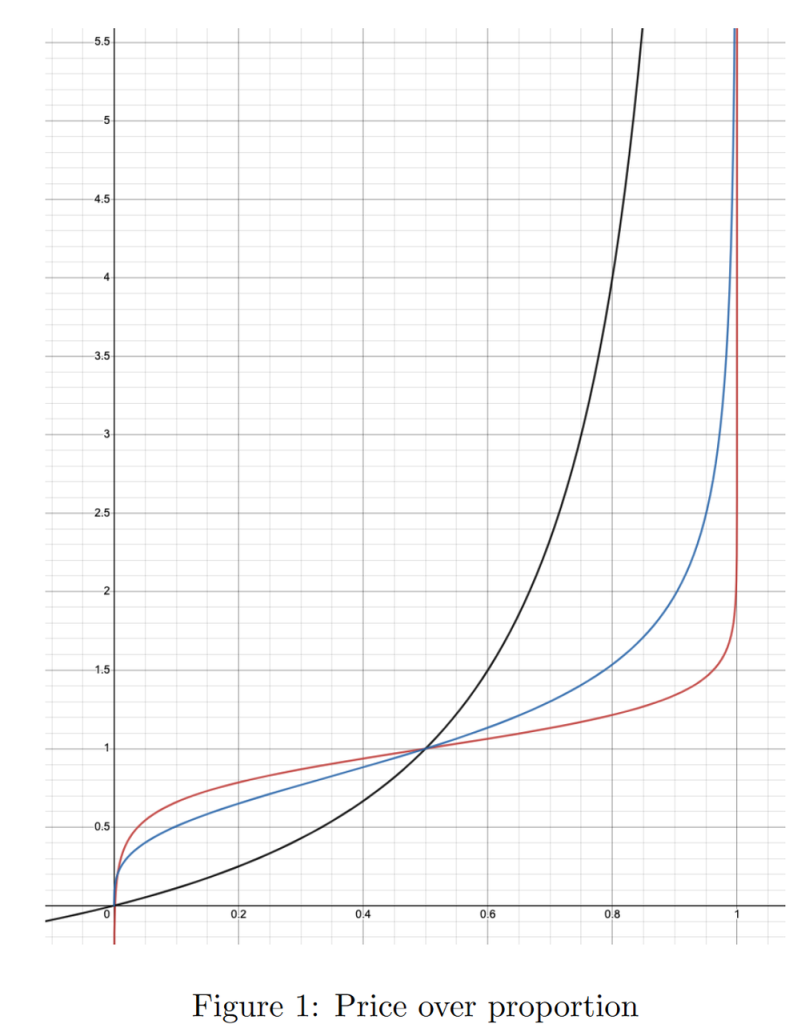
Source: https://raw.githubusercontent.com/pendle-finance/pendle-v2-resources/main/whitepapers/V2_AMM.pdf
In addition, the Notional Finance model, compared with the AMM model in the Pendle V1 version, can adjust parameters according to the interest rate range of different interest-earning assets, and develop a customized AMM model that is more suitable for different assets.

Source: https://raw.githubusercontent.com/pendle-finance/pendle-v2-resources/main/whitepapers/V2_AMM.pdf

Source: https://raw.githubusercontent.com/pendle-finance/pendle-v2-resources/main/whitepapers/V2_AMM.pdf
In the above model, adjusting the "rate scalar" can set the maturity time, which can improve capital utilization efficiency. If the maturity time is shorter, the liquidity will be more concentrated and the capital utilization efficiency will be higher. By adjusting the "rate anchor" to set the interest rate range, the efficiency of capital utilization can also be improved.
According to the backtesting situation, after using the new model, the capital efficiency of different underlying assets can be significantly improved compared with the V1 AMM model.
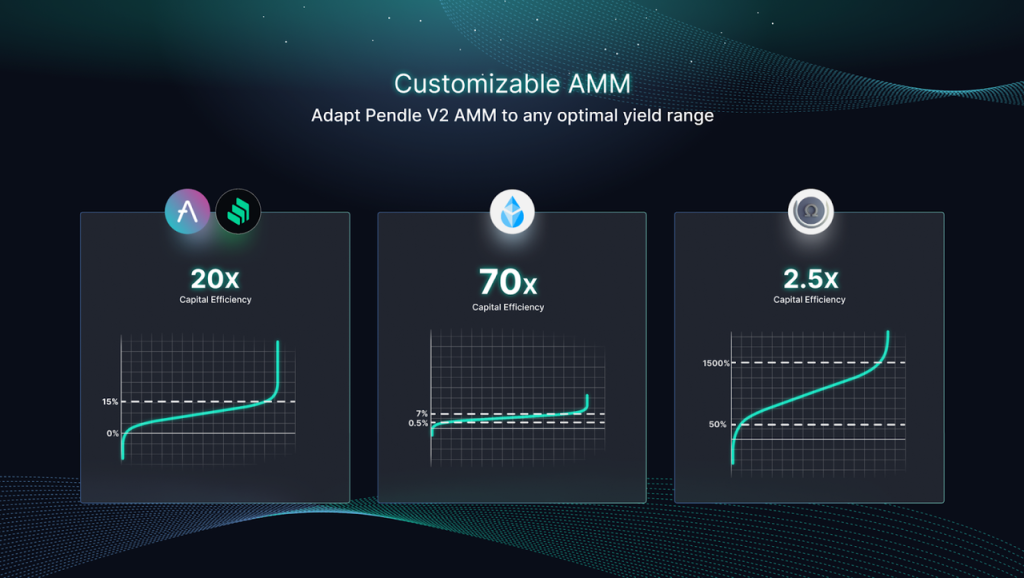
Source: https://docs.pendle.finance/PendlePro/HowItWorks/AMM
The original intention of this AMM model is to trade the principal token PT and the standardized income token SY. However, because YT+PT=SY, YT=SY-PT, this AMM model also supports the transaction of revenue token YT.
If the user wants to buy YT, the transaction process is as follows:
The buyer sends 1 SY into the transaction contract, hoping to buy YT;
The trading contract will draw N SY from the pool;
Split N SYs into N PTs and N YTs;
Send N YT to the buyer;
PT sent back to the pool.
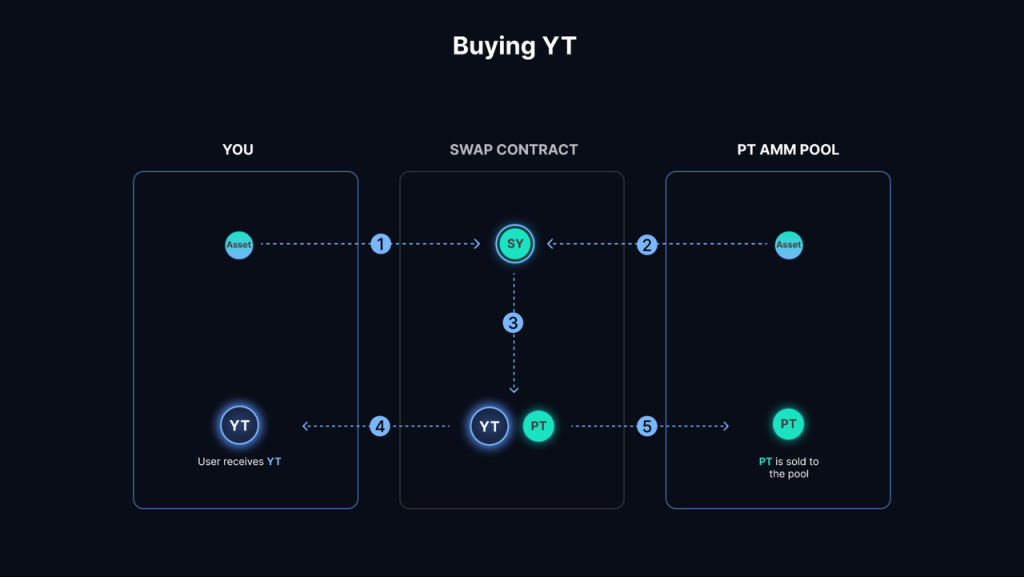
Source: https://docs.pendle.finance/PendlePro/HowItWorks/AMM
If the user wants to sell YT, follow the steps below:
The seller sends N YT into the transaction contract, hoping to sell YT;
The contract will lend N PT from the pool;
The contract synthesizes N YT and N PT into N SY;
A part of SY will be exchanged for PT and sent to the contract to repay the PT lent in step (2);
The remaining SY will be sent to the seller.
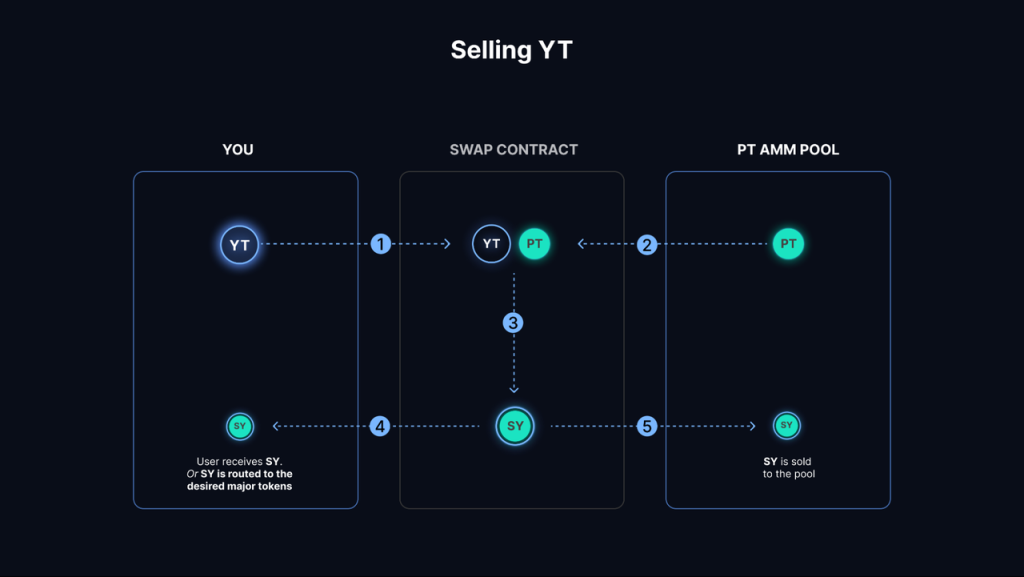
Source: https://docs.pendle.finance/PendlePro/HowItWorks/AMM
Therefore, although Pendle's AMM model supports the transactions of YT, PT and SY tokens, but when there is no YT transaction, there are only two types of assets in the pool, SY and PT.
Under such an AMM mechanism, several different investment strategies can be derived.
Source: https://app.pendle.finance/pro/learn?level=1
First of all, users can add liquidity to do LP, earn service fees and token incentives.
Because there are only two types of assets in the pool, PT and SY, and the price of 1 PT before maturity is less than 1 SY, and the relationship between PT and SY is based on the interest rate. Therefore, if you are a liquidity provider on Pendle, it can actually be regarded as providing a type of asset, that is, SY. Because LP=PT+ST=SY f(r)+SY=SY (1+f(r)), where 1+f(r)<2, f(r) represents a function of interest rate and is inversely related to interest rate Relevant because the higher the interest rate, the lower the PT price; the lower the interest rate, the higher the PT price. Therefore, as an LP in Pendle, it can be regarded as only providing assets such as SY, and it is believed that the interest rate level will decrease in the future, that is, the short interest rate.
At maturity, LP=PT+SY=2SY-YT.
Therefore, before maturity, there are four sources of income for LP:
Appreciation of PT
Partial transaction fee
excitation
Interest-earning income brought by the underlying interest-earning assets of SY
If LP is held until maturity, there will be no impermanent loss. Secondly, users can deposit interest-paying assets, sell YT after splitting into PT and YT, and lock in the yield; third, users can directly buy PT, which is equivalent to buying zero-coupon bonds, and make stable investments; fourth , users can buy YT directly, and gain greater profits by predicting the direction of yield changes.
In order to better guide users' transactions, Pendle gives two data for the probability of "interest rate":
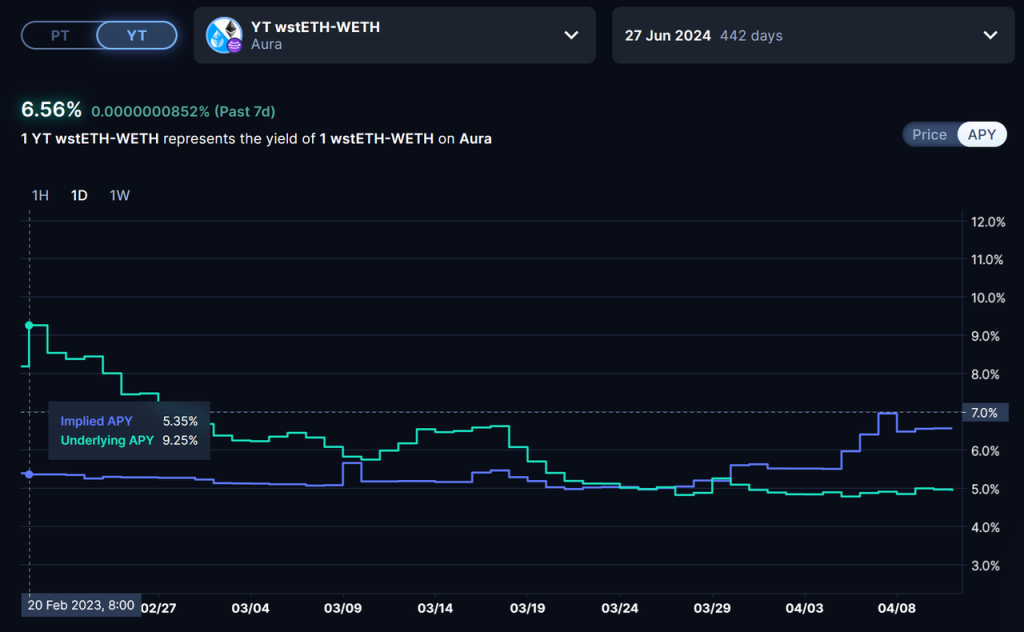
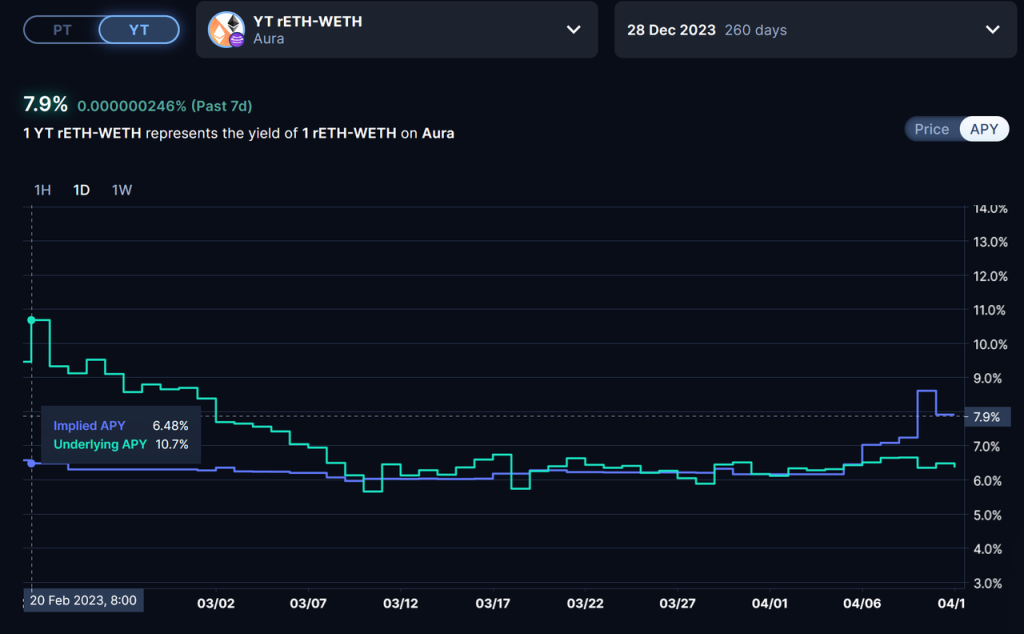
underlying APY, that is, the rate of return on holding assets;
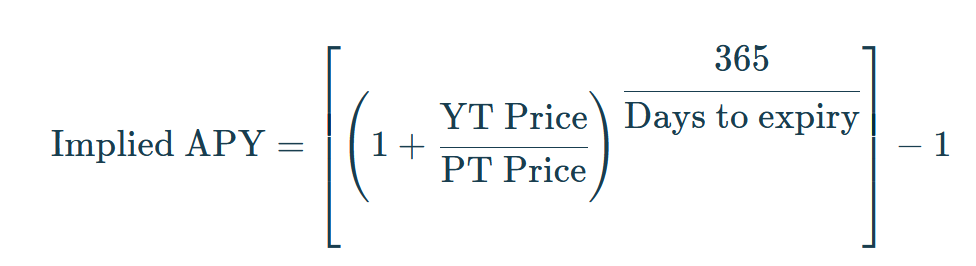
Implied APY, that is, the implied rate of return, the rate of return is the result of market transactions and is the expectation of future APY.
The implied APY is calculated as follows:
Source: https://docs.pendle.finance/FAQ/General#glossary
When underlying APY>implied APY, you can consider buying YT at this time, or selling PT and doing LP. However, it is possible that the convergence of underlying APY and implied APY is achieved through a decrease in underlying APY rather than an increase in implied APY;
When underlying APY<implied APY, you can consider buying PT, doing LP, or selling YT at this time. The way that underlying APY and implied APY converge may be realized through the decline of implied APY rather than the increase of underlying APY.
Source: https://app.pendle.finance/pro/markets/0xfcbae4635ca89866f83add208ecceec742678746/swap?view=yt
Source: https://app.pendle.finance/pro/markets/0x5546d0f27bed4075ea03a22c58f7016e24c94ea7/swap?view=yt
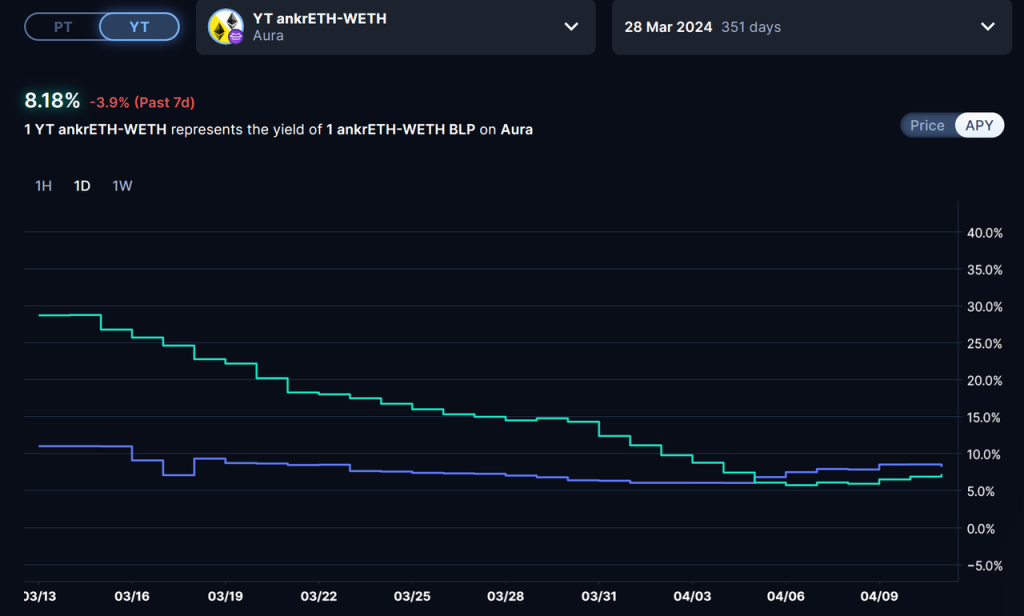
Source: https://app.pendle.finance/pro/markets/0x9a76925dd91a7561b58d8353f0bce4df1e517abb/swap?view=yt
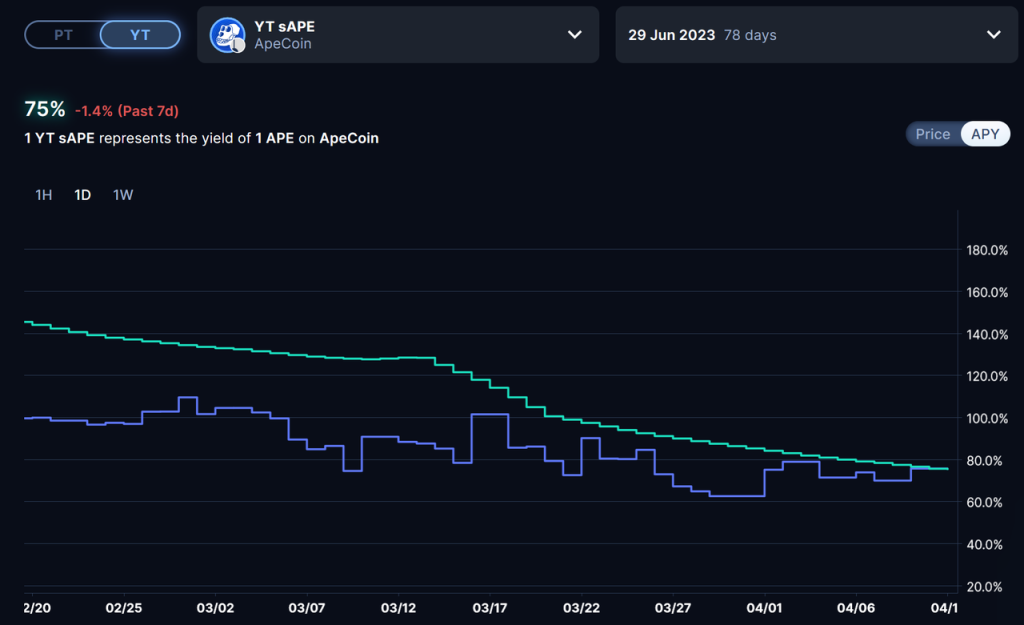
Source: https://app.pendle.finance/pro/markets/0x9a76925dd91a7561b58d8353f0bce4df1e517abb/swap?view=yt
The core of the relationship between implied APY and underlying APY is to consider the actual situation of the market. To predict the direction of APY, it is necessary to analyze the factors that affect the rate of return of the underlying assets.
Taking the interest-earning assets on the Ethereum chain as an example, there are currently three types of interest-earning assets that are LP tokens, including wstETH-WETH, rETH-WETH and ankrETH-WETH in Aura Finance. For these four types of assets, in addition to the token incentives from the corresponding projects, the factor that most affects the short-term rate of return is still LP handling fees.
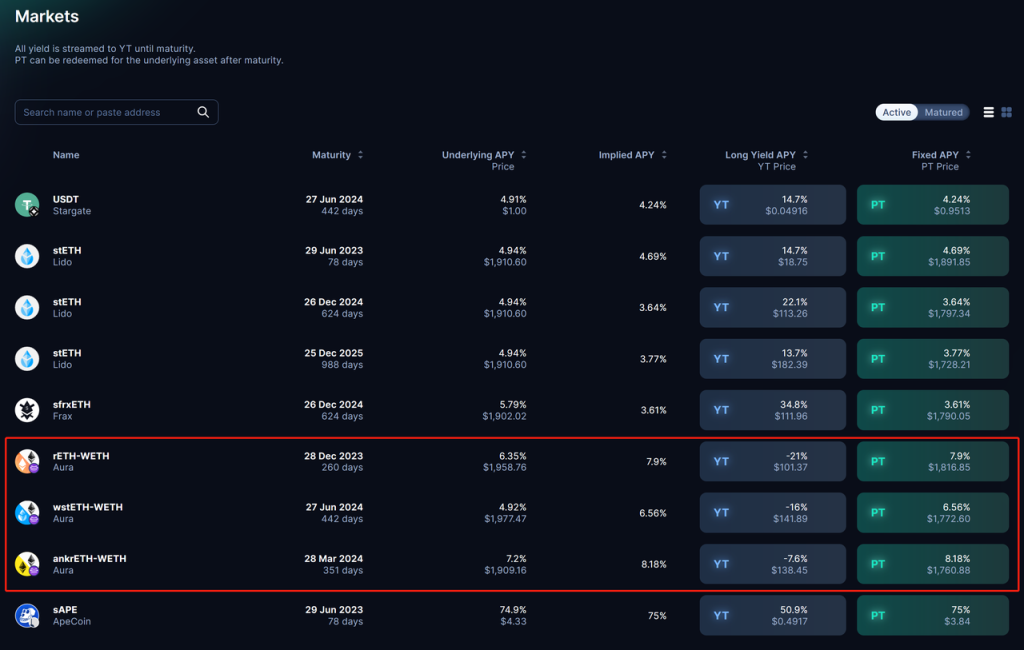
Source: https://app.pendle.finance/pro/markets
Observing the trading volume of the three trading pairs may be able to guide our judgment on the direction of yield.
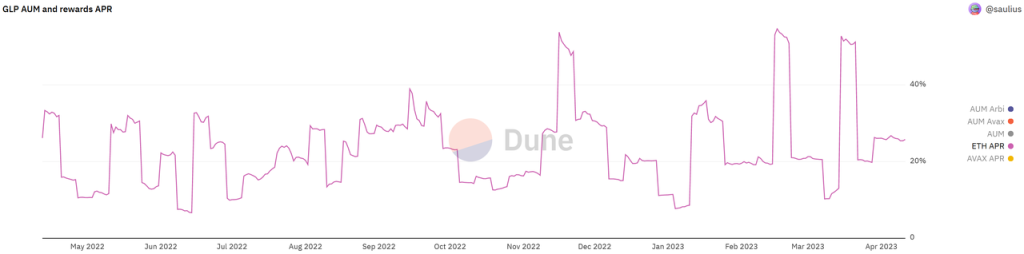
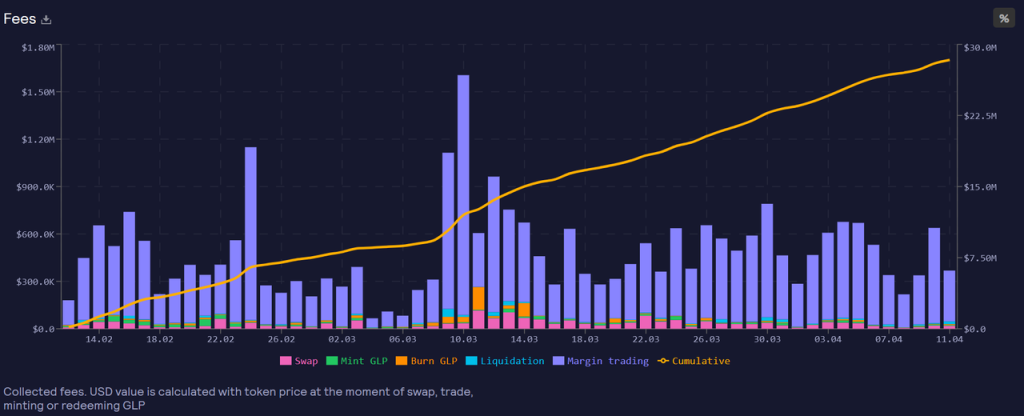
As can be seen from the four figures below, the transaction volume will increase in May, June, and November in 2022, and in January and March in 2023, and transaction fees will increase during this period.
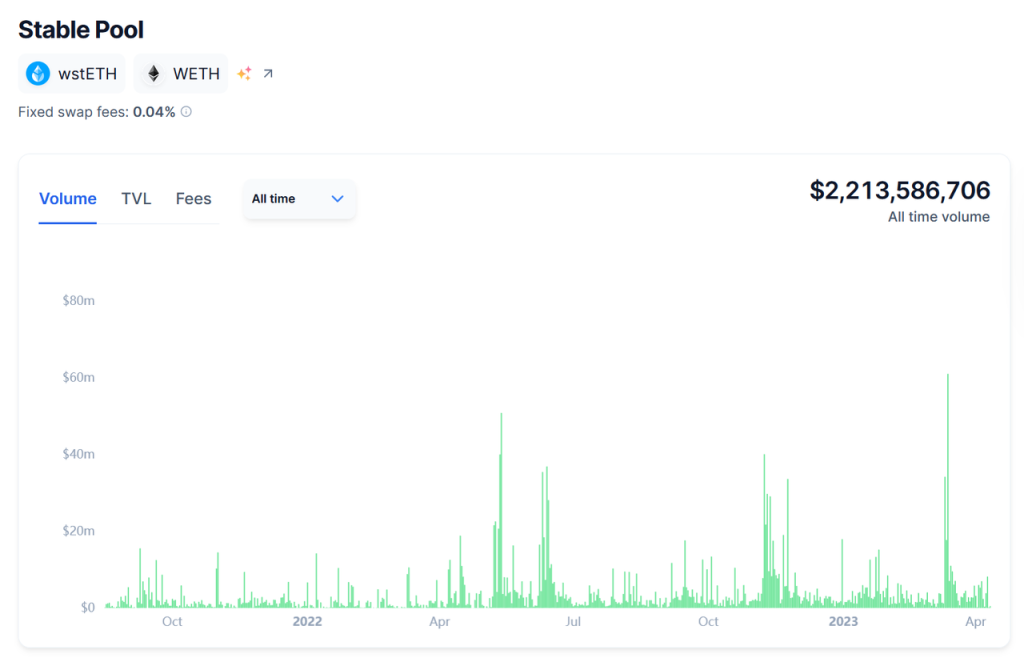
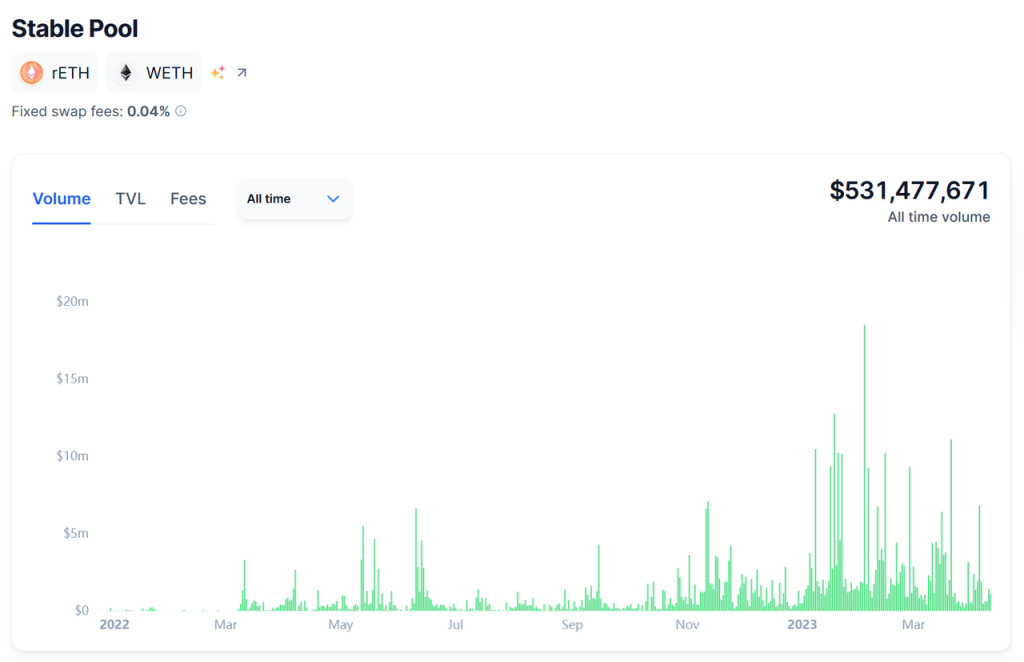
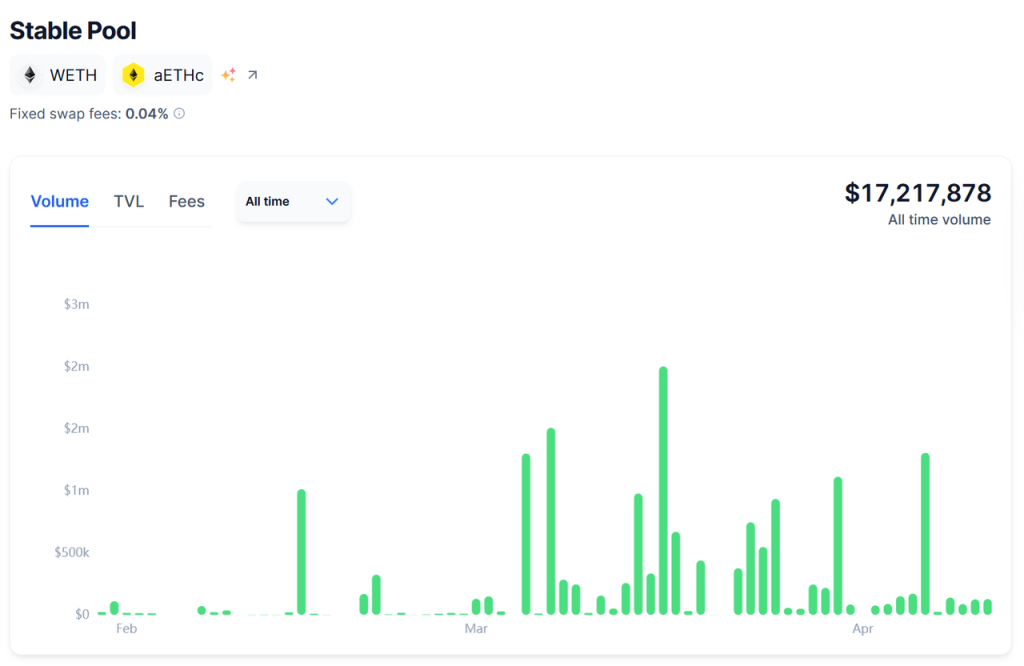
If you can anticipate the core factors affecting the market at that time, and make a timely judgment on the rise and fall of the yield after the event, you may have a better chance to guide the PT, LP and YT trading strategies in Pendle.
Source: https://dune.com/saulius/gmx-analytics
Source: https://stats.gmx.io/
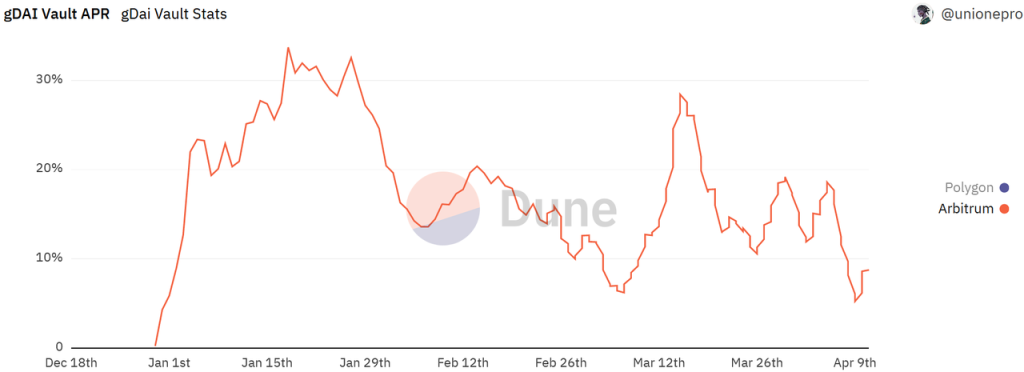
Source: https://dune.com/unionepro/Everthing-Gains-Network
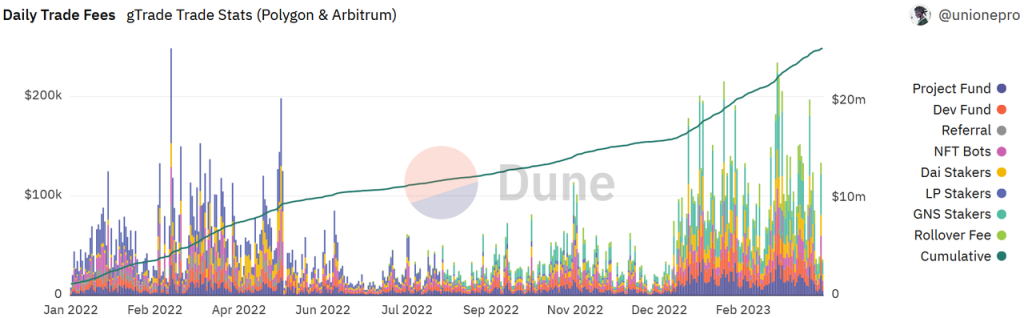
Source: https://dune.com/unionepro/Everthing-Gains-Network
The same principle also applies to GLP and gDAI transactions, but the net yield of GLP and gDAI, in addition to considering the transaction fee income brought by the transaction volume, also needs to consider the profit of the trader. If the overall profit of traders is more in the short term, the net income of GLP will be reduced, or even a loss.
For projects like APE, although they are still staking tokens, unlike public chain tokens such as stETH, the pledge yield of this type of tokens may be very high in the early stage, and then it will increase with the pledged tokens. The number increased and decreased rapidly.
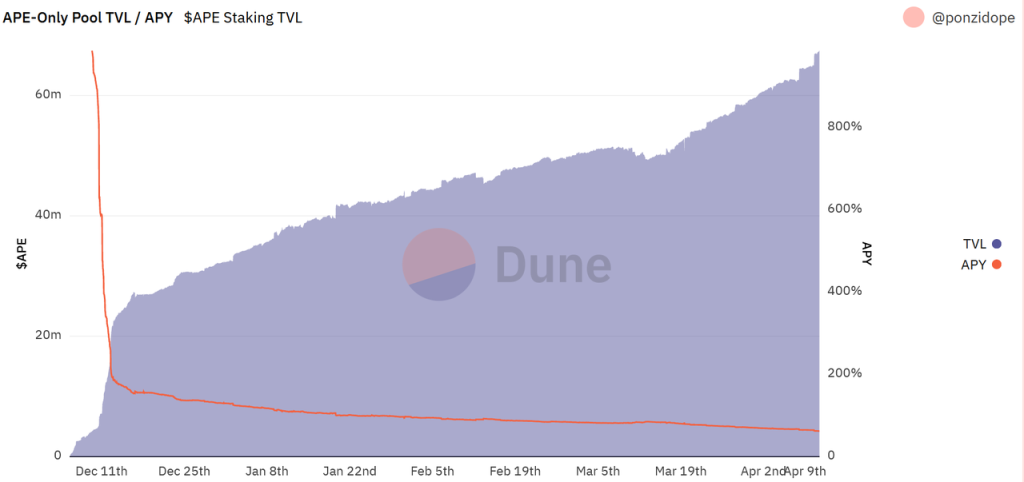
Source: https://dune.com/ponzidope/apecoin-staking-apy
Because PT and the rate of return show a negative correlation, and YT and the rate of return show a positive correlation, so the investment strategy for this type of token is to choose to observe the number of pledged tokens and the pledge rate of return. In the case of a rapid decline in yields, PT will rise significantly relative to SY in the short term.
If the investment rate of return is calculated based on the U standard, it is hoped that while SY is rising, the pledge rate will increase and the pledge rate will decrease. At this time, PT will be a good investment target. On the whole, according to the different attributes of the target, we can draw different investment strategies.
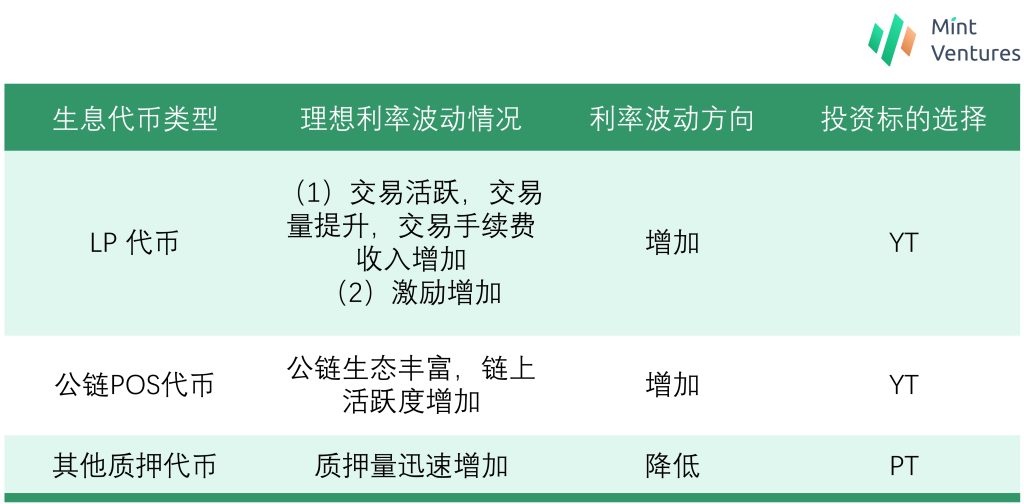
Source: Mint Ventures
3.4 Multi-chain deployment
In the V1 version, Pendle was deployed on Ethereum and Avalanche, and reached some cooperation with some projects on the two public chains.
For example, on Avalanche, it has reached a cooperation with BENQI and launched two pools, qiAVAX and qiUSDC. BENQI DAO has deployed USDC and AVAV worth USD 250,000 to Pendle's qiUSDC and qiAVAX pools; it has also reached a cooperation with Trader Joe, launched the xJOE pool, and established a PENDLE/AVAX pool in Trader Joe.
In the latest V2 version, Pendle is only deployed on Ethereum and Arbitrum at this stage. The reason for making such a choice may be related to the current ecological state of Avalanche:
Avalanche’s TVL is less than US$1 billion. Among its native DeFi projects, the project with the highest TVL is Benqi, which has a lock-up volume of approximately US$240 million, which is close to 600 million US dollars for Arbitrum’s current lock-up volume of nearly 2.3 billion and the largest TVL project—GMX. There is an obvious gap in warehouse volume. This point of view has also been positively responded by relevant people in the community.

Source: https://defillama.com/chain/Avalanche

Source: Ddiscord, Mint Ventures
3.5 Industry Space and Potential
3.5.1 Classification
Although Pendle itself is positioned in the fixed income market, judging from the changes in the V2 version, the Pendle team seems to have stratified the "on-chain fixed income market":
Represented by LSD, as a low-risk fixed-income market. The characteristics of this type of market are that the risk of the underlying assets is very low, the rate of return is relatively stable, and the cyclicality has little impact on the rate of return;
Represented by LSD's LP token and stablecoin LP token, it serves as a lower-risk fixed-income market. The characteristic of this type of market is that the risk of the underlying assets is low, but the cycle is relatively obvious, especially when there is high volatility in the market, the rate of return may be high at certain moments;
Represented by GLP and gDAI, as a medium-risk fixed-income market. This type of market is characterized by high returns and high risks at the same time. The returns are affected by derivatives traders on the chain and fluctuate violently with the market;
Represented by APE, as a high-risk fixed-income market. The characteristic of this type of market is that it fluctuates violently following the target, and the yield is high but may also fluctuate greatly. With the frantic influx of single project pledge users, the yield may plummet.
3.5.2 Market Size
- First look at the LSD market
Judging from the TOP 5 public chain projects that currently have the highest TVL ranking and can be pledged, the average pledge rate at this stage is about 35%. Public chains including Ethereum still have a lot of room for growth.
If the pledge rate level of more than 50% expected by the market is reached, then the pledge market growth rate of the leading public chain will be even higher. Taking Ethereum, which currently has the highest market value and the most mature ecology, as an example, its liquid mortgage derivatives account for about 33%. If the pledge rate of Ethereum increases to 50% in the next three years, about 16.5% of ETH will eventually form derivatives such as stETH. According to the current market estimate of about US$230 billion in Ethereum, the market size of LSD can reach about US$38 billion.
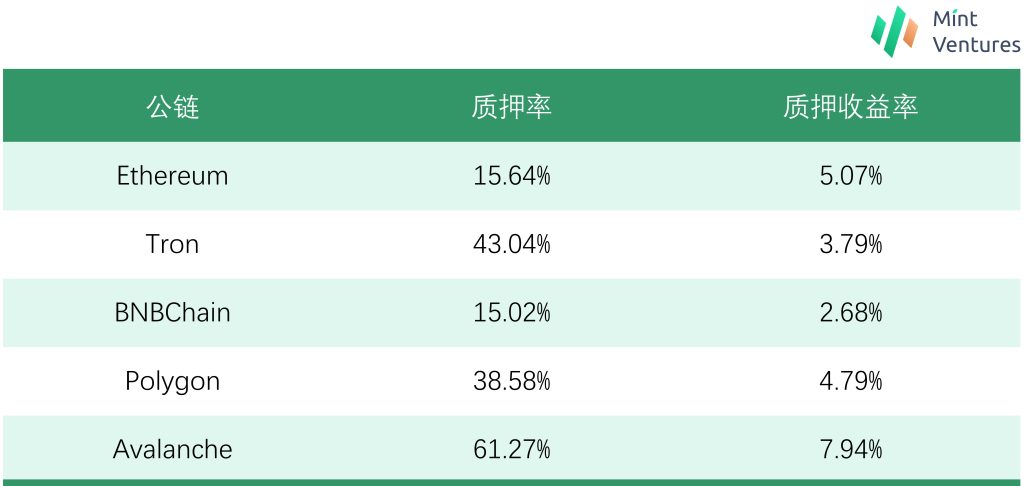
Data source: StakingRewards, Mint Ventures, data as of April 11, 2023
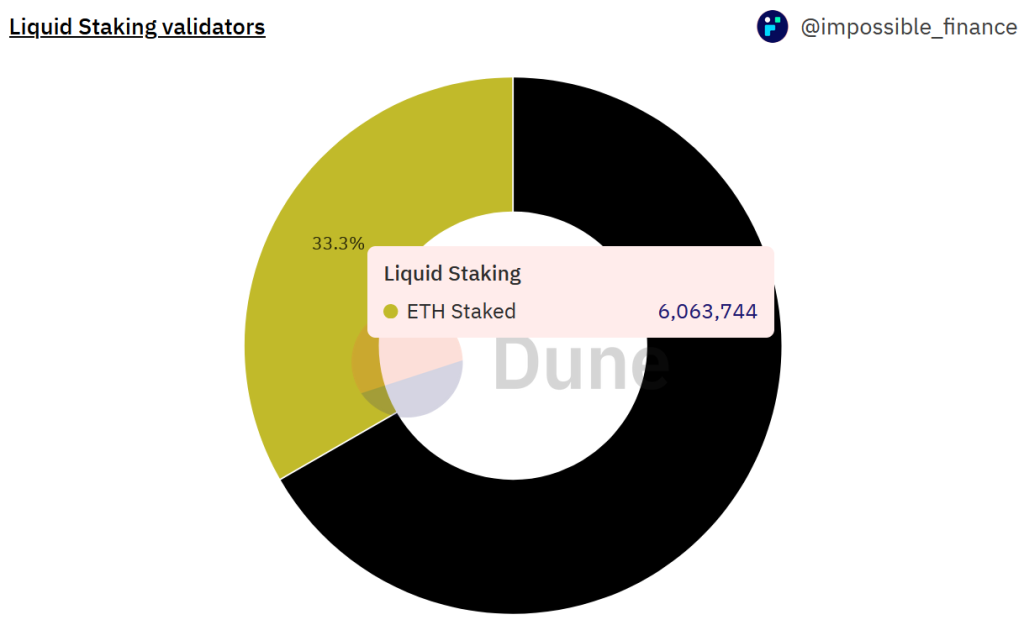
Source: https://dune.com/impossiblefinance/liquid-staking-derivatives
- Second, let's look at the LSD LP token market
In the liquidity staking track of Ethereum, Lido accounted for about 73.4%. About 14% of Lido’s liquid mortgage derivatives entered Curve.
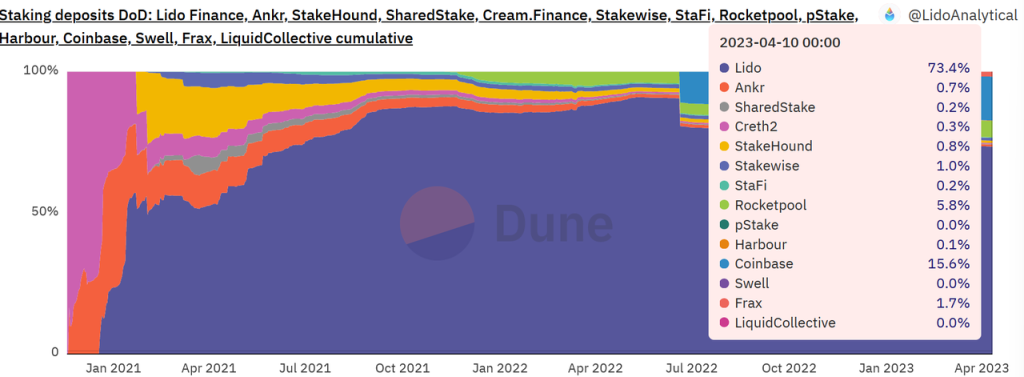
Source: https://dune.com/LidoAnalytical/Lido-Finance-Extended
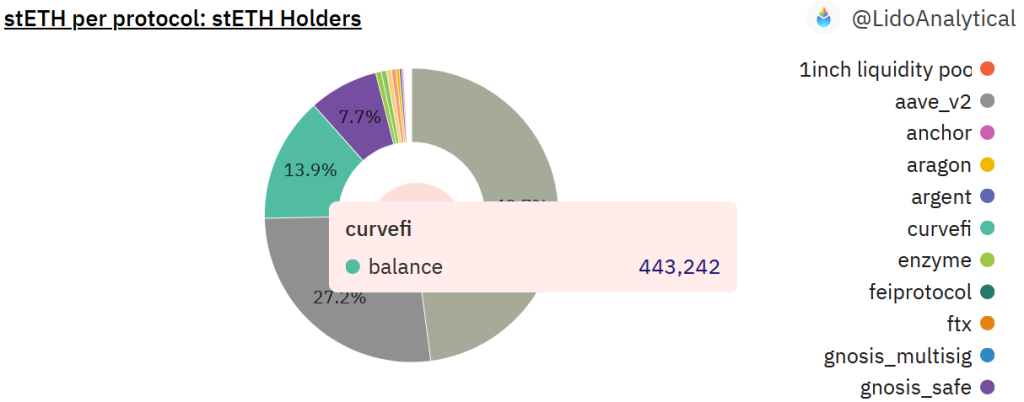
Source: https://dune.com/LidoAnalytical/stETH-deposited-per-protocol
If Lido’s market share does not decline significantly in the future, and the destination of LSD in DEX is mainly Curve, then about US$3.9 billion of LSD will form LPs in Curve in the future, and the corresponding market value of LP is about US$7.8 billion. Then the total size of LSD+LSD LP is close to 46 billion US dollars. This scale will further increase as the market capitalization of Ethereum increases, the pledge rate increases, and more and more LSD will be added to the DEX.
Demand in the fixed income market for LSD and LSD LP tokens was strong. After the corresponding asset pool in Pendle was launched, TVL has reached a scale of 24 million US dollars so far.
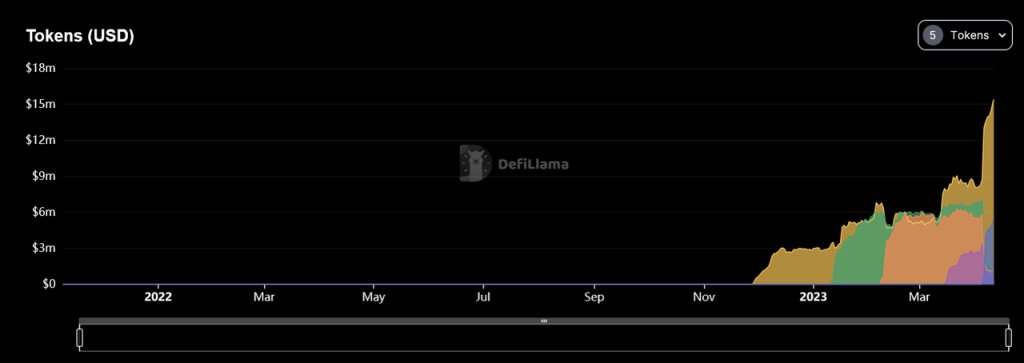
Source: https://defillama.com/protocol/pendle
- The third is the LP token market for stablecoins
Although stablecoin trading is active, it seems that the market is not enthusiastic about stablecoin-based LP tokens. This type of pool has been online for more than a year, and the overall liquidity is declining. It can also be seen from Pendle’s new pool strategy that stablecoin LP may not be the focus of Pendle’s next stage.
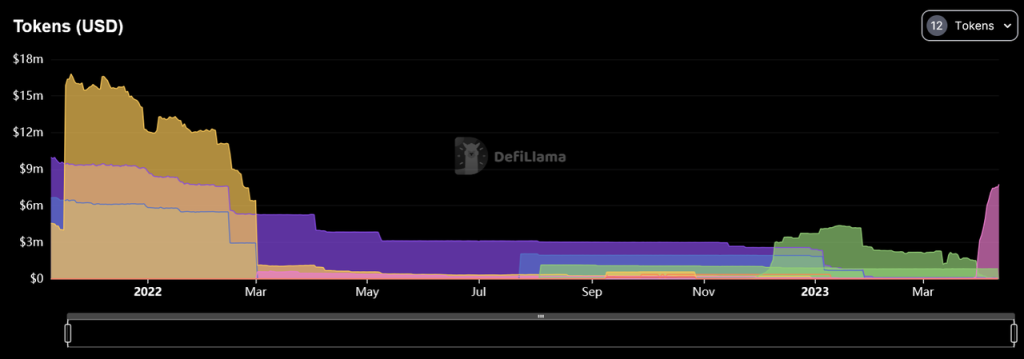
Source: https://defillama.com/protocol/pendle
- The fourth is the medium risk market of GLP and gDAI
The needs of this type of market are relatively clear. From the establishment of the pool to the present, there has been a TVL of about 20 million US dollars, compared with the total market value of GLP of 530 million US dollars. On the one hand, it is due to the token incentives given by Pendle, on the other hand, there is a stronger demand for speculation and risk hedging in the market.
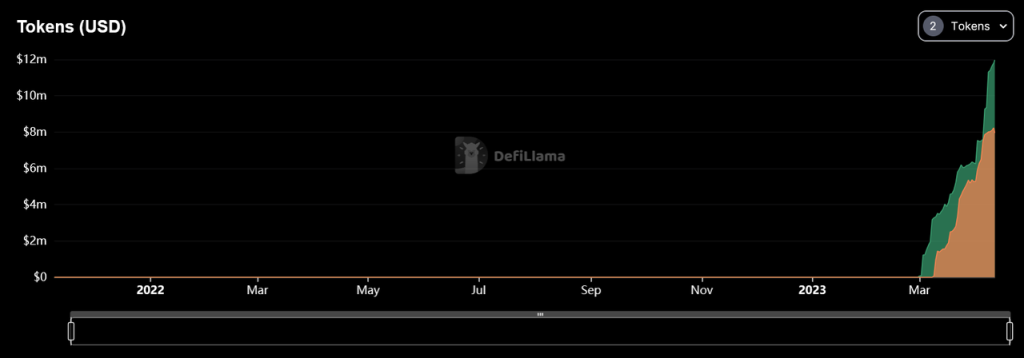
Source: https://defillama.com/protocol/pendle
Whether it is GLP or gDAI, the current PT yield is attractive. Just buying and holding PT can lock in the rate of return when the rate of return is high, which is attractive enough for some conservative investors, and the rate of return is higher than the long-term holding rate of GLP. The same reasoning applies to gDAI.
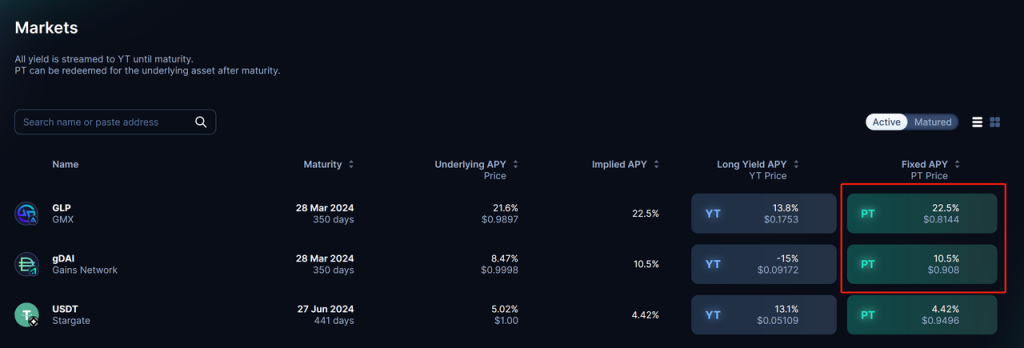
Source: https://app.pendle.finance/pro/markets
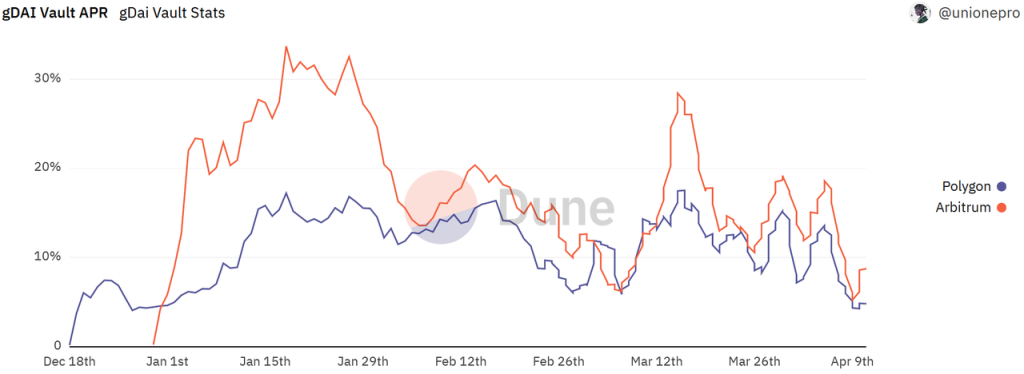
Source: https://dune.com/unionepro/Everthing-Gains-Network
However, among similar derivatives at present, only GMX and its imitation disk have run through the business scale. Therefore, the development space of this part of the business is limited by the development of this type of project. In the short term, the market space may be within US$1 billion.
- Finally, there are high-risk fixed-income markets such as APE and LOOKS
The development of this type of market is not only related to the market value of the token itself, but also related to the rate of decline in pledge revenue. If the rate of return on pledges declines too fast, it will be difficult to grow the size of this type of pool.
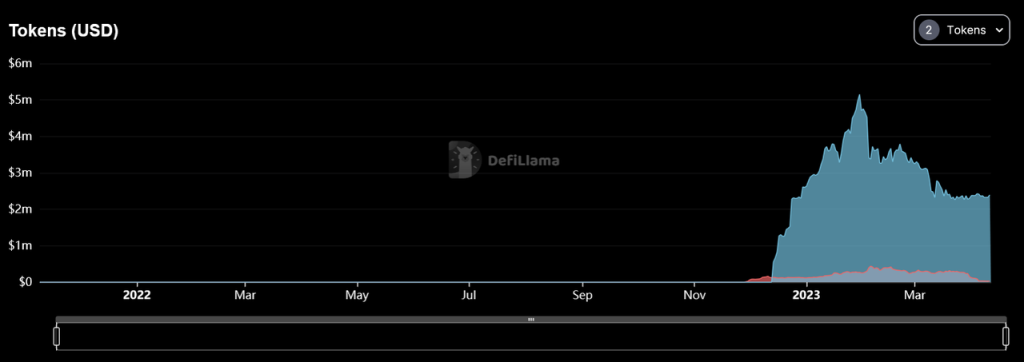
Source: https://defillama.com/protocol/pendle
However, the strategy of this type of pool may not be to expect a single pool to grow to a large market value, but to compete for speed: once a token with a higher market value and higher pledge income appears, it should quickly deploy the fixed income of the token transaction pool. A single pool may end up with a TVL of only a few million to tens of millions of dollars, but since there are a series of similar pools, the combined TVL will be relatively high.
Whether it is low risk or high risk, there are other strategies with different risks and benefits in the market, which can be included in the scope of Pendle in the future.
3.6 Business data
The current TVL of Pendle is approximately US$55.32 million, of which the business of Avalanche has been suspended, and there are still some unexpired assets left, with a TVL of US$960,000. There is a TVL of $28.71 million on Ethereum and about $25.65 million on Arbitrum.
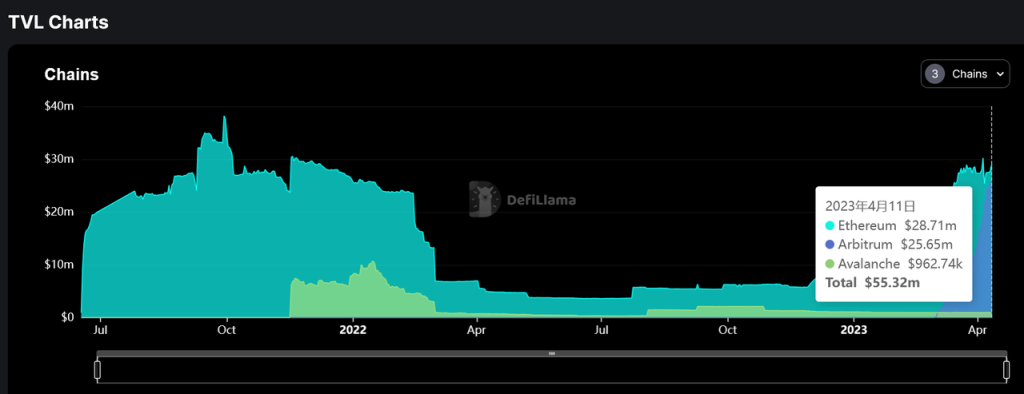
Source: https://defillama.com/protocol/pendle
Among the 12 existing pools, there are a total of 7 pools related to LSD, and TVL accounts for more than half.
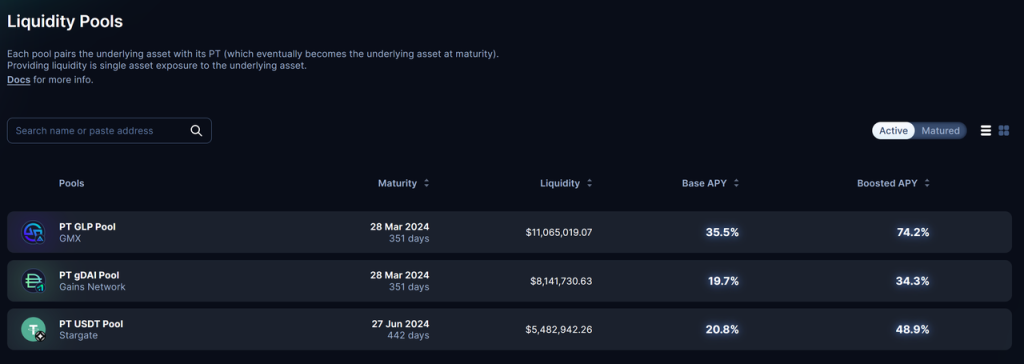
Source: https://app.pendle.finance/pro/pools
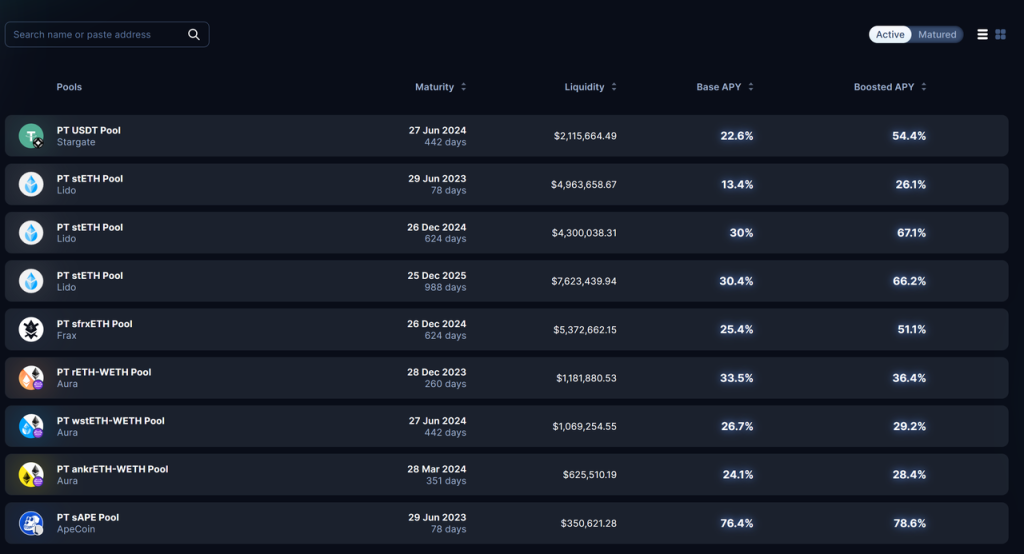
Source: https://app.pendle.finance/pro/pools
The current weekly trading volume is about 10 million US dollars, and the highest peak has reached a weekly trading volume close to 1.1 million US dollars.
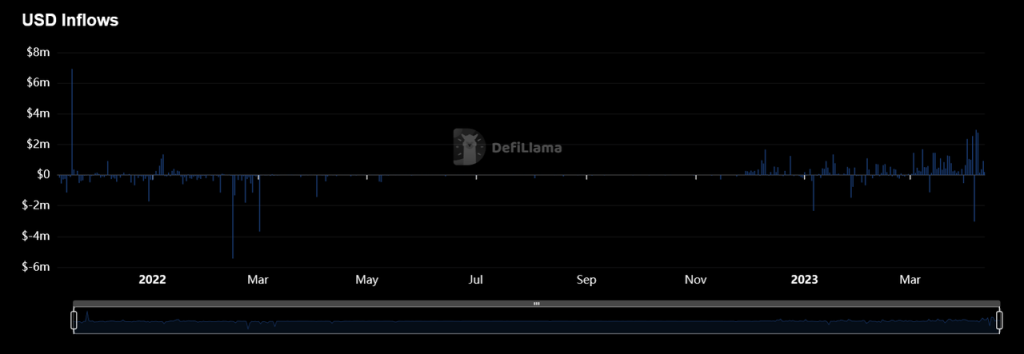
Source: https://defillama.com/protocol/pendle
3.7 Project Competition Landscape
There are also Swivel Finance, Delv (Element Finance), APwine and Sense Finance that are based on income tokenization and deeply cultivate the fixed income market. The differences between them can be seen from the two simple dimensions of TVL and product line.
3.7.1 TVL
After experiencing the bear market in 2022, the TVL of a large number of projects has plummeted, and the track where Pendle is located is no exception. At present, only Pendle has a TVL in the tens of millions, and Delv's TVL is in the millions. The TVLs of the other three projects have hovered in the hundreds of thousands or even tens of thousands of dollars.
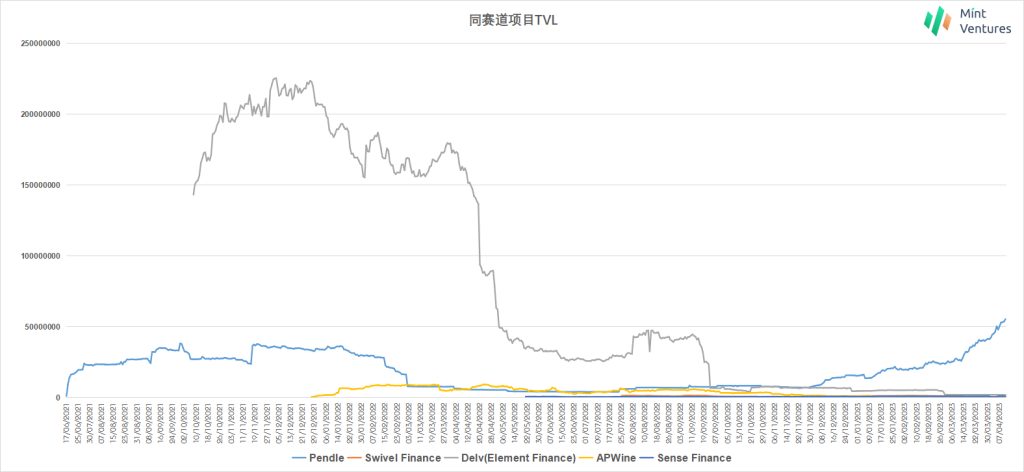
Source: DeFi Llima, Mint Ventures, data as of April 11, 2023
3.7.2 Product line
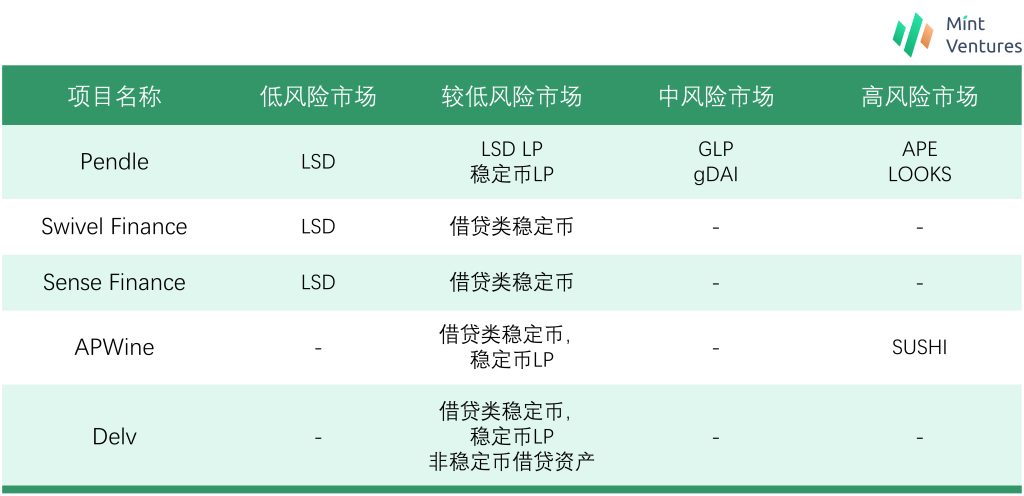
Source: Project websites, Mint Ventures, data as of April 11, 2023
Judging from the distribution of product lines, APWine and Delv did not choose the right target. In the current encryption ecosystem, only LSD has no counterparty risk and can support long-term value capture.
It is a good strategic move for Swivel Finance and Sense Finance to incorporate LSD into the underlying assets, but they can also try to incorporate LSD’s LP tokens or LSD’s lending tokens into the ecology. Taking Lido as an example, 15% of its stETH is in Curve As an LP in China, nearly 30% of stETH is used as collateral in Aave.
Using LSD as a low-risk market can ensure that the project still has a relatively good rate of return during the bear market, and using "medium-risk" and "high-risk" assets as a more aggressive strategy can cater to the needs of users when the market is hot. The distribution of asset pools is more appropriate. At present, Pendle has the most abundant product line, and new product lines, such as GLP and gDAI, have also been recognized by the market, and TVL has grown rapidly. On the whole, Pendle temporarily occupies the leading position in the track.
3.8 Token Model Analysis
3.8.1 Total amount and distribution of tokens
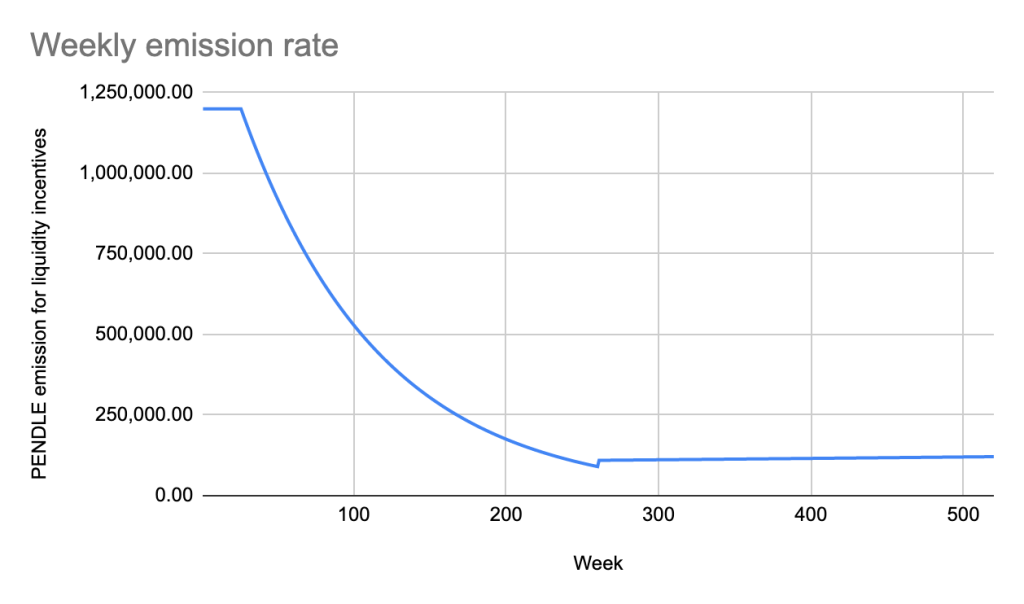
There is no upper limit on the token supply of PENDLE, and the release is divided into 3 stages:
The first 26 weeks: release 1.2 million PENDLE per week;
Weeks 27 to 260: 1% reduction in weekly release;
Starting from week 261: the inflation rate will be 2% per year in the future, which will be used to motivate users.
Source: https://medium.com/pendle/pendle-tokenomics-3a33d9caa0e4
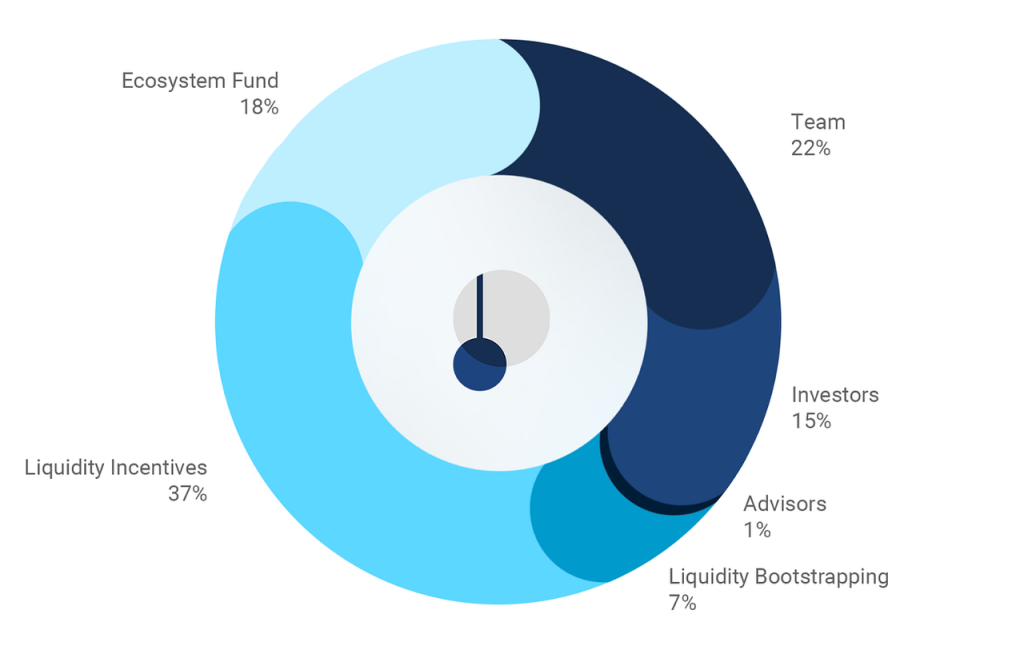
Two years after PENDLE was launched, the distribution of tokens is as follows:
Source: https://medium.com/pendle/pendle-tokenomics-3a33d9caa0e4
Among this:
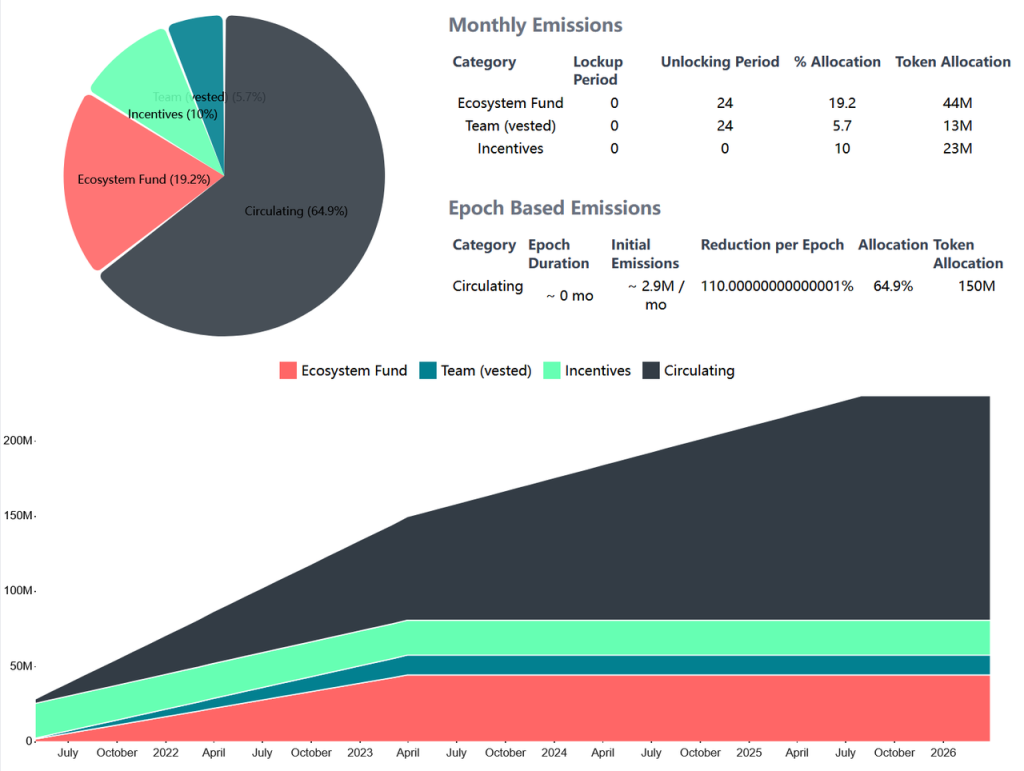
Tokens held by the team: they will be unlocked quarterly and linearly one year after the tokens are launched, and will be unlocked in two years. According to the latest situation, all will be unlocked in April 2023;
Tokens held by investors and consultants: 3 months after the launch of liquidity mining incentives, they will be unlocked linearly, and they have all been released;
Ecological Fund: 50% of the tokens will be unlocked after they go online, and 50% will be unlocked linearly after one year.
Source: https://www.tokenomicshub.xyz/posts/pendle
3.8.2 Token Value Capture
In the V1 version, PENDLE is just a utility and governance token, and its main function is to participate in project governance. However, at that time, the Pendle team had noticed the advantages of the Ve model in governance, and left a window for improving the token mechanism with reference to the Ve model.
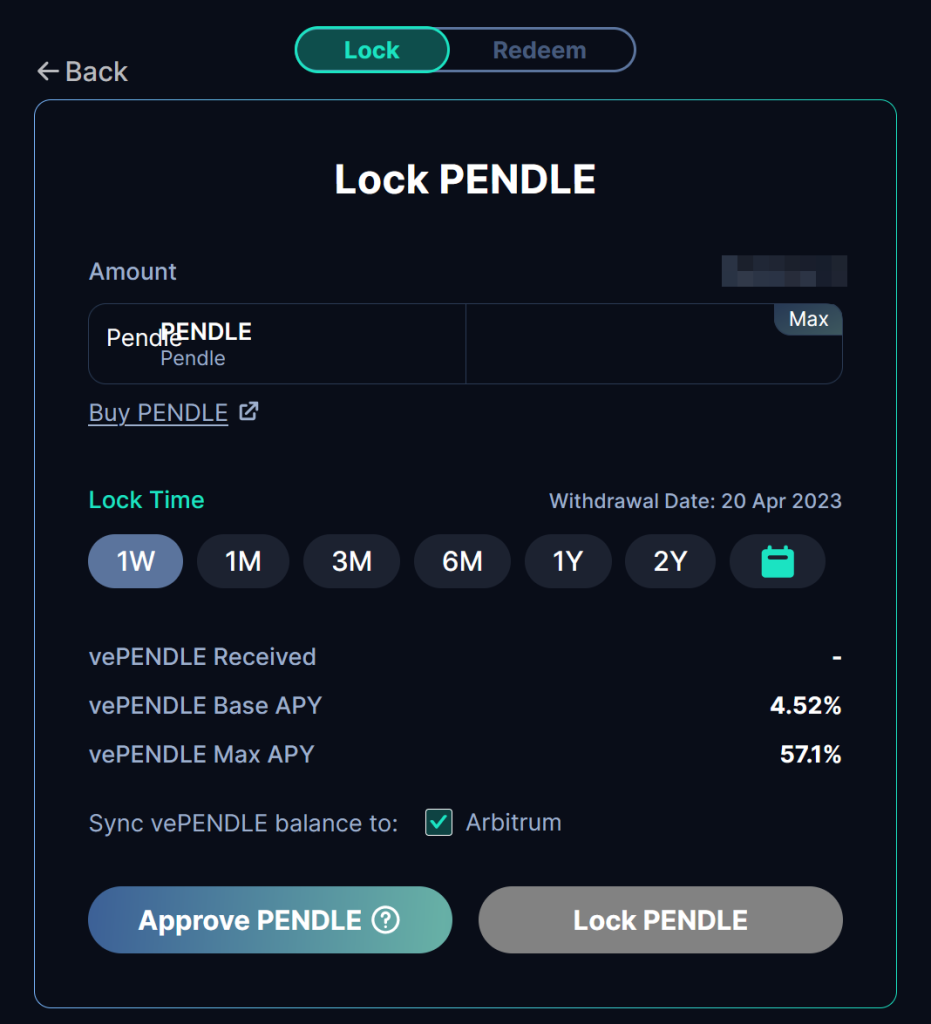
In the V2 version, the Pendle team officially introduced the Ve model into the PENDLE token, so that the PENDLE token has the ability to capture value.
Source: https://app.pendle.finance/vependle/lock/update
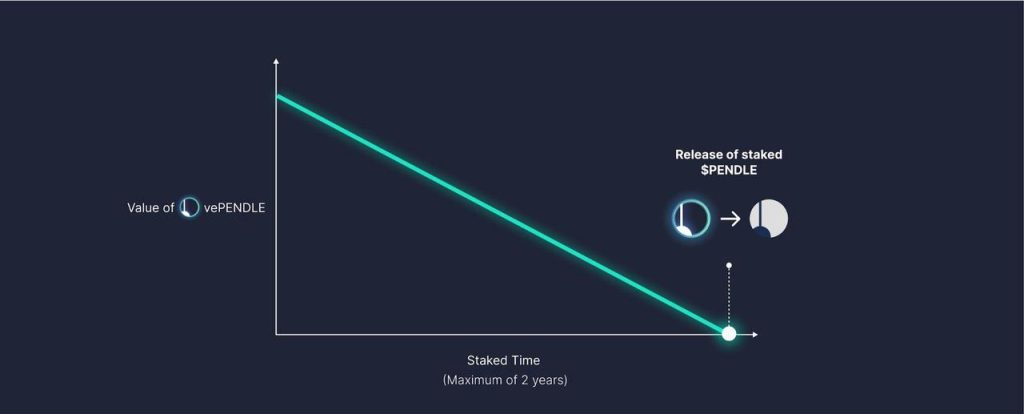
The user can choose the shortest lockup period of 1 week and the longest period of 2 years. Like veCRV, vePENDLE will decrease in value over time.
Source: https://docs.pendle.finance/Governance/vePENDLE
In terms of value capture, first of all, holders of vePENDLE can participate in the distribution of handling fees and income.
Holders of vePENDLE can vote to decide which pool to reward and get part of the income in the pool: 3% of the income from YT will be distributed to the vePENDLE holders who voted for the pool. If the PT is not redeemed by the user after the expiration, the income generated after the expiration will also be distributed to the vePENDLE holders who voted for the pool.
Most of the current pools on the Ethereum chain are ETH liquid mortgage derivatives, with a TVL of about 24 million US dollars. Assuming that these assets provide an annualized rate of return of 5%, vePENDLE holders can be allocated to: 2400*5%*3%=36,000 USD;
Currently, in the pool on the Arbitrum chain, there are only GLP and gDAI, and the TVL is about 20 million US dollars. According to the past data of the two projects, assuming that these two projects can provide an annualized rate of return of 15%, vePENDLE holders can distribute To: 2000*15%*3%=90,000 US dollars. In addition, 80% of the transaction fees generated by each pool will be distributed to the vePENDLE holders who voted for the pool.
Since the beginning of the year, the average daily transaction volume of Pendle is about 400,000 US dollars, and the transaction fee rate is 0.1%. If the average daily transaction volume remains unchanged and calculated according to this ratio, the annual income that can be provided to vePENDLE holders is: 40 **365**0.1%*80%=$117,000.
If there are no significant changes in the business, vePENDLE will generate approximately $243,000 in total revenue in one year. Secondly, in addition to charging fees and benefits, if the holder of vePENDLE is also an LP, they can get up to 250% of Pendle emission incentives.
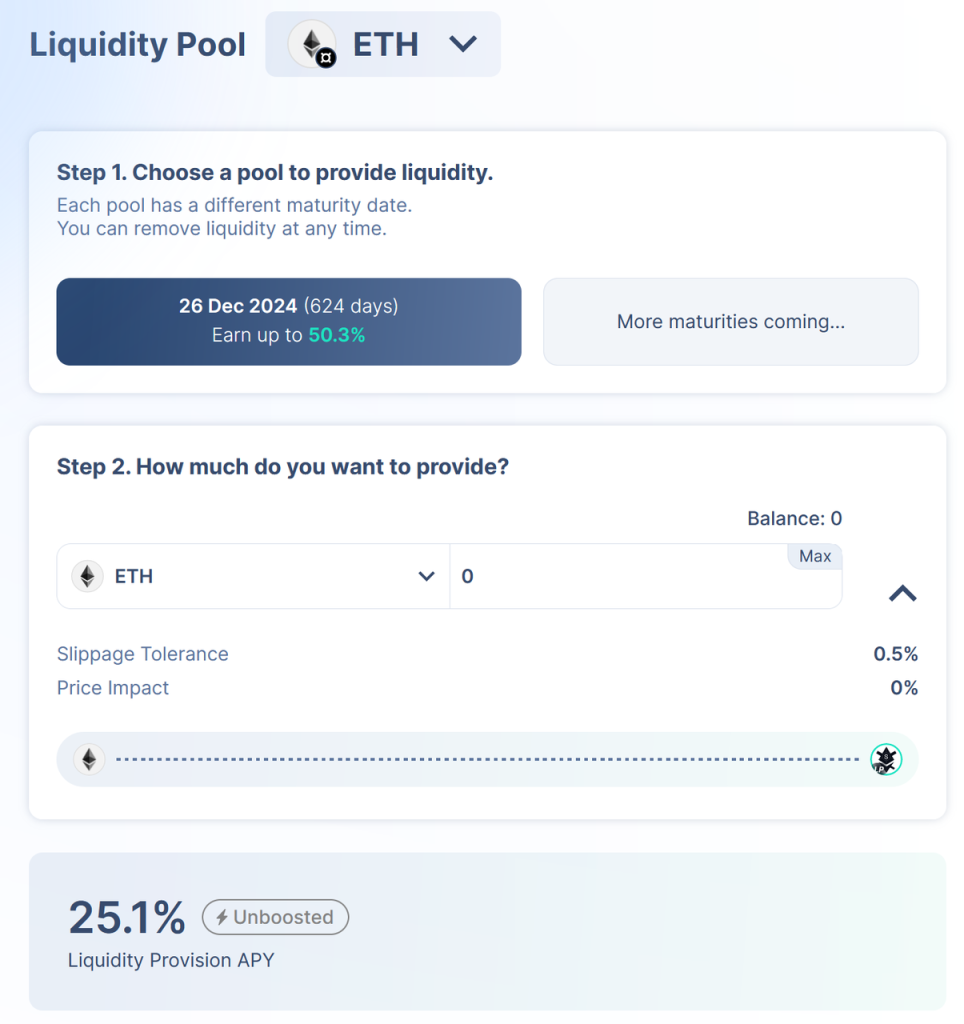
Taking the sfrxETH pool as an example, the basic rate of return for users as LPs is 25.1%, and under the incentive of vePENDLE, they can obtain a maximum rate of return of 50.3%.
Source: https://app.pendle.finance/simple/pools/0xfb8f489df4e04609f4f4e54f586f960818b70041
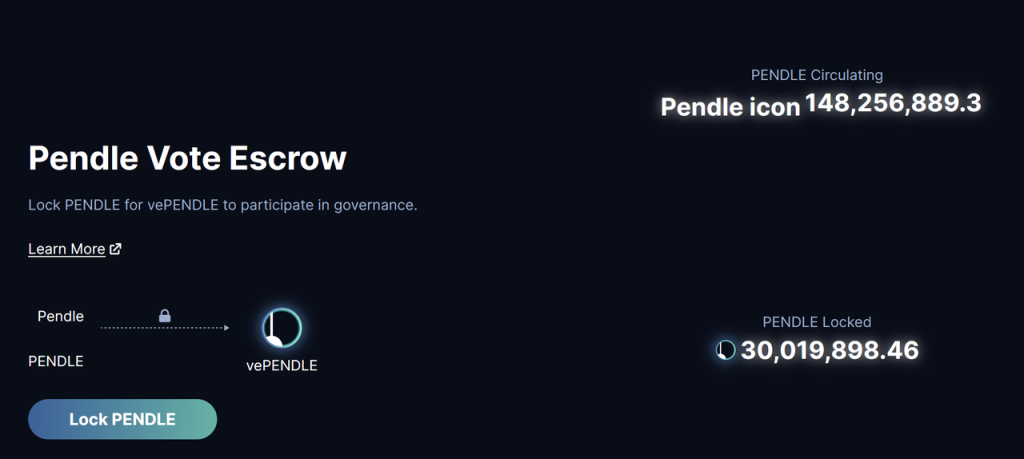
The significant increase in yield also stimulated the lock-up scale of PENDLE. Currently, 30.02 million PENDLEs are locked, which is close to 1/5 of the total amount of PENDLEs currently in circulation.
Source: https://app.pendle.finance/vependle/overview
3.8.3 Token core demand side
After adopting the vePENDLE model, the demand side for PENDLE becomes more diverse:
Liquidity Provider (LP): For LPs, the adoption of vePENDLE will significantly increase the rate of return. Some investors may choose to buy PENDLE and lock their positions. At the same time, vePENDLE can also obtain the income of the pool and part of the handling fee;
Long-term investors of PENDLE tokens: Since PENDLE can obtain service fees and revenue sharing, PENDLE has become attractive to some investors who want to obtain long-term cash flow, and this part of investors may also include PENDLE tokens own investment scope. However, considering that the current estimated annual income of vePENDLE is only about US$200,000, which is insignificant compared to the locked PENDLE, holders of PENDLE are more likely to care about future growth.
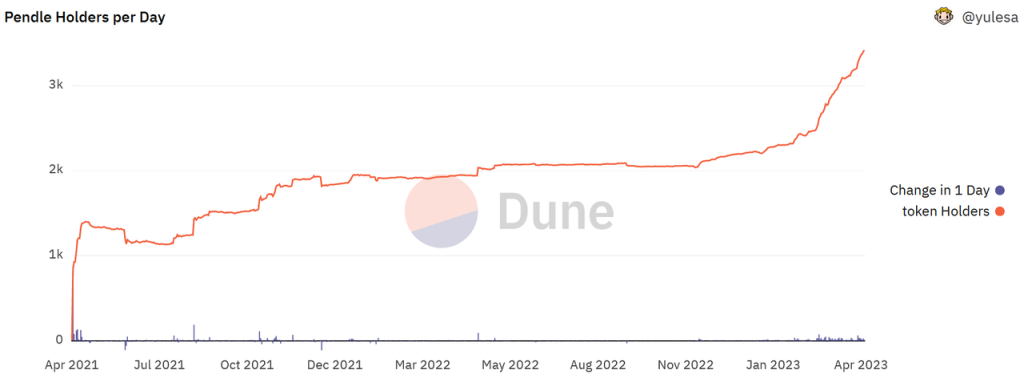
After the release of the V2 version, the number of PENDLE holders has increased by nearly 50%, and there are 3,415 existing currency holding addresses.
Source: https://dune.com/yulesa/Pendle
From the perspective of currency holding concentration, the current TOP 5 holds about 44% of PENDLE tokens. Among them, the first address of currency holding is the address of locking PENDLE. Some investors in the private round, such as Crypto.com still currently hold tokens. According to Bubblemaps data, about 3.4% of PENDLE tokens are currently held.
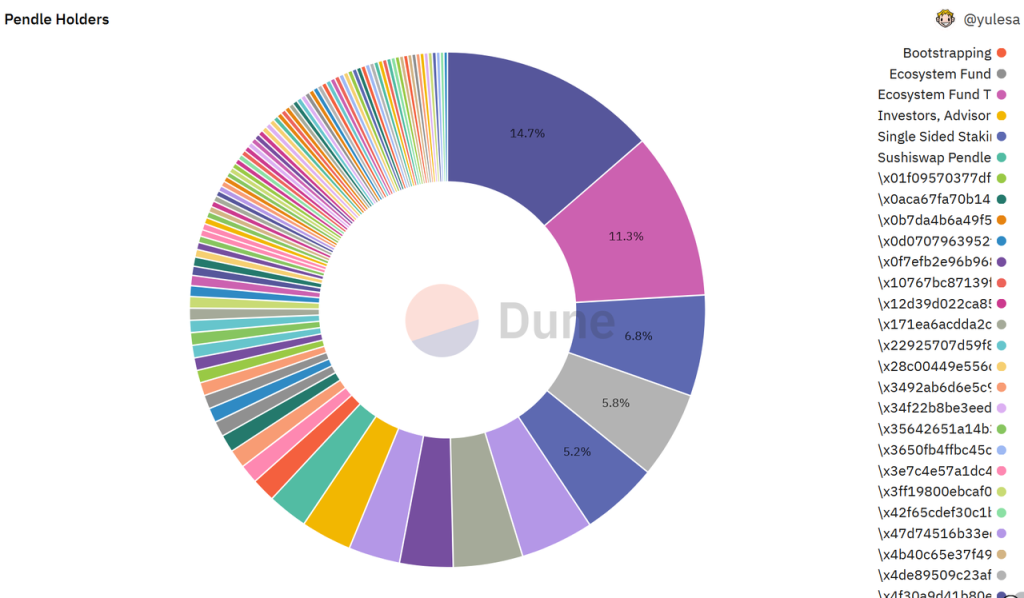
Source: https://dune.com/yulesa/Pendle
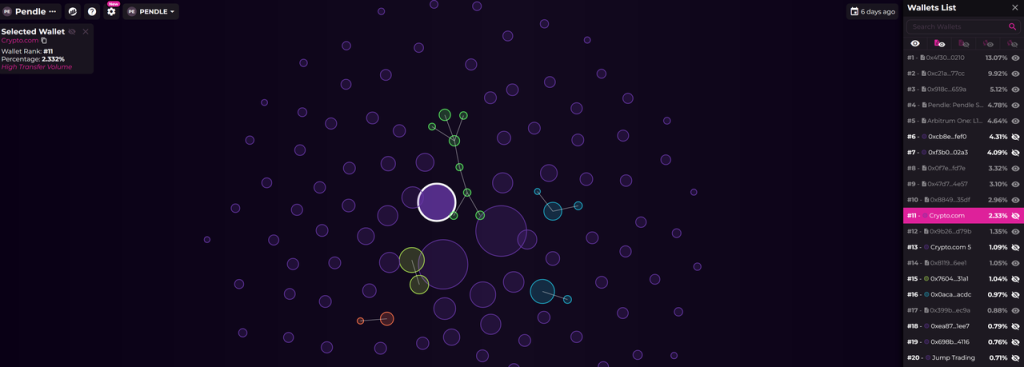
Source: https://app.bubblemaps.io/eth/token/0x808507121b80c02388fad14726482e061b8da827?mode=3
3.8.4 Summary of Token Model
After the improvement of the V2 version, the application scenarios and value capture of PENDLE have been significantly improved compared to before. If you want to attract long-term stable low-risk investors, how to enrich the variety of underlying assets and increase TVL is very critical.
3.9 Risk Analysis
Contract risk : There have been many hacking incidents recently, and the stolen amount is also in the hundreds of millions of dollars. The types of stolen projects are not limited to decentralized exchanges and lending agreements. If such an event occurs, it will have a significant impact on the normal operation of the project and the capture of token value. This risk is not limited to Pendle itself. Since the underlying assets of Pendle come from other projects, any contract risks in other projects will also implicate Pendle, resulting in the shrinking of Pendle's business and operating conditions.
Strategic risk : choosing a good underlying asset is critical. If you do not select the assets and the public chain where the assets are located, you may be left behind by competitors in the next stage of competition. In the V1 version, choosing to deploy on Avalanche seems to be a strategic mistake at present, and its Avalanche business continued to decline after a short-term rise. At that time, the project team did not think clearly about what underlying assets should be selected, and did not anticipate the brutality of public chain competition, which resulted in the failure of the plan to deploy Avalanche in the V1 version.
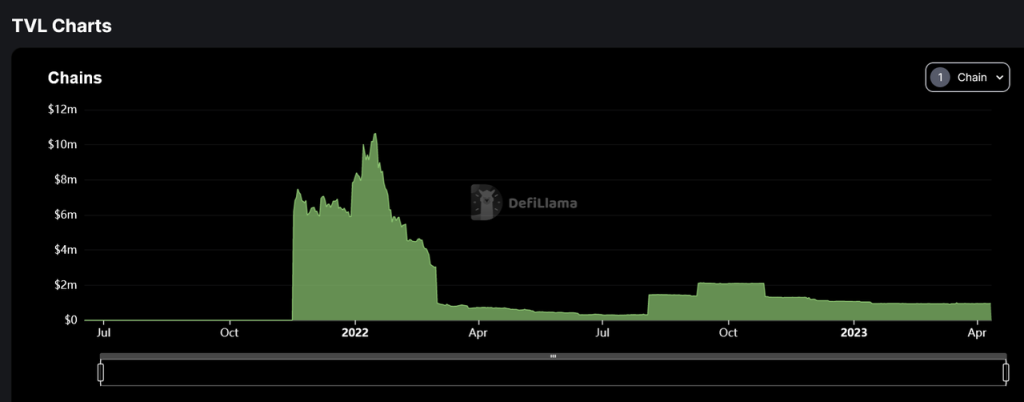
Source: https://defillama.com/protocol/pendle
- Market risk : The price of some underlying assets, such as GLP, is not anchored to the U.S. dollar or public chain tokens, and is in a relatively floating state, and it is not convenient for hedging. This is not friendly to U-standard investors. If the market drops sharply during the operation of the project, resulting in a drop in the price of GLP denominated in U.S. dollars, especially YT investors, may suffer large losses, which may cause users to lose to other relatively safe projects.
4. Preliminary Valuation
4.1 Core Issues
- What operating cycle is the project in? Is it a mature stage, or an early and middle stage of development?
After about 2 years of development, the project team’s ability to select the underlying assets has been improved. By learning other excellent AMM models, it has also improved the user’s transaction experience and reduced costs. Compared with other projects on the same track, the product is in period of rapid growth. However, the tokenization of income and the track of fixed income are still in the early stages of DeFi.
- Does the project have a solid competitive advantage? Where does this competitive advantage come from?
Part of the core strengths of DEXs come from trading models and asset classes. Judging from the AMM model mechanism currently adopted by Pendle, it has certain advantages. In the choice of asset class, LSD is used as the basic market, which ensures that the project will have a relatively stable income even in a bear market, and can retain some investors. The Pendle team also needs to further improve the innovation ability of the model and the identification ability of the underlying assets, so that it is possible to continue to maintain a leading position in the competition of the income tokenization track.
- Is the long-term investment logic of the project clear? Is it in line with the general trend of the industry?
The rate of return of PT is close to the annualized return of low-risk arbitrageurs. YT can satisfy the game of high-risk investors on the market. At present, the choice of "low-medium-high" asset class is appropriate, which is relatively close to the composition of investors in the current market.
- What are the main variables in the operation of the project? Is this factor easy to quantify and measure?
The main variables remain the optimization of the AMM model and the choice of asset class. Both of these factors can be observed through transaction and product popularity.
- How will the project be managed and governed? What is the level of DAO?
The project is still managed by the team and will be gradually transferred to DAO in the future. Judging from the degree of discussion in the discord group, the project-related personnel have a better understanding of the product. What deserves attention in the future is the management level of DAO.
4.2 Valuation level
Since the main projects in the current track have not all issued coins, and the projects that issue coins do not have the ability to capture value for the time being, so the "market value/locked position" is used as the reference standard here. From the data point of view, Pendle's current valuation is relatively cheap compared to the other two projects that have already issued coins.
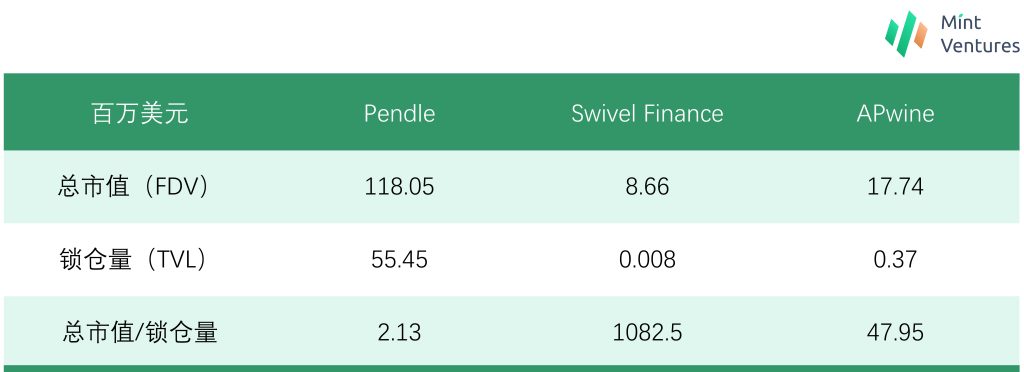
Data source: Coingecko, DeFi Llama, Mint Ventures, data as of April 11, 2023
5. References
https://medium.com/pendle/treasury-management-with-pendle-x-benqi-f495250940a2
https://medium.com/pendle/pendle-and-the-qi-musketeers-8f084352c249
https://medium.com/pendle/pendle-and-the-3-joesephs-dee7c645ff12
https://medium.com/pendle/pendle-x-rari-fuse-pool-6016713a0d2
https://medium.com/pendle/apecoin-market-launch-f39294872976
https://medium.com/pendle/apecoin-compounder-by-pendle-af5bd60814f1
https://ethereum-magicians.org/t/eip-5115-super-composable-yield-token/9423
https://medium.com/pendle/pendle-v2-part-1-3-foundation-6e1773a1d2f4
https://medium.com/pendle/pendle-v2-part-2-3-open-access-25c1783a0b4f
https://medium.com/pendle/pendle-v2-launch-part-3-3-updated-tokenomics-b6c6501b8286
https://medium.com/pendle/pendle-v2-part-1-3-foundation-6e1773a1d2f4
https://raw.githubusercontent.com/pendle-finance/pendle-v2-resources/main/whitepapers/V2_AMM.pdf
https://handbook.pendle.finance/liquidity-provision/simple-lp-zap
https://dune.com/impossiblefinance/liquid-staking-derivatives
https://dune.com/LidoAnalytical/stETH-deposited-per-protocol
https://app.bubblemaps.io/eth/token/0x808507121b80c02388fad14726482e061b8da827
https://multicoin.capital/2021/10/06/exploring-the-opportunity-for-defi-interest-rate-markets/