By @TheDeFISaint
Compile: Biteye core contributor Crush
The success of $PEPE triggered a new wave of meme coins, but compared to skyrocketing all the way, RUG and junk coins are the norm.
How to avoid such a situation when investing in meme coins? Today this guide may help you.
There are usually many tools we can use, but as my mentor @thedefieedge said, there are not many tools, and using a certain tool well has surpassed many people.
01. Find your own Alpha
Everyone seems to be a researcher since the meme narrative, and there are a few places we usually look for memes:
• Dextools
• Analysis tools such as Blockpour, Kyberswap Discover, etc.
• TG channel, Discord community
• Even the big V you follow issued meme coins
02. Specific steps
step 1
Let's use the following memes as a case study
• $PEPE
• $POGAI
• $BOBO
No matter where you see these memes, the first thing you should do is use @bubblemaps to analyze them, our goal is to ensure that there are no large players potentially holding a large amount of chips, if they use multiple wallets to hold It is very dangerous to smash the plate after a large number of chips.
Let's start with $PEPE and see what a uniform distribution of tokens should look like. For ease of analysis, I have removed the exchange address here.
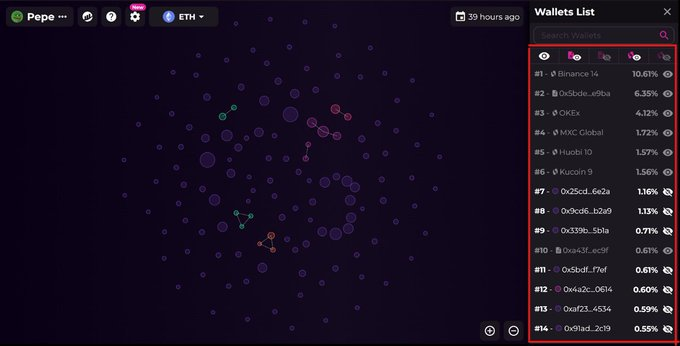
It can be seen from the above figure that there are not a few people holding a large number of tokens, which shows that RUG or smashing is less likely. However, we still need to pay more attention to the addresses of these large investors. The red box on the right shows their position rankings.
Then let's check another token $POGAI for comparison.
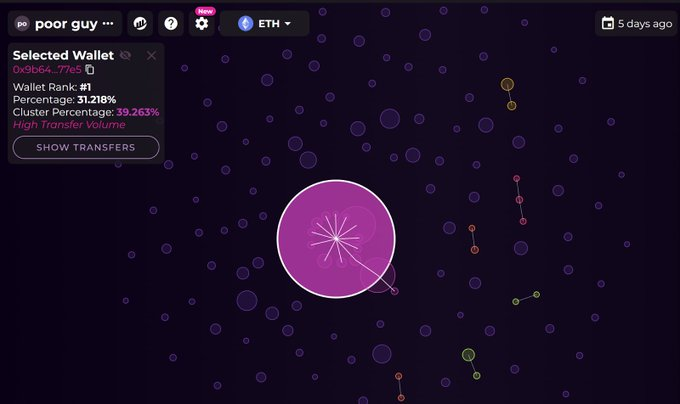
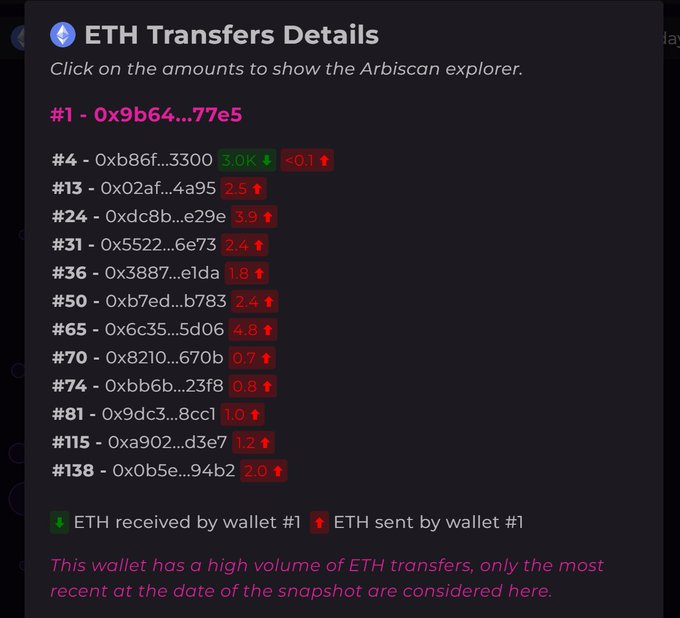
From the above figure, we can easily find that the number one address 0x9….77e5 is related to all other addresses of different sizes, and has been transferring assets of about 32 ETH to these addresses.
Is this the contract deployer transferring tokens to his or his friend's wallet?
I checked the address through Debank and it turned out it was just a big guy who made money in the meme narrative.
By comparing $POGAI with $PEPE we can see the difference between the unusual activity of these coins.
We just said that 0x9....77e5 transferred assets to other addresses, but before that, 0x9....77e5 has received 3000 $ETH from the address 0xb....3300 one after another.
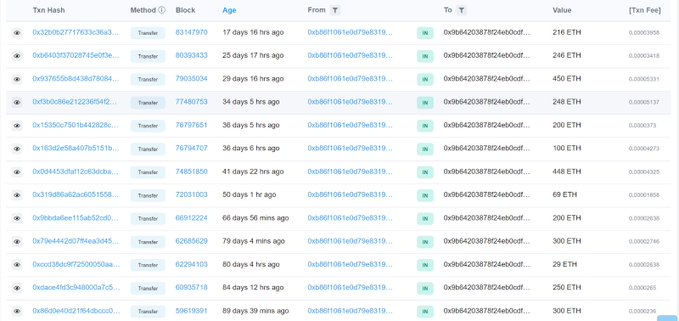
What we do know is that these addresses have been transferring money to each other for a long time between the $POGAI release, and the earliest records even date back to 8 years ago.
In this case, you should pay attention to the potential risk of smashing the market. At the same time, the operations of these large players are worth tracking and analyzing.
https://debank.com/profile/0x9b64203878f24eb0cdf55c8c6fa7d08ba0cf77e5
https://debank.com/profile/0xb86f1061e0d79e8319339d5fdbb187d4e7ad3300
step 2
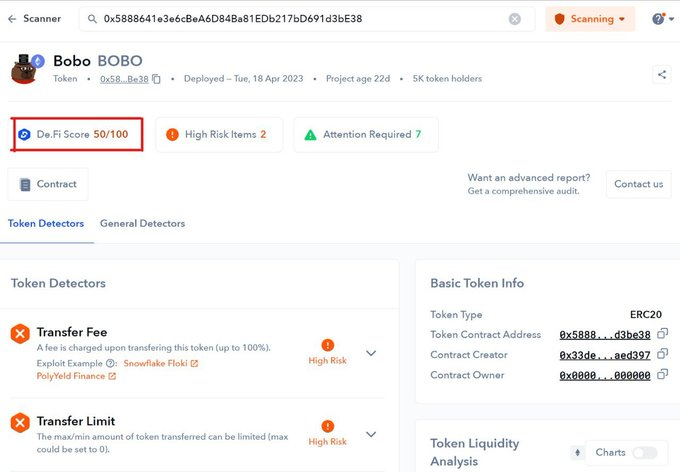
After analyzing these tokens with Bubblemaps, you can then go to DedotFI for token checking, which can also effectively reduce the risk.
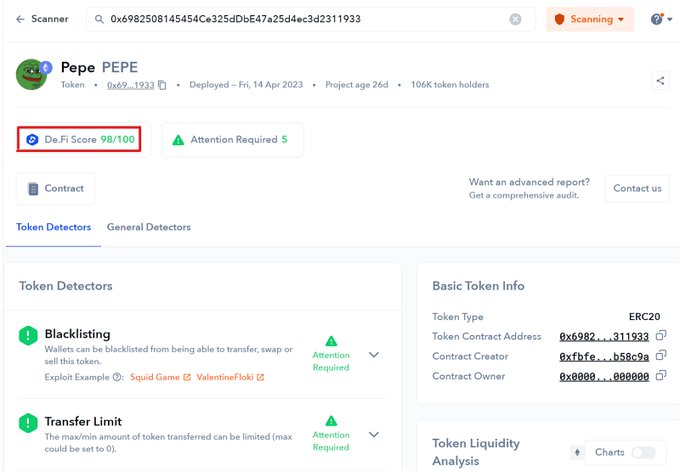
From the figure above, we can see that the contract of $PEPE has potential RUG risks and other common smart contract vulnerability risks.
The situation of another meme coin $BOBO is not optimistic. Through tool inspection, we can find that its risk is very high.
The above are the few steps I took when buying meme tokens. Only through the above two tools can you quickly judge the risk when analyzing any token.
If the above content is helpful to you, don't forget to forward it and like it!