author | CZ
Principles of CZ
1 General principles
1.1 Fairness
This is a broad principle that covers many aspects of life, including personal relationships, relationships with colleagues, and business transactions. I believe in the principle of treating people fairly. Don't take advantage of others, and don't let others take advantage of you. If you can't get this balance right, you won't achieve much in life. However, many things are easier said than done. Everyone is subjective and will be slightly biased towards themselves. We need to resist that thinking and be as objective as possible.
1.2 Build a long-term, win-win relationship or transaction
The use of these words is now so rampant that they get a bad rap, but I'm a big believer in their meaning. Success is built on a long-term basis, and to maintain a healthy long-term relationship, you must establish and participate in a long-term win-win relationship. For a deal to make sense, it must be profitable for both parties. So, be sure to ask what the other person can get in return.
Deals that only benefit one side don't last long because you're constantly looking for new (weaker) partners. The resulting ROI will be negative. Short-term returns are minimal, so I'm not in favor of earning short-term returns. Because short-term returns often have long-term negative effects, they will distract you from focusing on long-term returns, and the hidden opportunity cost is extremely high.
Therefore, we must focus on long-term returns to achieve greater success.
Try playing an infinite game
( https://simonsinek.com/books/the-infinite-game/ ).
When I say "short-term returns" here, I mean one-time short-term returns. Please do not confuse it with progressive returns built on a larger long-term goal, because the latter is very necessary.
1.3 Avoiding "Bad" Relationships
Some people are immoral, others are "immoral/toxic"; some people don't share your values or mission; and some people waste a lot of your time. Let these people go and get them out of your life, but we tend to miss that last category of people who waste our time.
Some people are "difficult," as in "difficult friends." They always need your attention, fret over little things, need to talk to you, or need you to keep repeating to them how important/nice they are/etc. There's nothing wrong with that in itself, but I (CZ) can't stand it. I just want to deal with people who don't have to bother with maintenance and confidence.
And those who "love to chat". I repeat, there is nothing wrong with that in itself. But at this point in my life, I don't have time for small talk. So, I would also avoid these types of people. More on that later.
1.4 Ethical
Never cross the moral line, or you will be backlashed one day.
When dealing with users, always do the right thing, not the easiest thing.
1.5 focus
Success is not about how many things you do, but how well you do a few things. Focus allows you to work hard and remove distractions from your life.
For me, I don't have many hobbies. I exercise 30 minutes a day. I don't have much material possessions to maintain because the time cost is very high.
However, the potential risk of doing this is to focus so narrowly that you miss some opportunities. But in today's world of information overload, that hardly ever happens.
1.6 Be positive
We all face many challenges in our lives, whether it's dealing with relationships with family and friends, or problems at work. If you have a positive attitude, it tends to produce positive results as well. I'm not sure exactly why this is, but that's how the world works.
There is a saying that has stuck in my head that has helped me a lot over the years.
"What do you do when you hit rock bottom? Just keep going and you'll get out."
And, if you know you're doing the ethical thing, all negativity goes away with it. You will have positive energy, which is one of the main benefits of being ethical.
1.7 Serious and responsible
The right attitude is a prerequisite for success in life. Be responsible and take pride in what you do.
Don't think of yourself as just doing tasks, don't think of yourself as just laying bricks on walls, but think of yourself as a cathedral builder. If you don't see yourself as "building a cathedral," then this job is not for you and you should find a different job.
If you want to do something, you should be serious and responsible. Think about what else you need to do to do better what others are not telling you. To be responsible for the results, but also responsible for all results, whether it is success or failure. If you adopt this mindset, your work output will continually improve and you will make faster progress on the path to success.
1.8 Continuous Learning
The world we live in is constantly evolving and changing. We have to keep studying, read books, live in different cities, and have a worldview.
I generally don't read the news. I find it easy to agree with some articles that take only 10 minutes to read, but often don't go deep enough and don't leave a lasting impression.
But when I read a book, the book generally goes into details, such as discussing the reasons behind it in detail, and after reading for 8 hours, some new concepts will be firmly remembered. I've found that reading books has the highest ROI when it comes to self-improvement. I buy a lot of books, about 300 a year, but don't read them all. I read about 80 books a year.
I also try to write a little bit every day, either a blog post or an article (like this one). Writing helps me solidify my thoughts and organize them better.
2. Understand the world
Understanding how the world works is obviously important if one is to achieve any level of success.
To understand how humans work, read the book Sapiens. We live in a human world. Everyone has a different version of the world in their head, that is to say, everyone lives in a different world. We need to understand the world they live in.
Don't hold too many views of black and white, this world is not a binary world of black and white. Many people have a simplistic view of the world that makes it difficult for them to achieve great things. We have to look at things from a deeper perspective. In real life, most things are balanced.
For example, some people naively believe that all rules are good, but rules are made by people and are not perfect. Read: Laws (1850), Economics in One Lesson, etc.
We also need to understand that this world has some limitations, and we don't live in a perfect world.
Don't fight a war you can't win, but avoid it, go somewhere else, do something else. In this world, there are many things to do. Please focus on the things you can make a positive contribution to.
3. Framework for decision-making
Making good decisions is a skill that can be mastered with practice. Whether it is a quick decision or a well-thought-out decision, I go through such a mental decision-making framework.
3.1 First principles
If a decision touches on one of the core principles, then follow those principles. This is easy to understand. Otherwise, the decision is made through the decision framework.
3.2 Small decisions and major decisions
The first thing to determine is the scale or impact of the decision.
If it's a small decision that needs to be made quickly or delegated and then moved on, like where to eat, or a small investment.
If it is a major decision, first collect data and discuss it in the group, and then consider it for 24 hours, such as large sponsorship, investment, etc.
3.3 Reversible decision and permanent decision
Some decisions are reversible, such as developing new product features. You can stop and do something else at any time, or close it when you're done. There will be some sunk costs of time and effort, but this is limited.
But some decisions are not easily reversed, such as a large upfront payment for a sponsorship deal, acquiring a large company that we plan to integrate with our team, etc.
3.4 Do I have professional knowledge
If it's something that I'm very familiar with, or has some background information, like technology, product, then I can make decisions faster. In areas I'm less familiar with, like marketing, I either delegate or involve other experts or make decisions more carefully.
3.5 Sufficient information
The last thing to ask is whether I/we have enough information. For small decisions, I don't need a lot of information; but for big decisions, we should get as much information as possible. But often in the end, we will have to make decisions with limited information.
Finally: It is often much better to make a decision and then execute it than to not make a decision.
4. Team and organization
4.1 The team is bigger than the self
In an underperforming team, no matter how good an individual performs, it seldom brings satisfactory results to the individual, and vice versa. But if a team is doing well, every member, including those who are struggling, is likely to do well.
The team should usually come first, and that's the best long-term individual outcome for everyone on the team. In the short term, you may have to "sacrifice for the team" on various occasions, but in the long run, you will ultimately win.
4.2 Adjust the team frequently
Don't let the organization become obsolete, and provide more opportunities for new leaders to experience. Quick fix for the "man in the wrong seat" problem (although it might add to that as well)
The team structure determines the system architecture. Please read the book "Team Topology". We don't want our architecture to become obsolete, we need to change the team structure frequently.
4.3 Internal competition is good
We will always face all kinds of (external) competition, and some internal competition is fine as long as it is done professionally.
4.4 Controlled chaos is also a type of structure
This explanation is a bit counterintuitive. Let's look at the two extremes of chaos and structure. It's easy to understand that complete chaos is bad.
Many people tend to think that the more structured an organization is, the better. I disagree with this point of view. Of course, a clear structure has many benefits, including clear lines of authority and responsibility, less duplication or wasted effort, etc. In general, it increases the efficiency of the organization. But what most people don't think about is that it usually only makes an organization more efficient at doing one thing. (In fact, the word "organization" means the structure and optimization of a thing.) The most extreme form of overorganization is bureaucracy. As we grow up, we need to constantly remind ourselves not to go that far.
When the world changes, a well-structured organization will need to work harder to adapt. The world is changing rapidly, especially in an industry as young as ours. In a tightly structured organization, there is less organic innovation and less internal competition (or pressure to improve). At a certain scale, top-down decision-making becomes less effective.
However, that's not to say that "mess" is better. There is a balance somewhere between "chaotic" and "structured". We live and work in a changing world, in a new industry. Our industry has redefined many traditional concepts such as headquarters, company, team, and even money. Given that we are working remotely globally, many traditional structures will not work for us.
At the same time, we do need strong controls in many areas. We need to handle users' funds, and we must firmly implement the principles of security, compliance, ethics and neutrality. We operate in a regulated environment where compliance is paramount. A controlled chaos environment requires the best people, people with passion and responsibility. How to find this balance point is a continuous challenge for us. The point is, sometimes chaos is a feature too.
4.5 Frequent local team building
Our goal is to hold team building once a month, but in practice, due to scheduling etc., it is usually held every two months.
Eating together is the best team building activity. Getting everyone together for a meal is simple and effective.
Team building can be done locally and across teams. I'm usually against flying for team building because it's too expensive and time-consuming. I don't want to give the impression that we're just flying people on a "vacation". For small, really dispersed teams, team building every 18 months might also be OK as an exception, ideally leveraging some existing trips or events.
4.6 Providing Feedback
I provide direct feedback whenever and wherever ideas are presented, whether in one-on-one discussions or in larger groups. This is learned from the Netflix book ("Rules Without Rules"). I actually prefer to give feedback in a large group so others can learn without me having to repeat it multiple times.
Many people have told me that they were shocked the first few times they received this feedback, but eventually got used to it.
I want to build a candid feedback culture at Binance . I feel like 99% of people don't give enough feedback to other people. Working remotely, we can't get body language feedback in offline meetings. We must compensate for this by providing direct and candid feedback.
Bridgewater (Ray Dalio) has a DOT feedback system that I really like. We will find a way to adopt this system in the future.
4.7 Don't give too much verbal praise
If you do something well, you may hear "well done, well done, etc" compliments from others. But probably won't hear as many compliments from me. Conversely, when you're not doing well, if I see it, you're likely to hear advice.
My reasons are:
1. We hold ourselves to high standards, we expect excellence and good results should be the norm. If we make a fuss about every "little" achievement, it feels like we're setting a low bar. This is not something we want to do.
2. I haven't seen all teams succeed in working remotely. I can't possibly cover everything. If I congratulate some people but not others, it creates a psychological imbalance or a feeling of favoritism. This question is not meant to be critical, I'm going directly to give constructive feedback on what I've seen so others don't complain about favoritism.
3. Satisfaction should come from within. When I do one thing well, the reward in my heart is enough.
4. Time efficiency is not high. Once something is done, we should focus on the next thing.
I'm not saying it's a good approach, it's just how I do it. In fact, I think "carrot" plus "stick" might be a better approach, but I haven't figured out how to do it effectively in a balanced way.
Different cultures also create different expectations. The book "Cultural Maps" explains this very well. Americans generally have more of a "praise" culture, while Asians are more of a "stick" culture.
A more effective approach would be to adjust their pay during the next review cycle. So I do give them "carrots", just not verbally.
4.8 Reporting and lies
Reporting is a normal part of business, but there are right and wrong ways to do it.
The rumor is that when you complain to me one-on-one about someone else, you don't tell the other person. Rumors are scary, but I don't deal with rumors, I just ignore them. In fact, when you spread rumors to me, I only have a negative image of you (not them).
Debriefing involving a third person is when you book a three-way meeting with CZ, yourself, and the person you want to complain about. That way, I can hear both sides at once.
More importantly, it forces you to have an honest conversation with the other person before you tell me.
I only need one meeting to deal with debriefing issues involving a third person. In contrast, if I were to deal with rumors, I would need to have multiple one-on-one conversations. You guys know how I feel about time (more on that later).
Therefore, it is necessary to use an open method for reporting involving third parties, not rumors. It's tough, but being able to articulate why you're unhappy with someone or something in a professional way is one of the key skills for success. Not too soft, but not too tough, finding the right balance is key.
4.9 Bottom Elimination
I believe in the "last place out" principle. I've seen many arguments against ranking employees, not creating internal competition, etc. These arguments have their merits, but I don't think they strike the best balance.
In my experience, high performers love working with high performers. When a team of high performers is happy to work together, the work itself can be addictive. When you have one poor performer on your team, everything is destroyed. The worst performers should be eliminated.
I also believe in the principle "it's a team, not a family" described in the book "Rules Without Rules". As ugly as it may sound, there is a difference between an organization and a family. We care about each other, but we don't bring underperformers around because it's irresponsible to the rest of the team.
5. Recruitment
Always hire the best people. You need to be part of a strong team to be successful, whether you're recruiting subordinates, peers, or superiors. Hiring your own boss is one of the best ways to grow professionally, and it shows you are at a high level of maturity.
5.1 Passion
Passion is one of the most important factors I focus on. We need to work remotely. We can't (and shouldn't) micromanage. People without passion will slack off and get eliminated. We're looking for people to build cathedrals.
5.2 Hiring "Aspirational" People
Hire people who can grow into the role, not people who have been there and done that. While previous experience is certainly helpful in many situations and is a prerequisite for certain roles such as compliance work, the latter can get boring. It also often creates a "fixed" mindset, as people tend to be over-shaped by their previous experiences.
5.3 Doers and talkers
Hire doers who can speak their minds, not talkers who can't get things done. Doers who cannot articulate their ideas are also tricky. They might be fine in some narrow technical contexts, but we can't have too many of them on our team.
5.4 Targeted recruitment
Every new hire must have a clear role, ideally set aggressive numerical goals, and have about a 70% chance of success.
5.5 Refuse to place too much emphasis on titles
Don't hire people who worry about titles. Although this is not a matter of principle, it is definitely not a good sign.
5.6 Mission Beyond Money
Don't hire people who put too much emphasis on salary and compensation, but we should pay fair compensation.
5.7 If in doubt, do not hire
If in any doubt during the hiring process, do not hire. Small doubts at the interview stage can always turn into big problems later.
6. Leadership style
6.1 Don't try to motivate the unmotivated
It's like dragging a dead horse, it's impossible and not worth it. You're also unlikely to inspire people who don't share your mission or values, or don't like you as a leader, or are just lazy. Let them work elsewhere. People are either motivated or not. We only work with self-motivated people.
We need to work remotely. Lazy people are prone to being lazy because no one is watching them. However, it is a blessing in disguise. They can be lazy for a day, a week, or even a month, but after a few months, when they don't produce any work results, you'll know. Working remotely will actually make it easy to identify these people over time. As soon as you spot unmotivated people on your team, let them go.
6.2 Never micromanage
It takes more time to manage everything than to do it yourself. If you need to micromanage it, then you should let that person go.
6.3 Interview qualifications, post-hiring performance
Use "years of work experience" only in the hiring process. When a person joins the team, the results are used to measure their performance.
6.4 DO: Work hard, live up to our values, and lead by example
7. Goals, OKRs/KPIs
Use output metrics (users, revenue, market share) rather than input metrics (tasks, features, meetings, hours worked).
7.1 Don't take your goals too seriously
There are many potential downsides to making goals or setting goals. There have been many articles on this point, so I won't go into detail. Some of these disadvantages include: feeling frustrated when goals are not achieved, not working hard when goals are easily achieved, lack of flexibility in direction, etc.
I think the biggest problems with goals are: 1. Goals are never accurate, nor scientific, and always guesswork. In our industry, the market environment changes too quickly. 2. Discussing goals takes too much time (and is too costly).
For these reasons, set a goal, work towards that goal, and if you have achieved it, set a new goal. Don't take your goals too seriously, and don't be too attached to them.
I will end this topic with an example. When Binance was founded, we set a goal to become the top 10 exchange in the world within 3 years, but we became the number 1 exchange in the world in just 5 months. We didn't stop there.
8. Commercial transactions
8.1 Simplified transactions
Complex transactions involving many variables often fail, even after they are signed. Complex transactions can be difficult to understand and often lead to confusion or misunderstanding. One partner always feels screwed up in some way and wants to change things. To simplify the transaction: that is, Party A provides this and gets that; Party B provides this and gets that.
8.2 Say "no" early
Too many people waste too much time on useless "partnership" discussions. When your brain space is spent on these useless discussions, you're not thinking about useful partnerships.
8.3 Non-exclusivity
A long-term mutually beneficial relationship does not need exclusivity. People who demand exclusivity are often insecure about competitiveness or the value they can provide, at least in the long run. In these cases, a short-term (or one-time) compensation plan may be more appropriate. But you know my point, don't spend too much time short-term trading. The world is changing too fast to lock in and you can't predict the future.
Never sign an exclusive contract . Don't lock yourself out, and don't expect others to lock you down.
8.4 Termination
Be sure to include a termination clause in the contract . We need a way out of relationships that aren't win-win, that allow us to always have options. Many people think of general conditions (often optimistic) at the contract stage, which is wrong. You should think about the worst-case scenario, that's what a contract does.
8.5 Limited liability at all times
Never sign a contract that could end up with huge or "unlimited" liability. Extreme worst-case scenarios should be considered at the contract stage, not "normal/best-case".
8.6 Do not engage in special
Never offer a client a private deal that no one else has, and always treat all clients the same.
9. Passive business development, the pursuit of "low-hanging fruits"
I (CZ) generally take a reactive approach to business development, and in life in general. People often don't understand this side of me, or what it's like.
This is by no means to be confused with passion. I'm passionate about what I/we do, but passive in how I deal with others, build business partnerships, etc.
I don't go after things that shine. In the business development process, I usually don't go to big customers or big partners , because it takes a lot of energy and time to teach them about crypto assets, go through their own internal legal, board process to close the deal, and convert The time frame is too long, and they often demand unfair terms with low return on investment.
Instead, I like to spend my time working with the top companies that come to us on their own initiative . They are already planning to enter the field of encrypted assets and hope to cooperate with us. We only need to determine the transaction method and transaction terms. The return on investment is much higher. Even though these companies may not be Apple or Google, if we can continue to have small successes, sooner or later, large partners will come to us, and most of them will come to us "unsolicited".
Other examples include: I will not waste time trying to convince people who are determined not to like cryptocurrencies, such as Warren Buffett. I talk to people who want to learn, even if they may not be that famous.
Instead of visiting countries or governments that are negative about cryptocurrencies, I will visit countries or governments that want to adopt cryptocurrencies and help them, even if they are small countries.
Essentially, trying to make deals that we can.
But please don't confuse this with a "short-term" mindset. While they may not be deals with the 10 most famous companies in the world, most of these easy deals are still long-term deals.
There are a few things to note about this approach.
We need to be good enough to make people want to come to us. Fortunately, Binance is currently in this state. We need to keep it going. Even before the success of Binance, I had this mentality, but it is obviously better after the success of Binance.
We need to pick our clients carefully. We always get a lot of requests, especially considering where Binance is today. Choosing the best request is not as easy as it seems. Again, my approach tends to be to close the core deals quickly.
Still, we sometimes need to do a little outreach in case the other side has a "passive" mentality too. We make outreach specific and specific, and then, if they don't respond, then we know they're not interested.
In life, I wouldn't try to meet someone famous. I love dealing with people who come to us on their own initiative.
10. Work style - don't waste time
Time is a more limited resource than money. Don't waste time, when you start appreciating time, money will follow.
10.1 Say “no” early and often
The most effective way to save time is to say "no".
When someone wanted to discuss an “important” but nebulous partnership, I said no; when someone invited me to meet some bigwigs with no clear purpose, I said no; when someone invited me to a gallery to see an art exhibition, I said no ;I was invited to watch an F1 game, and I declined; football games, no... Although I would go to these events with my friends, the default answer was "no".
That way, I can save time for more important things, even if it's just being alone in a hotel room. I would start thinking and focus on more important things like writing this article.
11 communication
11.1 Concise and clear
Be sure to articulate your intention or goal clearly. what do you want Say "I want to..." before you start explaining the background. The other person may agree with you without you needing to explain.
11.2 Write concisely
Please read the book "The Essentials of Writing". I really dislike seeing people either not writing, or writing too long. This means they either didn't take the time or couldn't organize their thoughts.
You need to write your ideas down, but keep them short (not too long), and well written.
For me I just want to see:
3–5 main points (15 minute session)
Half a page to a page (30–60 minute group sessions)
Up to 5 pages (monthly or quarterly business review)
Reject PPT . No need for fancy slideshows, just text and simple histograms.
For blogs, articles or books, it can be longer
But learn to write better. I'm still practicing myself...
11.3 Use the most effective methods/tools possible.
There's an old saying that I don't agree with: "If you can call someone on the phone, don't use email; if you can meet in person, don't call". My point is the exact opposite: "If a phone call is enough, don't meet; if an instant message is enough, don't call." There's nothing wrong with either approach. If it’s not clear on the phone, face-to-face communication is better. However, for most common communications, I care more about efficiency than form. You need to have a strong enough relationship (or reputation) with someone you communicate with regularly to understand each other, not guess, and always be skeptical. Most of our jobs are remote, so I've adopted this method of mine.
11.4 Avoiding Communication Chains
Do not talk to someone who is passing on someone else's news, you will definitely get incorrect information. Please speak directly to the source.
At work, we often have project managers or other leaders as intermediaries. We need to avoid lengthy communication chains. Bring sources into a group/meeting, but don't make the meeting too big.
11.5 Use instant messaging tools for synchronization or work coordination.
11.6 Use one message instead of multiple messages.

Sending a message like this would generate 5 notifications on the receiving end, possibly making me wait longer to read the reply. Instead, send a message like this:
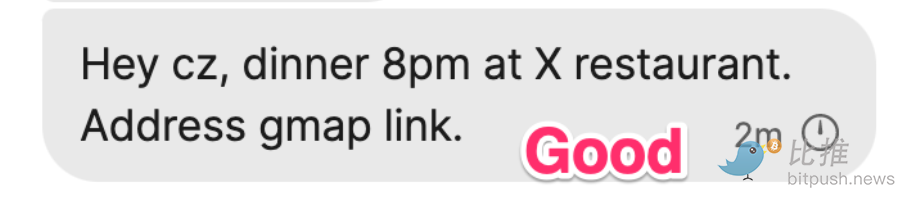
One notification, done.
Yes, I try to optimize my time this way. I don't like chatting with people who have a "bad" chat style. They have a lot of time and I don't.
11.7 Do not use instant messengers to argue
Don't text and chat for the sake of debate or argument. Pick up the phone and make a video or voice call to debate.
11.8 Too much communication is bad
Too little communication is bad, and too much is bad . If you have to constantly overcommunicate to get things going, something is wrong and you need to fix the underlying problem.
11.9 Explain context when asking questions
We work in a remote environment, and we don't have the opportunity to see many of our colleagues. Some questions are easily misunderstood. So, be sure to explain the context in which you ask the question.
12. Meetings
12.1 Keep it short
Keep meetings as short as possible. 5 minutes is best. If you can't hold a 5-minute meeting with a close colleague, you haven't found your groove with them. Think about how to solve this problem.
12.2 Start on time
Join the meeting 1 minute early. Set your alarm to 3:59 instead of 4:00. This way the meeting can start on time at 4:00:00.
12.3 Things not to do
Don't say the same old "Here's what I'm going to tell you, tell you now, and what I just told you..."
Just say the part of the "tell everyone" content.
Don't start with "Today's agenda is..."
Go straight to the meeting.
Don't ask "Can you hear me? Can you see me?"
Test your equipment ahead of time, then jump right into the meeting.
Don't say "Thank you for joining..."
Go straight to the meeting.
12.4 Do not discuss with more than 10 people
A discussion should only involve 5–10 people familiar with the topic. The larger the number of people, the slower the pace of discussion.
Calls with more than 10 people should be quick sync calls.
12.5 Eliminate non-speakers
If you're in a workshop and don't need to speak, then you probably shouldn't be in the session. You may just need to get the meeting minutes.
12.6 Write down the main points
Write down the main points before the meeting. Writing down the main points helps to clarify the thinking. I (CZ) am a visual person. I remember much less of things that were just explained to me orally. Written documents are also easier to forward. Word of mouth is not possible for forwarding. Google "Game of Telephone".
Written documents should not be too long. For a 30-minute meeting, 1 page should suffice.
12.7 Reject PPT
PowerPoint is a waste of time. Use point symbols and histograms to show history and trends.
12.8 No "introduction" sessions
I do not attend meetups, awareness sessions, discovery sessions, etc. I am not a hub nor am I good at maintaining many relationships. I prefer meetings with a clear purpose. Some might say this is too "realistic", but it's efficient. While it may offend some people, my goal is not to be friends with everyone, but to get things done .
13. Products and Delivery
13.1 Scalable products only
Only work with products that scale. MVP, then close, tweak or expand (all in). If a product doesn't scale, don't use it to work.
13.2 User-centric
Having users is the key, everything else is less important. No users means no value, so treat our users well.
14 PR
14.1 Releases without a big bang
Don't run a massive PR campaign on day one of launch, something will always go wrong. Give the system/product a week or so to adapt and stabilize before we do a massive PR campaign.
14.2 Do not run a PR campaign on empty MOUs or LOIs
We must focus on the results of public relations activities, unless public relations can provide us with meaningful help. Beware of small partners who just want to leverage our brand for credibility.
14.3 PR campaign without delay, announce when ready
Here's what I disagree with: Sometimes PR teams recommend waiting until a certain date or time before announcing something that's ready. Reasons may include but are not limited to: It’s Friday night, so there will be less PR content, let’s wait until Monday morning; we just announced some other news, and we want to space out the PR time; Until Christmas a week later, because then we will have less news. This just creates unnecessary delays, pushing all future workflows further back, so the loss of efficiency far outweighs the small optimization achieved in terms of "better access to" news. Delaying our work is extremely costly. Postponing the PR just keeps it on people's minds for a longer period of time, but it's not necessary.
Announce when you're ready and move on to the next project.
Twitter. Many social media experts have suggested the best times of day to tweet. If your work is specifically for social media, this approach might work. I just tweet when I have an idea in my head. Otherwise, the mental cost of keeping it in your head isn't worth the benefit I'll get from tweeting the information a few hours later. After tweeting, I was off to other things.
14.4 Responding to journalists
If you don't respond, they'll just write the worst version of the story. Respond, document it, and post it later when needed.
14.5 Quick response to negative news
Otherwise, negative news will only continue to spread. Unless you're sure it's just a small news outlet, it won't get any reposts.
15 Rest, Calm and Relax
I've been asked about sleep duration, jet lag, etc. So I added this section.
15.1 Sleep
I recommend that everyone find their sleep patterns so they can get the most energy.
For me, I sleep 5–6 hours at night and then usually take a 30–45 minute nap in the afternoon. I'm usually most awake after a nap. The second most awake time period is the morning, which is the hour after I wake up. So, during my most waking hours, I think hard or make hard decisions. Then use the rest of the day to tackle more "normal" tasks.
I have a little secret, napping is also a way for me to cope with jet lag. When I'm jet-lagged, the nap time is a bit longer. It helps to have two chances to sleep.
Plus, when I'm tired, I either relax or take a nap.
15.2 Calm down
My personality is relatively calm. If other people feel their emotions fluctuate to a certain extent, then my mood swings may be smaller. I also have strong emotions, but I'm not overly excited or overly sad. Having this calm disposition helps navigate the high-pressure environments we often encounter as a start-up in a fast-moving new industry.
Part of this personality is innate, and part of it is acquired. I believe in imitation theory, which has helped me a lot in keeping my emotional calm.
Holding yourself to high ethical standards can also help. Knowing we're doing the right thing, there's nothing to worry about. It made me mentally strong. And knowing that we're having a positive impact on the world helps, too.
15.3 Relaxation and entertainment
I would also relax like most people. I do exercise every day, I do some sports, like snowboarding. I'll watch some movies (usually after being recommended); when I go to a new city, I'll do some tours; I'll hang out with friends, eat, drink, etc.
I'm not interested in luxury goods, cars, jewelry, etc., even though my lifestyle might already be considered high end by most people. I travel a lot and I stay in fancy hotels. I'm often invited to fancy parties (which I don't actually like).
I love gadgets, phones, cameras, drones, even digital watches, some of which I never even use.
CZ's time management: what not to do is more important than what to do
Someone asked me today: "How do you have time to read so many books?" So in this article I will answer that question.
I think time management is mostly about saying "no". What you don't do is more important than what you do.
I do not attend meetups, introductions/discoveries, etc. These can take a lot of time and are often extremely inefficient. I would decline these invitations outright, even to the point of being considered rude. I can send this article to others to show that I don't like socializing with other people. This might be rude, but it saved me time.
I like simplicity. It frees me up to do other things. If you can summarize something, then all you have to do is summarize.
I keep most meetings to 15 minutes or less, even face-to-face meetings. Before the meeting, I always tell them I only have 15 minutes.
I wouldn't be in a meeting if I wasn't needed. I don't just have to listen. What I want is a summary that I can read in 30 seconds.
I don't chat, either at work or in my personal life, online or IRL. I always ask, "What do you want me to do?" If there's no action involved, I end or ignore the meeting. I don't chat for fun.
I would quit chat groups where I no longer needed to speak, whether at work or in my personal life. It's just one less thing I need to click. One less notification, one less pop-up window.
I'm not very social either. I'm not a "hub" and I don't keep in touch with many people. I have a small network. I make sure I have some "hubs" (supernetworks) in my network. I rely on them to connect with people when needed.
I do hang out with a handful of friends, but probably a lot less than most.
I don't shop. I hate it. I buy most things in bulk online. 10 identical pants, shirts, socks, etc. Most are one of the top 5 items in search results, or whatever the AI recommends so I don't have to think about it.
I can't cook (talent issue). I ordered 1 of the first 3 things I saw on the menu. It doesn't take me more than 10 seconds to order. I prefer fast food to "French dinner". Maybe I'm sorry for France for saying this, but it's not a matter of taste, it's just a matter of time. I always ask French chefs to serve "all dishes" at once and try to ignore the offended looks on their faces.
I won't organize my room, desk or suitcase. Always a mess.
I don't read the news unless someone sends me a link. Even then, I just scan it in 10 seconds. I am a fast reader.
I don't watch sports unless we have some sponsorship like CR7 or Argentina in the World Cup, I actually only watch the last game on TV. However, a very exciting game! But I know I have to give up and do something else to make up for the time.
I don't watch TV. I used to watch a lot of movies, but now, I find most of them boring. Maybe I'm too old.
I don't do TikTok, video feeds, etc. For my back pain, I follow some of the "osteopath/chiropractor/exercise" types on Instagram so that I get motivated to do some simple exercises every day.
I do spend a lot of time on Twitter and do some blogging.
I don't listen to music. I also hate loud music being played in restaurants or meeting places. I always ask them to turn it down. I like quiet places.
Basically, I'm a very boring person.
I listen to books. I listen to books while showering, brushing my teeth, and of course, going to the toilet. I listen to books when I'm in the car, passing through airports, etc. I listen to a book for an hour or so every day before bed (that alone easily amounts to a book a week). The biggest piece, though, is on the plane. I'd try to write a blog post or something if I wanted to. When I am tired, I listen to books. I can read 2-3 books on a long flight. I fly a lot. 600 hours in the air last year.
I listen to it at 2.5x most of the time (you get used to it after a while). The average listening time for most books is about 4 hours.
How do I choose books? Some were recommended by friends. Some are AI recommendations based on books I like.
Books I don't like, once I feel that way, I stop listening to them. Most of the books I bought were never finished.
The book I like, I have listened to it several times and bought the Kindle version to read it.
Time is the most limited resource. And knowledge is the most powerful multiplier. Don't trade your time for anything else.