According to the past cycle of the industry, the bear market has already passed halfway. Hot spots such as the LSD market brought about by the upgrade of Ethereum, the rise of Bitcoin NFT and BRC-20, and the MeMe sector have successively rotated, bringing new vitality to the entire market.
So, what are the latest developments in various sectors of the encryption industry at present?
Lao Bai, former columnist of vernacular blockchain and ABCDE investment research partner, sorted out the cutting-edge technologies or trends of various tracks recently seen in the primary + secondary markets. This article is the first one, introducing public chains and interoperability The latest trends in seven popular tracks such as sex, MEV, and DeFi. The following is the text:
A few points in advance:
1. "Frontier" does not necessarily mean better, it just means that they are relatively new, and most of them have not yet entered the mainstream of the market, such as modularization, DA, RAAS, ZKEVM, which are hot or well-known, do not occupy pen and ink up.
2. I can only make an introduction for each track, and I will not write in-depth. If I write in-depth, it is estimated that I can make a book.
3. Because of the frontier and I am not a developer myself, I may have a wrong understanding of some technologies. I also welcome criticism and corrections from all masters.
4. The Portfolio of ABCDE is basically not involved in it, and if it is involved, it will be marked.
01
public chain
1. Public chain
Write the public chain first, because the public chain will always be the biggest and fastest place for blockchain technology innovation.
Looking back at the time when Dfinity was launched, the mainstream voice in the market believed that the final gate of the public chain has been closed . Possibly endless.
Especially for L2, because the consensus and security are handed over to L1, there is actually a lot of room for performance improvement.
At present, whether it is OP or Arb, or ZKEVM such as Zk-Sync and Scroll that will be launched soon, the performance is still very far from the end, and there is no chain that can support the real Kill Dapp, which can accommodate hundreds of thousands of people online at the same time. .
To give a simple example, the current design of the ETH node pool is to divide orders into Local Trasaction (from RPC directly) and Remote Trasaction (from P2P). Once it thinks that there are too many transactions, part of the Remote will be discarded directly.
You can play this way on ETH, because firstly, there are not so many orders, and secondly, many orders are sent through P2P, which is regarded as Remote, and the proportion of Local is not large.
However, many of the current L2 architectures are based on the L1 design. Basically, all orders from the Sequencer (sequencer) are directly sent by RPC. There is almost no Remote, and all Local.
When ABCDE's technical masters test some Sequencers, they are basically hundreds of thousands of TX and directly let the Sequencers with normal configurations directly Out of Memory. This has not considered bandwidth, hard disk I/O and other BottleNecks that may be stuck.
So at present, the upgrade potential of the L2 client alone is huge , just as Arbitrum was upgraded from One to Nitro before, and OP launched Bedrock. The improvement of blockchain performance is a systematic project, including disk I/O, parallel processing, selection of Merkle tree or other data structures, state synchronization and update, RPC nodes...not simply changing the "POX" consensus mechanism It can be solved.
Now that there is L2/L3, and the consensus is handed over to the upper layer, the upper limit of the performance of the execution layer or the details that can be refined will be more.
Two, VM
One of the newer VMs seen on the VM side is SolanaVM, and the representative projects are Eclipse, MoveVM, Rooch, Dfinity EVM, and InifinitySwap.
1. SolanaVM
Although Solana often goes down, and 70% of the so-called high TPS is consensus news, many developers still recognize Solana's many technological innovations. There are more than one project that disassembled SolanaVM and turned it into an SVM. A pure execution layer is put into the modular blockchain.
In this way, you can not only enjoy the advantages of Solana’s parallel processing and dynamic GAS model (Eclipse brother believes that this dynamic GAS model will be standard for all blockchains sooner or later), but also avoid massive consensus messages and downtime caused by consensus voting possibility.
2. MoveVM
The Starcoin team, which is the first to use the Move language in China, is doing this. The project is called Rooch, and its positioning is also a modular MoveVM execution layer.
The advantages of the Move language will not be repeated. The only thing that is currently lacking is time and market verification.
Making MoveVM an execution layer can theoretically bring Move into the ETH ecosystem and position L2.
Or join the Cosmos and Celestia ecology and bring Move into IBC.
3. Dfinity-based EVM
Two years late for EVM compatibility, the infinitySwap team made it, called BitfinityEVM.
To be honest, if it came out a year or two earlier, Dfinity might not have the ecology and price it is now.
Looking at the data from the Dfinity partners, this EVM is a stand-alone EVM chain running in a Dfinity container, and its security depends on the Dfinity network consensus (I always feel that the Dfinity network consensus cannot 100% guarantee that this stand-alone EVM will not be tampered with... ).
This EVM is currently TPS100, with a delay of 5-10s.
The advantage is that deploying EVM is the same as deploying contracts, with a natural Multichain architecture, and you don’t need to find nodes yourself.
Because the contracts are all in the IC network, these EVM chains based on Dfinity all have their own native Cross-chain interoperability
3. ZKVM
I won’t talk about those ZKEVMs. ZKVM everyone should mainly think of Starkware’s Cario-based ZKVM, but in fact there are several other companies that are also working on this.
One is Risc 0, they are based on Risc V architecture, Risc V is a very low-level thing, chip-level architecture.
Parallel to him are Intel's X86 and Apple's ARM architecture, both of which are not open source, but Risc V is open source, with a little bit of visual sense of Windows on Linux, IOS and Android.
Risc 0 is basically ZK-Stark+Risc V, and all programs that can be compiled into Risc V can run on Risc 0, coupled with ZK Proof.
By the way, the Soverign SDK (for ZK-Rolup as a Service) should depend on Risc 0.
One is ZKLLVM, which is mainly done by Nil Foundation.
From the perspective of the entire compilation and execution workflow of the program, LLVM is one level higher than Risc V. As an extension of the LLVM tool chain, in short, all programs that can be compiled into LLVM can generate Proof through this ZKLLVM.
Finally, there is ZKWASM, which is mainly done by Delphinus Labs. Similar to the above, all programs that can be compiled into Web Assembly can run on this ZKWASM with ZK Proof.
These three have a common feature, that is, they all support high-level languages such as C, C++, and Rust.
Four, EVM parallel processing
The biggest performance bottleneck of EVM at present should be serial processing. Solana also relied on Sealevel’s parallel processing and POH consensus mechanism to increase TPS by a large margin. If EVM is also processed in parallel, will all EVM compatible chains including L2 TPS go one step further?
At present, this direction is mainly done by NodeReal and Monad. @cyodyssey, our technical guru of ABCDE, also submitted a method to realize parallel EVM by adding Opcode in ETH Denver.
At present, the overall thinking of each company should be similar to that of Solana, which is to identify "operations without common contracts or account dependencies" in advance, and then process them in parallel.
5. Sharding Sharding
Sharding (specifically referring to transaction and state sharding) was the holy grail of expansion at the beginning. The reason why it is abandoned by the route abandoned by ETH is because sharding is really too difficult. It is so difficult that Ethereum’s expansion plan changes from the earliest 1024 shards After making 64 fragments, I still feel that I can’t do it, so I just give up.
Let Rollup stand at the C position, and the sharding technology becomes pure data sharding (DankSharding), which is used to assist Rollup.
Those who are still insisting, such as Zilliqa, Harmony, and Elrond, basically have no ecology and brand recognition. There is only one Near standing alone there, and now there is an extra Shardeum to accompany Near.
The Night Shadow Protocol roadmap released by Near in September 2021 divided the sharding into four stages. Now that a year has passed, it has only reached the second stage, which should be the sharding of the order.
The most difficult thing in the next stage should be state sharding. I guess we can see it in the next year or two?
The dynamic re-sharding in the final stage , I guess at least 2026-2027... It also shows how hard the sharding is, so hard that ETH gives up directly...
As for Shardeum... The Indian project focuses on "dynamic sharding". I don't know if it is the same way as the final stage of Near. The style is to realize a "parallel" based on sharding through different nodes responsible for different address ranges. In short, after chatting with my Indian brother, I didn’t feel that they had a stronger technical team than Near. After all, cross-shard communication and state synchronization are easy to say but extremely difficult to do.
ETH gave up, and Near has been working on something for two years before reaching the second stage. I don’t believe it if you say you can easily achieve it... But the ability of this project to "do things" is absolutely top-notch. It is said that there are more than 100 ecological projects in half a year. up.
It has a sense of the Indian TRX(it is said that Polygon first started by doing things first), so the encryption technology is very important, and it is equally important to be able to do things.
6. Double Consensus
This is basically Sui, who is about to go online, representing that Sui divides the order into "simple (independent) orders" - using Byzantine consensus broadcast, basically confirmed within 1 second, "complex (subordination) orders", using Narwhal-Tusk (Essentially a variant of Hotstuff), confirmed in about 3 seconds, it can be regarded as a relatively unique innovation in performance improvement.
It is very interesting that all the project parties on Sui that I talked about, whether Chinese or foreign teams, have a very high evaluation of Mysten Labs, and they are also very optimistic about Sui’s technical strength. Similar scenarios can be seen in the Aptos ecosystem. less than.
As a result, I now have the impression that "Aptos is better at doing things, and Sui has stronger technical strength" .
Seven, EVM performance upper limit
As I said before, the performance improvement of the public chain is actually a systematic project, and it is by no means a matter that can be solved simply by using a PoX consensus mechanism. Just like Solana’s technological innovations, there are 5 or 6 items, and it is by no means a simple EVM parallelism mentioned above in the POH support scene. Processing is an important part, but it is not the only one.
For Rollup, most of the current L2 clients are inherited + magically modified from traditional L1 such as Geth, and its potential for improvement is also great.
Disk I/O performance, memory pool design, parallel processing scheme for orders, choice of Merkle tree or other data structures, state synchronization between all nodes...these are all important factors that affect Rollup's TPS.
ABCDE recently discovered a project that has made optimizations and innovations for almost all of the above points, and is expected to increase the performance upper limit of the current EVM L2 (about 1000) by another order of magnitude.
Not surprisingly we will lead the seed round. Because the project is still in the very early stage, the name and details will not be announced here. After a while, everyone will definitely see the investment logic of our signature "Why We Invest in XXXXX" to the "milk article".
Eight, browser-based peer-to-peer network
If you want a smart contract platform like ETH, but a more decentralized blockchain than ETH, what should you do?
It's very simple, just implement a Fully Snarked ETH, that is to say, every time a block is produced, it will be quickly matched with a ZK Proof, so that the verification of the entire blockchain will be more decentralized. You can use Raspberry Pi, laptop, Even mobile phones to verify a block.
It is estimated that ETH is at least 5-10 years away from this vision, and then I saw a new project, which was the main focus when it came up. It uses a Stark algorithm that I don’t understand very well, and generates ZK proofs based on browsers. Cooperate with the sharding and fast consensus mechanism , to build a browser-based point-to-point high-speed ZKVM decentralized blockchain, which is much faster than ETH, and more decentralized than ETH. It’s a bit too beautiful, so I don’t really believe it...
I have also seen another blockchain "full-link" decentralized solution project based on a browser-based peer-to-peer network. From domain names to servers to RPCs, everything is decentralized for you. Although it is not a chain itself, it can theoretically To decentralize the "centralized" part of all current blockchains through a browser-based peer-to-peer network, the idea is very "officially correct". Is the business prospect... needs further investigation.
02
Interoperability
Let me talk about some current trends in interoperability. The main direction of interoperability must be bridges. When the concept of bridges first came out, the industry roughly divided them into three categories:
One is the external verifier (represented by Multichain)
The second is the light client (represented by Cosmos)
The third is Liquidity network + atomic swap (represented by Celer)
In theory, the light client is the safest, because it is completely trustless, but there are too few adaptation scenarios, so it is often limited to a local ecology. Liquidity network + atomic swap is basically relatively safe because of the hash time lock technology, but the experience Generally, the types of tokens supported are also limited.
So you will find that the most used bridges on the market are based on external verifiers. After all, this is the most flexible, most convenient, and supports the most scenarios.
And even though multi-signature, MPC, TSS and other technologies are used to help out, the bridge using external validator technology has still become the hardest-hit area of hacking incidents. None of them (such as Ronin, such as Wormhole) There are so many new exploration directions at present. Category:
1. The first class of new interoperability technologies
ZK is undoubtedly the key breakthrough direction . When you can quickly generate ZK proofs for behaviors on one chain and be quickly verified by another chain, this interoperability can basically be regarded as "safely connected."
In essence, ZK- Rollup is an expansion solution that opens up interoperability between L1 and L2, but because L1-L2 is isomorphic, it is very convenient to verify, rather than between chains of isomorphism. It is much more difficult for people to verify ZK proofs with each other.
At present, there are several companies that are working on ZK bridges:
-Polyhedra
This is the first batch of Portfolios of ABCDE. ZK Bridge is the main product of the project. It uses the innovative ultra-fast Devirgo protocol + recursive proof function. Currently, it can generate block header Snark proofs for most blockchains within 10 seconds. , the EVM compatible chain only needs to spend 200kgas to verify.
-Succinct Labs
The available Telepathy protocol has been launched, and other EVM-compatible chains are currently implemented for single-phase verification of information on ETH, including 1. Sending messages from Ethereum to any EVM chain 2. Requesting arbitrary Ethereum data from any EVM chain 3. At the execution layer Access to Ethereum consensus data.
In addition, there are Electron Labs, which first proposed the ZK-IBC concept, and Polymer, which also focuses on ZK-IBC. I am not sure where their progress is. If anyone knows, please let me know.
2. The second category is bridges based on optimistic assumptions
One is the optimistic assumption that "the oracle and the Relayer node will not collude", everyone knows this, Layer0, I won't go into details; the other is to use the OP Rollup mechanism on the bridge, let's assume optimistically what's going on No, no one does evil and no one makes mistakes, and then give a window period to allow node detection and challenges, and completely settle if nothing happens during the window period. In my impression, Orbiter and Nomad are mainly doing it.
3. The third category is not considered a bridge, but some protocols of the Liquidity sharing layer - DAMM
In 21 years, Luyin and Starkware proposed to realize the asynchronous Liquidity sharing of each ZK Rollup L2 through the shared L1+ZK technology, and solve the problem of Liquidity fragmentation of multiple L2s. However, it seems that the latest Update and progress have not been seen in the past two years. , Friends who know it, please let me know, I think it will be very useful if it is feasible.
4. The fourth category is not considered a bridge in the strict sense. It is specifically for a specific L2 to achieve intercommunication through the Sequencer method, called Shared Sequencer
Isn't RAAS popular now? Naturally, someone will do the shared sequencer. It's a bit like when the website first became popular, everyone used the shared hosting server to build their own company or personal homepage.
This can be regarded as a branch of decentralized Sequencer, but I personally think that several mainstream L2s like OP and Arb will not participate in this method, because Sequencer's rights and profits are too great, which is equivalent to a country's army + tax System, it is impossible for a big country to outsource this kind of thing, and you can see from the OP’s roadmap that although the decentralization of Sequencer will definitely be done, the priority is not high, and it has been scheduled to the end of 24 years.
Therefore, some games and social Gamefi Appchains that use this shared Sequencer may use RAAS infrastructure to directly access some shared Sequencers provided by RAAS.
Then this shared Sequencer is equivalent to a node processing many chains. Naturally, these chains also realize atomic Cross-chain interoperability on the Sequencer. Currently, two projects in this direction are Astria and Espresso.
5. The fifth category - I recently talked about a project that uses some extended data from the DA layer + Rollup to achieve a Trustless Cross-chain similar to the ZK-Bridge method. ZK is not needed yet, and it sounds fancy
But the project party is not planning to disclose the technical details and Whitepaper yet, and I dare not really vote for them before I understand the technical details and feasibility, so I am stuck here, which is embarrassing...
6. The sixth category - completely abandon the concept of the bridge, and directly perform operations on other chains through cryptography
This is what Dfinity is currently doing. At present, BTC has just been opened up, and BTC can be directly received, held and sent on the container. Based on this, they also created a decentralized Mint contract ckBTC, which feels a bit like the previous renBTC , but the trust level of nodes is completely replaced by the Dfinity network.
Looking forward to them being able to connect to ETH in the future, interoperability is all I can think of for the time being.
03
Trends in MEV and Privacy
Let’s start with trends in MEV and privacy.
1. MEVs
MEV is a technology-oriented topic, and it has become more and more complicated, especially after the conversion of Ethereum to POS, the non-user roles involved in MEV alone include Searcher, Builder, relayer, Validator, Proposer, basically non-technical Looking at the big head, there are various "ten thousand character long essays" series on the principle of MEV on the Internet. I will not repeat it here, but simply talk about the current status and trending technologies.
1. Status:
MEV clip robot (sandwich attack, also known as malicious MEV) often earns more than reasonable MEV (arbitrage and liquidation), and it is also the main income of many MEVs. However, some time ago, the malicious Validator used the relay vulnerability to replace the clip robot order, The gangster incident that caused the robot to lose 25 million US dollars still caused a lot of waves in the circle, and it also made many traps restrained a lot.
In short, most of MEV's profits go to Searcher and Builder, and those who do MEV protocol or technology can't make much money. Flashbot is said to have no profit so far (but Flashbot is a non-profit organization). I saw at least 4 or 5 MEVs in a month, with different technical styles, but we didn't vote for any of them, because we really didn't think they could really achieve stable profits (such as the earliest Eden).
2. Several technical trends of MEV at present:
- Smart Slippage Smart Slippage Management - This is mainly for Cross-chain MEV. Seeing that there are projects in progress, it saves users from manually setting slippage + anti-pinch.
- Threshold Encryption - This Cosmos ecology is relatively good at it. Now Penumbra and Osmosis should be working on it. Orders entering the memory pool are encrypted, and MEV is basically useless.
- Delayed Encryption Delayed Encryption - The threshold uses a style similar to multi-signature, and 2/3 of the verifiers decrypt it. If it is still unsafe (because the security assumption of the verifier committee is introduced), then use delayed encryption to let the encrypted information It is set to automatically decrypt after a certain period of time. This is mainly the application of VDF technology. It is still relatively early, and the performance is said to be not good.
- SGX encryption - similar to the above two, but using trusted hardware, which is mainly done by Flashbot's SUAVE.
- Fair Sorting FSS - Outsource the sorting and give it to a trusted subject to prevent MEV, Chainlink is doing it
- MEV Auction - MEV Auction, the method proposed by the OP, V God is said to like it very much, and it may be used as a solution for Optimism's decentralized Sequencer in the future.
- MEV-Share - Share MEV profits with users. This was just created by Flashbot recently. If it had been earlier, the clip robot that lost 25 million is said to be able to get back about 18 million...
- Mev-Blocker - This is made by Cowswap. It is realized by letting Searcher bid to backrun your order (finally share 90% of your profits). Backrun (mainly arbitrage and liquidation) is relatively mild in Mev, and users can be exempted from it. FrontRun (run away) and Sandwich Attack (clip) with greater damage.
- ETH protocol level PBS - Ethereum protocol level proposers and builders are separated, this follows the usual style of the Ethereum Foundation, seeing a high probability that it will be after 2025...
2. Privacy
Privacy has always been a track that I am not very optimistic about from an investment point of view. From the earliest Zcash to the later Tornado Cash to the current Aleo, Iron Fish, etc., there are no other reasons. Although this thing is politically correct, it is not suitable for 99% of users. Except for hackers, a few institutions and giant whales, who cares about a local dog on Uniswap, a loan on AAVE, and a pledge on Lido, afraid that others will see it?
Even if privacy is really needed, it should be in the form of a plug-in similar to Aztec's Aztec-connect to serve this mainstream Defi protocol, instead of building a "privacy public chain" from scratch. With the closure of Aztec Connect (possibly I am afraid that Sec will check the water meter, or it may be because I really don’t make money), my bearish sentiment on the privacy track is even worse
At present, the following two new designs of privacy have been seen in the primary market.
1. The first category is based on Tornado Cash . The front end of Tornado is blocked. Its design can help hackers to dispute illegally, but in fact 80% of the funds in Tornado Cash are clean, and only about 10-20% are caused by hackers’ illegal use. Because there are indeed whales and institutions that need similar services to ensure privacy. God himself has also used it.
So I have seen more than one project that wants to combine Tornado Cash with KYC. Since I am afraid of illegal use, it is OK to ensure that the money coming in through KYC + whitelists is clean money. But this actually puts the regulatory risk on KYC On the provider side, KYC is theoretically very easy to forge or buy. If hackers use this "Tornado Cash with KYC", once KYC is passed, it may be more convenient for illegal activities.
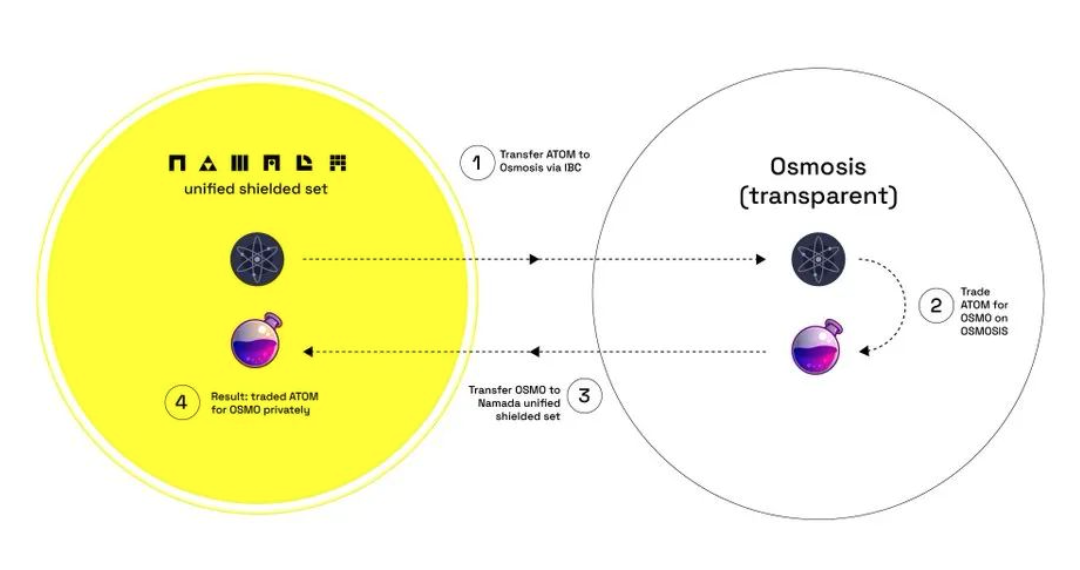
2. The second category is similar to the design of Namada in Cosmos, called Multi-Asset Shielded Pool (MASP) . Multiple privacy-protected assets share an anonymous set, coupled with the strong interoperability of IBC, at least within the Cosmos ecosystem, theoretically It can provide shielding protection for all mainstream assets on the Cosmos chain. For example, if you want to exchange OSMO and ATOM privately, you can implement it similar to the diagram below.
I have also seen the use of homomorphic encryption for privacy, but homomorphic encryption is too early, and its performance and operability have not reached the stage of "really usable". It is a bit like ZK around 2017. , To develop into a usable high probability, there will be a feeling of 5-10 years.
04
The three major parts of DeFi: DEX, lending, Stablecoin D stable
1. DEX
Let’s talk about DEX first. Since the appearance of UniV3, DEX has rarely had major innovations. Curve War can be counted as one. The Dex track has officially confirmed the duopoly situation in the past two years.
The Dex that improved slippage and Impermanent Loss in the past few years has basically disappeared. I have seen the following four trends on Dex:
1. The suture monster Ve (3, 3) is currently happening. AC built a Solidly on FTM before, trying to integrate Uniswap, Curve, and OHM , so there is such a thing as Ve (3, 3) , but in fact it is not very popular, and it is not popular to open a branch in ETH. On the contrary, Fork Velodrome on OP is popular.
I feel that one is related to the decline of Alt L1 and the rise of L2, and the other is that the various rewards of OP are also indispensable.
Now Ve (3, 3) is infiltrating into various chains, Arb has recently been on Chronos, BSC has Thena, and Polygon has lost its name... In short, every project has made some fine-tuning on Solidly, similar to Sushi For UNI, the only fun thing is that UNI is not popular, and the imitation disk Velodrome is very popular, and it directly killed UNI on the OP .
I personally don’t like this model very much. One is that the stitching marks are too heavy, and the other is that it is too complicated for many ordinary users to understand. It is not as simple and clear as Uniswap.
Although Curve War is also complicated, it is originally a bribery mechanism for project parties and large households, and its positioning is different.
Finally, the popularity of Velodrome is inseparable from the OP rewards. Major election bribers like SNX use AirDrop OP to bribe elections. It depends on whether the flywheel can continue to spin after the rewards stop.
2.Hybrid Dex - It is also a kind of stitching , but it is more of an experience seam.
One is that after the downfall of FTX, people’s distrust of Cex increased, but they still like the silky experience on Cex, so a combination of CEX experience + DEX self-hosting appeared . The basic front-end is similar to DYDX and Blur. First connect the wallet, then deposit money in, and then the fund operation is completely off-chain, and Settle goes back to the chain when withdrawing money.
The second is the combination of AMM+ OrderBook , using the combination of the market maker’s Orderbook + the traditional AMM using LP, the user will automatically select the best price of the two when operating, for long-tail assets (Orberbook may lack MM or lack depth ), you can also use the AMM mechanism to "guarantee the bottom line".
We have talked about more than one project like this, and the most representative one is Vertex, which has just been launched on Arbitrum recently. It combines the above one and two, and not only makes spot products, but also makes Derivatives. The team is also quite reliable.
It's just that we think that the Dex track is currently too complicated, so we didn't vote. Of course, this is normal in ABCDE. We can talk about 40 or 50 projects every month, and in the end we only make one or two shots. What we pursue is the One Shot, One Kill style.
3. UniV3-Fi
A few points: First, the protection of the V3 License expired some time ago, which is equivalent to open source, and we will definitely see more V3 forks on various chains; second, various Fi based on V3, such as Paraspace (this is currently The turmoil has been on the cusp for a few days) The borrowing based on V3 NFT, the options based on Panoptic based on V3, the Impermanent Loss hedging based on Gammaswap based on V3, etc., there will definitely be more games based on the bottom layer of V3 in the future.
4. Curve's Tricrypto New Generation upgrade
Curve has one foot into the mainstream currency field before, but retail investors still use less, because Gas is much higher than UNI, this time the upgraded Gas is down to the same level as V3, there should be more retail investors and aggregators scenes to be used.
Coupled with the gains brought to Atomic Swap by the upgrade of SNX V3, the PK between Curve and UNI in the mainstream spot field should be a highlight for some time to come.
Second, borrowing
After talking about DEX, let’s look at borrowing. I see the following three trends in borrowing:
1. Full chain
From the design of Compound V3 and AAVE V3, as well as the popularity of RDNT, it can be seen that full-chain borrowing is an undoubted trend.
However, according to Mr. Mindao, the current full-chain borrowing is still in a "pseudo-full-chain" stage, at most it is a "Cross-chain borrowing".
The real full-chain lending should be "allow any chain to deposit, withdraw, borrow, and return, Multichain share one Liquidity, and Multichain have one interest rate curve", currently no one can do it.
2. Isolation pool
The concept of Collateral asset isolation began to emerge from Euler. Now large platforms like AAVE, including some new platforms, are basically equipped as standard. The purpose is to prevent the manipulation of oracle machines such as XVS or Mango. One asset directly KOs the entire agreement. Although the situation has lost some flexibility, it must not be allowed to spoil the whole pot of porridge with a mouse dropping.
3. No oracle, no liquidation and borrowing
This is especially suitable for long-tail asset lending, because the depth and liquidation mechanism of mainstream currencies are very mature at present, but even if many long-tail assets have isolation pools, many lending platforms are afraid to use them, because of the control and liquidation of oracle machines The risks are very high. If the use of these two mechanisms can be avoided, the capital efficiency of long-tail assets can be further released. At present, three different approaches have been seen.
One is Timeswap, which uses an extremely complicated three-variable XYZ=K AMM, and the design is a bit 6, but I doubt how many users can really understand it... The other is InfinityPools, which borrows V3 LPs, which is equivalent to automatic liquidation through V3, and finally One is Blur’s Blend protocol, which is actually a peer-to-peer protocol for NFT, but its ingenious design feels that it can be used as a long-tail ERC20 borrowing with a little magic modification. I don’t know if there will be a project that does this.
3. Stablecoin
Finally, let’s look at Stablecoin. In fact, there is not much to say about Stablecoin. Last year’s Luna crash basically declared that “stable is dead.” Some time ago, Frax changed the mortgage rate to 100% to completely consolidate this statement.
Although there are still new mortgage-type Stablecoin appearing in the market, using various technologies to ensure that you will not be unanchored, but in fact, apart from pure stability, people are not very worried about your unanchoring problem. , the application scenario is king.
1. To insist on the few trends seen on Stablecoin, they should be the following:
MakerDAO's Endgame Plan, AAVE's GHO, CRV's crvUSD, SNX V3's sUSD, and the BTC-based NUSD proposed by Arthur in the concept.
crvUSD, GHO, sUSD To be honest, there are still Stablecoin projects, all kinds of fancy algorithms to guarantee Peg, but in my opinion, this is meaningless.
Except for Luna's "printing money out of thin air", people are not really worried about your unanchor. What really matters is the usage scenario. ) FEI, Float, and Reflexer will not be reduced to the current end.
2. Let me talk about the three real Stablecoin heroes in my eyes:
- crvUSD
Curve is actually the most "justifiable"Stablecoin. It is the Dex with the largest depth of Stablecoin. Its billions of TVL are basically blue chips, and its capital efficiency needs to be released urgently.
In addition, crvUSD has the following advantages:
- LLAMA's reverse UNI V3 liquidation mechanism, although worn out, is much safer
- Based on 1, crvUSD will naturally form a trading pair with the collateral. This has a natural Swap usage scenario
- The Curve team still has a large number of CRV(veCRV), and the various pools of crvUSD will naturally be the winning generals of Curve War, so there is no need to worry about the cold start problem
-GHO
AAVE does not have the advantages of Curve's DEX and vote-buying. AAVE's advantages lie in V3, Lens and Facilitator:
V3 - Multichain deployment. In theory, GHO can seamlessly move on Multichain like USDC in Stargate. This advantage should be consistent before Circle's official CCTP Cross-chain protocol is formed.
Lens - Musk wanted to turn Dogecoin into a witch-proof and tipping token on Twitter, so what is the most suitable tipping on Lens? It must be GHO. This is a direct expansion of the real usage scenarios for GHO.
Facilitator - The facilitator can theoretically bring RWA and credit-based borrowing into AAVE, and credit-based borrowing must be connected to DID. How does DID come from Lens!
-sUSD
I think the most undervalued Stablecoin has a market value of only tens of millions. sUSD has two fatal shortcomings, one is the application scenario, and the other is based on the ultra-high mortgage rate of 400% of the SNX local currency, and the capital efficiency is extremely poor.
The first one was after the cooperation between Atomic swap and Curve + the recent launch of Perp V2, which is much better than before, especially the use of synthetic assets + atomic swap to go to Curve, which is close to slippage-free swap, theoretically promising in the future Multichain era, I just don’t know if SNX has this Multichain ambition.
LayerZero has seen the emergence of synthetic asset projects that imitate SNX’s gameplay + full-chain deployment, and the second one is expected to be resolved soon by introducing collateral similar to ETH in the upcoming V3 version.
When we have enough SUSD and enough synthetic assets, it means that the Curve pool has enough depth, and many Swaps, especially large-amount Swaps, can theoretically have zero slippage, which is also a way for Curve Good.
3. The BTC-based Stablecoin NUSD mentioned by Bitmex boss Arthur Hayes
In fact, if you have been following Arthur’s articles, you should know that his idea was actually written last year, but this time he took it out and re-written it because of the Stablecoin incident. This idea is technically feasible, but it is realized in reality. more difficult.
The technology is very simple and similar to the hedging principle. Each NUSD consists of a dollar worth of BTC+ 1 BTC/USD perpetual short order. In this way, you will find that when BTC is 1 dollar, NUSD is 1 dollar, BTC falls 0.5, and the empty order Earn 50 cents, NUSD is still one dollar, BTC rises to 2, short position loses one dollar, NUSD is still one dollar, no matter how the NUSD rises or falls, it is one dollar, doesn’t it sound wonderful?
But it is not so easy to implement. The most direct question is that it was not difficult when the market value of NUSD was small. Now that the market value of USDT is tens of billions of dollars, with so many short orders, do you have to have long orders with a corresponding amount?
This requires too much depth and order volume for this platform, and currently no one can do it.
If there is a large-scale redemption of NUSD, it means a large-scale liquidation of tens of billions of dollars. Imagine this picture, hmm...
But if one day BTC costs several million dollars, and the perpetual trading volume is comparable to the current foreign exchange volume, this idea still has the possibility of implementation. This is also the most Crpyto Native Stablecoin, which is based on BTC and does not require over collateralized.
4. RWA-based Stablecoin
This is what Ondo is currently doing. It has created an OMMF Stablecoin, which is backed by MMF (market fund) and US treasury bonds. It is something that is on the fringes of the circle...
5. The development of LSD is in full swing before and after the Shanghai upgrade. I feel that there should be a Stablecoin based on LSDFi
For example, fork a Liquity, change the collateral to stETH or a basket of LSD version of ETH, and then make some articles on the interest... I don’t know if there are any projects that have already done this, if not, I guess it will definitely happen in the future have.
The previous article is over, so stay tuned for the next one.