Original author: MIX, founder of MixWeb3
Original source: Chain Tea House
The restaking agreement makes Eigenlayer the most popular infrastructure project on Ethereum. The core team EigenLabs received US$50 million in financing, led by Blockchain Capital, and Coinbase Ventures, Polychain Capital, Bixin Ventures, Hack VC and other well-known VCs in the industry participated in the investment.
According to the official tweet on May 2, the first phase of EigenLayer's mainnet will be launched soon, and will support Liquid Resttaking and Native Resttaking. EigenLayer hopes that by introducing the Restaking service, it will provide additional pledge opportunities for ETH holders who choose to join, and promote project innovation in the Ethereum ecosystem by reducing the security cost of AVS. It has to be said that Restaking has once again verified the power of Web3 composability.
What is Restaking?
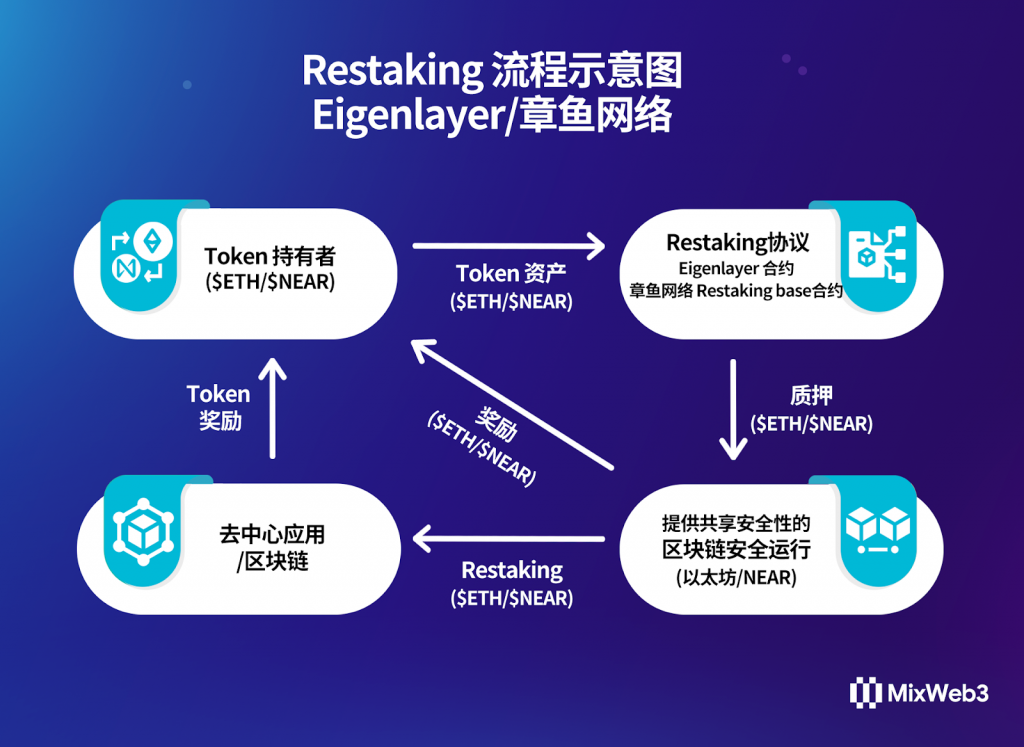
Restaking was first proposed by Sreeram Kannan, the founder of Eigenlayer. Eigenlayer is a decentralized trust market in the Ethereum ecosystem, aiming to expand the trust network of Ethereum. On other consensus protocols, let it share the almost unshakable economic security of Ethereum to ensure its own safe start and operation. In addition to receiving Ethereum's pledge rewards, ETH stakers can also get Restaking benefits provided by AVS.
In essence, Restaking is a shared security mechanism that allows the same asset to be pledged to multiple "decentralized applications/blockchains" at the same time to provide security. Generally speaking, a new "decentralized application/blockchain" will choose to join a blockchain ecosystem that has sufficient security and is compatible with its own project, and attracts pledgers of this blockchain by issuing rewards; pledgers The assets that have been pledged can be pledged to this new "decentralized application/blockchain" again, and a reward income can be obtained again.
"The so-called shared security is to allow a blockchain to enhance the security of its own blockchain by sharing the value of another blockchain's verification node. For example, Polkadot's slot scheme, Octopus network's LPoS rental proof of rights, Cosmos' Replicated Security, as well as Avalanche's "subnet" and Polygon's "supernet", are all players in the field of shared security. "
Just a few months after Eigenlayer proposed the Restaking concept, Octopus Network, the NEAR ecological head infrastructure project, announced to follow up the Restaking service. Octopus Network allows the holders of $NEAR to restake the application chain while staking the NEAR public chain, providing security to obtain the pledge rewards provided by the application chain.
I believe that other Layer1 public chain Restaking projects are also in the pipeline. If there is an official announcement of the project, the author will research and share it as soon as possible.
Why is Restaking held high expectations?
As the narratives of multi-chain networks and application chains gradually become popular, it is particularly important to provide lower-cost and more decentralized shared security services for the safe start and operation of blockchains. Usually, in various shared security solutions, there are three key stakeholders, namely "decentralized applications/blockchains", "blockchains that provide shared security" and "pledgers". The Restaking mechanism not only realizes The interests of the three are maximized and the interests of the three are fully unified.
1. Decentralized application/blockchain
"Decentralized applications/blockchains" represented by middleware chains and application chains need to pay extremely high economic and time costs if they want to achieve safe startup and operation by building their own verification node network.
When choosing Restaking, first of all, because it will join a blockchain ecosystem with sufficient security and fits with its own projects, its community has a large number of pledgers who can serve as security service providers, and decentralized applications/blockchains can use Its existing billions of dollars to tens of billions of dollars of security, through rewards, according to its own security needs at different stages of development, flexibly obtain and adjust the amount of pledge and security level. For example, the security level in the early stage of the project can be relatively low, and later assets can be adjusted to a higher security level through governance.
At the same time, Restaking allows new projects to be more closely bound to the selected ecology, which helps to gain ecological support.
2. Pledger
From the perspective of stakers, Restaking is the best choice. In addition to staking the original blockchain and earning rewards, the Restaking mechanism allows the same pledged token to be pledged to other blockchains to provide security, and then get another security reward. This kind of compound income is the most capital efficient pledge method at present.
Gabriel Haines used a 7-second magical video to succinctly describe the great attraction of Restaking to stakers: "You take your staked ETH... and you stake it again )".

3. A blockchain that provides shared security
Blockchains that provide shared security are usually PoS-based Layer1 public chains.
First of all, Restaking solves the problem that the original encrypted economic security of the blockchain is difficult to transfer and expand to other protocols in the ecosystem: for example, Ethereum is the blockchain with the highest security level, but the security level of various middleware protocols in its ecology is obvious. lower than Ethereum.
Secondly, Restaking has created more economic value for the mortgaged tokens. The scale of the blockchain token pledge market will be greatly expanded, and the value ceiling of the pledged tokens will be unprecedentedly improved.
With the gradual increase of resttaking projects, the blockchain that provides shared security will surely become the hub blockchain with the highest security, the most pledgers, the most application layer protocols, the most Web3 users and the most encrypted assets in the entire ecosystem. The back-feeding effect further enhances the economic security and value capture capabilities of the blockchain.
The beauty is that blockchains provide shared security at no additional cost.
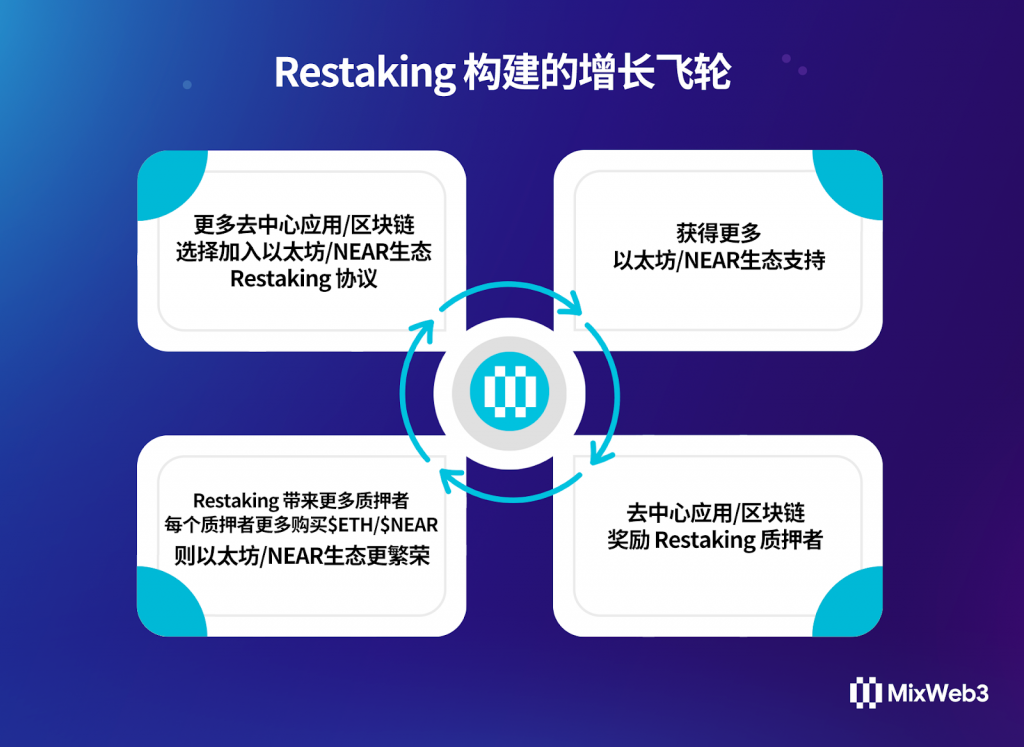
The Growth Flywheel Built by Restaking
Each decentralized application/blockchain adopting Restaking is like a bond market, with different degrees of productivity and yield. Part of its value will continue to flow to the blockchain ecology and be transformed into the value-added of pledged tokens.
Pledgers use Restaking to bring higher returns, which not only increases the value of pledged tokens, but also stimulates the motivation to continue staking. When stakers put these proceeds back into the staking pool, the entire Restaking shared security model forms a logical closed loop of the value growth flywheel.
Of course, as a new thing, Restaking also has a variety of potential risks, such as possible centralization risks, risks brought by high leverage, cross-domain MEV, and how to establish a censorship market, which requires continuous innovation Complete.