



As a Layer 2 of zkEVM, Linea is not much different from other layer-2 solutions in the general direction, all of which are aimed at improving the scalability of the blockchain, reducing gas fees and high efficiency.
Author: Web3CN
As the infrastructure of the blockchain industry, the public chain has always been considered the belief of the encrypted world. Countless teams are eager to build a blockchain that can handle one billion users. In 2023, with the maturity of Rollup, modularization and other solutions, the concept of Layer 2 will explode in an all-round way. Various Layer 2 projects based on ZK Rollup will emerge in an endless stream. More and more institutions will start to participate in the competition and deploy native Layer 2 networks.
ConsenSys, the developer of MetaMask, announced in March that its Ethereum Layer 2 network ConsenSys zkEVM was renamed Linea and opened its testnet, which attracted a lot of attention. In this article, we will discuss what Linea is, as well as Linea's technical architecture and advantages.
What is Linea
Linea is a Type2 zkEVM, which is a bytecode equivalent EVM. This type of zkEVM strives to be completely equivalent to the EVM, that is, they look exactly the same as Ethereum from the inside, but they have some differences externally, especially in Data structure aspects such as block structures and state trees. The goal is to be fully compatible with existing applications, but with some minor modifications to Ethereum to make development easier and proof generation faster.
As a new ZK Rollup network, Linea provides full EVM compatibility, combining Zero-knowledge Proof with full EVM equivalence, developers can build the Ethereum environment on the main network, allowing builders to create scalable dapps Or migrate existing dapps without the hassle of changing code or rewriting smart contracts, while still getting the same security guarantees of Ethereum.
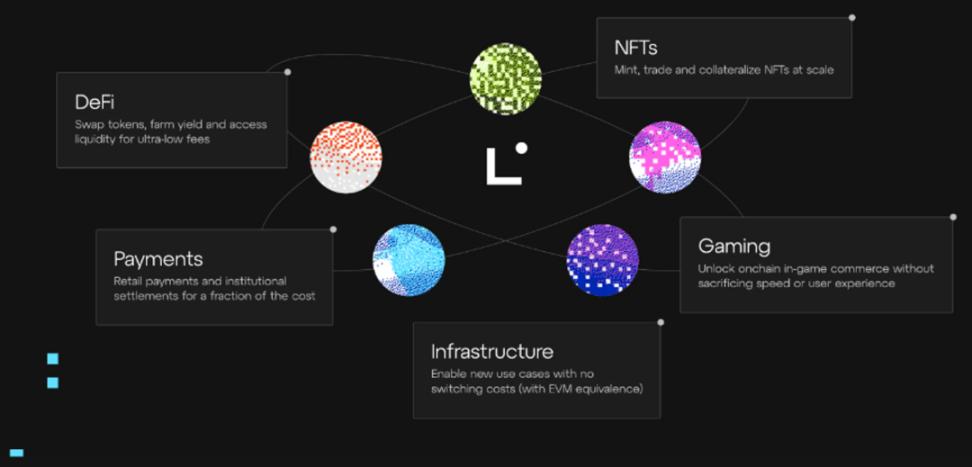
Linea Team Background
Linea is developed, designed and operated by ConsenSys. As one of the most influential and powerful companies in the Ethereum ecosystem, ConsenSys is committed to promoting the development and application of blockchain technology and providing blockchain solutions for enterprises and individuals and service. ConsenSys has a wide range of businesses, employing top entrepreneurs, computer scientists, protocol engineers, software developers and delivery experts to build development tools, decentralized applications and solutions for the blockchain industry for enterprises. Before the launch of Linea, ConsenSys There are 5 products: MetaMask, Diligence, Quorum, Infura, Truffle.
ConsenSys founder Joseph Lubin graduated from Princeton University with degrees in electrical engineering and computer science, focusing on the intersection of cryptography, engineering, and finance. He has developed autonomous music composition tools at Tomandandy Music's Princeton Robotics Lab and autonomous mobile robots at Vision Applications Inc., a private research company.
In addition, Joseph Lubin was also the co-founder of Ethereum. At that time, he proposed to write the architecture of Ethereum in C++ programming language, and was mainly responsible for the technical part. Joseph Lubin's relationship in the Ethereum ecosystem may become Linea's secret weapon.
Linea Technical Architecture——Linea Prover
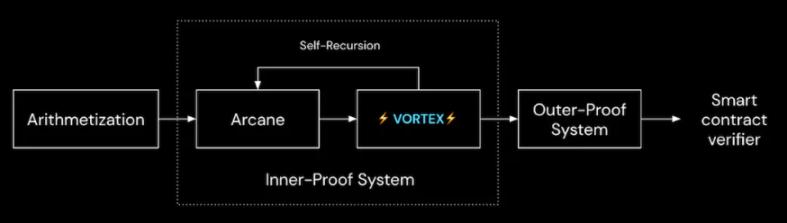
In order to prove that a transaction occurred, Linea must go through the above steps:
The first step is called arithmeticization, and in simple terms, it can be summarized as the process of converting a computer program into mathematics for zk-proof to understand. More specifically, it is the process of turning transactions into trajectories, and a set of constraints that must be satisfied in order to justify the computation. After arithmeticization, through an internal proof system that recursively shrinks the proof until we pass the final compression step in the outer proof system.
Linea's Internal Proof System: Vortex and Arcane
Linea's technology differs from other zkEVM in terms of its algorithm scheme and internal proof system is the internal defense system: Vortex and Arcane.
To prove transactions on Linea, to prove that certain traces satisfy certain constraints, the set of constraints must be changed into something more homogeneous (i.e. polynomial evaluation) so that it is easier to work with the prover. This is done through Arcane, which compiles arithmetic operations into Interactive Oracle Proof (IOP) models. (IOP is an interactive proof in which the verifier does not need to read the prover's entire message. Instead, there is an oracle - think of it as a third party who knows what the prover knows, and the verifier queries it probabilistically. getting information.)
Since Linea does not rely on third parties, cryptographic assumptions and small iterative transformations are used to replace oracles with polynomial commitment schemes. Polynomial commitments are fancy hashes of traces sent as part of a proof, this information allows a verifier to know whether an evaluation satisfies certain properties and was done correctly. For Linea, this relies on "lattice"-based cryptography and error-correcting codes.
So, how do polynomial commitments work?
Essentially, all trajectories are laid out in a large rectangle of rows and columns, then each row of trajectories is encoded and a "lattice" based hash is applied that cannot be changed. The verifier then sends a challenge, which asks for a random linear combination of hashed data and a random subset of trajectories. The computation is correct if there is agreement between the linear combination, the declared evaluation, and the selected subset of trajectories.
Vortex proof size and verifier work is a trace of the size of the Euler function, which is cheaper than the trace itself, but still too large to be directly verifiable on Ethereum. This therefore requires a final compression step: PLONK, which is a zkSNARK structure based on advanced cryptography.
For the final compression step, Linea made a final proof, the PLONK proof, to make it directly verifiable on Ethereum. Linea's fast verification is thanks to the SNARK-friendly nature of lattice-based hashing and SNARK's ability to verify multiple transactions in the same amount of time. Furthermore, it generates a very small proof such that it can be efficiently verified on L1.
Finally, Linea creates a proof that the proof, state commitment, and call data are sent to the verifier contract, which is verified by its verifier contract on Ethereum L1. If the verification is passed, the new Rollup state will be in the L1 smart contract finalized on.
Advantages of the Linea project
Zero cost migration
Linea is highly composable. It is designed to work seamlessly with all other EVM-based Dapp and allow fast communication between them. Our developer-friendly design ensures that you don't need to be a zero-knowledge technologist to use it. And it uses ETH as the gas fee and does not rely on third-party translators or custom middleware.
With Linea, developers can use their favorite applications, tools and infrastructure for scalability, and with full EVM equivalence, existing Dapp can be built on Linea and migrated without changing code or rewriting intelligence contract. Additionally, a Lattice based prover enables its zkEVM to provide higher throughput.
seamless integration
With Linea, you get native integrations with tools like Infura, MetaMask, and Truffle. Builders can easily onboard users using the web3 wallet MetaMask. Additionally, with Infura's easy-to-use API, developers can launch and scale dapps faster.
Developers can also build, test, debug, and deploy their Solidity smart contracts using Truffle or using popular developer environments such as Hardhat, Foundry, and Brownie, with compatible Ganache and Diligence supporting native code testing and auditing, respectively.
Additionally, ConsenSys' native, trustless bridge and MetaMask user-friendly bridge allow developers to securely move tokens in and out of the network.
Project progress and roadmap
Project Progress
Linea's public testnet has been launched, and Linea is currently launching a loyalty program "Linea Voyage" to encourage early users to use the public testnet. Since its announcement, the Linea network has processed nearly 31 million transactions, over 950,000 blocks, and over 4.7 million wallet addresses.

community performance
Linea currently has 417,000 followers on Twitter, and has tweeted 298 tweets in 3 months, with an average of about 100,000 views per tweet, and relatively positive comments; Discord currently has 182,407 followers, and the number of regular online users remains 10 % about. Overall, the community is more active.
route map
- 2022/11/9 - ConsenSys zkEVM registration form opens
- 1/10/2023 - ConsenSys zkEVM private beta is now open to selected users
- 2023/3/28 - Launched public testnet and renamed ConsenSys zkEVM to Linea
- 4/5/2023 - Created an open commemorative NFT on Mirror to celebrate Linea's public testnet launch
- It is expected that the mainnet will be launched in July 2023.
summary
As a Layer 2 of zkEVM, Linea is not much different from other layer-2 solutions in the general direction. They are all aimed at improving the scalability of the blockchain, reducing gas fees and high efficiency, etc., but because the parent behind Linea The company ConsenSys has huge resources, and it also has many blockchain solutions in the encryption field, so once launched, it has attracted widespread attention from the public. With network effects, it may become a strong competitor in the Ethereum Layer 2 track.






