


On June 16, BlackRock applied for a spot bitcoin ETF; on June 20, EDX Markets, a cryptocurrency trading platform backed by Citadel Securities, Fidelity Investments and Charles Schwab, was launched. In less than a week, two Wall Street giants have entered the cryptocurrency industry, which is facing strict regulation. It seems that because of the positive signals released by these two events, Bitcoin briefly broke through $29,000 this morning, and is now quoted at $28,916, a 24-hour increase of 6.82%.
Although the market reacted positively, with both Bitcoin and Ethereum achieving short-term minor breakthroughs, the sentiment in the English-language crypto community does not seem to be aligned with the market price.
Five days ago, BlackRock, one of the world's largest asset management groups, submitted a document application for a spot bitcoin ETF to the US SEC through its subsidiary iShares. Corporation, bringing in large traditional corporations that have partnered with the U.S. government in an attempt to gain control over Bitcoin and cryptocurrencies.
On the heels of that, EDX Markets, a new cryptocurrency trading platform backed by Citadel Securities, Fidelity Investments and Charles Schwab, has begun executing trades. At the same time, EDX Markets also announced that new equity partners have completed a new round of investment in it, including Miami International Holdings (Miami International Holdings), DV Crypto, GTS, GSR Markets LTD and HRT Technology.
BlackRock ETF is bad-mouthed
Earlier BlockBeats reported that some encryption industry practitioners and communities do not seem to support BlackRock's application for spot Bitcoin ETF. According to the rules of Bitcoin spot ETF, Bitcoin ETF is only used as an asset to track the price of Bitcoin. Investors own Bitcoin fund shares, not directly hold Bitcoin. This goes against the spirit of encryption to some extent: "Your keys, your bitcoin. Not your keys, not your bitcoin". (Related reading: " Why does the encryption community generally sing bad news about the application of Bitcoin ETF under BlackRock's high-pressure supervision? ")
In the context of the recent SEC regulatory pressure, the US Securities and Exchange Commission recently sued four large cryptocurrency trading platforms, including Gemini, Coinbase, Binance US and Kraken. This means that they may be investigated for allegedly violating US securities trading regulations; the Federal Reserve closed Silvergate Bank and Signature Bank, two banks that are well-known for providing services to cryptocurrency businesses; moreover, the Federal Reserve is deciding whether to approve A related plea from two crypto-friendly banks, Custodia Bank and Protego Trust.
Moreover, many spot bitcoin ETFs have not been approved before, and BlackRock's submission of a bitcoin ETF application at this time is also very surprising. In the discussion about BlackRock's spot ETF application, another popular view in the community is "Operation Chokepoint 2.0" (Operation Chokepoint 2.0), Wall Street intends to clear the currency circle.
Since February this year, rumors about the US authority's intention to strengthen supervision have begun to increase. First, Coinbase CEO Brian Armstrong revealed that there are rumors that the US SEC may ban cryptocurrency staking services for retail investors. Then, multiple sources said that the Federal Reserve and financial regulators are taking large-scale actions to put pressure on the banking industry to prevent encrypted companies from getting bank accounts, thereby cutting off the connection between cryptocurrencies and banks. In March, several U.S. banks were forced into bankruptcy and liquidation. Afterwards, it was discovered that several banks that were liquidated, including Signature Bank, Silicon Valley Bank, and Silvergate Bank, were all friendly to the encryption industry. Among them, a large part of Signature Bank's daily business is related to the encryption industry.
Well-known KOL AutismCapital (@AutismCapital) stated on Twitter that BlackRock chose to launch ETF under the regulatory pressure of the US Securities and Exchange Commission (SEC), which probably means that the SEC may be conducting a clean-up operation. The goal is to clear the "low-level liars" in the encryption field, so that the "elite giants" of traditional American finance can rebuild the game platform according to their own rules.
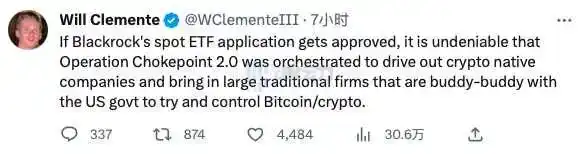
Will Clemente (@WClementeIII), co-founder of digital asset research company ReflexivityRes, believes that if BlackRock's spot ETF application is approved, then "Operation Choking Point 2.0" is very likely to be carefully planned. Aims to drive out crypto-native companies and bring in large legacy companies that have partnered with the U.S. government in an attempt to rein in Bitcoin and cryptocurrencies.
Just when BlackRock’s application for a bitcoin spot ETF was generally bad-mouthed, and Wall Street was accused of driving out crypto-native companies and trying to control bitcoin, backed by Citadel Securities, Fidelity Investments and Charles Schwab, the cryptocurrency trading platform EDX Markets went online , Public opinion escalated to Wall Street's attack on crypto exchage.
Wall Street Attacking Crypto Exchage?
Five days ago, the well-known KOL Hsaka (@HsakaTrades) listed on Twitter several incidents of traditional financial giants entering the encryption industry, implying the "giant financial" attribute of BlackRock's application for Bitcoin ETF:
- BlackRock’s filing for a spot bitcoin ETF;
- Soros Fund Management says TardFi is ripe for cryptocurrency acquisitions;
-Citadel Securities-backed cryptocurrency exchange EDX is rumored to go live later this year;

To the surprise of many, traditional finance can attack the encryption industry so quickly. Days after Hsaka’s tweet, the launch of the EDX trading platform was announced. Andrew Parish, co-founder of Arch Public, pointed out that in the past 48 hours, trading companies such as BlackRock, Citadel Securities, Fidelity, Charles Schwab, WisdomTreeFunds and Invesco US have jumped into the encryption field with both feet. And all this comes 7 days after the SEC sued Coinbase and Binance.
Many see this as the latest evidence of Wall Street's progress in digital assets during the Crypto Winter. But Hsaka believes that the EDX market started to operate, the crypto-native trading platforms were flooded with lawsuits, and a lot of fear was created around them. At this time, these traditional trading companies swooped in like vultures.
CEHV partner Adam Cochran (@adamscochran) believes that BlackRock, Citadel Securities, Deutsche Bank and Nasdaq all started to enter the cryptocurrency space last week. They bully the participants so they can scoop up cheap chips. The trajectory of cryptocurrencies has never been clearer. Grit Capital CEO Genevieve Roch (@GRDecter) had a similar sentiment: Now we know why the SEC has been cracking down on crypto exchanges... Here's EDX Markets making room for Citadel Securities' crypto trading platform space.

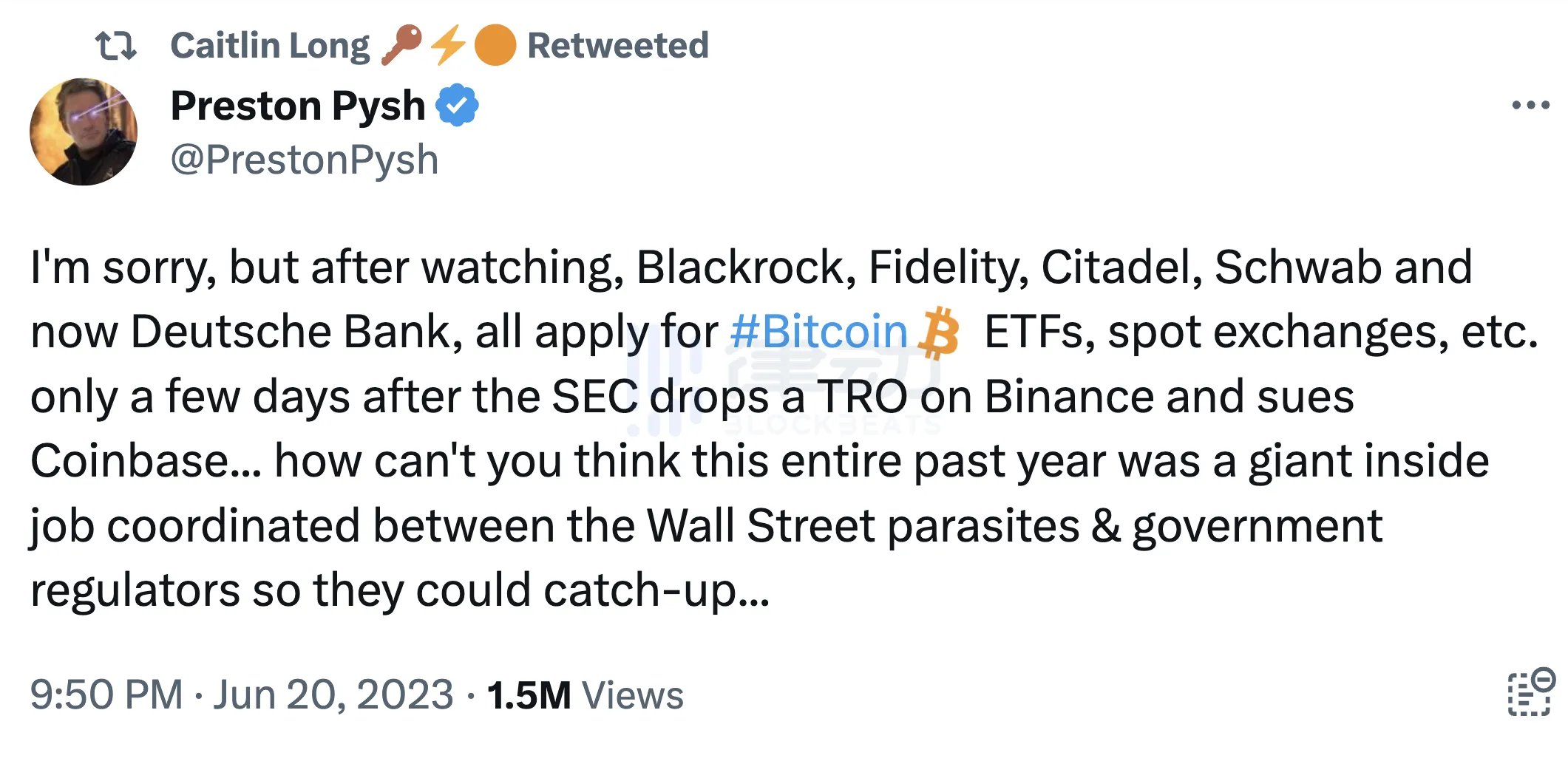
Preston Pysh (@PrestonPysh), host of The Investor’s Podcast: “Sorry, but after watching, Blackrock, Fidelity, Citadel Securities, Schwab and now Deutsche Bank have all applied for Bitcoin ETFs, spot exchanges, etc., right in the SEC Days after TROing Binance and suing Coinbase. How can you not think that the past year has been a huge inside job coordinated between Wall Street parasites and government regulators so they can catch up… "
Sam Bankman-Fried's FTX collapsed in November after its affiliated crypto trading firm Alameda Research tapped billions of dollars worth of client assets to fund venture deals and venture capital investments.
FTX collapsed, Coinbase and Binance were sued before. In order not to fight against regulation, EDX Markets is very smart to choose to favor institutional customers, and will provide API-based transaction access instead of traditional front-end user interface. At the same time, EDX Markets will not directly host customer funds, but will manage customer funds through third-party banks and professional custodian service providers. The transfer of funds will not "handle" EDX Markets, but only between relevant service providers. Finish. Currently, none of the four cryptocurrencies offered by EDX Markets (BTC, ETH, LTC , and BCH) are considered securities by the SEC.
As a non-custodial trading platform, EDX Markets does not directly deal with customers' digital assets or serve individual investors directly. Instead, it expects retail brokers to send investors' orders to buy and sell digital currencies into its marketplace.
According to the information displayed on the EDX Markets official website, we can see that EDX does not provide direct retail accounts, nor does it allow individuals to join members. Only institutions are eligible to apply for EDX membership. This is similar to how the stock market works, where instead of going directly to the NYSE or Nasdaq, investors submit orders through brokerage firms like Fidelity and Charles Schwab, further bringing individual crypto investors under the management of traditional financial intermediaries portal.
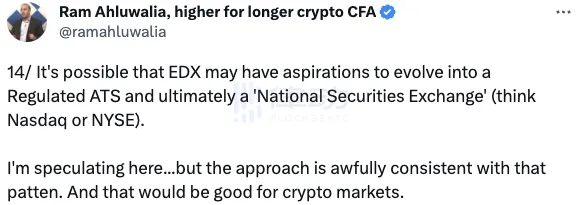
LumidaWealth CEO Ram Ahluwalia (@ramahluwalia) believes that EDX may hope to develop into a regulated ATS and eventually become a "national stock exchange" (think Nasdaq or NYSE), which is beneficial to the crypto market. EDX is applying federal securities laws to cryptocurrencies, by utilizing 3rd party banks and crypto custodians for asset custody, EDX minimizes conflicts of interest and prevents asset misuse like we did in FTX, Celsius and DCG/Genesis issues As you can see.
According to the SEC lawsuit, Binance's trading volume surged to $9.58 trillion in 2021, and Binance.US' revenue surpassed $265 million in 2021. Binance is the world's largest cryptocurrency exchange by trading volume, and most of its Revenue also comes from transaction fees. CryptoQuant, an encrypted data analysis tool, also tweeted that Binance has seen a 10-fold increase in revenue over the past two years, reaching approximately $12 billion in revenue in 2022, and OKX's revenue has increased fourfold over the past two years.
The prosperity of the world is all for profit; the world is full of hustle and bustle, all for profit. As the most profitable business in the encryption industry, exchanges are inherently attractive. On the one hand, the regulators are biting their mouths, and on the other hand, Wall Street is retiring the native encryption army and attacking crypto exchage. Native in the encryption industry will face unprecedented pressure.






