Large-scale models are "hot" at the moment, and news about Open AI's GPT-5 is coming frequently. Although its CEO has personally appeared to refute the rumors, some people believe that GPT 5 will be available by the end of 2023. The emergence of GPT-5 will "completely change the rules of the game" . In addition to achieving more accurate and intelligent multi-modal dialogue, ChatGPT may truly be able to "think like humans". Coincidentally, the Open AI Academy program is also expected to be launched by the end of this year. This is a "crazy" plan to promote global education equality. According to CEO Sam Altman, "Whether you are a developed country or a developing country, you can get learning opportunities through Open AI Academy". To this end, Open AI has cooperated with a number of educational technology companies and worked hard to build an artificial intelligence adaptive learning system. Is there a fundamental turning point and change in the long road to promote the "world harmony" of education?
The not-too-distant future: What does GPT-5 look like?
According to the release of GPT-3 only a few months apart, GPT-4, which has demonstrated powerful functions, has generated enough energy to subvert the existing industry production model. However, when countries and regions around the world are chasing the trend of developing large-scale general models for fear of missing the "next industrial revolution", news of Open AI's layout of GPT-5 is coming frequently. According to reports from the Internet, GPT-5 is said to have "the ability to change the rules of the game", with more reliable data and information sources, smarter mathematical computing capabilities, more complex human-like logical reasoning capabilities, and "infinite" The length of the message also includes a certain amount of creativity. OpenAI CEO Sam Altman also hinted at potential new capabilities of GPT-5, such as speech recognition, synthesis , and emotion detection .
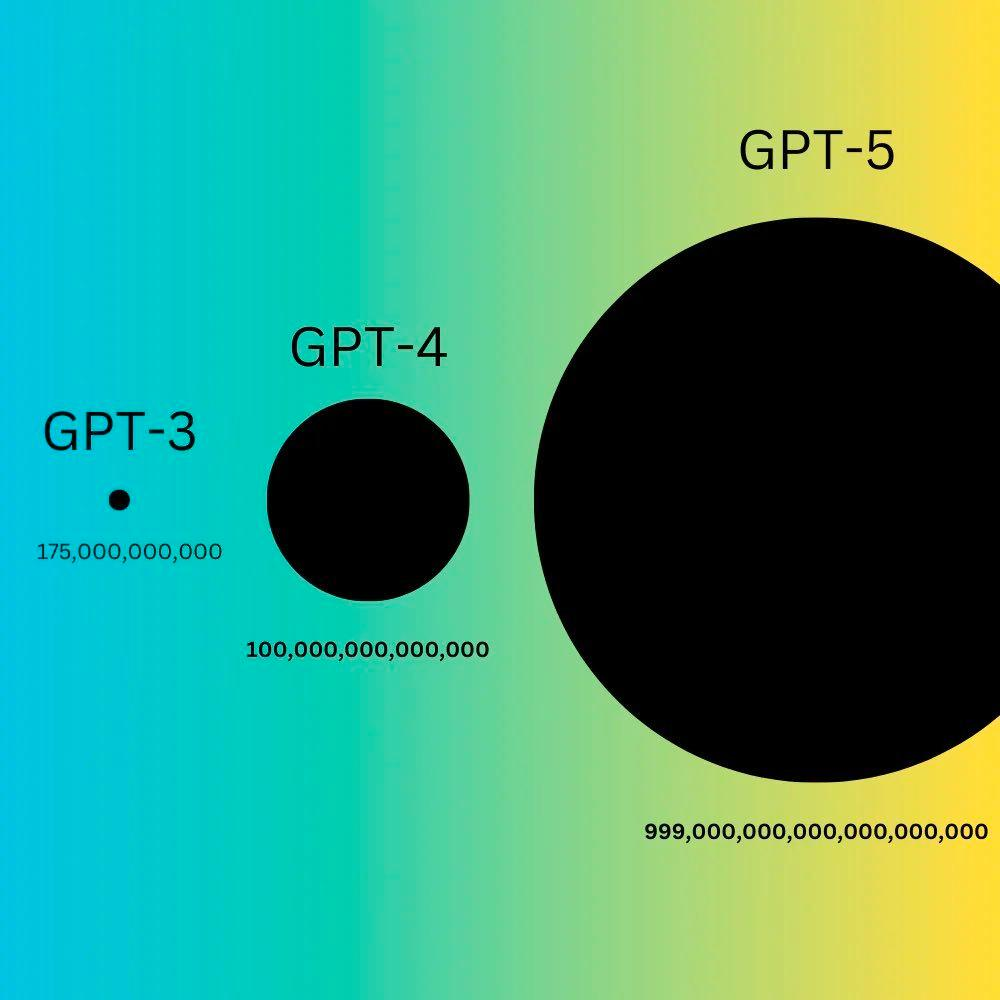
According to the forecast of relevant persons, GPT-5 has added the following functions based on people's cognition of the existing capabilities of the large model:
· Personalized templates: Customized based on the user's specific needs and input variables to provide a more personalized experience.
· Allow users to adjust the default settings of AI: including professionalism, humor level, speaking tone, etc.
· Automatically convert text into different formats: such as still images, short videos, audio and virtual simulations.
· Advanced Data Management: Includes logging, tracking, analyzing and sharing data to streamline workflow and increase productivity.
Assisted Decision Making: Assists users in making informed decisions by providing relevant information and insights.
Stronger NLP capabilities: Enhance AI's understanding and response to natural language, making it closer to humans.
Integrated Machine Learning: Allows AI to continuously learn and improve, adapting to user needs and preferences over time.
Some scholars believe that by the end of 2022, there will be very few effective and widespread applications of artificial intelligence in the field of education. For example, the dominant learning management system is still mainly file upload/download technology, and its underlying technology and teaching architecture have changed little since the beginning of web or cloud computing in the 1990s. Some general applications of artificial intelligence have been applied to education, such as machine translation and grammar and style checking, but these are complementary external services to support the work of digital texts, rather than specific educational technologies.
In the first quarter of 2023, the large-scale education field applications that "emerged" like mushrooms at home and abroad have shown their outstanding disruptive capabilities. GPT-3.5 has been shown to be "capable of providing more detailed feedback than human tutors, summarizing student performance fluently and coherently", showing "high agreement with tutors when evaluating the topics of student assignments", and GPT-3.5 is also It has been successfully used to simulate the utterances of a student talking to a trainee teacher. It is speculated that this ability will continue to improve with the launch of subsequent versions, and will present a new look in the GPT-5 version.
For example, when various companies released smart hardware devices on 618 this year, they all used "1v1 AI teacher" and "personalized" teaching as their attractive selling points. However, due to the immaturity of the existing technology, there is still a gap from the ideal AI teacher effect. GPT-5's intelligent voice and image processing functions, combined with virtual digital human technology, may become possible to create a real "AI teacher".
One World: Open AI's Global Academy Program
It can be said that the combination of GPT-5 technology and education has a very promising prospect, which is also reflected in OpenAI's active contact and cooperation attitude towards the education industry. Sam Altman, CEO of Open AI, has shown great enthusiasm for advancing the transformation of education around the world. According to the official website of Open AI, Open AI Academy, an online learning platform connected to GPT-5, may be launched by the end of 2023.
Currently, there is limited information about the Open AI Academy, but there is no doubt that it will fulfill OpenAI's global educational philosophy of ensuring that the benefits of artificial intelligence are available to all. Among the few GPT-4 customer cases displayed on its official website, two American education companies have reached cooperation with them, namely Khan Academy, a subject learning platform, and Duolingo , a language learning platform. . Open AI provides GPT-4 drivers for the two platforms as an assistant for artificial intelligence-driven course learning. It can be used not only as a virtual tutor for students, but also as a courseware assistant for teachers, providing assistance in language teaching, course writing, courseware production, and student Q&A.
In the future, the Open AI Academy imagines an educational vision of "Under Heaven" —an affordable, and possibly free, education for anyone who wants to learn anything. The Open AI Academy will allow users to access a variety of courses and topics. Users will be able to interact with ChatGPT-5 as their teacher, tutor or mentor, receiving feedback and guidance during the course. Users can even create their own courses and teach them to others. It is reported that the Open AI Academy will launch its grand plan with the "artificial intelligence adaptive education system" as the core, including:
(1) AI Adaptive Education System
Big data analysis: AI adaptive education systems can analyze large amounts of data about student performance to identify areas where students need more support or challenges, helping to personalize the learning experience for each student.
Personalized learning paths: AI adaptive education systems can create personalized learning paths for each student based on their strengths, weaknesses, and learning styles, helping to ensure that each student is challenged at the appropriate level and able to Progress at your own pace.
· Personalized feedback: AI adaptive education systems can provide individualized feedback to each student based on their performance. This can help identify areas where students need more practice or support, motivating them to continue learning.
Adaptive assessments: AI-based adaptive education systems can create adaptive assessments that adjust the difficulty level of questions based on student performance, helping to ensure that each student is challenged at the appropriate level and can provide feedback on student learning more accurate assessment.
(2) AI-assisted decision-making model
Adjustment of curriculum structure: AI-assisted decision-making models can help adjust the structure of courses to better meet the needs of students. By analyzing data on student performance, these models can identify areas where students need more support or challenges and adjust lessons accordingly.
· Comparative analysis: AI-assisted decision-making models can extract data from various levels and fields of the education system and conduct comparative analysis to make the entire decision-making model more reliable and faster. This can help ensure that decisions are based on accurate and relevant data.
Recordkeeping: AI-assisted decision-making models can aid recordkeeping at all levels of the education ecosystem. This can help ensure that important information is readily available and can be used to inform decision-making.
· Performance monitoring: AI-assisted decision-making models can monitor student performance at each learning stage. This can help identify those students who are struggling and provide them with the support they need to succeed.
· Real-time classroom behavior analysis: The working principle of real-time classroom behavior analysis is to use a classroom behavior analysis system, such as teachers wearing smart glasses with behavior analysis models. The system obtains the image data of the classroom through the camera of the device. The faces in the image are then segmented into individual entities for analysis based on the students' facial emotions. The system analyzes statistics on student behavior in real time and provides feedback to teachers.
Overall, Open AI believes that by harnessing the power of artificial intelligence, educators can teach more efficiently, make more informed decisions, and allow technology to support students better and more equitably.
Compete in large-scale models, a global start
In fact, in addition to the above-mentioned two customer cases of cooperation with Open AI, education companies in other countries and regions around the world are not far behind, not only in Europe, America, Asia Pacific and other regions, but also in Southeast Asia and the Middle East and North Africa. Founded a group of educational technology companies that are exploring and nuggeting in the field of large models. These companies have incorporated generative artificial intelligence into the education platform sector one after another, and industry leaders have seized the opportunity to access the GPT-4 large model in an attempt to change the learning mode of platform teaching.
For example, Cheggmate, which was previously introduced by Duojing, uses the GPT-4 function to help students query content in any format, including language learning, mathematics and science learning, and can even use pictures for dialogue. Cheggmate will distribute and disassemble the answers to present personalized answers. Whether it's text, photos, math problems, or diagrams, students also have access to instructions and step-by-step breakdowns in different formats.
As one of the best edtech platforms for international schools, Century ensures its products incorporate evidence-based science and instructional technology. Today, they are using CENTURY AI for everything from an effective classroom learning platform to a homework tool. CENTURY's new pop-up AI classroom provides personalized learning paths for all students.
Wonder Workshop is an online coding education platform that uses robots to inspire creativity in kids and provides a learning space to acquire key coding skills. These robots provide a fun and interactive learning experience for little ones. Most recently, the edtech company launched a new product, Class Connect. It provides tutors with an AI dashboard to monitor student progress, understand in real time where students are succeeding and struggling, and identify precise learning standards and resources.
The Gradescope AI tool enables students to assess each other while providing feedback, relying on a combination of machine learning(ML) and AI to streamline grading, saving time and effort. Help teachers focus on more important tasks.
There is no doubt that the use of generative AI and the implementation of large-scale models in the education industry have entered the era of "competing for the throne" . Although the platform technology has only been launched for a few months, the effect and profitability of new products empowered by artificial intelligence still need long-term observation and structural adjustment, but the next era will definitely be an era of fighting for technology and "human-like services" . In the future of education that Open AI promises to be "one world in harmony", a new pattern will be born.
A beautiful vision requires the two-way rush of technology and people
However, is the bright prospect of "world harmony" too idealistic? This is a question worth discussing.
After all, although ChatGPT has added millions of users in just a few days, there are restrictions on its use. The technical barriers behind the Open AI company and the hidden technical bias between countries are also affecting education. Publicity poses a challenge. In the face of different regions, different countries, and different levels of education, many applications of artificial intelligence are still in different stages of experimentation, testing, or implementation. Resource integration will be extremely labor-intensive.
In addition, ChatGPT also faces some ethical challenges during its use, such as bias, privacy and other issues. The emergence of AI teachers has also created an ethical dilemma in the current teacher industry and technological development. It is said that OpenAI is investing heavily in AI safety research, creating guidelines for the use of AI, and working to increase transparency in its work to help form a global consensus on AI ethics, including the universality of AI education. All in all, there is still a long way to go for the bright future imagined by Open AI.
This article comes from the WeChat public account "Duojing" (ID: DJEDUINNO) , author: Duojing compiled, 36氪 authorized release.