Author: Chloe
Original source: Chain Tea House
Bitcoin has always been known as digital gold as a store of value, while Ethereum is known as the world computer because of the existence of smart contracts. Various project parties have been trying to make the Bitcoin network also support smart contracts, but they are all inconsistent. Tepid, until the emergence of BRC-20 tokens. From the past to the present, the Bitcoin ecology has almost no practical application scenarios. Even compared to the TVL of the Ethereum, which costs tens of billions of dollars, the TVL of the Bitcoin ecology is not even comparable to the fraction of the Ethereum ecology. The Ordinal protocol exploded, and the NFT myth of a hundred times and a thousand times was born. Coupled with the huge increase in the income of Bitcoin miners, the Bitcoin ecology became famous directly in a short period of time.
Next, let's take a look at why Bitcoin became popular all of a sudden. What are BRC-20 and Bitcoin NFT? What is BRC-30 again?
1. Bitcoin NFT and BRC-20
On March 9, a Twitter user named Domo tweeted the Ordinal-based brc-20 protocol document. It benchmarks against Ethereum's erc-20 protocol, aiming to explore the possibility of the homogenization of tokens on Bitcoin. The first token ordi based on the BRC-20 protocol was deployed by Domo on March 8, and was minted on March 10.
On May 5, encryption KOL Plan B released a vote on BRC-20 on Twitter; Wang Feng, founder of NFT market Element, said on social media that Element will develop BRC-20 inscription tokens that support Bitcoin Ordinal for community users and NFT trading market.
On May 6, the news that "the price of BRC-20 token Ordi exceeded $10, and the market value exceeded $200 million" was circulated in various communities. The tokens were issued online on March 9th, and they were free at the beginning of the issuance. Users only need to pay the gas fee for casting on the chain to obtain a large number of ordi tokens. Assume that the user minted 1,000 ordi at the beginning of the release, and the current value is close to 100 million U. Compared with AirDrop, the myth of BRC-20 tokens making wealth is easier. Users do not need to participate in the inversion of operations on the chain, and do not need to worry about not being able to meet the harsh conditions. They only need to mint the tokens at the first time when the tokens are issued. Even when the early Bitcoin chain is not congested, the cost of gas fees on the chain is only A few U's are all it takes to get involved.
On the same day, Huobi issued an announcement saying: BRC-20 token ordi won the first place in the fifth voting activity with 23.91 million total votes. Once the relevant standards get the industry consensus, ordi spot trading will be opened as soon as possible. The second name is PEPE of BRC-20; subsequently, OKX tweeted that it is stepping up the analysis of BRC-20 and promoting the wallet to support the transaction ordi.
Although BRC-20 was just an experiment at that time, and there were still many imperfections in its functions, it set off a frenzied pursuit of it by the community. Today, there are thousands of BRC-20-based tokens on the platform, and there are also decentralized trading platforms like RelayX.
And why BRC-20 will suddenly rise, we must first understand the format standard. BRC-20 is an experimental format standard for issuing homogeneous tokens on the Bitcoin network . It was created by the above-mentioned Domo on March 8, 2023 based on the Ordinal protocol. It is similar to the ERC-20 standard of Ethereum: The name, circulation, transfer and other functions of tokens issued on Ethereum, all token contracts developed based on Ethereum comply with this standard.
The main difference between BRC-20 and ERC-20 is that the Bitcoin network does not support smart contracts. It deploys token contracts, mints and transfers tokens by using the Ordinal protocol to set inscriptions as JSON data format, that is, to develop Personnel can create and issue homogeneous tokens through the Ordinal protocol.
We are very familiar with NFT on Ethereum, but the Bitcoin network lacks smart contracts, why can NFT be issued? Rodarmor's solution is simple, engrave NFT on BTC .
The above-mentioned inscriptions (inscriptions) can be pulled back to the end of December 2022. Rodarmor brought the concepts of Bitcoin Ordinal and Inscriptions (ordinal numbers and inscriptions) to everyone's field of vision, introducing NFT to the Bitcoin network. On January 21, 2023, the Ordinal protocol released version 0.4.0, and the amount of BTC NFT minted began to soar. (5/30 news that Rodarmor resigned, he said he "couldn't give Ordinal the attention it deserved")
Let’s briefly understand BTC NFT first. Because the Bitcoin network does not support smart contracts, NFTs cannot be issued through contracts. Rodarmor's solution is to engrave NFT on BTC. Since the total amount of Bitcoin is limited, 21 million pieces, and its price is very high, Bitcoin has a smallest unit "Satoshi" (English sat: Satoshi), and 1 Bitcoin can be divided into 100 million Satoshi.
Rodarmor's thinking at the time was:
We might be able to arrange these satoshis in a certain order, assign them an ordinal number between 0 and 2,100,000,000,000,000, and link them to other information: pictures, text, videos or even a string of codes. That is to make each Satoshi unique and irreplaceable, which is equivalent to giving Bitcoin the native ability to create NFT.
So it can be seen that Rodarmor wants to create a system to number Satoshi, assign a unique serial number (Ordinal) to each Satoshi, and get integers starting from 1 to 100 million, and each ordinal number represents a Satoshi bit Currency is indivisible. This unique identifier will allow users to track each satoshi on the blockchain. He hopes to be able to do this in a thoroughly bitcoin-native way, without the use of sidechains or separate tokens. And when the user attaches specific information to the Sats, such as pictures, text, codes, etc., each Satoshi can become unique, which is the so-called Bitcoin NFT. The additional information is called "inscriptions", and the process of adding information to Sats is called "inscribe", that is, to engrave "inscriptions" on Satoshi.
And Rodarmor also succeeded. According to the latest data from Dune Analytics on May 09, the cumulative minting volume of the Bitcoin NFT protocol Ordinal has reached 1,795,678, and the total cost has reached 185 BTC.
This is also the reason for Domo. BTC NFT (Ordinal) has attracted so much attention, and it also made Domo think, since NFT can be minted through the Ordinal protocol, can BTC -based tokens be minted through the Ordinal protocol.
BRC, the abbreviation of Bitcoin Request for Comment in English, means "Bitcoin Request for Comment Agreement" in Chinese. BRC-20 is obviously aimed at Ethereum’s ERC-20. ERC-20 is a standard token issuance protocol based on the Ethereum network. With ERC-20, developers can achieve efficient, reliable, and low-cost To create tokens exclusive to its own projects, BRC-20 must have this vision.
Taking ORDI token creation as an example, users only need to enter the code below the picture to create the token.

The picture above shows the JSON data text input for deploying ordi tokens, with a total issuance of 21 million and a maximum limit of 1,000 for each minting. Among them, the user can change the field after "OP" to represent the operation performed, Deploy represents the deployment of tokens, Mint represents the casting of tokens, and Transfer represents the transfer of tokens; "tick" represents the name of the code being executed Token, the user can enter the name of the token to be executed.
The following figure shows the three contract standards of BRC-20:
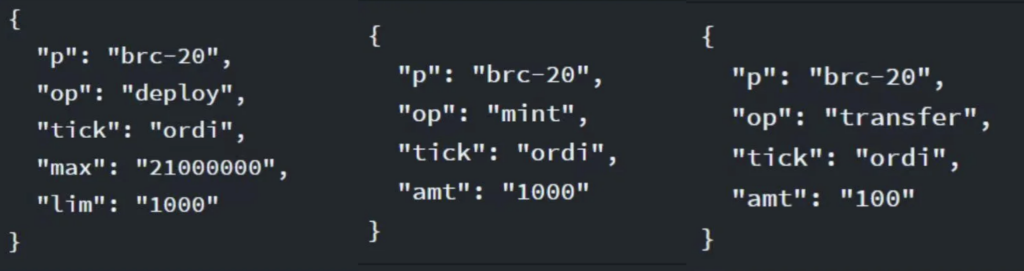
Currently, anyone can deploy BRC-20 tokens. It should be noted that the name of the deployed BRC-20 token only supports the input of 4 characters (English punctuation, English, numbers), and is not case-sensitive (Doge= Doge); first come, first served, that is, there are ordi tokens , the token with this name cannot be deployed later. Now users can perform operations such as token deployment and transactions through third-party tools. At present, related activities are mainly carried out through the Unisat wallet.
In addition, judging from the existing BRC-20 tokens, except for the first ordi token, Meme tokens with the highest market capitalization, such as MEME, PEPE, PIZA, etc., are mainly hype-based. and has no real value. From the perspective of the number of players, there are only 5,261 holders of ordi tokens with the largest market value, which also means that the current number of BRC-20 players is very small, and the Liquidity of tokens is relatively poor. city.
The reason why BRC-20 is sought after by users is mainly that the issuance method of BRC-20 tokens is relatively fair and just. All casting users are treated equally, and the project party cannot reserve and issue additional tokens. Even the issuer wants to obtain the issued BRC-20 tokens , but also start casting like ordinary users, so that everyone is an equal participant in the ecology. However, it should be noted that the current BRC-20 token is just a token, and it is still unknown where it will go and what application it will have.
Because most of BRC-20 projects and tokens have no value and no application scenarios, BRC-20 has been opposed by the original users of the Bitcoin community, who believe that doing so will only increase the congestion of the Bitcoin network. Bitcoin is no good. However, some users believe that this has added new application scenarios to the Bitcoin network, and attracted a new wave of enthusiastic users and developers to join the Bitcoin community, increasing the demand for BTC , which is conducive to the rise of BTC prices, because users Any purchase of BRC-20 tokens on-chain requires payment in Satoshi.
>> BRC-20 vs ERC-20
As mentioned above, BRC-20 is an alternative token standard built on top of the Bitcoin blockchain. Tokens are deployed, minted, and transferred using JavaScript Object Notation (JSON) ordinal inscriptions, and sats can be assigned value, traded or exchanged for other tokens.
But even though BRC-20 sounds similar to Ethereum’s ERC-20 token standard, there are key differences. BRC-20 uses the proof-of-work mechanism on the Bitcoin blockchain , while ERC-20 uses the Proof-of-stake mechanism on the Ethereum blockchain . In addition, the BRC-20 token standard does not currently support smart contracts, which is why it has not yet become popular in DeFi.
Smart contracts enable developers to build programmable currencies, automate various financial processes and create new types of financial products, which has become a limitation of BRC-20. The BRC-20 protocol can only implement the deployment and management of token contracts. That is, the ordinal inscription is used to store the information of the token contract, including token name, symbol, total amount, decimal places, etc. By storing these encoded information on the Bitcoin blockchain.
In addition, adding some text information in the information record column of Bitcoin transfer can also realize the minting and transfer of tokens. Therefore, the deployment, casting, and transfer of BRC-20 are all castings of the new inscription (Text format). However, unlike smart contracts, BRC-20 tokens cannot perform automated operations, such as automatic transfers or dividends. Although this is the difference between BRC-20 and ERC-20, simplicity and security are the cornerstones of Bitcoin's development. Therefore, this is also the reason why the BRC-20 protocol stands out from the competition in the market.
However, many people in the market currently say that BRC-20 is not flexible to deploy on DeFi, but this article has a different point of view:
The height of Ethereum and EVM network touching Defi is still in its infancy. However, the launch of BRC-20 could be the starting point for decentralized finance because, unlike Bitcoin, BRC-20 is flexible and can be incorporated into DeFi protocols.
For miners, the emergence of BRC-20 is a good thing . The average fee income of miners per block exceeds the subsidy amount of 6.25 BTC . ( This is important because one of the most frequent debates in the mining industry is whether transaction fees will be enough to maintain profitability after the block halving. )
From the perspective of miners, this extra income is indeed happy, but we may be able to listen to what the opposition has to say. In fact, there are still many people who are not so optimistic about BRC-20. The most obvious problem is that although the high transaction fees brought by BRC-20 inscriptions benefit miners and increase income, they also increase the cost of using Bitcoin for ordinary users. .
In this regard, Samson Mow, CEO of JAN3, said, "If you think it's fun to put JPEG on Bitcoin, then you may not be well adjusted."
>> In-depth introduction to NFT projects
It can be seen that the advent of the "Ordinals Protocol" allows users to put NFTs on the Bitcoin blockchain. Finally, I will take you to take a look at several popular Bitcoin NFT head projects currently on the market, as well as an in-depth discussion on Bitcoin. The characteristics of Coin NFT and the difference from Ethereum NFT:
- Twelve Fold
- The TwelveFold series is a Bitcoin NFT based on the Ordinals protocol. Each work is a generative art NFT, combining 3D graphics and hand-painted features, the size falls on a 12×12 grid, and a limited edition of 300 pieces, of which 288 are The auction is conducted (12 are reserved for public welfare), the highest bidder is 7.11 BTC , and the lowest bid is 2.25 BTC.
- On the morning of March 7th, Yuga Labs officially announced that the auction of TwelveFold has ended, and the top 288 successful bidders will receive the inscription within a week. During the 24-hour auction, Yuga Labs received a total of 735 BTC, worth about $16 million, with the highest bidder paying $161,000.
- And even in the current volatile market, Yuga Labs' NFT experiment on the Bitcoin network has created a huge economic effect. Relying solely on the following, commonly known as "bubble charts", they have harvested more than 16 million US dollars.

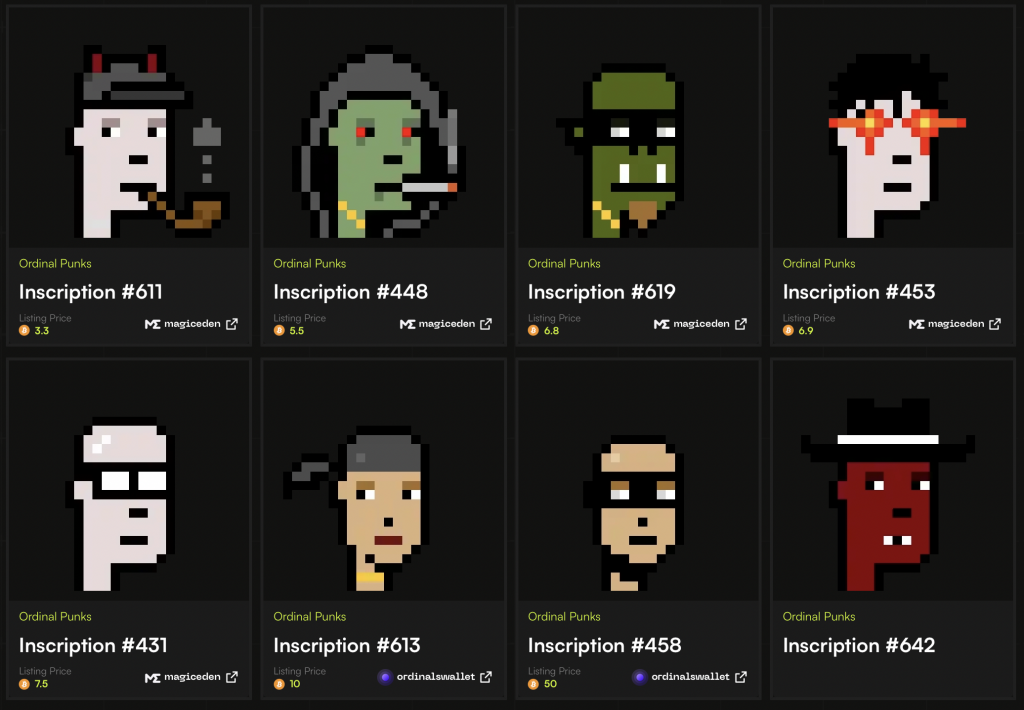
- Ordinal Punks
- On February 8 this year, an Ordinal Punk was sold for 9.5 BTC , and the price reached $215,000, which is twice the price of the CryptoPunk floor. According to foreign media, an anonymous NFT investor, dingaling, claimed that he had purchased 7 Ordinals Punks at a price of 15.2 BTC at a price of approximately US$349,000.
- Ordinals Punks is a project that pays tribute to CryptoPunks, the "ancestor of Ethereum's NFT", and was launched on the Bitcoin blockchain in late January 2023. One of the first 650 minted series on the Bitcoin blockchain, the Ordinals Punks collection consists of 100 unique NFTs, each featuring an open-source algorithm developed by anonymous Web3 creator FlowStay, 192 x 192 pixels image.
- Not only that, but it may also be one of the most talked about NFT projects on the Bitcoin chain at present. These avatars have been minted on the Bitcoin blockchain in an "inscription" manner through the Ordinals protocol and can be traded.
- OnChainMonkey
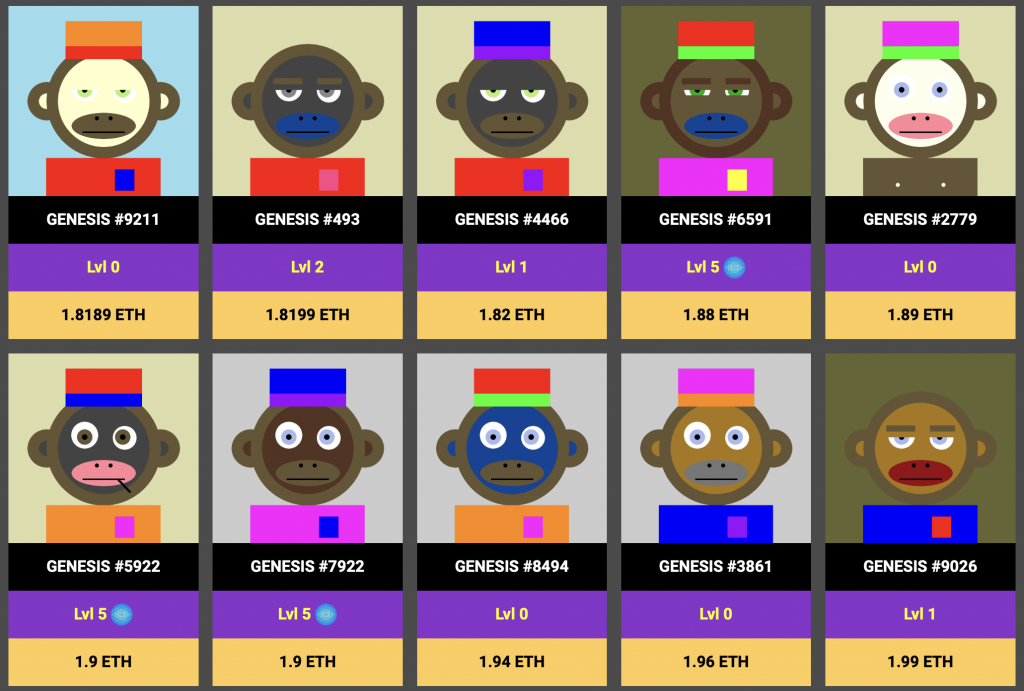
- OnChainMonkey is an NFT series launched by the NFT startup Metagood, which aims to give community members the opportunity to promote and fund social welfare projects through its DAO. In December last year, the company completed a $5 million Pre seed round of financing, Animoca Brands, Morgan Creek Capital founder and CEO Mark Yusko and Virgin Group investment manager Freddie Andrews participated in the investment.
- And OnChainMonkey also joined the Ordinals protocol and started the casting of "inscriptions" on the Bitcoin blockchain. At present, its 10,000 NFT collections have all been uploaded to the chain, and the above-mentioned CryptoPunks and Bitcoin Punks are both on the Bitcoin blockchain. The casting was completed, promoting the single-day Ordinals protocol NFT casting volume of more than 20,000 pieces on February 9.
- Bitcoin Punks
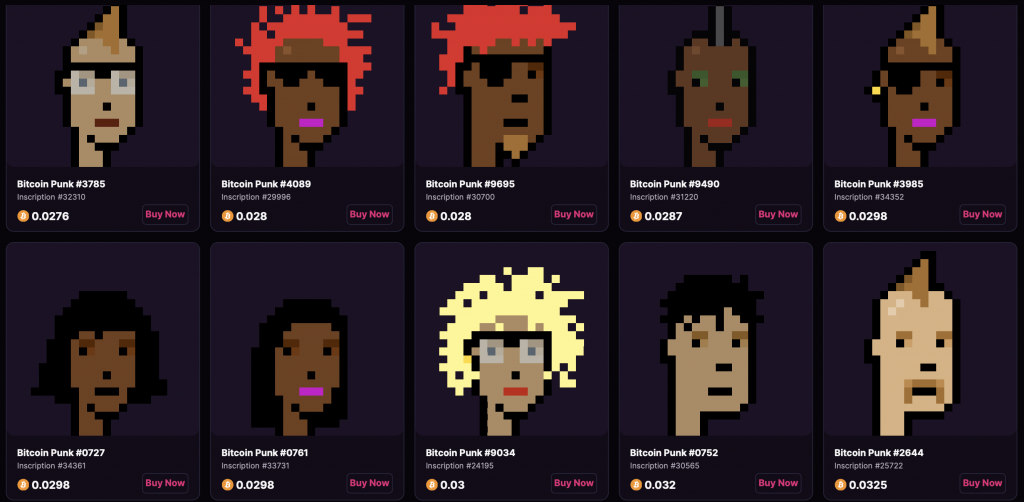
- Bitcoin Punks is the first project to use the Ordinals protocol and successfully upload the Ethereum CryptoPunk to the Bitcoin blockchain. All Bitcoin NFTs are minted by collectors for free, and all minting has been completed in less than a day.
- Officially, Ordinals Punks is not a direct copy of the original CryptoPunks series. In order to make this website, the team checks the hash value (Hash) of each image uploaded to Ordinals and compares it with the original 10,000 CryptoPunk images.
- The casting cost of Bitcoin Punks is about 25 US dollars, and there is no OTC transaction outside the market. According to foreign media, after the casting transaction is completed, the NFT secondary market price will reach more than 1 bitcoin, which is as high as 100 times the cost price.
Then there are the characteristics of Bitcoin NFT. How is it different from Ethereum NFT? Taking Ethereum NFT as an example, it basically binds the tokens on the Ethereum blockchain with the work itself, which is equivalent to using an "indirect" method, so the place where the work is stored is usually off-chain, with a certain degree of privacy. The risk of loss, Bitcoin NFT is the opposite. Because the inscription is "directly" written into the SAT and stored on the Bitcoin blockchain, it is quite different from other blockchain NFTs.
Finally, explain the current challenges faced by Bitcoin NFT. First of all, because Bitcoin NFTs are fully chained, it directly blocks the development of large-scale application and popularization of the project, and even lacks relevant infrastructure and application scenarios. Most of them have to rely on off-site transactions, and even users will encounter complex operations The problem. Also, because there is no smart contract on the Bitcoin blockchain, its NFTs are difficult to modify and update, leaving most Bitcoin NFTs in a static form. On the contrary, Ethereum NFTs can be enriched due to their smart contracts. Interesting gameplay, such as synthesis, mutation, evolution, burning, etc.
The last one is an argument that varies from person to person. Some Bitcoin users think that Bitcoin NFT violates Satoshi Nakamoto's original intention of creating "peer-to-peer electronic currency", and writing NFT-related data into Bitcoin is a waste of block capacity.
2. BRC-30 Tokens
According to the news on June 1, the OKX official website released the BRC-30 proposal, which can be regarded as an enhanced version of the BRC-20 protocol, adopting the design principles of BRC-20, and introducing equity operation functions such as deposit, casting, and withdrawal. The main purpose is to introduce a staking mechanism for BRC-20 tokens and Bitcoins to the Bitcoin network. Users can stake their own BRC-20 tokens and Bitcoin and receive corresponding BRC-30 tokens in return.
Jason Lau, Chief Innovation Officer of OKX, said : “We are excited to propose and pioneer the BRC-30 standard to support Bitcoin and BRC-20 token staking. With BRC-30 support soon included in the OKX Wallet, users will be able to stake Bitcoin Bitcoin and gain access to opportunities on Multichain. With explosive new developments in the Bitcoin ecosystem, we are proud to work with a whole community of developers and projects to contribute to the growth of the overall ecosystem.”
In fact, the term BRC-30 is not mentioned in the OKX Whitepaper, but BRC20-S, which reflects the derivation strength of BRC-20. And the official also directly revealed the motivation for introducing this mechanism, "The introduction of BRC20-S and its pledge function provides BRC-20 token holders and projects with a wider range of applications and interaction with the user community."
By implementing BRC20-S, OKX believes that both BRC-20 token and Bitcoin holders can use their tokens to significantly contribute to the ecosystem and get rewarded accordingly. "This staking mechanism introduces a new dimension to the BRC-20 token ecosystem, facilitating greater user participation and creating a stronger connection between token holders and the Bitcoin blockchain network .
Next, let's take a look at how the BRC20-S (BRC-30) works, please look at the picture below:
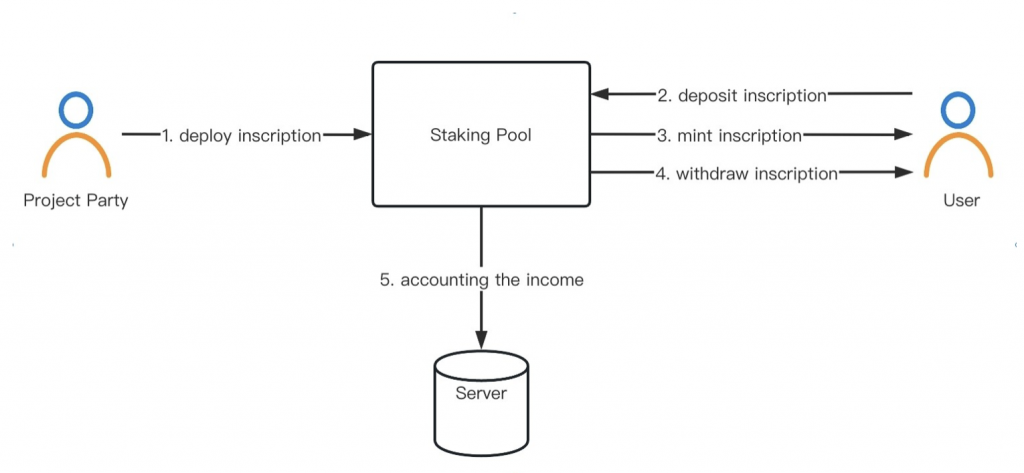
The pictures can be easily divided into:
- Project Party: It can define the attributes of the staking pool, including pledged tokens, revenue tokens, mining rate, total mining rewards, and token holders’ permission to participate in multi-mining. After this operation, the user's deposit operation will be identified and recorded (according to the BRC-20 protocol).
- User User: Deposit, minting and withdrawal of inscriptions can be performed, and users can claim their mining rewards by minting revenue tokens at any time.
- Server: Comprehensive interpretation of BRC-20 and BRC-30 proposals, that is, providing an open source interface for profit calculation. The staking rewards of any user will be calculated consistently in the backend and open source tools, ensuring the uniformity of all calculations.
However, the BRC-30 protocol proposed by OKX does inherit the shortcomings of BRC-20's incomplete decentralization. There is a centralized server. If there is a problem with the server, the user's reward may be calculated incorrectly.
According to the official definition of the application scenario, the project party can issue BRC20-S tokens by creating a pledge pool to acquire initial users; while users can pledge BTC to earn other similar BRC20-S tokens or pledge BRC-20 tokens coins to earn other similar BRC20-S tokens.
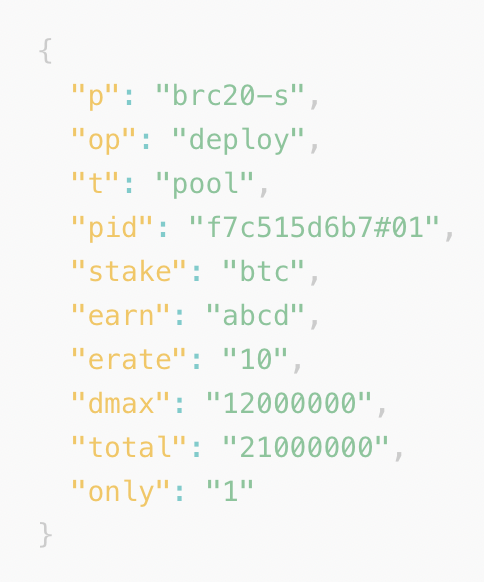
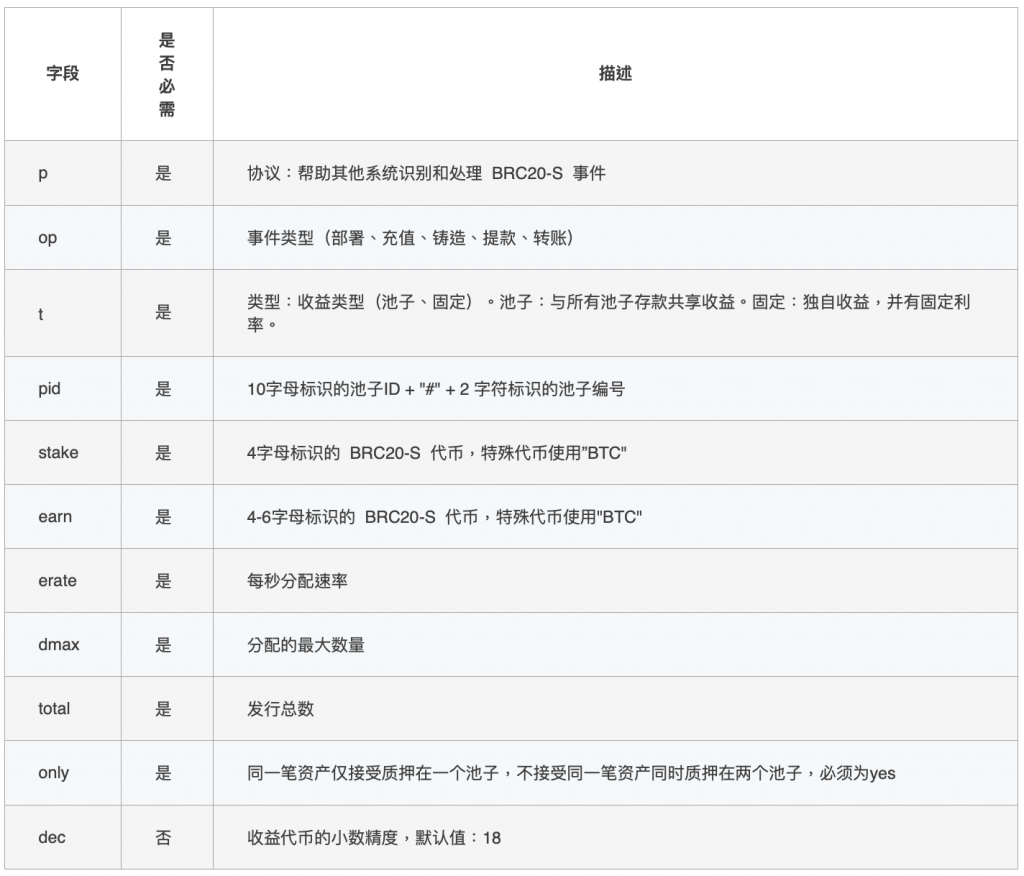
Next, I will show you how to operate and define the fields. The first step is to deploy the BRC20-S pool , the following figure is its code:
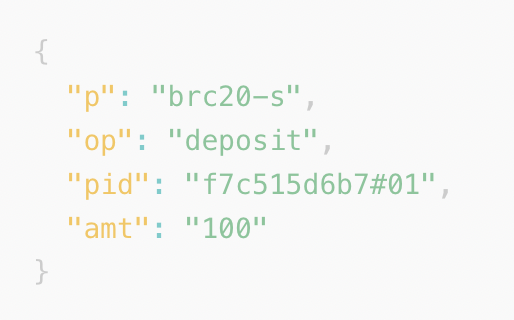
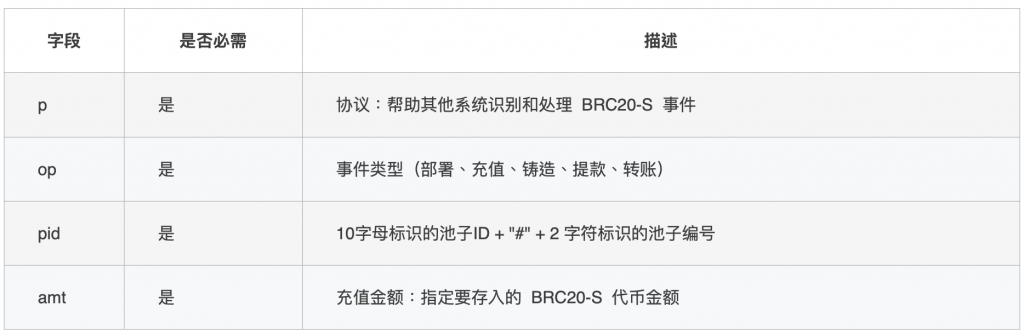
The second step is to recharge BRC20-S tokens/ BTC into the BRC20-S pool, as shown in the figure below:
The third step is to claim: minting BRC20-S tokens (users only need to mint BRC20-S tokens to perform the "claim" operation to claim and get benefits), the code is shown in the following picture:
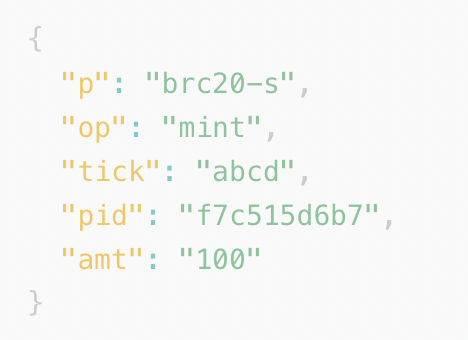
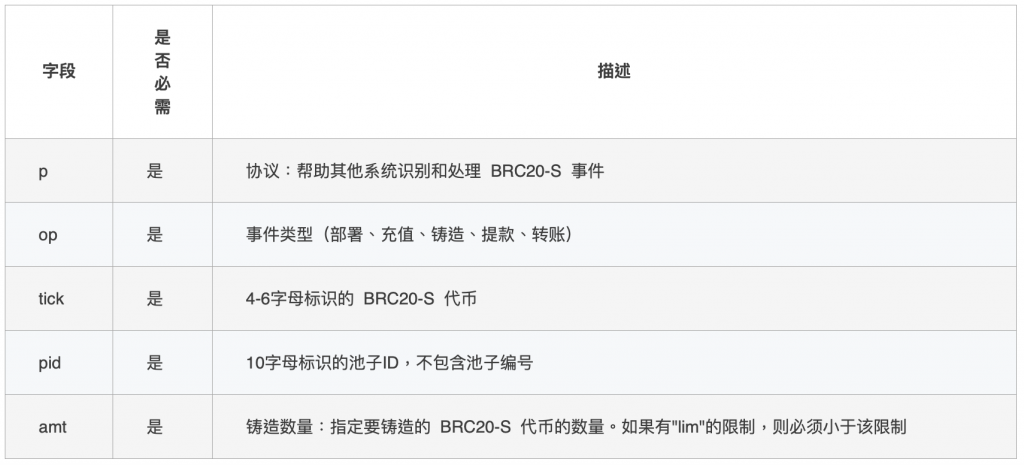
The fourth step is to cancel the pledge: withdraw BRC-20 tokens/ BTC from the BRC20-S pool (the withdrawal and transfer logic for the pledged tokens are the same), and the following figure is its code:
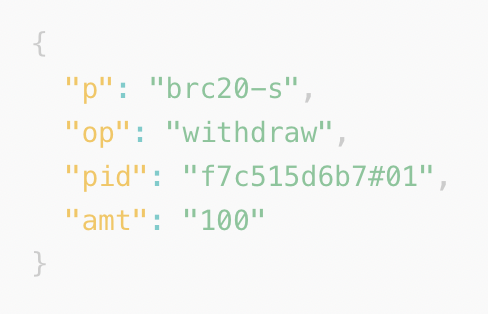
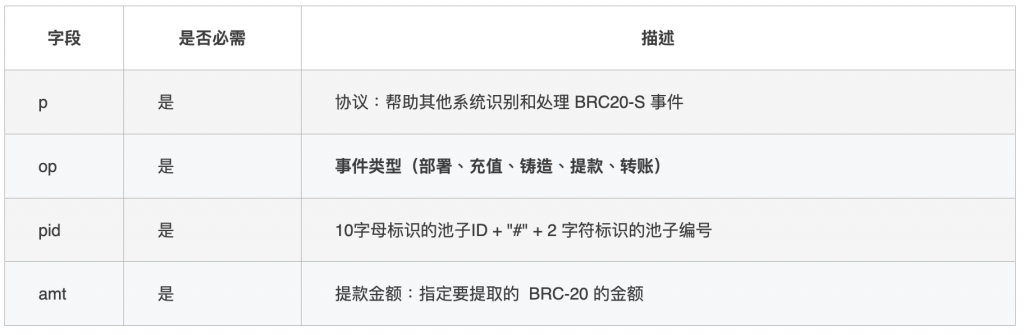
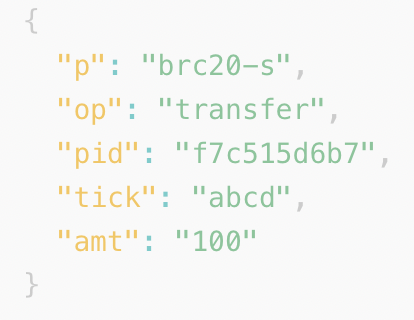
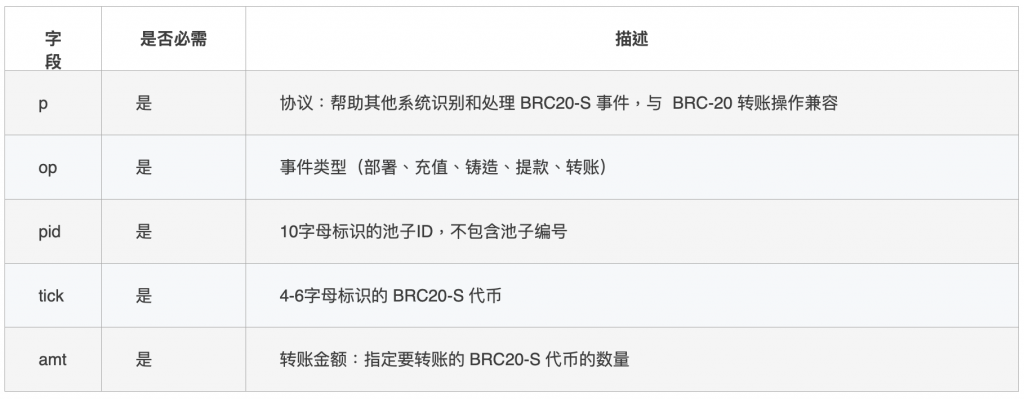
The fifth step is to transfer BRC20-S tokens, the following picture is its code:
The above five steps are the overall process of implementing the BRC-30 agreement. Finally, I would like to explain the current views and predictions on the ecology in the market. The great advantage of BRC-30 is that the assets pledged by users are still in their own wallets, instead of transferring assets to contracts like DeFi in the Ethereum ecosystem. Even if there are too many pledges in the market, it is necessary to continuously transfer and transfer assets. This greatly highlights that BRC-30 frees users from the risk of staking assets.
However, in the long run, if BRC-30 does not have any innovative applications, it is unlikely that it will last forever with such mining methods. On the contrary, users can also use this as an advantage, that is, as an early mining method. The first mine on the new track has great profit potential and even high security. It has become a gold mine in the eyes of many mining people.
>> Ordinal essence and concept
Finally, let me explain the concept and source of Ordinal. As mentioned earlier, at the end of December 2022, Rodarmor brought the concept of Bitcoin Ordinal and Inscriptions (ordinal numbers and inscriptions) to everyone's field of vision, introducing NFT to the Bitcoin network. And what is the real definition of this Ordinal? What impact will the narrative behind it have on the future?
Ordinal theory, as defined in the OKX Whitepaper, is a method of numbering and tracking individual satoshis (bitcoin's smallest unit) using a numbering system called an ordinal. These numbers are assigned according to the order in which satoshi are mined and transferred in transactions. Ordinal can be expressed in different ways, such as integers, decimals, degrees and percentiles. The core feature is that it can be expressed according to the time point of specific events in the Bitcoin network (such as block mining, difficulty adjustment and halving). Set different rarity levels for satoshi. These rarity levels are Common, Uncommon, Tare, Epic, Legendary, Mythic .
- Common: Applicable to any satoshi in the block, not limited to the first sat of the block, the most common in Bitcoin, they can be found in almost every transaction.
- Uncommon: The first satoshi of each block. These sats are relatively few, as only about 144 new blocks are added to the Bitcoin blockchain each day.
- Tare: The first satoshi in Bitcoin's difficulty adjustment cycle, which occurs every 2016 blocks (about two weeks).
- Epic: The first satoshi of each halving cycle, which occurs every 210,000 blocks or roughly four years.
- Legendary: The first satoshi of each cycle. A cycle here refers to a longer period in the Bitcoin market, stretching from one halving event to the next.
- Mythic: The first satoshi of the genesis block, which is the first bitcoin transaction, is included in the initial block of the bitcoin blockchain. Mythic sats are the rarest blocks because they only appear once in the entire history of Bitcoin.
After understanding the Ordinal theory and block level, we can imagine how to apply it to the ground. Suppose a user takes a great picture and wants to share it with the world, they can use the ordinal inscription to "burn" it onto the Bitcoin blockchain. Just like an NFT, create a unique digital artifact, the difference is that it is built entirely on the Bitcoin network, without the need for a separate token or sidechain. It can even be sent to other bitcoin addresses like a regular bitcoin transaction.
As we mentioned above, the way inscriptions work is based on the Ordinal theory, where each sat has a specific order and value. This makes it possible to send and receive burnt sats, but also means that transactions must also conform to the rules of Ordinal theory.
3. Conclusion
Since the Ordinal protocol was created in January of this year (2023), in addition to the rising market heat, it has also been continuously accompanied by cheers and criticisms from supporters and opponents. Those who embrace them believe that the protocol can provide Bitcoin with more financial use cases, while others believe that it goes against Satoshi Nakamoto's original vision for Bitcoin as a peer-to-peer cash system, and the rarity structure that occupies the Bitcoin network. space, pushing up transaction costs are also arguments that many opponents are stepping on.
However, miners have different opinions. Li Qingfei, chief marketing officer of Bitcoin mining pool F2Pool, said that the network congestion caused by the Ordinal and BRC-20 upsurge is a temporary problem, and there will be solutions like Lightning Network , to improve the current Bitcoin network environment.
And what is the Lightning Network? The next research report will give you an in-depth analysis of the theory, use cases and future trends of Lightning Network.