Original author: EMC Labs
Original source: EMC LABS
macro market
In the May briefing of EMC Labs, we pointed out that "...you can expect the market to continue to rebound in June, and I believe the market will try to give an answer before the middle of the month."
The rebound came as expected! After briefly falling below the lower edge of the ascending channel line on June 15, BTC rebounded rapidly. From June 15 to 23, it rebounded by 14.44% in nine trading days, recovering in one fell swoop the 36% decline that had lasted for two months since mid-April.
Throughout June, BTC opened at $27,210, fell as low as $24,800, and finally closed at $30,472, with a slightly enlarged trading volume.
Based on the strong performance of the labor market, the Federal Reserve made hawkish remarks in June, suggesting that two interest rate hikes may be carried out in the second half of the year to suppress inflation from returning to normal levels. In terms of the capital market, after the interest rate hike was suspended, the US stock market launched a fierce offensive around AI concept stocks, driving the Nasdaq and Dow to continue to rebound. It can be said that whether it is employment indicators that reflect economic trends or stock market indicators that reflect capital trends, the performance of the United States is very strong. The market seems to have temporarily forgotten about the fabled recession.
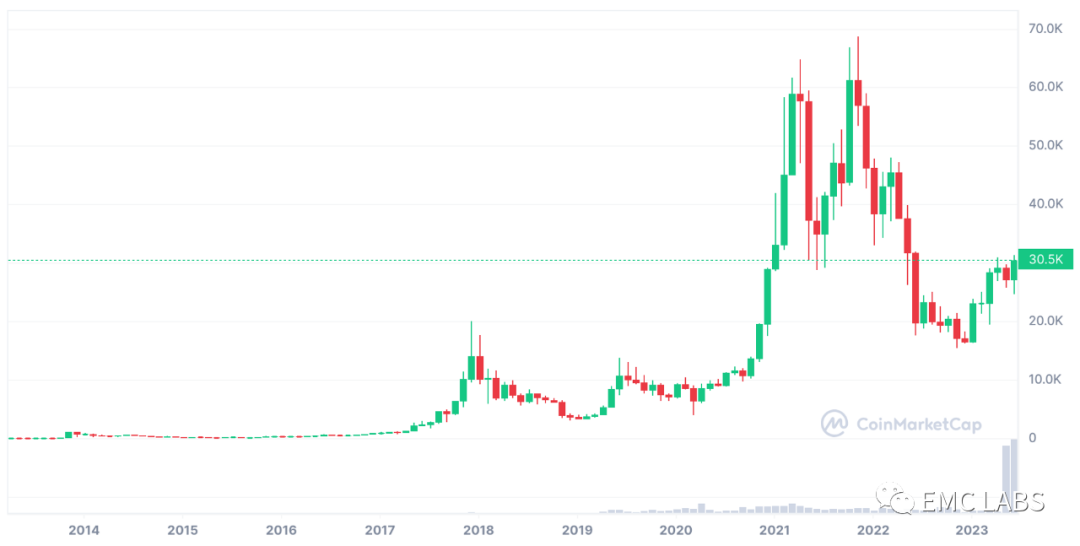
After the Great Clearance, 2023 is destined to become the year of BTC's strong counterattack. In the first half of the year, BTC opened at 16,541 and closed at $40,472, recording an increase of 84% in half a year, significantly outperforming the 34% rebound of the Nasdaq, and the monthly line achieved 5 yang and 1 yin, and the strong rebound trend was maintained!
Crypto Market Trends
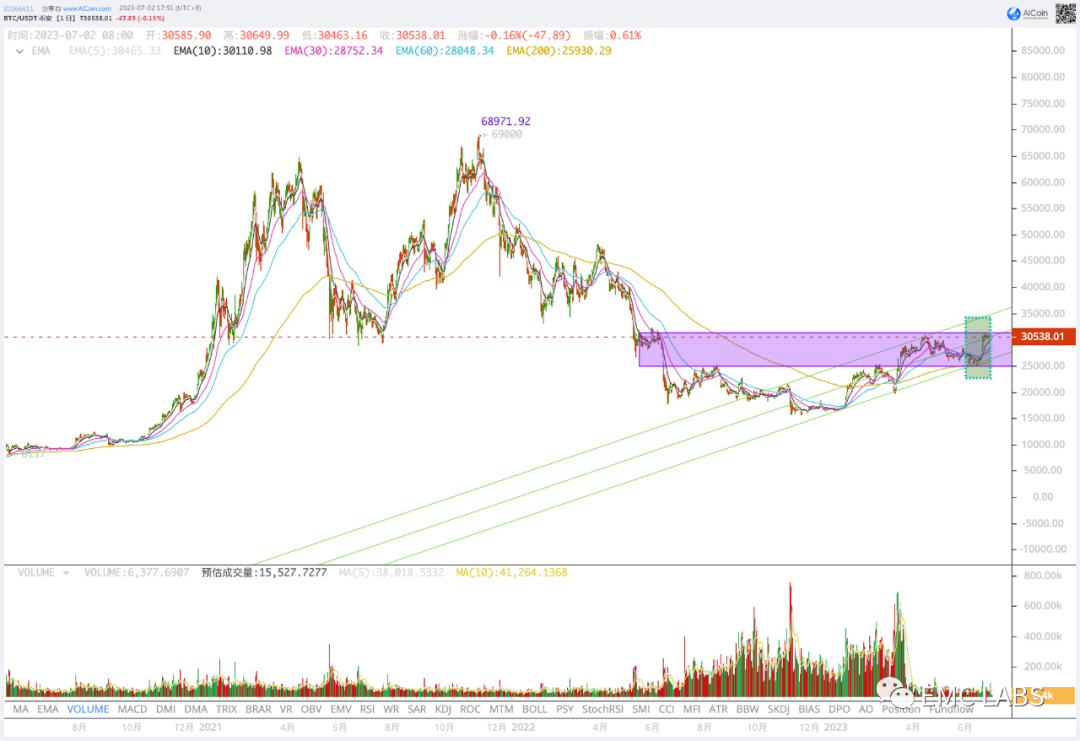
Judging from the pressure line, BTC has returned to the upper edge of the box near the pressure level of $31,000, which is the upper edge that was tested in mid-April.
From the perspective of the trend line, the rising middle track has risen from $26,000 in mid-April to $30,000. Although there was a false break in one or two days in mid-June, it was quickly recovered, and the ascending channel was maintained very well.
The EMC Labs Emergence Engine judged that BTC entered a "repair period" in January, and the rebound that started in January is defined as a repair market where funds are replenished on the market.
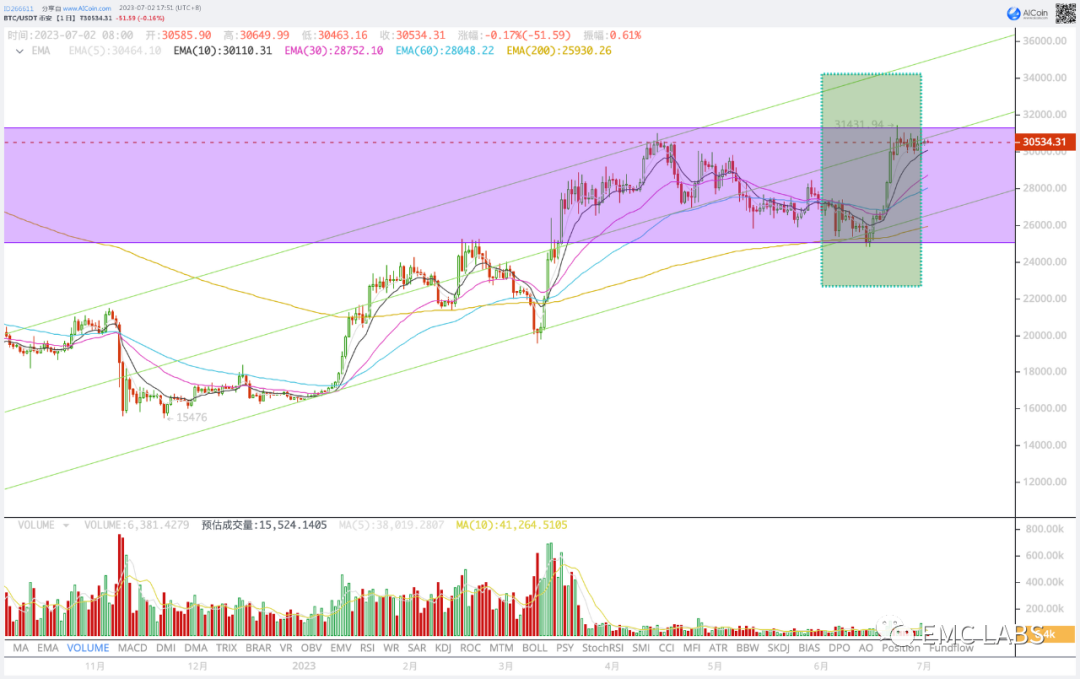
From January 8th to March 10th, it was the first wave of rebound.
From March 11th to June 14th, it was the second wave of rebound.
From June 15th, BTC officially started the third wave of rebound.
Inventory replenishment rebounded to a certain height, such as US$25,000 in mid-February and US$31,000 in mid-April. Market participants began to diverge, either to lock in profits and sell their positions, or to continue to hold with high ambitions.
This divergence formed two retracement adjustments from February to March and April to June, and the adjustments reached 26% and 20% respectively.
The two adjustments cleaned up the cheap chips bought at the bottom.
Let's take a look at the most recent adjustment market that lasted for two months——
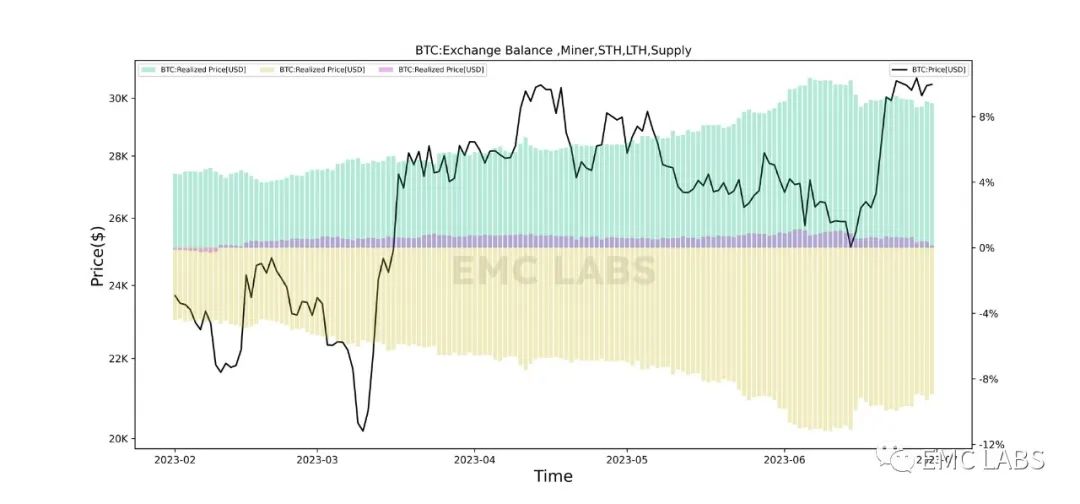
The US region is the biggest loser in this purge. By June 15, they had lost nearly 5% of their position. Behind this is the continuous rebound of AI concept stocks in the US stock market, which has a siphon effect on funds. The pressure comes from the SEC's lawsuit against Binance and Coinbase and the accusation that several well-known POS public chain projects are securities.
These events are the fundamental reasons for the continued reduction of holdings by market participants in the US region. And when the reducers noticed that the SEC’s suppression had come to an end, and when established financial institutions such as BlackRock continued to advance the BTC ETF application, they began to quickly stop reducing their holdings and cover their positions. This covering directly pushed BTC to regain all the lost ground it had lost in the past two months in just over a week.
game of strength
For the market cycle, the game of strong and weak hands is the underlying market structure. This round of adjustments is no exception.
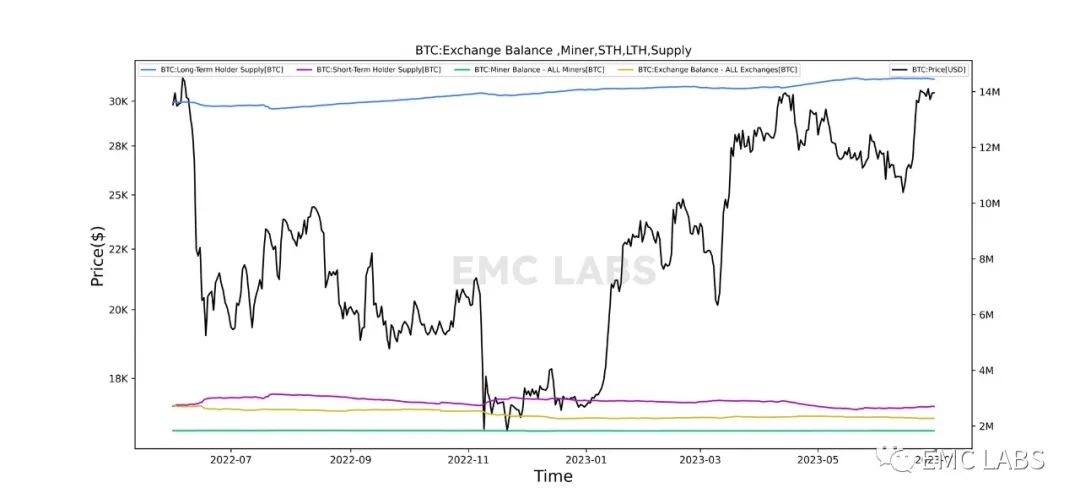
Strong hand 1414.771446.9732.21445.3330.56 Weak hand 289.14265.07-24.07270.58-18.56 Miner 182.53182.970.44182.780.25CEX232.96230.45-2.51227.98-4.9 8
During this round of adjustment, weak hands sold more than 240,700 BTC, and even after the rebound, they still lost 185,600 BTC.
The strong players continued to increase their holdings, and the BTC holdings increased from 14.1477 million on April 14 to 14.4533 million on June 30, an increase of 305,600.
The stock BTC on CEX exchange continued to flow out, with a total of nearly 50,000 BTC outflows during this period.
Crypto market cycles are a game of strong and weak hands exchanging BTC across time and space. Before the arrival of the rising period, strong players will continue to increase their positions, while weak players will continue to reduce their positions. Because strong hands are accustomed to low-frequency trading, while weak hands are accustomed to high-frequency trading, the essence of the phenomenon that weakly-held positions continue to flow into strong hands through price fluctuations before the rising period is that Liquidity is continuously absorbed.
This absorption begins in bear markets and continues through bear market bottoms and recovery periods. The two adjustments that have occurred since January are two specific interpretations of the Liquidity absorption game.
supply trend
Through the data on the chain, we can count the cost structure of different market participants.
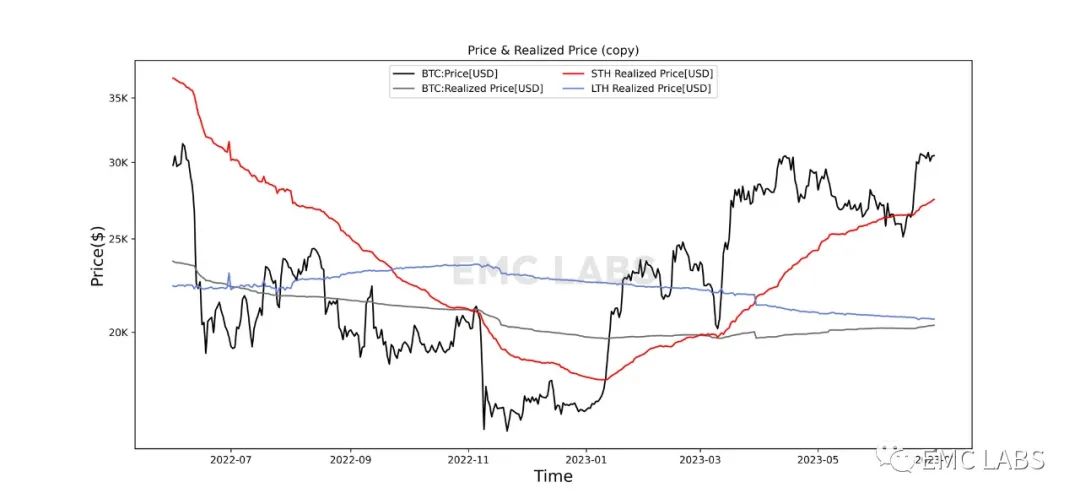
Strong players and weak players use different strategies to participate in the market at different stages of the market.
In the "repair period" we judged, which is the current stage of the market -
Falling, when the price is lower than the cost, the strong players often choose to continue to increase their holdings, while the weak players choose to continue to surrender.
When rising, when the price is higher than the cost, weak hands will often take profit and sell, while strong hands will often continue to hold.
After June 15th, BTC rebounded strongly, and so far both strong and weak players are in a state of profit. The average profit level of the market has been greatly increased from 27% on June 14. If you look closely at the profit structure, the strong players have reached 48%, while the weak players have around 11%. The strong players have a higher proportion of profits.
During the recovery period, the main selling force comes from weak hands. Compared with April 14, where the market is currently at $30,000, the selling pressure has dropped significantly because more chips have flowed into the hands of strong hands.
Therefore, EMC Labs judges that after the market fluctuates, BTC will most likely choose to go up, or break through the box suppression of $31,000 in July.
Activities on the chain
On-chain activities are the most basic support for market prices. In this round of rebound, we noticed that the new addresses on the chain rebounded before the price.
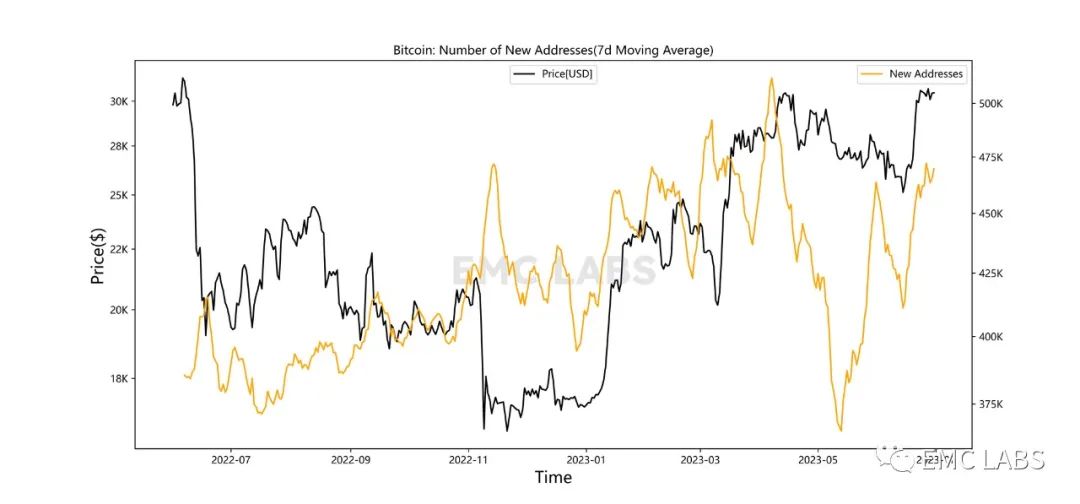
And the value transfer on the chain has also shown a steady upward trend.
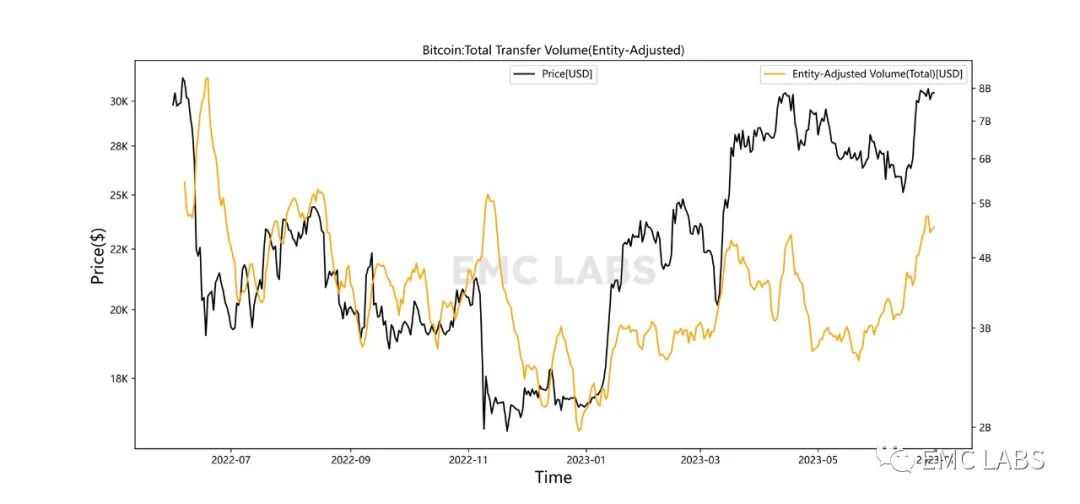
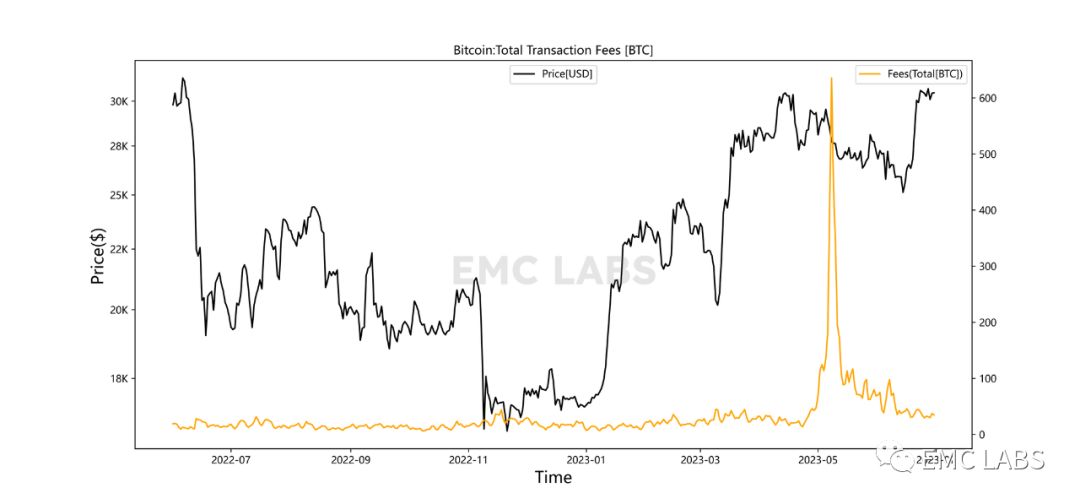
After the Ordinals frenzy, the consumption income of miners continued to decline and returned to the level of the repair period, showing that the current level of on-chain activity (including scale and frequency) still does not support the start of a bull market. But the current income level is also higher than the bottom of the bear market, and it is at the normal level of the repair period.
Incremental funding
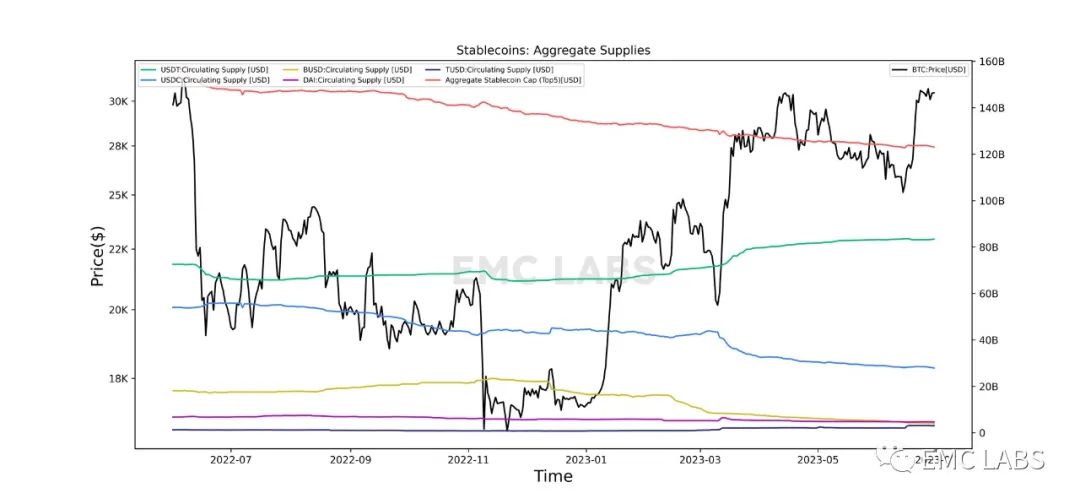
The start of a bull market is bound to be accompanied by the continuous entry of large-scale incremental funds, and during the repair period, it is more of a replenishment of funds on the market.
At present, the positive information on the supply of Stablecoin is still lacklustre. Only at the beginning of this round of rebound, there was an increase of 1 billion US dollars. However, when the price reached 30,000 US dollars, the total supply returned to the supply scale on June 14.
Industry dynamics
Opening up the compliance market, especially the road to old money, is still the strongest narrative of BTC.
This round of market adjustments started from the SEC’s lawsuits against Binance and Coinbase and its judgment on POS public chain token securities such as Cardano, Polygon, and Solana. Ultimately the buying power from Asia absorbed the selling pressure from the Americas, and the market fully digested the negative news after hearing the adjustment. The news that BlackRock and other established institutions submitted BTC ETF applications has boosted market confidence and made people willing to believe that the SEC does not and cannot deny the encrypted asset market.
Another market response to the SEC crackdown is that POW mining coins have attracted the attention of existing funds in the market. LTC, BCH, etc. have no securities suspicions, and the targets in asset packages created for old money such as Grayscale have attracted the attention of on-site funds. , ushered in a huge increase in the short term.
Another trend worth paying attention to is DEFI blue-chip projects, such as COMP, AAVE, etc., which seem to have started signs. These projects illuminated the starting point of the last round of bull market in the summer of 2020. After a sharp drop, the concentration of chips has increased, and the team is actively planning new businesses. DEFI is the underlying narrative of the encrypted asset market and deserves continuous attention.
epilogue
The profit-taking lock-in and the SEC's attention to the encrypted asset market have jointly created a two-month adjustment. Sellers came mainly from weak hands and traders in the Americas. The adjustment of 36% is very sufficient, and hundreds of thousands of BTC have changed hands.
EMC Labs successfully predicted the bottoming out of the market in June. We have noticed that the scale of holdings of strong players is continuing to expand, and the will to hold coins continues to strengthen.
Here, we maintain the judgment that the market "replicates" the market in 2016. Next, the market will continue to fluctuate to force weak players to hand over more chips. In the mid-term, it will continue to rise in the ambiguity of fear intertwined with hope, welcoming the arrival of the bull market.