In this report, we will start from Binance and explore why Binance can become the leader of the centralized exchanges in the Crypto industry. It is discussed that with the update and iteration of technology, it is possible to realize "decentralized Binance" through decentralized order book exchanges. And through the detailed introduction of StarkEx, zkLink , StarkNet, zkSync, Arbitrum and Cosmos , in-depth analysis and comparison of their situations in terms of user experience, security, performance and cost, guide readers to understand these infrastructures in depth.
Here are some highlights from the report:
Why do you need a "decentralized Binance"?
Binance Binance is the largest Crypto exchange in the blockchain space today with more than 120 million registered users. As the leader of the centralized exchange, it has rich asset types and sufficient liquidity. Its trading experience and trading performance are also far ahead of other competitors.
However, in the blockchain industry, centralization is the "original sin". As a centralized exchange, Binance has certain risks in terms of asset security, business transparency, and supervision. This exacerbated people's concerns about it, and they began to aspire to create a Crypto exchange that combines the user experience of CEX and the self-custody advantages of DEX - that is, building a fully decentralized Binance.
The road to a "decentralized Binance"
In the process of building decentralized Binance, people have made many attempts.
The pioneer of decentralized exchanges is Uniswap . It was first deployed on Ethereum , using the AMM mechanism to trade using a constant price formula and a liquidity pool. However, this mechanism has problems such as low capital efficiency, slippage, and Impermanent Loss. This means that while achieving decentralization, it has to sacrifice part of the liquidity and trading experience.
After the initial attempt of AMM , many high-performance Layer 1s began to emerge. The improvements they bring to transaction performance make order book mechanism DEX possible. But Layer 1 sacrificed the security and mature ecology of Ethereum while improving performance. At the same time, they cannot support transactions with a huge user volume like Binance.
With the continuous advancement of technology, Layer 2 , the Ethereum expansion solution, came into being. They help decentralized exchanges further increase transaction speed and reduce transaction fees. These Layer 2, as Ethereum's expansion solution, retain the security of Ethereum and inherit its mature ecology. However, general Layer 2 networks have some limitations in high-frequency trading. They lack seamless interoperability between blockchains other than Ethereum.
Recently, a new generation of application-specific, transaction-focused order book infrastructure solutions has entered the crypto market. Each of these solutions can improve users' trading experience by providing a high-performance and secure trading environment. They further innovate on the basis of Layer 1 and Layer 2, and open up the possibility of building a "decentralized Binance".
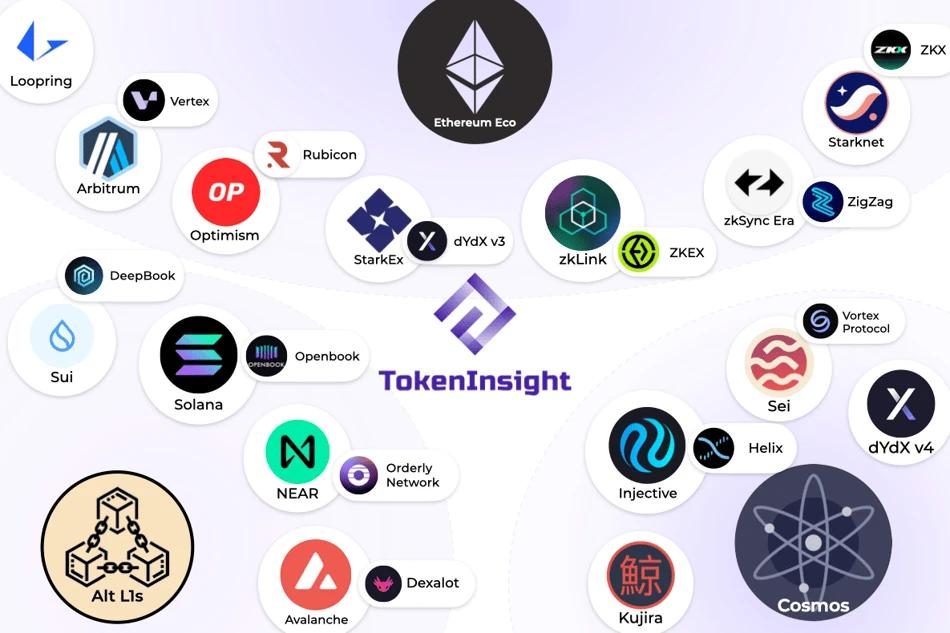
Overview of Trading Infrastructure
When analyzing the infrastructure for building a "decentralized Binance", we considered four main factors that affect transactions:
user experience
safety
performance
cost
Based on the above four dimensions and combined with examples of decentralized order book trading protocols, we analyzed several of the hottest infrastructures at present.
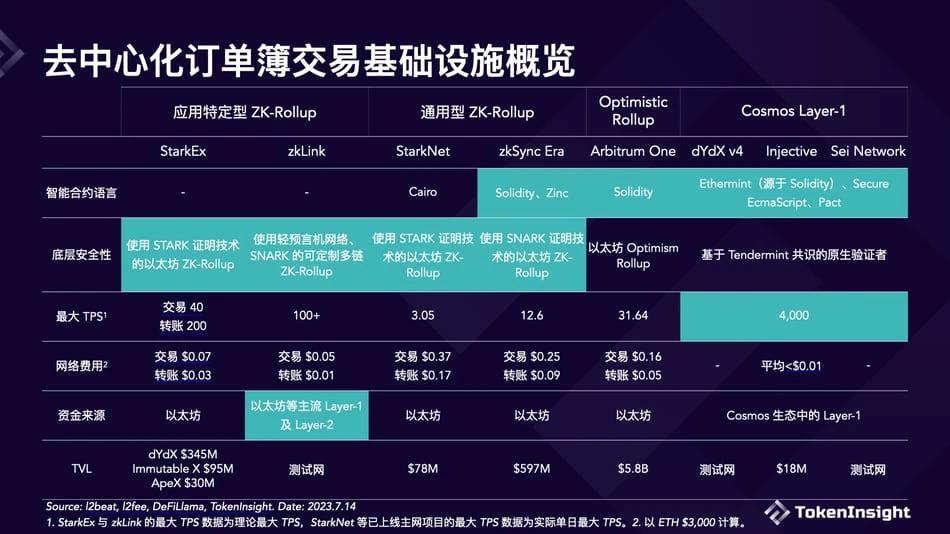
StarkEx
StarkEx is a trading infrastructure designed to serve specific applications. Based on the STARK zero-knowledge proof technology developed by StarkWare , it operates as the Layer 2 expansion engine of the Ethereum mainnet and provides specific ZK- Rollup services for independent applications. StarkEx was officially launched on the Ethereum mainnet in 2020. Its services are currently used by many well-known decentralized derivatives trading protocols such as DYDX v 3, immutableX and ApeX .
zkLink
zkLink is a transaction-centric multi-chain middleware based on ZK- Rollup technology. Its biggest feature is that it can connect multiple Layer 1 and Layer 2 blockchains to aggregate liquidity in different ecologies, thus making it possible to trade and combine native DeFi assets on different chains. Through the mechanism of "ZK- Rollup + oracle machine network", it realizes the multi-chain function and the extension of the classic ZK- Rollup .
StarkNet
StarkNet , developed by StarkWare, is a general-purpose Layer 2 expansion solution based on ZK- Rollup . StarkNet supports the deployment of any smart contract, and developers can create different types of decentralized applications on it, and the applications can be combined with each other. It uses Rollup based on STARK technology to execute transactions, which has high scalability and low transaction costs.
zkSync
zkSync is a series of general-purpose Layer 2 Ethereum expansion protocols based on ZK- Rollup . There are two main products: zkSync 1.0 (later renamed zkSync Lite ) and zkSync 2.0 (later renamed zkSync Era ). zkSync Lite uses a SNARK prover, but is not compatible with EVM. That is, smart contracts are not supported, and only basic transactions such as transfers are supported. On the other hand, zkSync Era is EVM compatible on the basis of zkSync Lite.
Arbitrum
Arbitrum is a set of Optimistic- Rollup based Ethereum Layer 2 expansion solutions. It currently includes two products: Arbitrum One (general) and Arbitrum Nova (exclusive for games/social applications). Among them, Arbitrum One is the main product of Arbitrum, and most DeFi applications are concentrated on Arbitrum One.
Cosmos
Cosmos is a Layer 1 blockchain collection network with a mesh structure based on the Tendermint consensus mechanism . Each blockchain in its network is an independent, fully functional PoS blockchain. Chains can achieve cross-chain communication through the IBC protocol , while sharing security and liquidity. At the same time, Cosmos also provides a custom blockchain development toolkit - Cosmos SDK , which allows developers to use existing modules to develop blockchains that meet different needs, with a high degree of freedom.
Infrastructure comparison
Application-specific ZK- Rollup
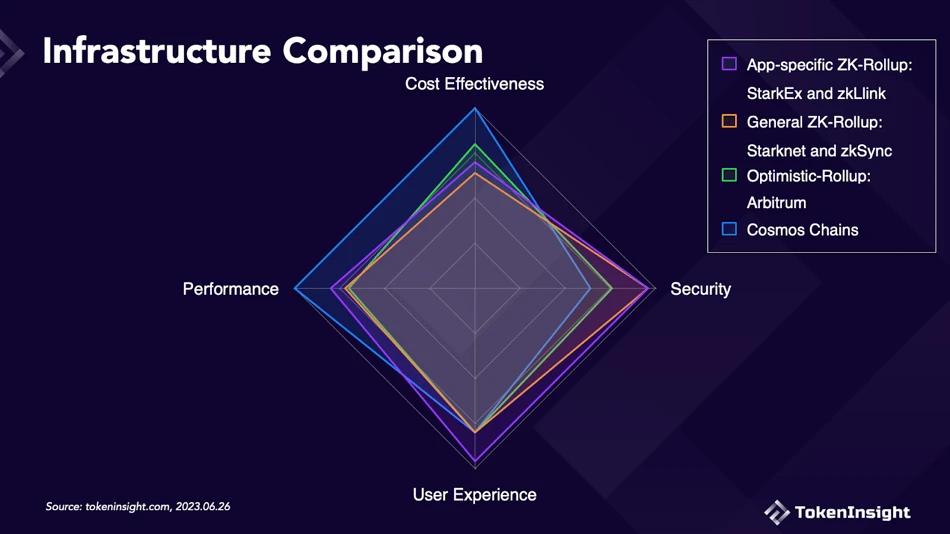
Applying a specific type of ZK- Rollup infrastructure, StarkEx and zkLlink have obvious advantages in terms of technical availability. And due to the use of ZK technology, they also have certain advantages in transaction security compared with the Cosmos network and Optimistic solutions. However, application-specific infrastructure may be more limited in terms of functional development. In contrast, StarkEx applications are currently deployed on Ethereum, and the basic security is better. On the other hand, zkLlink supports native multi-chains, with richer sources of trading assets and liquidity.
Universal ZK- Rollup
Representatives of general types of ZK- Rollup infrastructures are Starknet and zkSync. They all support Turing's complete programming language, so they have high flexibility in function development and can realize the deployment of order book applications. But as a general Layer 2, there will be many applications running at the same time. Therefore, Starknet and zkSync will also be unable to avoid the problems of expensive Gas fees and on-chain congestion that Ethereum is currently facing in the future.
Optimistic Rollup
The representative of Optimistic Rollup infrastructure, the advantage of Arbitrum lies in the flexibility of function development and compatibility with Ethereum. It is highly compatible with Ethereum and supports the Solidity language, so it is highly friendly to developers and facilitates function development. Compared to ZK- Rollup infrastructure, Arbitrum has some cost advantages due to the omission of expensive zero-knowledge proof calculation fees; but compared to ZK- Rollup , it lags behind in transaction finalization time. And from the perspective of security, it is slightly inferior to the ZK- Rollup infrastructure with multi-chain functions.
Cosmos Layer-1
As a mature Layer 1 infrastructure, Cosmos has great advantages in transaction performance and cost. Its Tendermint consensus can provide faster transaction confirmation speed for order book applications. At the same time, its other two core technologies, Cosmos SDK and IBC protocol, are of great help to improve user transaction experience. However, from the perspective of decentralization and security, Cosmos' performance is relatively average. And because the entire Cosmos ecosystem is still in its early stages compared to Ethereum, it has certain disadvantages in terms of asset types and liquidity and other key indicators that affect the trading experience.
The above are some of the key contents of the entire report. For details, please download the full text of the report .