Original title: Token incentives in a world of intents
Original Author: jim obrien, RabbitHole
Original source: Mirror
Compiled by: Lynn, MarsBit
Applications are merging into the supply chain, as evidenced by two trends: the migration to application aggregation and the adoption of wallet abstractions. In other words, applications are using declarative user "intent" to control transaction initiation and routing to optimize user experience and unlock new growth.
While these trends will improve the arduous onboarding experience of cryptocurrency, they also increase competition for user attention, liquidity, and transactions. This battle for attention has been waged through various airdrop tactics in recent years. However, as the UX barriers presented by crypto wallets fade away, consumers will see a plethora of crypto-enabled apps vying for their attention. This raises an important question: How do applications acquire and retain users in this emerging environment?
In this post, we explore how adoption of intent moves token allocations down through micro-reward incentives, gradually converting loyal users into owners.
A more purposeful cryptocurrency
In order to understand where the future battle for attention will be fought, we must first understand the fundamental shift in the ecosystem that the account abstraction proposed in EIP-4337 and multi-party computing solutions such as Capsule are introducing.
In a nutshell, a new transaction wrapper, an "intent", is introduced with the aim of alleviating the burden of reasoning on the user when constructing and signing a transaction - the root of many of the UX problems that cryptocurrencies suffer from . If a transaction describes "how" an action should be performed, an intent describes "what" the result of an action should be, regardless of the execution path. The intent is to move the reasoning of how to structure transactions to the application layer outside of the blockchain, ultimately allowing applications to determine the execution path of user actions.
As you might imagine, this has profound implications for MEV, as intents are fake transactions organized in off-chain private mempools before committing to the public mempool. The main difference in this world of intents is that applications control how intents are turned into transactions , and since block builders are interested in maximizing the extractable value per block, they are active buyers of these fake transactions.
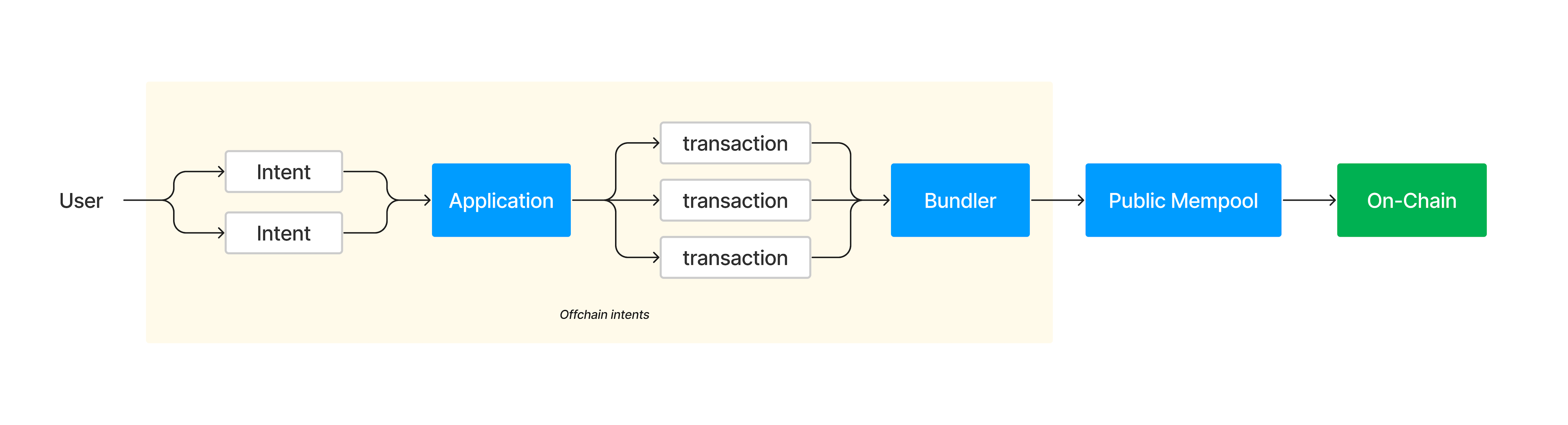 The flow of user intent (simplified)
This model introduces a fundamental shift in the way competitive moats are formed. Differentiation by building better infrastructure is less important. Instead, building engaging experiences that attract and retain user interest is the differentiator, while economic incentives to capture the flow of intent are the catalyst.
The stakes for apps to acquire and retain users are higher than ever.
disturbing fact
Cracking fetch and hold in non-encryption apps requires constant experimentation and fine-tuning, and the same is true for apps that support encryption. With the adoption of intent and wallet abstraction, the difference between traditional and cryptocurrency becomes harder to discern at the top of the acquisition funnel.
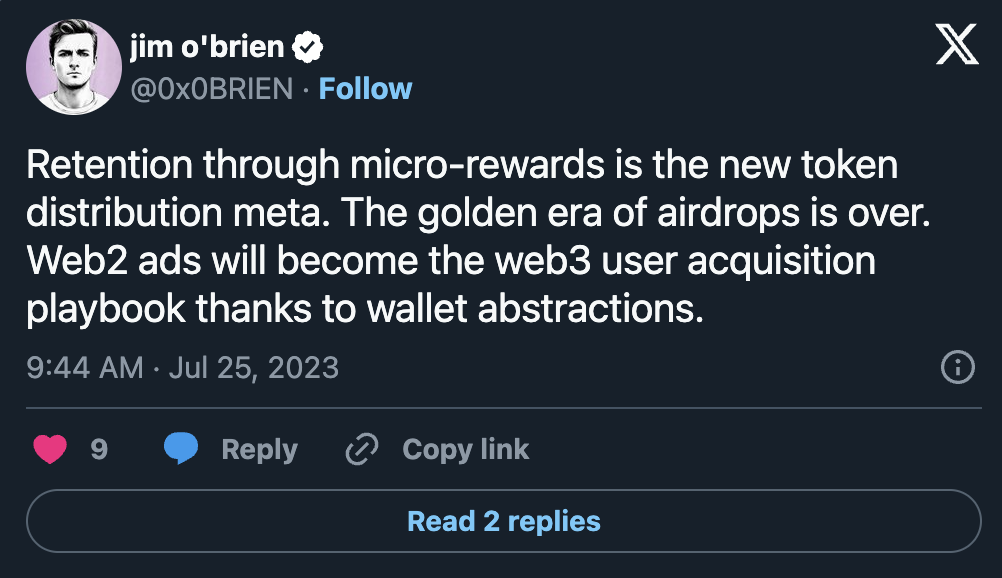
As such, we believe ad buys on traditional media platforms will replace airdrops as the primary acquisition strategy for crypto-enabled apps, as through the wallet abstraction potential users can join without being trapped in a brick wall. For some, this is a disturbing truth, as cryptocurrencies aim to expand their user base.
But once acquired, what can make users willing to stay? This is where cryptocurrencies have a unique advantage over traditional retargeting campaigns and loyalty points. The factors that have always driven retention — the perception of positive value exchange and the incentives that reward reuse — still hold true in cryptocurrencies, but with one important difference: ownership.
The current format of airdrops has repeatedly proven to be costly and ineffective at aligning incentives with actual participants . On the basis of CAC, traditional advertising works better than any airdrop - another disturbing fact. Apps will weigh how airdrops fit into their growth and retention strategies, but chances are they won't. At least not in its current form. The golden age of airdrops is over .
Instead, the application will seek to distribute tokens down the channel as a form of loyalty incentive to reward retention behavior. This is the new token allocation meta.
Create the next billion users
With futuristic abstraction of cryptography, the "next billion" users may not even know they are interacting with the blockchain, which is largely a necessary step for the ecosystem to mature. However, the virtues of cryptography — the permissionless, user-owned and interoperable parts that set cryptography apart — will be shown to newcomers for the first time in the form of automated loyalty incentives.
The core of the new token distribution meta is to move away from "big bang" airdrops to a more continuous and attractive incentive system. Frequent, instantaneously delivered micro-rewards are the best way to simultaneously drive retention behavior while rewarding user contributions with ownership.
At RabbitHole, we've been working hard to build this future. In June, we launched Terminal , a permissionless self-service tool that demonstrates the benefits of a micro-reward approach for acquiring crypto-native users. Going forward, we’re excited to share more about our efforts to implement micro-reward incentives in every app. stay tuned.