Author | IOBC
Token2049 is over, Crypto entrepreneurs and practitioners from all over the world have left in droves, and the Crypto atmosphere in Singapore has returned to calm. After intensive exchanges and discussions during this event, I have some new thoughts on the narrative of the new cycle.
The overall structure of the Crypto industry has been improved this year:
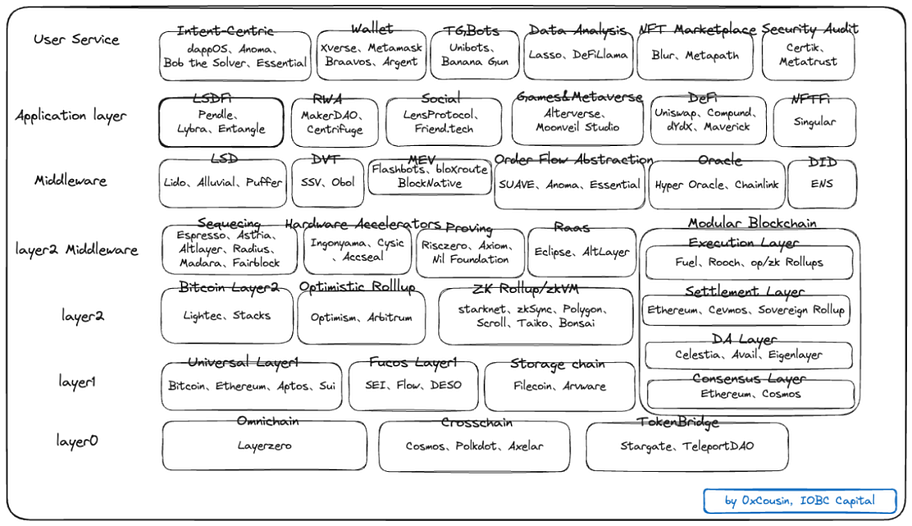
1. The most star narrative of Layer0 is still Omnichain
Layerzero not only defines the full-chain interoperability of the ultra-light node model, but also defines a new standard for Omnichain Fungible Token (OFT). OFT provides a more user-friendly and efficient cross-chain transfer solution. OFT has two versions, v1 and v2. The main difference between the two versions is that v2 can support non-EVM chains (such as Aptos, etc.). In addition, there are also OFNT721 and OFNT1155 that support Omnichain NFT.
There are already many projects adopting Layerzero's OFT standard. For example: Ethereum layer2 Metis, Multichain stable currency MIM, CDP protocol TapiocaDAO, Wrapped Bitcoin protocol BTC.b, multi-chain lending protocol Radiant.capital, etc.
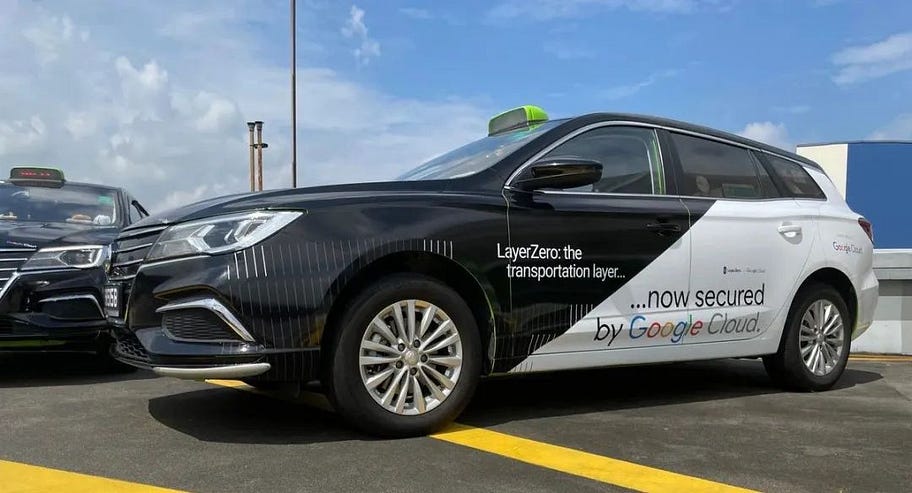
At this Token2049 event, Layerzero dispatched a fleet of electric vehicles to safely transport attendees to any Token2049-related events on many Singapore streets. Attendees only need to show their conference pass or wristband to get a free ride to the event destination and receive a small Layerzero gift.
2. This cycle of Layer1 is no longer the narrative of the first echelon.
This cycle, everyone has different views on the Layer 1 track project. Move is a new public chain that has attracted a little more attention. Other new public chains, whether they are Focus's new public chains in the DeFi direction or the NFT direction, or public chains that support multiple programming languages and can attract tens of millions of Web2 developers... do not seem to have received any attention. Broad consensus. (This only represents the communication feelings during Token 2049. Even if there is no broad consensus, it does not mean that the prospects are not good. There may be Alpha benefits if there are differences)
Many people no longer believe that there will really be a new public chain that can surpass Ethereum. Even if they still believe that Ethereum may not be the End Game, they are not willing to bet heavily in the New Layer 1 direction. Of course, many institutions are still investing in New Layer1, such as Jump Crypto, Coinbase, Circle Ventures, etc. are still common VCs for New Layer1 project financing information.
3. The layout of Layer 2 has basically been decided, and Layer 2 Middleware is also ready.
Optimistic Rollup mainly consists of two strong ones - Optimism and Arbitrum. The first-tier ZK Rollup/zkEVM mainly includes StarkNet, zkSync, Polygon, Scroll, Taiko, etc.
The supporting Middleware for ZK Rollup/zkVM is also in place. According to the Transaction Flow of ZK Rollup:

The key Middleware mainly includes:
Sequencer — The decentralized Sequencer Network is generally called for in the industry. Head projects include Espresso system, Astria, Altlayer, Radius, Madara, Fairblock, etc.;
Prover — There are already many projects for ZK Proof. According to the specific ZK Proof directions that they are good at or well-known for, they include: Nil Foundation, which does Layer2 ZK Proof, Axiom, which is more oriented to Applications ZK Proof, Risczero, which not only does Layer2 ZK Proof for its own Layer2 Bonsai Network, but also does Applicaitons ZK Proof. etc.; there are also Provers that are affiliated with a certain project, such as Stone, Platinum, Sandstorm, etc. that focus on StarkNet CairoVM.
Hardware Accelerators - One of the constraints that limits the performance of ZK Rollup / zkEVM is that the zkp generation speed is not fast enough, so hardware acceleration projects for zkp generation have been derived, such as Ingonyama, which has both GPU, FPGA and ASIC hardware acceleration, and has launched SolarMSM Cysic (accelerating MSM computing performance based on FPGA), Accseal, which deeply researches privacy computing hardware acceleration, etc.
4. There is no shortage of cash cows in Middleware
After ETH2.0, the LSD track became the second "cash cow" business direction in the Crypto industry after Bitcoin PoW mining. Under the Ethereum PoS mechanism, the annual output value of Staking is approximately 680,000 ETH (over 1 billion US dollars). There are also some very high-quality or potential projects, such as Lido, which has the highest market share, Alluvial, which is mainly aimed at B-end users, and Puffer, which can prevent Slash, etc.
Since MEV-Boost proposed by Flashbots is a practice of PBS outside the agreement, the MEV track has already begun to preview the future benefit distribution mechanism before the implementation of Danksharding. For MEV value capturers, if they want to get more MEV opportunities, they must have sufficient Orderflow; for users, if they want to avoid their transactions being sniped by MEV value capturers, they seem to have no choice but to defeat them. join in. Because there is no way to completely eliminate MEV, this business must exist. At present, a more reasonable way to exist is to feed MEV income back to User's Wallet, DEX or other dapps.
5. Gao Qi’s “risk-free returns” create application layer opportunities for LSDFi and RWA
ETH Staking income becomes Crypto's "treasury bond income", and LSDFi further helps increase the yield of ETH holders. According to current Lido data, Ethereum's PoS annualized yield is approximately 3.6%, which is similar to treasury bonds in the Crypto industry. After the upgrade in Shanghai, ETH Staking can basically be withdrawn at any time, and there is sufficient liquidity between stETH and ETH to exchange each other at any time. This greatly increases the confidence of long-term ETH holders to participate in Staking to obtain ETH2.0 mining income.
Thanks to stETH and others, ETH, which is equivalent to staking, has regained liquidity, which has led to more LSDFi applications. For example: Lybra Finance, a stablecoin supported by LSD. Since its underlying pledged asset is an interest-bearing asset in the form of stETH, coupled with Token rewards, Lybra Finance's stablecoin eUSD can bring holders an annualized rate of return of approximately 7%. , thus making its stablecoin behave as an "automatic interest-bearing stablecoin". The current TVL of the Lybra Finance protocol is approximately $72M; Pendle, an interest rate swap protocol, gives users the opportunity to implement various revenue management strategies by dividing revenue tokens into principal tokens and revenue tokens. The current TVL of Pendle Finance is about $144M; there are also some DeFi protocols that have emerged due to capturing more LSD Tokens, such as the emerging AMM Maverick, which has successfully joined the first line due to its high market share of LSD Tokens such as swETH, wstETH, and cbETH. AMM.
The annualized rate of return of ETH Staking of about 3.6%, coupled with the additional income of LSDFi, can indeed allow long-term ETH holders to capture more income. Correspondingly, the annualized yield of US Treasury bonds of around 5% has pushed RWA to the forefront, but this can only be said to allow existing Crypto users to enjoy the recent higher yields of US Treasury bonds. But there is no actual explanation that RWA can help Crypto attract new users. In short, the "risk-free rate of return" at the current stage is indeed a bit high. For long-term Crypto holders, it can be regarded as a bit of starlight in the bear market.
6. Targeting Mass Adoption and lowering the user experience threshold is the underlying requirement.
There are many innovations in the User Service Layer in this cycle. The common narrative is to lower the user experience threshold. The ultimate goal is the same, all for Mass Adoption.
Intent Centric is a hot topic recently, centered around intentions. There are some differences in the entry points of several leading projects. Bob the Solver focuses on attracting more users, dappOS aims to lower the user threshold, Anoma aims to help users express their needs better, and Essential focuses on helping users reduce MEV. press. In fact, in summary, these projects are either solving the problem of "protocols are difficult to use and protocol combination is difficult", or they are solving the problem of "maximizing user benefits".
TGBot is another hot topic and one of the practical applications of Web3+AI. Telegram bots are small applications that run within Telegram. Users interact (converse) with the robot in Telegram's chat window and only need to use some simple commands to support users to monitor Token information, do some on-chain DEX transactions, follow-up transactions, etc. With the increase in Unibot's user volume, transaction volume and Token price, TBGots quickly gained market attention. In a very short period of time, TBGots has developed trading, analysis, airdrop & mining products. In essence, TGBots actually lowers the user experience threshold and helps achieve Mass Adoption.
7. This time Token2049 has many projects that combine Crypto and AI.
The combination of Crypto and AI is undoubtedly the choice of the times. Crypto and ZK technologies create Trustless, non-sovereign currencies and smart contracts that are more suitable for smart robots. This Token2049 event has many entrepreneurial projects that combine Crypto and AI. The exchange was a bit shocking and touching.
Humans with carbon-based life have created AI with silicon-based life to better realize automation, improve production efficiency, process large-scale data, and explore a wider space in the universe. In the process, AI is gradually given the ability to think. 70% of the oceans and oxygen-rich earth are suitable for carbon-based life; but in the wider space without oxygen and water, silicon-based life is easier to survive than carbon-based life. Crypto, aerospace technology, and green energy developed by humans may eventually be used in AI, allowing intelligent robots to better survive and produce in space, thereby better serving humanity.
At present, I mainly see the following combinations of Crypto and AI:
On-chain interaction automation : TGBots represented by Unibot. For many new users, the threshold for using Web3's on-chain products is too high and difficult to use. There is a market for Bots products. Telegram has more than 500 million monthly active users, is relatively open, and is relatively friendly to Crypto. The emergence and popularity of TGBots came naturally.
To Earn empowers AI business : represented by Public.ai. Public.ai is an annotation company focusing on the medical field. On the one hand, it provides professional medical annotation tools and annotation services. On the other hand, it integrates global professional annotation talents in a decentralized manner to improve annotation quality and reduce costs.
Web3 version of ChatGPT : represented by Lasso and Kaito. Lasso is a natural language search engine for on-chain data. There is no need for SQL or other complex smart contracts. You can use natural language to search for chains, data, etc. For example, if you want to know the TVL of Lido Finance vs Rocket pool over time, the user only needs to enter the natural language "Show TVLs of Lido Finance vs Rocket pool over time" “That’s it, Lasso can present the results in a graph.
ZKML : Modulus Labs is more vocal in this direction. With ZKML we are talking about creating zero-knowledge proofs for the inference step of ML models, not ML model training. The effect of ZKML is that the prover can prove the computational correctness of the ML model without revealing any further information. Modulus Labs is building use cases including RockyBot, Lyra Finance, Self-improve blockchain, and more.
at last
Singapore is an important hub for the Web3 industry connecting the East and the West. This Token2049 event had over 10,000 attendees and is said to be the largest event so far this year. Most of the important projects came. Service projects mostly participated in the main venue booths, and narrative projects mostly held Side Events.
I visited all the booths at the main venue of Token2049 this time, and also learned about the approximate costs of various booths. I found that mainly public chains, Layer2 projects, exchanges and payment solution companies participated in the exhibition. The form of exhibition and sales may be beneficial to such companies. business is more valuable.
Side events are mostly hosted by leading Infra projects or VCs, and are mostly co-organized by projects within the Infra project ecosystem and VC portfolios. As for the activity format, it’s about equal parts social Dinner Party and competitive Hackathon/Workshop + Demo Day.
Still have to continue Build.