Written by: Bing Ventures
With the development of blockchain technologies such as IBC, application chains, as a technologically sovereign solution, have attracted more and more attention. Application Chain allows application developers to control and customize every aspect of the blockchain to meet specific needs and achieve optimal integration. This issue of Bing Ventures' article will focus on a striking application chain project - Osmosis, exploring why it deserves attention and its independent innovation path in the DeFi field.
We have discussed in previous articles that application chains can give developers technical sovereignty and enable them to unleash their creativity. By trying out innovative features such as different consensus models, custom node requirements, and state models, developers can explore and experiment with the technical solutions that best suit their applications. The sovereignty of an independent blockchain allows applications to put the value of their public chain first and make decisions based on the most meaningful trade-offs. This sovereignty enables AppChain to allow communities to control their own destiny.
However, we have also concluded that application chain is not a perfect solution for all projects, but a subjective trade-off. Some critics have mentioned that the AppChain approach has issues with synchronized composability and liquidity fragmentation. However, just like the liquidity on general L1 will be concentrated in a few popular applications, the same situation will also happen in the application chain ecosystem. Various DeFi functions will be concentrated in the core of a few high-liquidity application chains. products, so that liquidity fragmentation is no longer a problem. This is being confirmed by the development of Osmosis.
Advantages of concentrated liquidity
DeFi projects face many problems in terms of user experience, such as complex operating procedures, high fees, network congestion, and low liquidity. As an application chain DEX and emerging liquidity center within the Cosmos ecosystem, Osmosis is trying to use the advantages of application chains to solve these problems. Osmosis allows users to create liquidity pools with unique and variable parameters, experiment with different types of bond curves, multi-weighted asset pools, and more. In addition, Osmosis has introduced innovative features such as super-liquidity staking, which incentivizes users to participate in the security of the chain and give back more value to the community by using LP tokens containing $OSMO.
We have stated a point in many articles before: in Cosmos, liquidity will determine security. Osmosis is a project launched when IBC was in its infancy, when the liquidity of the entire ecosystem was very limited. To solve this problem, Osmosis launched a Balancer-style fund pool to attract a large amount of liquidity into Cosmos through incentives. However, much of this liquidity is not fully utilized as funds are dispersed across various fund pools.
The concept of pooled liquidity emerged, allowing liquidity providers to choose to provide liquidity within a specific price range. This means that centralized liquidity will allow users to be more strategic in providing liquidity. At the same time, Osmosis can also handle the same transaction volume with less liquidity, thus improving efficiency by approximately 100 times.
The Supercharged Pools incentive model that Osmosis will soon introduce will further optimize the use and liquidity of the capital pool. This mode allows users to claim rewards on their own without having to wait for a specific period of time. In addition, there is no need to bind LP tokens when entering the Supercharged capital pool. However, if users wish to participate in Superfluid Staking, there are still relevant binding requirements.
Mesh Security came into being
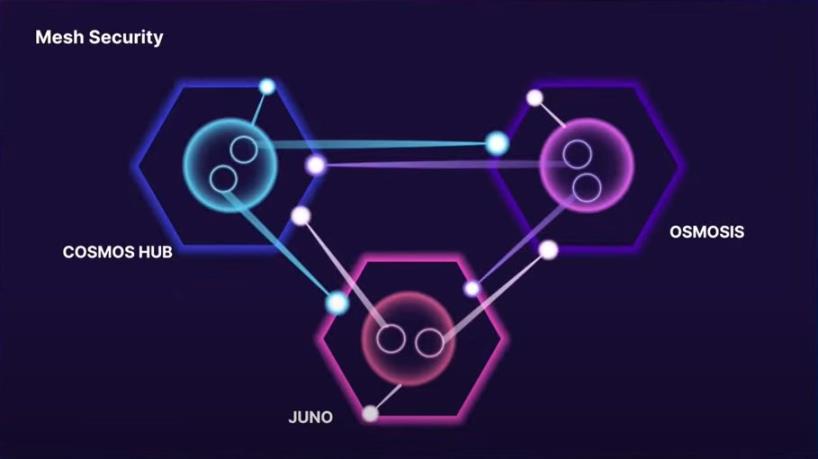
Another major Osmosis innovation that also complements centralized liquidity is Mesh Security. Mesh Security is an innovative cross-chain security model designed to strengthen the security of the Cosmos ecosystem. The core idea of this model is to increase security through the combination of cross-chain pledged assets, solving the security loopholes in the traditional cross-chain model and the problem of validator collateral being taken over.
First of all, in the traditional cross-chain security model, security flows in one direction. The validator set completely verifies another chain. Although this model improves efficiency, it results in a lack of sovereignty in the ecological chain. Another model is that a subset of the validator set can choose to validate in a chain, which improves scalability, but does not fully utilize governance, and the ecological chain still lacks sovereignty. In contrast, under Osmosis' Mesh Security model, security can flow in both directions. The ecological chain can have its own set of verifiers and has sovereignty, and at the same time, the two chains can provide mutual security.
The Mesh Security model allows pledged tokens on one chain to be pledged again to validators of other partner chains, allowing the Cosmos chain to pool validators' pledges together to resist security attacks, thereby increasing the security of a single Cosmos chain. In short, Mesh Security can not only obtain the protection of ATOM stakers, but also enhance the security of Cosmos through OSMO staking.
We expect that the Mesh Security model will bring long-term benefits to the Osmosis ecosystem. One of the important functions of the Mesh Security model also includes preventing validators from misbehaving and the resulting tokens being slashed, thereby protecting the security of transactions. In addition, the introduction of this security model also helps to resist MEV-related attacks and ensure fairness in the transaction process. Mesh Security, coupled with centralized liquidity that can improve transaction efficiency, will provide users and ecosystem participants with a more reliable and secure trading environment and promote the sustainable development of Cosmos.
The innovation path of Osmosis and DeFi application chain
Osmosis is striving to achieve the user experience of a first-class centralized exchange, including integrating margin trading and lending into its core products, and working with Mars Protocol to integrate lending directly into the Osmosis trading engine. Additionally, Osmosis is exploring a number of innovative approaches to handling MEV on its DEX, such as threshold encryption, fee differentiation, Flashbots-like functionality, and in-protocol arbitrageurs that run at the start of each block.
As a pioneer in DeFi application chains, Osmosis makes full use of the powerful developer tools and asynchronous composability infrastructure of the Cosmos ecosystem, and is expected to have a profound impact on the entire DeFi ecosystem.
In terms of the Mesh Security model, despite its many benefits, the model also brings some challenges and risks, including the existence of a centralized model and the complexity of cross-chain cooperation and governance. Therefore, future development needs to carefully consider how to solve these problems to ensure that the decentralized characteristics are maintained and the interests of all parties are balanced.
Osmosis has demonstrated its innovative capabilities and advantages when it comes to handling MEV, especially when it comes to threshold encryption. This provides a potential solution to resist MEV attacks and gives Osmosis a competitive advantage over Ethereum in the Cosmos ecosystem.
The development of Liquid Staking will also flourish on Osmosis. Cosmos provides high staking interest rates and moderate unlocking periods, which provides users with a more flexible way to manage liquidity. Further innovation will enable Osmosis to become a platform that provides current loan returns and leveraged mining opportunities, improving asset efficiency and pledge rates.
Finally, we are also optimistic about the innovation of stablecoins, which may be the most important direction for Osmosis's future development. By introducing more diverse and innovative stablecoins, Osmosis will solidify its position as the DeFi liquidity center on Cosmos and promote the further development of the liquidity market. This will provide users with more trading and investment opportunities to meet the needs of different users.