



Written by: CloudY, Jam
This article starts with the Zuzalu sociology experiment, and compares the business map concepts of Elon Musk and Sam Altman, and then understands and analyzes the impact of blockchain technology and Cryptocurrency on the future world, especially identity authentication and authentication represented by third world countries. Feasibility development analysis of the combination of monetary payment systems.
summary
- Karl Marx[1] might like ETH, Dogecoin, and Worldcoin.
Vitalik's sociological experiment Zuzalu. Zuzalu uses ZuPass and zero-knowledge proof technology to provide registered participants with "proof of identity registration" and promotes the implementation of democratic governance by setting up town halls. Therefore, some people compare it to "the early stage of Ethereum in an abstract sense." The two have established a natural connection because of Vitalik, but they are different. Zuzalu is metaphysical, while Ethereum is concrete. The programmability of Ethereum helps developers implement customized identity authentication through smart contracts. The currency payment of Ethereum is realized through the execution of smart contracts, which meets the currency payment that complies with the ERC20 standard, but is mainly ETH.
- Elon Musk’s plan to colonize Mars. Musk’s “Starlink” terms state that Mars is a free planet and does not recognize the laws of the earth [2].
Since his vision is to take humans to Mars, human identification and monetary payments on Earth need to be replicated on Mars. Acquiring Twitter and incorporating CryptoCurrency such as Dogecoin into its products as accepted payment currencies will undoubtedly become an important part of Musk's Mars colonization plan.
- Sam Altman’s idea of “world citizenship” [3].
Altman found that it is difficult for many people in the world, especially those represented by citizens of third world countries, to have legal identity documents, and the financial infrastructure in these countries is still in an imperfect stage, so it is also difficult for these people to have them. Basic bank account. The establishment of Worldcoin provides a new digital identity authentication and currency system. It achieves identity authentication by scanning the iris of everyone's eyeballs on the earth, and $WLD serves as the currency within its ecosystem.
The careers conceived by the above three people have the following things in common:
1) They all pay attention to and explore the issues of identity authentication and currency payment in a broad sense.
2) Realize the subject (1) by building a world-class platform.
Note [1]: Marx advocated that the proletariat should unite to oppose exploitation and oppression, and strive for the liberation of all mankind and social progress.
Note [2]: From the consumer service test terms at the launch of Starlink.
Note [3]: Usually refers to those who believe that they transcend national boundaries and national identity, and regard all mankind as a whole community.
Zuzalu: Explore countries without borders
Zuzalu’s vision and technical needs
Zuzalu is a real-world encryption community, also known as a summer camp about encryption, immortality and philosophy. In Zuzalu, participants register through ZuPass and receive identity authentication utilizing zero-knowledge proofs to verify the identity of the resident. This experiment aims to explore the programmability and smart contracts of Ethereum to implement customized identity authentication and digital currency payments [4].
In Zuzalu, participants included researchers, scholars, founders, etc., and spent two months in-depth discussions on issues such as immortality, public goods, zero-knowledge proofs, artificial intelligence, and coordination and network states. Zuzalu is committed to exploring how blockchain technology can be applied to urban governance and operations to improve process transparency, credibility and verifiability. Immortality is one of Zuzalu's important topics, and blockchain technology is believed to improve the efficiency of data management, intellectual property protection, trial transparency, fund raising, etc. in the field of life sciences. Additionally, Zuzalu discussed how blockchain can address the extreme risks posed by artificial intelligence. The development of artificial intelligence may lead to superintelligence, and blockchain technology is considered to potentially be used to resist the risks posed by superintelligence.
According to multiple participants at the meeting, Zuzalu aims to build a borderless digital country so that every digital citizen has a fairer and more transparent identity authentication and a customizable digital currency payment system.
Overall, Zuzalu is a unique and ambitious experiment that brings together blockchain technology, cryptocurrency, life sciences, artificial intelligence, and philosophy. It seeks new ways to improve all aspects of society, from urban governance to scientific research and artificial intelligence safety. Together, participants envision a future where technology promotes inclusivity, transparency and global collaboration in the digital realm.
Note [4]: From Shuyao (Twitter @hotpot_dao)
Elon Musk Matrix: Xeet and Digital Identity, Dogecoin and the Future of Digital Payments
Musk Matrix
Xeet (formerly Twitter) and Dogecoin serve as the basic matrix to concatenate the Musk matrix.
As a world-renowned social media platform, Xeet has a huge user base. Xeet can provide Musk with a powerful digital payment and cryptocurrency promotion platform. By integrating Xeet with digital payment functions, it can promote the popularity of digital currency payment methods and allow users to implement digital payment transactions on Twitter.
Secondly, Musk has repeatedly mentioned and "ordered" Dogecoin to show his interest in cryptocurrency. Although Dogecoin was born as a Meme Coin, it has won more recognition and attention due to Musk's support. By promoting the development and application of Dogecoin, he can further explore and promote cryptocurrency as a means of payment, and realize the application of digital currency payment in a wider range of business scenarios.
The above-mentioned Xeet and Dogecoin and Musk's other commercial versions can be well connected to form a large and comprehensive digital ecosystem. Companies such as listed Tesla, unlisted SpaceX, SolarCity and The Boring Company can promote services that support cryptocurrency payment through the Xeet platform. Users can use digital currencies to purchase Tesla electric cars, SpaceX space travel and other services to achieve Payment application. In addition, neurobrain science company Neuralink can also play an important role in the digital payments ecosystem. In the future, through brain-computer interface technology, users can even directly use brain signals for digital payment authentication, further improving the convenience and security of payment.
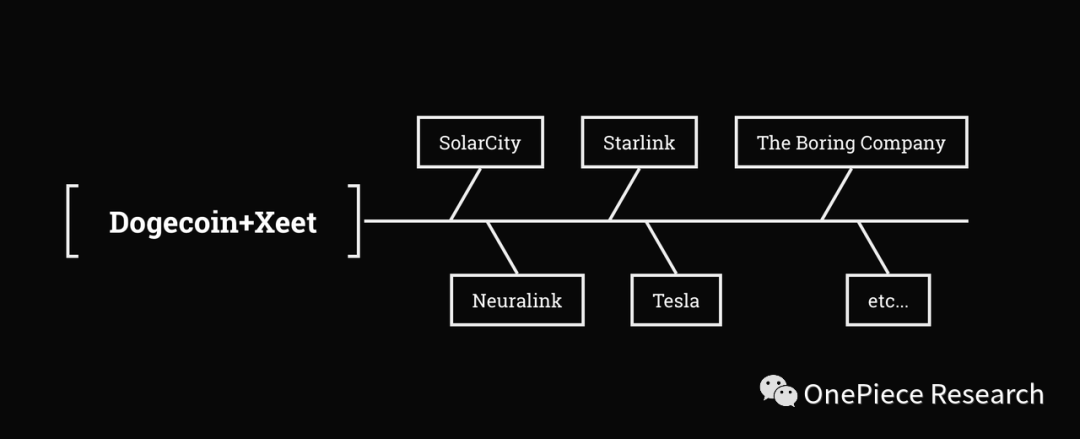
(Source: OP Research)
Note [5]:
【1】Tesla, Inc .: Tesla is a leading electric vehicle manufacturer and energy company.
【2】SpaceX (Space Exploration Technologies Corp.) : SpaceX is a private aerospace company founded in 2002. The company's goal is to reduce the cost of space exploration and achieve the goal of landing humans on Mars. SpaceX has successfully developed a variety of heavy-lift rockets such as Falcon 1, Falcon 9 and Falcon Heavy, and became the first aerospace company to achieve vertical recovery and reuse of rockets. Its greater role in Musk's matrix is to cooperate with the layout of Starlink.
【3】SolarCity: SolarCity is a solar energy services company founded in 2006.
【4】Neuralink: Neuralink is a neuroscience company founded in 2016. The company aims to develop brain-computer interface technology to connect the human brain with computers and other external devices to provide solutions for treating neurological diseases and enhancing human cognitive abilities.
【5】The Boring Company: The Boring Company is a tunnel construction company established in 2016. The company aims to develop underground tunnel systems to alleviate urban traffic congestion.
Musk's passion for digital payments
It can be said that Musk has always had a dream in the field of digital payments, and through continuous exploration, he has fitted it into his business matrix.
According to his self-report, his mission is to promote technological progress and create a better future, and the payment field is one of the technological innovations that he values . From the time he founded X.com (later renamed PayPal), an online payment company, his pursuit and passion for digital payment solutions can be seen. Musk's original intention when creating PayPal was to create a global payment method that would make cross-border transactions easier and solve the limitations of traditional payment systems. Although PayPal was later acquired by eBay, his interest in digital currencies and payments has never been separated. To a certain extent, Twitter changed its name to Xeet and its icon to "X", which is also a tribute to PayPal.
In the subsequent entrepreneurial process, he explored projects related to digital currency and encryption technology. Until the emergence of Dogecoin and the acquisition of Twitter. Musk’s digital payments matrix is back on the business map and will likely play an extremely important role in the future.
In addition, Musk praised the powerful functions of WeChat, saying that it can do everything and there is no spam [6]. He appreciates its features, including messaging, voice and video calling, social media, food delivery, mobile payments, gaming and news. Elon Musk’s appreciation for WeChat may be because he has seen the app’s success in social, payment, and services, and believes its versatility and user experience are revelatory in the digital payments space.
Note【6】: https://hypebeast.com/zh/2022/6/elon-musk-wants-twitter-to-be-more-like-tiktok-and-wechat
Musk’s Web3 ambitions
Xeet accounts can become digital identity certificates and even digital wallets; Dogecoin may be just the beginning of its "new digital payment" matrix.
Xeet accounts play a key role, not only as digital proof of identity, but also as digital wallets. By leveraging the social graph, Xeet accounts can effectively define and authenticate users' identities, making digital identity verification more secure and convenient.
Specifically, Xeet accounts can use social graphs to define/authenticate identities, and Twitter avatars link NFT PFP and NFT Tweet Tiles. "Tweet Tiles" is a feature officially launched by Twitter that attaches customizable formats to tweets. It supports users to interact with Twitter Tiles. The content covers text, images, videos or other elements, making the tweet timeline more dynamic and visual. .
Twitter has expanded this feature to the NFT market, where NFT projects or creators can display NFTs in their own tweets, providing a platform for NFT supporters to display and share digital collections.
According to a report by Financial Time in January this year, Twitter, under the leadership of Elon Musk, was exploring the introduction of payment services on its platform as a means of generating new revenue. Esther Crawford, a core member of Twitter, is designing a payment architecture with the goal of providing financial services such as "peer-to-peer transactions and savings accounts." Musk envisions Twitter becoming a "universal application" that integrates messaging, payments and commerce. Twitter is registered as a payments processor with the U.S. Treasury Department and is in the process of obtaining the necessary regulatory approvals.
Therefore, Musk’s payment dream can be realized through Xeet, supporting Dogecoin payment and integrating his other business territories. Such a comprehensive ecosystem will bring new innovations and possibilities to the field of digital payments, promote the widespread application of digital currencies, and promote the further development of payment methods. We may witness a digital ecosystem built by commercial versions such as Xeet and Dogecoin, which will bring more innovation and possibilities to digital payments and change our payment methods and habits.
Such a future may not be so far away.
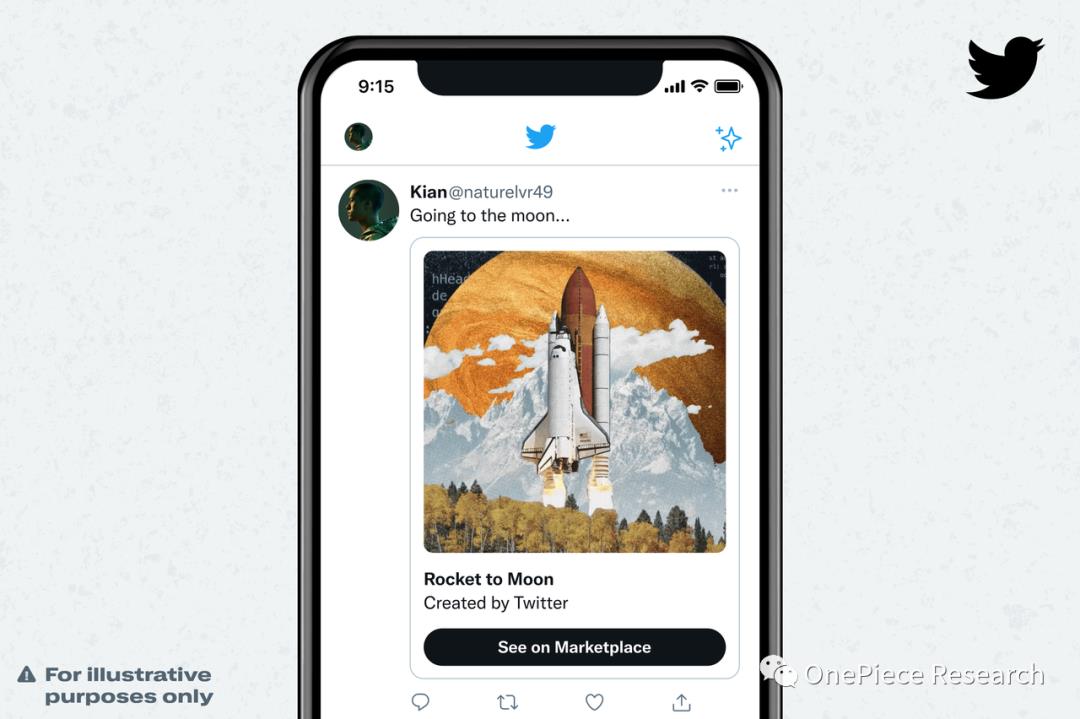
(Source: Twitter Development Team @XDevelopers)
Worldcoin and the Third World
How does Worldcoin physically prove that I am "me"?
Worldcoin claims that its goal is to solve the problem of human identity verification through a privacy-first, autonomous control and decentralized approach.
According to estimates from the World Bank's ID4D database, nearly 1 billion people worldwide lack any form of legally recognized identification. An additional 3.4 billion people have some type of legally recognized identity but struggle to use it in the digital world.
This “ digital identity” means clear identity verification through digital channels, unlocking access to banking, government benefits, education and many other critical services. Digital IDs not only empower citizens and societies but also enable real, inclusive economic gains.
Worldcoin's vision is to become the world's largest, most inclusive identity and financial public product that belongs to all mankind.
The WorldCoin protocol currently includes:
World ID is a privacy-preserving digital identity designed to solve the problem of personal identification, using biometrics to prove an individual's unique personality.
Worldcoin (WLD) is a digital currency that can be freely distributed to independent individuals as permitted by law.
World App is the first application compatible with World ID. It carries stablecoins supported by digital assets and legal currency, and can make payments, purchases and transfers globally.
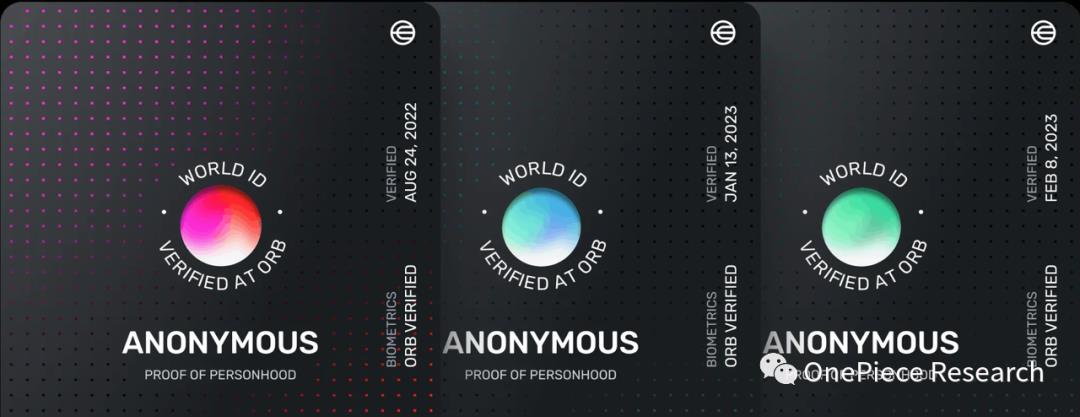
According to Wroldcoin data on July 13, the number of World ID registrations exceeded 2 million, and it only took less than half the time to reach the first million. On average, more than 40,000 people registered for verified World ID every week. Registrants from all over the world, including Barcelona, Berlin, Buenos Aires, New York, Seoul, and Tokyo, register through iris and biometric scans through The Orb developed by Tools for Humanity (TFH), and they will receive 25 WLD tokens as rewards. Alex Blania, co-founder of Worldcoin and CEO of Tools for Humanity, said: “The goal of Worldcoin is to allow anyone in the world, regardless of background, location or income, to access the Internet in a privacy-preserving and decentralized way. Growing numbers and the global economy.”
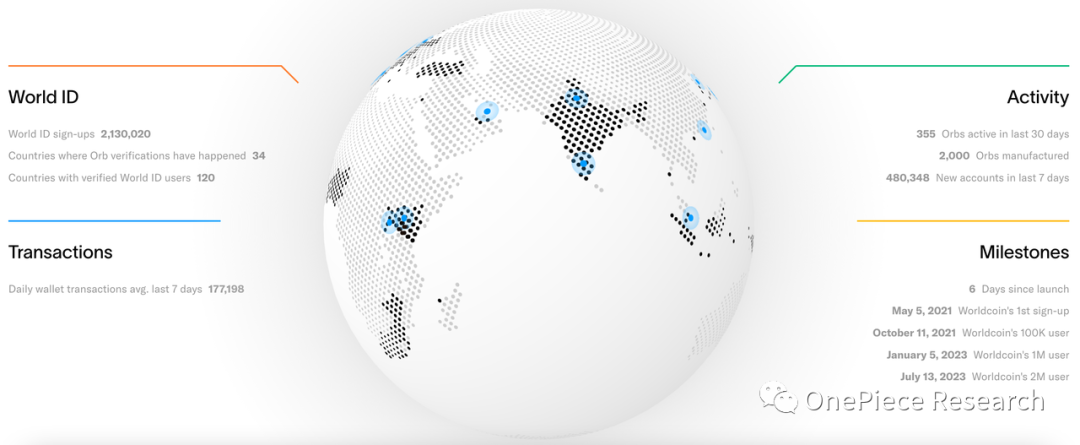
Worldcoin technology and applications
As shown in the figure, to obtain a World ID, users must first download the World App to store their World ID. Then make an appointment through the official website for an iris scan to verify your identity. Once verified through Orb, the individual will receive a World ID.
This World ID can be used on the chain to verify the user's identity to other protocols through zk certification, and can be done across chains. At the same time, as permitted by law, users can receive a certain number of WLD tokens every week through World ID. World App allows users to use the App through WalletConnect on the Optimisam chain, such as trading on DEX.
Importantly, the World ID-based SDK framework allows other developers to leverage World ID in their applications without requiring a license, simplifying the interaction of Web3 and Web2 applications.
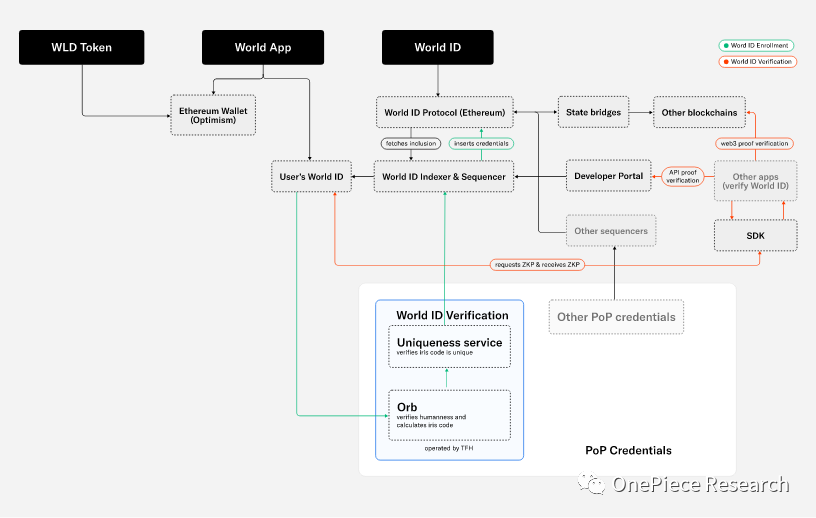
Worldcoin’s technical architecture
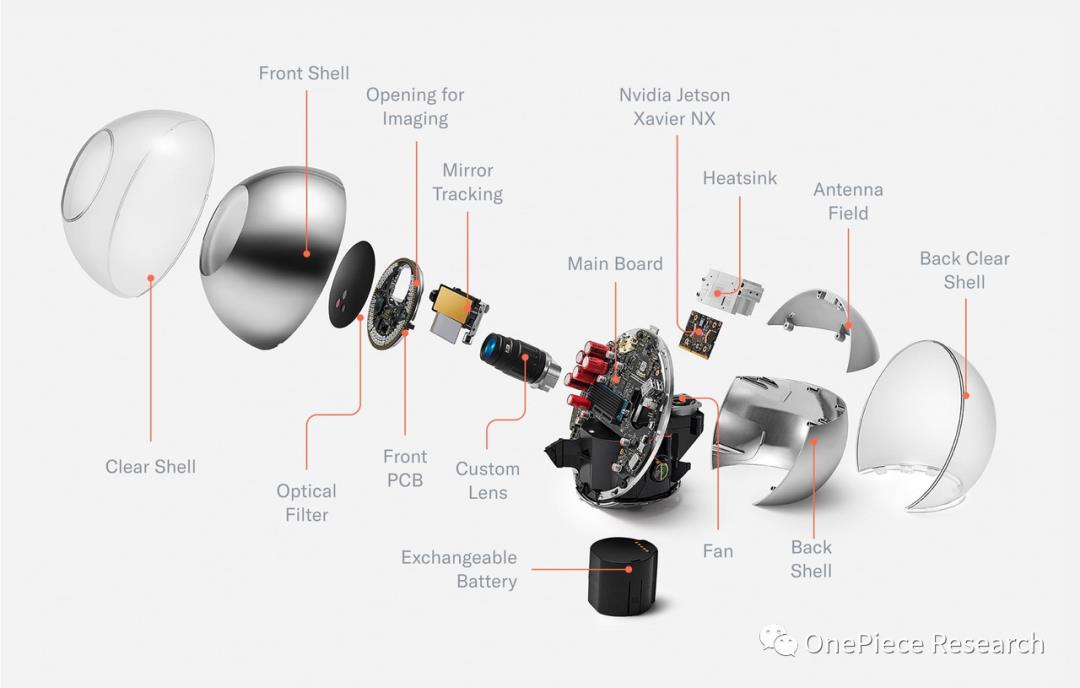
When performing personality verification, the Orb first uses sensors to ensure that the person standing in front of it is human. It then acquires, processes, and by default immediately deletes a sequence of iris images to create an iris code, which is a digital representation of the iris texture.
While Orb deletes iris images immediately after creating an iris code by default, individuals can also choose to back up their images. This will share their iris images with Worldcoin to train the project’s iris detection and segmentation models and similar algorithms.
Worldcoin promotes the establishment of its own public chain based on OP Stack, which will allow it to inherit the account anonymity and transaction disclosure features of Ethereum. As shown in the figure below, after using Orb to create a World ID, its data will be published on the chain through Worldcoin Protocol, and its identity can be verified by other applications on WorldApp through zk certification. The built-in cross-chain architecture of the SDK allows it to share identity information between the Ethereum main network, other Layer 2 such as Optimism and Arbitrum, and non-EVM compatible chains such as Solana, Sui, etc.
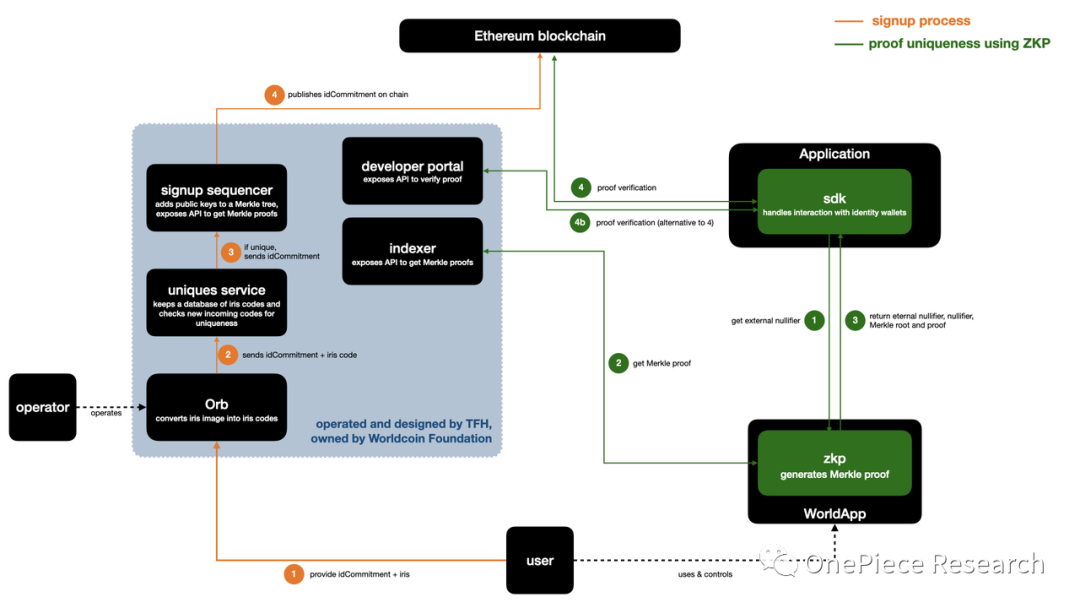
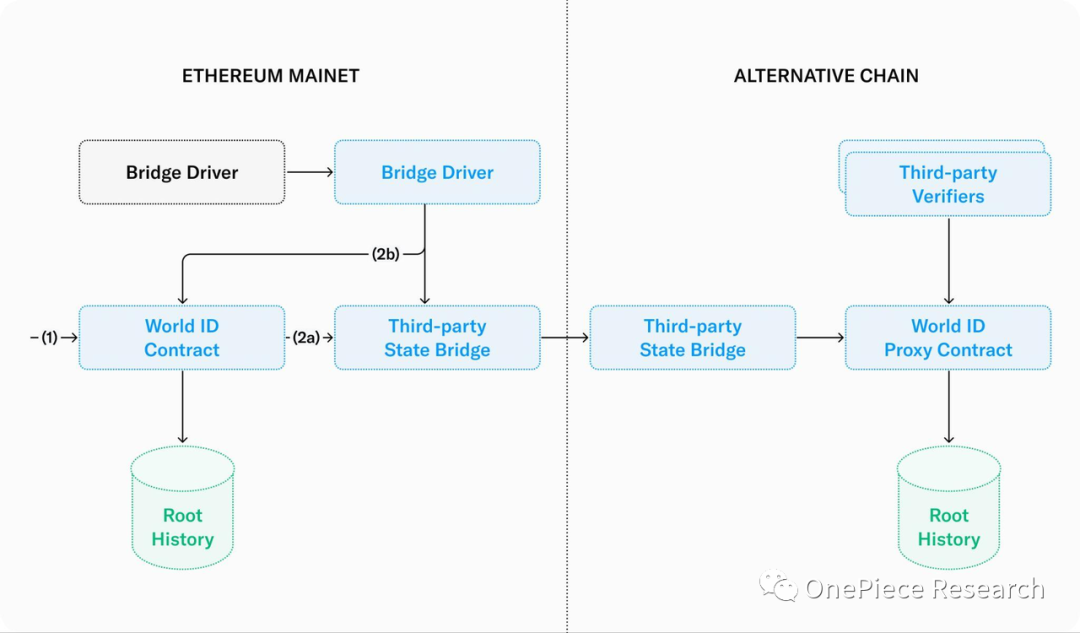
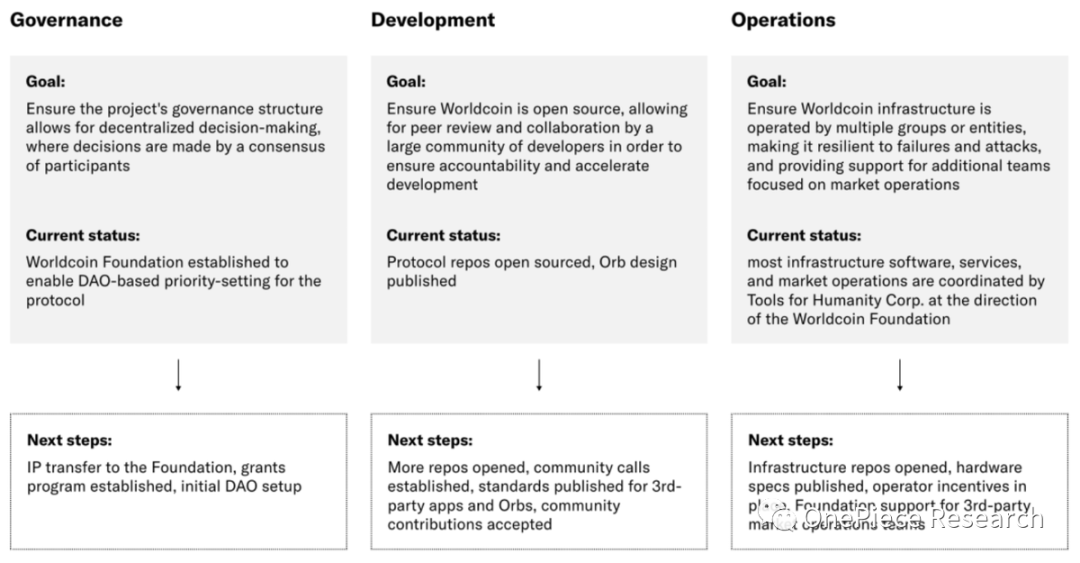
In its route, Worldcoin emphasizes the decentralization of the entire protocol, which simply means the decentralization of governance, development, and operations:
- Governance: DAO-based foundation management
- Development: open source protocol and open device design
- Operation: Diversification of operating entities
Applications of Worldcoin
Worldcoin hopes to allow everyone, anywhere to participate in the global digital economy through DeFi and DID, and to achieve equal opportunities around the world. The more developed the network is, the more obvious its effects should be. In other words, establish World ID, an identity system that belongs only to independent individuals, and WorldAPP, a wallet that can pay, purchase, and transfer money on a global scale, making it a Web3 portal, giving everyone the opportunity to participate in the global economy, thereby Address the current inequality of opportunity that exists primarily in third world countries.
This is why Worldcoin wants to distribute WLD for free to 1 billion people around the world, thereby rapidly expanding its financial network and occupying a very Crypto narrative. According to the Worldcoin article, it has the following applications:
- identity
Real Person Identification: Bots, spam, and robocalls on Twitter are all symptoms of a lack of robust and frictionless digital identity. These problems are exacerbated by rapidly evolving artificial intelligence models that can fool CAPTCHAs and generate convincing “human” content. Therefore the solution proposed by Worldcoin for identity proofing is crucial and can be used as public infrastructure. If every message or transaction contained "verified human" property, a lot of noise could be filtered out of the digital world, especially against Sybil attacks.
Currently, collective decision-making in Web3 relies heavily on token-based governance (one token, one vote). Although Gitcoin and others use quadratic voting to restrict whales, it cannot withstand witch attacks. When digital identities are introduced into the real world, they face issues of resource allocation and over-incentives. Therefore, reliable, Sybil-resistant personality proofs like World ID open up a new solution for global democratic governance and resource allocation mechanisms, and it will become increasingly important for everyone to participate in its governance.
- Identity-based financial applications
Corporate incentive alignment: Coupons, loyalty programs, referral programs, and other systems that share value with customers are vulnerable to Sybil attacks and insider cheating because the cost of doing evil is extremely low but the rewards are high. So, frictionless and fraud-proof digital identities help align incentives and benefit consumers and companies alike. This allows users to participate in the company's operations in another form other than stocks or even partially own a company.
Equal distribution of social resources: Social subsidies and social welfare are particularly important in developing economies, because the social welfare programs in these countries not only face the problem of using false identities to obtain more than an individual's fair share of resources, but also have backward identity statistics. misallocation of resource shares. India saved $5 billion in subsidy programs in 2021 by implementing a biometric system that reduced fraud. A decentralized personality proof protocol can extend similar benefits to any project or organization around the world. As artificial intelligence advances, access to equitable distribution of rights and the value created through universal basic income will be able to offset the concentration of economic power to some extent. World ID ensures that each person registers only once and guarantees fair distribution.
- Opportunities for overtaking on curves in third world countries
Worldcoin's platform based on personality certification, on-chain credit system and Crypto payment system is exactly the solution to the current dilemma of a third world country. The current world monetary system and economic status, as well as climate, epidemics and wars, have gradually worsened the economic environment of third world countries. They urgently need such a breakthrough to reverse their decline, and today's infrastructure and blockchain The improvement of technology gives them the conditions to do so, and the demand for digital identity and new currency systems gives them the motivation to do so. Take the most typical African example:
1) Current economic conditions of African countries
The April 2023 edition of the Pulse of Africa report shows that economic growth in sub-Saharan Africa remains sluggish and insufficient, weighed down by global economic uncertainty, poor performance of Africa’s largest economy, high inflation and a sharp deceleration in investment growth. to reduce extreme poverty. Economic growth is expected to slow to 3.1% in 2023 from 3.6% in 2022.
In December last year, Ghana's inflation rate climbed to 54.1%, reaching the highest level in nearly 22 years. In January this year, Nigeria's inflation rate rose to 21.82% from 21.34% in the previous month, the highest level since September 2005.
The government faces increasing debt payment and liquidity problems, related to high borrowing costs and the appreciation of the U.S. dollar caused by the collapse of European and American banks.
Africa's natural resource wealth holds huge untapped economic potential, which requires good sectoral governance, appropriate taxation to capture a greater share of resource rents, and regional cooperation and investment.
Combating inflation remains central to achieving macroeconomic stability, and African governments have the power to undertake internal reforms to restore macroeconomic stability and better prioritize spending.
Economic performance across sub-Saharan African subregions is inconsistent.
Investment growth fell sharply across the board, and this decline occurred across subregions, resource-rich and resource-scarce countries, and investor types (public, private and foreign).
2) Infrastructure
In recent years, Africa's Internet and mobile Internet infrastructure have been built rapidly. According to the "Sub-Saharan Africa Mobile Economy 2022" report released by the Global System for Mobile Communications Association, as of the end of 2021, more than 500 million people in sub-Saharan Africa have subscribed For mobile services, the mobile user penetration rate is 46%. The report predicts that by 2025, 613 million people in the region will subscribe to mobile services, and the user penetration rate will reach 50%. And more than 84% of Internet connections in Africa are via smartphones. Data from the Federal Communications Commission of Nigeria show that as of June 2022, Nigeria’s mobile Internet users have exceeded 150 million, and the Internet penetration rate is about 70%.
Fintech and e-commerce have also been popular application tracks in Africa in recent years. DataSparkle data shows that these two tracks will still maintain strong growth in 2022 despite economic headwinds. The number of active users of financial mobile applications in Africa increased by 26% in December 2022 from January of the same year, exceeding 73 million; the number of active users of shopping applications increased by 6% in December 2022 from January of the same year, exceeding 36 million.
3) Blockchain technology
Blockchain technology has developed from the original peer-to-peer cash system of Bitcoin to the global computer of Ethereum. Due to the emergence of smart contracts, a large number of new technologies and concepts have emerged. These mature solutions can be used to improve the current world currency system:
1. Different solutions under the same standard: Layer2/Rollup
Countries operate their own plans according to their own policies under the same standards, unify "weights and measures", and resolve systemic frictions under multi-party cooperation.
2. Identity and credit system: DID
The identity and credit chain replaces traditional banks in personal credit assessment, makes identity authentication systems in various countries compatible with each other, and optimizes entry and exit management.
3. Asset and data ownership: Wallet + RWA + zk
The account system based on the blockchain protects personal asset ownership, lowers the threshold for financial asset transactions, and provides everyone with the right to participate in economic activities on the premise of using zk certification to ensure the security of national information and citizen data.
4) International monetary system
From the Bretton Woods system established by 44 countries including the United States, Britain, France, West Germany, Canada, Italy, and Japan to the Jamaican system that specifically provides developing countries with greater exchange rate flexibility and policy space, they are all developed countries. and the dominance of international institutions, resulting in developing countries having a smaller say in decision-making and the formulation of international financial rules. At the same time, developing countries may face some challenges in their financial systems and technological reserves, which limits their full participation in the international monetary system. Therefore, there are almost no opportunities for developing countries to participate in the evolution of the international monetary system. Blockchain-based identity verification and Cryptocurrency-based cross-border instant payments may be a good opportunity for developing countries to create and deeply participate in a new international monetary system.
5) Demand for digital identity and new currency system:
Unlike developed countries and large economies, third world countries mainly rely on cash currency systems, lack a mature credit system, have just come into contact with mobile payments, and have not established a complete banking system. Therefore:
The country's borrowing costs are high and external investment is difficult.
The scope and categories of economic activities are restricted.
There are not many historical obstacles to the adoption of a digital currency system.
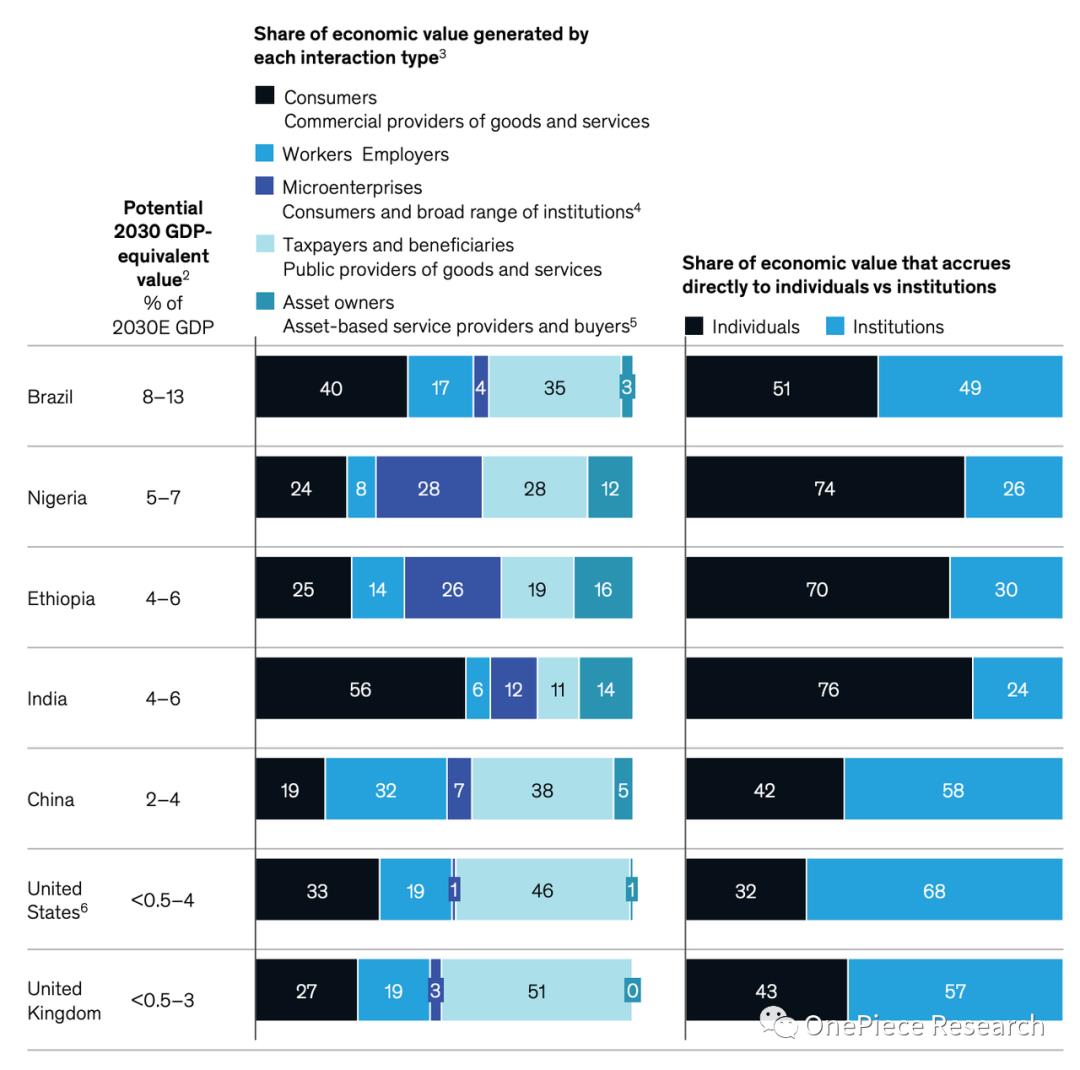
Currently, there are still a large number of citizens who do not have digital identities or do not benefit from digital identities. As shown in the figure below, various developing countries have the potential to obtain substantial GDP growth from the use of digital identities, while individual citizens are likely to gain value from digital identities. of more than 50%. Take Nigeria as an example. 81% of its labor force is self-employed. Digital identity can help them participate in small and micro entrepreneurship and investment, thereby obtaining support and protection from the government. It can also help the government recover tax revenue lost due to income fraud. . For Ethiopia, digital identity can bring 41 million potential users in the financial industry, because it allows banks to conduct remote identity authentication to provide corresponding financial services, which will generate a value of $2.5 billion. investment. Therefore, the economic value that digital identity can create in emerging economies is far greater than that in mature economies.
The significance of a world-class platform
This world-class platform is a brand new narrative and has a huge potential market because its users are humans all over the world. This is what DeSoc wants to achieve and what Satoshi Nakamoto wants to achieve.
Currently, the world-class platform covers major technology and Internet giant companies from the United States, China, Europe, and Southeast Asia and Africa.
In the United States, companies such as Google, Microsoft, Amazon, and Apple provide search engines, cloud computing, e-commerce, smart devices and other Internet services globally. Representative Chinese companies include Baidu, Tencent, Alibaba and Huawei, which also cover areas such as search engines, social media, e-commerce, cloud services and communication equipment. Although Europe does not have giant companies like the United States and China, it also has many well-known technology companies, such as SAP, Spotify and ARM.
In addition, there are also some important influential platforms in Southeast Asia and Africa, such as Grab and Transsion. Grab is Southeast Asia's largest travel service platform, providing ride-hailing, food delivery and express delivery services. Transsion is a mobile communications equipment manufacturer headquartered in China that occupies a significant share of the African market. Its mobile phone brands include Tecno, Infinix and Itel.
These world-class platforms have large user bases and widespread influence in their respective regions. With the rise of emerging technologies such as blockchain, digital identity authentication and payment, more new global platforms may emerge in the future, which are expected to change the existing competitive landscape and promote the vigorous development of the digital economy on a global scale.
Both DeSoc and Satoshi Nakamoto’s Bitcoin are trying to break the monopoly of the traditional Internet industry and provide users with more secure, autonomous and privacy-protecting digital identities and payment methods through decentralized technology. This is similar to the business map concepts of Zuzalu, Worldcoin, and Musk mentioned in this article. They are all exploring the fields of digital identity authentication and currency payment, and trying to build a world-class platform to drive ecological development with users, giving users greater control and privacy protection.
The potential market for these global platforms is huge because their user base is humans all over the world. This covers not only already highly developed regions such as the United States, China, and Europe, but also developing countries such as Southeast Asia and Africa. In developing countries, digital identity and payment systems are critical because many people lack legal identity and financial infrastructure, and these global platforms are trying to fill this gap. This will bring more convenience and opportunities to people in these areas.
However, establishing such a new platform on a global scale still faces many challenges, including technical difficulties, legal and regulatory issues, privacy and data security, etc. But no matter what, these emerging technologies and platforms are trying to change the existing Internet landscape and bring more rights and choices to users.
in conclusion
Sam Altman and Elon Musk both want to do the same thing, namely identity + payment, but the implementation paths are different.
1) Altman starts by determining the identity of each person, issues airdrops, and gradually guides users to use the built-in wallet, thereby establishing an ecosystem, which is more like a rural area surrounding a city, built from the bottom up.
2) Musk uses the formed Twitter social graph to build an Internet identity. By integrating their respective Web3 projects and assets, he transforms Web2 into Web3, which is like a constitutional monarchy that changes the existing ecology.
By comparing Worldcoin, Twitter (now Xeet) and Vitalik’s sociological experiment (Zuzalu), we can draw the following conclusions:
Worldcoin: The main goal of Worldcoin is to achieve digital identity authentication through biometric verification such as iris scanning, and to provide a digital currency system to 1 billion people around the world through the free distribution of Token ($WLD). Worldcoin attempts to build an ecosystem from the top up, gradually guiding users to use the built-in wallet to establish a global digital identity authentication and currency payment system. It focuses on solving the problems of imperfect identity authentication and financial infrastructure around the world.
Twitter (Xeet): Twitter’s vision is to enable digital identity authentication and digital currency payments through the social graph and the existing Twitter social network. Elon Musk plans to leverage the existing Xeet user base and social graph to build a digital identity. By integrating Web3 projects and assets, convert Web2 into Web3, and upgrade the existing ecosystem into a new digital payment ecosystem. This approach brings digital identity and payments into existing social networks by reforming and integrating existing platforms.
Zuzalu (Vitalik’s sociological experiment): Zuzalu is a sociological experiment that provides identity authentication with the help of ZuPass and zero-knowledge proof technology, and explores the customization of Ethereum and the scalability of smart contracts to achieve customized identity authentication. and digital currency payments. Zuzalu’s goal is to explore how blockchain technology can be used to oversee urban governance and operations, improving process transparency, credibility and verifiability. This kind of experiment focuses more on exploring the application of digital identity authentication and payment methods in urban governance and social operations.
To sum up, these three projects differ in their goals and implementation paths. Worldcoin focuses on solving the identity authentication and financial foundation problems of citizen facilities in third world countries, and achieves this by building an ecosystem from multiple layers and dimensions. Twitter (Xeet) plans to introduce digital identity authentication and payments through the existing social network and social graph, upgrading the existing platform into a new digital payments ecosystem. Zuzalu is an experimental project that explores the application of digital identity authentication and payment methods in governance and social operation projects in future cities.






