


On September 21, at the Polkadot Developer Conference Sub0, Polkadot announced that it would support up to 1,000 parachains and more than one million transactions per second by implementing a series of improvements and plans. Behind these improvements and plans, it is also clear that there will be "major changes" in the Polkadot ecosystem.
1,000 parachains and one million TPS
Polkadot announced at this conference that it plans to start experimenting with a new and transformative network expansion solution-asynchronous support in the next few weeks. The so-called "asynchronous support" refers to "Asynchronous backin", which usually refers to a technology or mechanism that allows system components (such as validators, nodes or services) to operate without the need for real-time or synchronous interaction.
Parity Technologies, a major contributor to Polkadot, said at the conference that the asynchronously supported version will be deployed to Polkadot's Rococo test network in about two weeks, and is expected to support Polkadot up to 1,000 parachains and more than one million times per second. trade. At the same time, asynchronous support can halve the block generation time of the parachain from 12 seconds to 6 seconds, and increase the block space of each block by 5-10 times.
"Asynchronous support provides flexible scheduling for our future scaling efforts through Elastic Scaling and Instantaneous Core Time," Polkadot Parity engineering lead Sophia Gold said in a statement "Asynchronous support will also more than triple Polkadot's number of validators to approximately 1,000 by the end of 2024, which is the most important evolution of the parachain consensus since we launched the parachain nearly two years ago," said the statement.
In fact, since Polkadot officially released the full version of Polkadot 1.0 on July 19 this year, Polkadot has continued to receive attention from the industry. The full version of Polkadot 1.0 provides Polkadot’s initial architecture based on heterogeneous sharding, including relay chains and connected parachains, all secured by a shared set of validators, as well as a staking system, on-chain governance, cross-chain communication and transactions Core functions such as routing and forkless upgrades.
Polkadot's parachain has also been further expanded. For example, the Uniswap community announced in May that Uniswap V3 will be deployed to the Polkadot parachain Moonbeam. Since then, Circle officially listed USDC on the Polkadot mainnet in September to improve the liquidity of the entire ecosystem. But as the Polkadot ecosystem expands, the issue of community governance has gradually entered a broader perspective.
Governance problems to be solved
On June 15, Polkadot officially launched the Polkadot OpenGov community governance model. OpenGov attracted widespread discussion and attention upon its release.
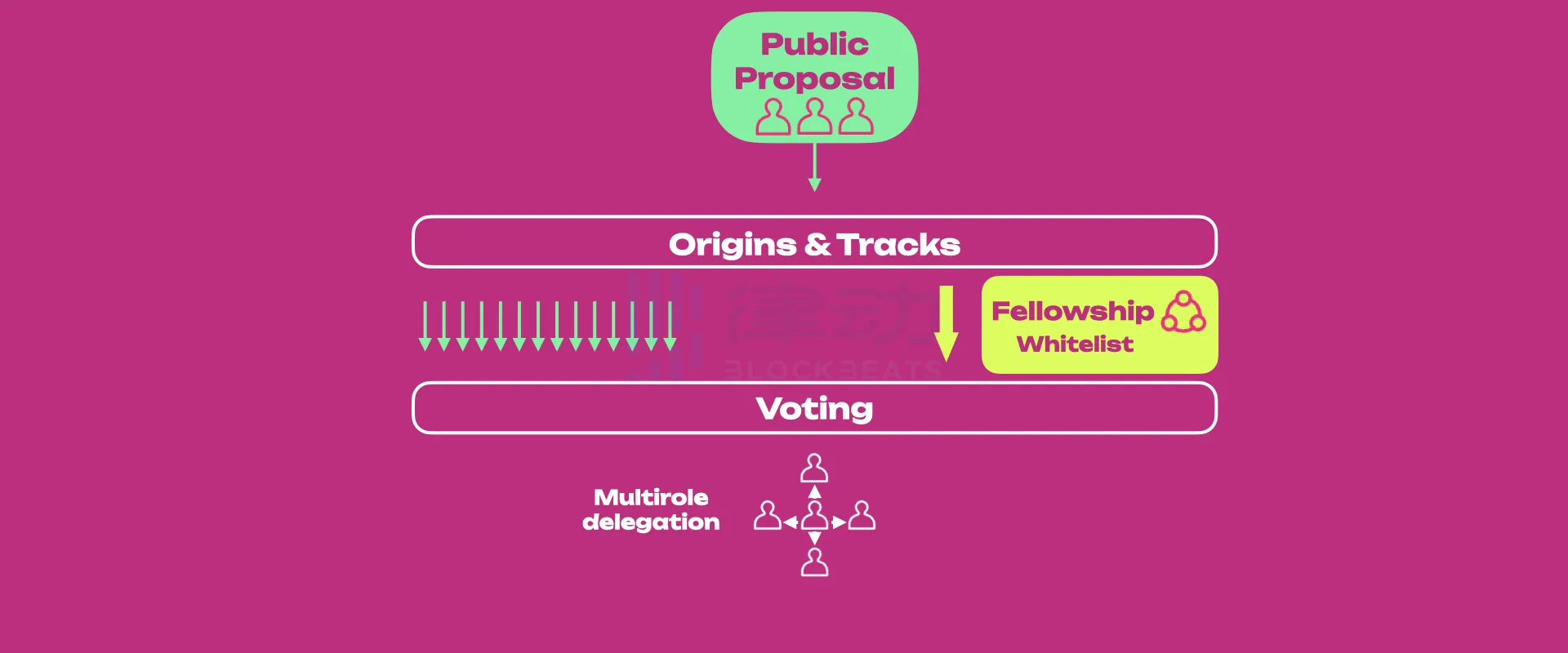
As Polkadot's new governance model, OpenGov supports voting on multiple issues at the same time, and everything is directly controlled by the community. At the same time, OpenGov abolished the Board of Directors and Technical Committee of Polkadot Governance V1 and replaced them with a newly elected body, the Polkadot Fellowship. The Fellowship has no real authority over the network and cannot change parameters or move assets. It is reported that the Fellowship organization has 45 members, and the number of members may continue to grow in the future.
In the deprecated Polkadot Governance V1, all referendums were equally weighted, voters could only vote on one referendum at a time (except for emergency proposals), and the voting period could last several weeks. In addition, the alternating voting schedule allows voting on a public referendum or parliamentary motion every 28 days; while OpenGov builds on the voting delegation function of Governance v1 and introduces the function of multi-role delegation so that voters can delegate their voting rights to another party. A voter.
For the OpenGov governance model, Polkadot's largest Chinese community, PolkaWorld, has had a certain degree of response. On September 15, PolkaWorld issued a statement stating that its proposal to apply for official funding was rejected and therefore suspended operations. As of now, PolkaWorld has been suspended for nearly a month.
PolkaWorld explained that under the original governance framework, DOT holders will choose a council with professional knowledge reserves, which will evaluate specific proposals. This effective treasury mechanism should be integrated into OpenGov within the governance framework; however, under today's OpenGov governance framework, DOT holders tend to resist all proposals to cash out treasury reserves, which leaves many long-term contributors and organizations without due funding.
In fact, some people did leave the Polkadot ecosystem because of this. PolkaWorld issued an article on September 18 stating that Brushfam was withdrawing from the Polkadot ecosystem. As an infrastructure developer, Brushfam provides consulting to many development teams to help companies join Polkadot. PolkaWorld therefore calls on all DOT holders to realize that the existence of treasury is to promote the development of the ecosystem. If OpenGov will lead to the loss of ecological projects, then this may mean that DOT holders are making decisions under OpenGov. Wrong vote.
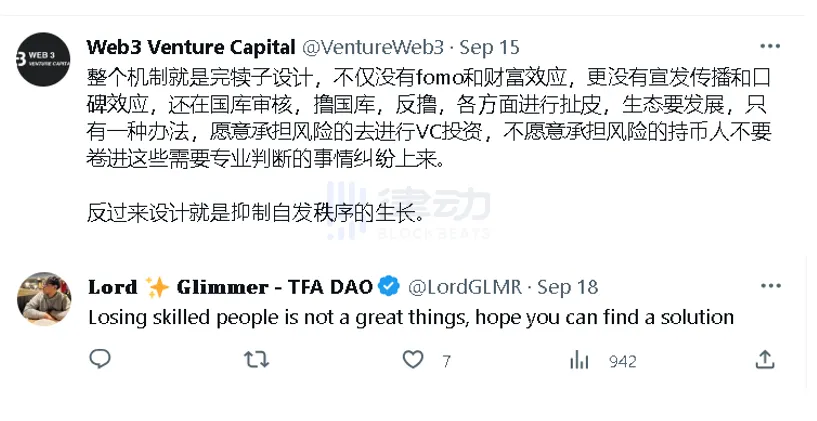
Many encryption enthusiasts have also criticized OpenGov. At the same time, PolkaWorld stated that OpenGov was originally designed to make Polkadot's governance more decentralized while improving the efficiency and transparency of the treasury. However, the treasury management mechanism under this framework has now led to funding applications from many long-term contributors and organizations. Repeatedly rejected.
Perhaps while continuing to advance the ecosystem, Polkadot also needs to spend more time improving its community governance plan so that more community participants can better invest in construction.






