


Author: Pioneer of the Web3 world
Table of contents
“Money + Credit” two-wheel drive economic cycle
Open finance core value proposition and primitives
The core functional triangle of DeFi protocols
3.1. Issuance and expression of digital assets
3.2. On-chain liquidity of digital assets
3.3. Create decentralized credit on the chain
Welcome DeCredit Summer
Part 01. “Money + Credit” two-wheel drive economic cycle
Ray Dalio is the founder of Bridgewater Associates, one of the largest hedge funds in the world. In his article "How the Economic Machine Works", he elaborated on the interrelationship between currency, credit, trading, market and economy.
Ray Dalio pointed out that transaction is when the buyer uses money and credit to exchange products, services and financial assets with the seller. Different markets are formed around the buying and selling of different commodities, such as wheat market, stock market, etc. The economy is composed of all transactions in all markets, and all economic cycles and dynamics are caused by transactions. Transaction is the most basic part of this economic machine. If you understand transaction, you will understand the entire economy.
In transactions, credit is used the same as currency, so currency and credit together constitute the total expenditure of the transaction subject, that is, currency + credit = total expenditure . While expenditure is the driving force of the economy, money and credit become the "two-wheel drive" of the economy , as shown in Figure 1-1.
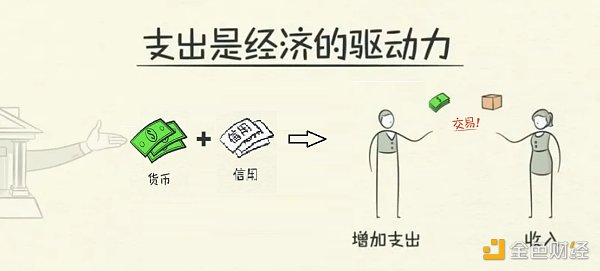
Figure 1-1 The relationship between currency, credit, transaction and economy (image edited based on Ray Dalio’s source image)
Under the "two-wheel drive", the economy becomes volatile, showing short-term and long-term economic cycles. Among them, currency can be simply understood as income, that is, the rewards brought by traders' productivity and workload. Productivity and workload generally do not fluctuate violently, so the amount of currency held by traders is a relatively stable factor and is not an important driving force for economic ups and downs. Credit , here, should be understood as the currency obtained because of credit, which is called "credit currency" here to distinguish and understand it. As long as both the lender and the borrower are willing, credit money can be generated instantly out of thin air, thereby increasing the total expenditure of traders in a short period of time. This means that we use debt to consume, so that consumption exceeds the output brought by productivity, but when repaying the debt, consumption must be lower than output, and a cycle is formed in this process. This is where credit differs from money in transactions. It is also where productivity differs from credit in business cycles. Productivity is most critical in the long run, but credit is most important in the short run. As shown in Figure 1-2.
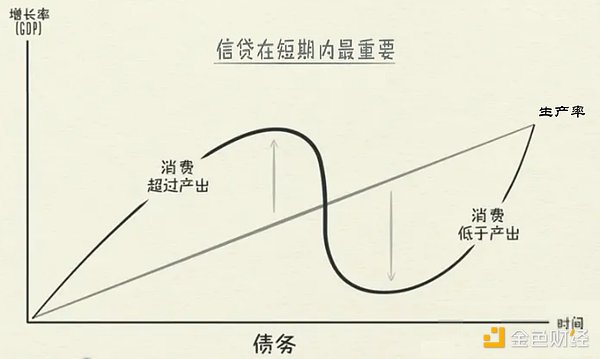
Figure 1-2 The relationship between money and credit, productivity and credit in the economic cycle (image edited based on Ray Dalio’s source image)
It can be seen that although money and credit are both driving forces of the economy, they play different roles, and their amounts and proportions vary greatly. In reality, what we call money is almost all credit currency. According to the article, the total domestic credit in the United States in 2013 was approximately US$50 trillion, while the total monetary amount was approximately US$3 trillion. It can be seen that credit is the most important component of the economy . A large amount of money in reality is credit money generated by credit. Credit money plays a more important liquidity role in the real economy.
We believe that the above logic also applies to the field of crypto-economics, that is to say, credit will also be able to play a vital role in the field of crypto-economics. The difference is that in the traditional economy, a complete set of operating systems has been formed from qualification certification, credit assessment, credit execution and risk control management, allowing it to operate effectively in real economic activities. But looking at the encryption field, perhaps because the infrastructure is missing or imperfect, or the chain has completely different operating logic, in short, the current on-chain credit system is still blank. Even the most common lending protocols are over-collateralized. Although the borrowing amount can be enlarged multiple times through cyclic over-collateralization, this is only a multiplier effect under the logic of "deposits create loans" (Note: The credit monetary system in reality is "loans create deposits out of thin air", following the "Central Bank + Brazil" The dual system of "Seer Agreement + Commercial Bank") has nothing to do with credit and does not generate any credit. What will happen if credit can be created in DeFi and introduced on a large scale ?
But the crypto economy and the traditional economy are still two parallel worlds. How to build credibility in crypto? Can credit in reality be transferred to the crypto world? What factors are considered? How is it different from that in the traditional economy…
We have realized the importance of creating credit and implementing credit for the encryption economy. Next, we will bring our thinking into the encryption field to think about the topic of "building decentralized credit". Here, we try to sort out some thoughts on encrypted digital assets, open financial value propositions, DeFi protocol primitives and core functions, etc. These thoughts help clarify the underlying logic of open finance and the fundamental differences with traditional finance, and can explore possible implementation paths based on this.
Part 02. Open finance core value proposition and primitives
With the emergence of blockchain, the concept of “decentralization” has been constantly mentioned and emphasized. When people talk about "decentralization", it is often related to "identity autonomy, ownership, currency issuance, distributed nodes, distributed ledgers, decentralized governance and organization", etc.
However, the success of open finance, or decentralized finance (DeFi) protocols led by Uniswap and others, has made us focus more on the core value proposition of "decentralization" in open finance, as shown in Figure 2-1.
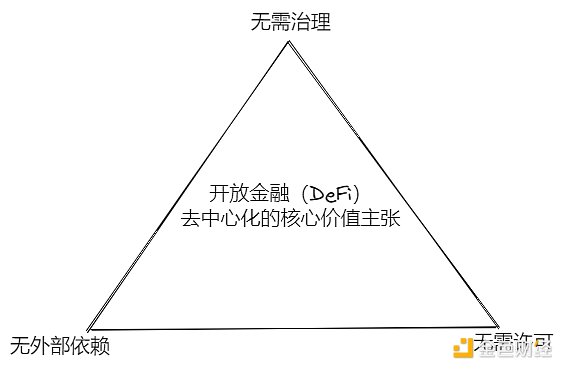
Figure 2-1 The core value proposition of open finance (DeFi)
● No permission required : Permission means control, rights, opacity and asymmetry, which means centralization; and no permission means freedom, equality, transparency, and decentralization. For example, you can provide ETH-DAI to add a liquidity pool to Uniswap and obtain LP income. This does not require authorization from anyone or the agreement. It depends entirely on your willingness and ability. At the same time, the amount of income you receive depends entirely on the value of the ETH-DAI you provide. . Everyone follows such rules and there are no privileges.
● No external dependencies : Blockchain is a closed system to protect state consistency and system security, which is the basis for forming a global consensus. If external data is introduced into a contract through an oracle, the contract will inherit risks related to external dependencies, such as data accuracy, timeliness, consistency, etc. External oracles may bring problems such as centralized evil, single point of failure, and destruction of consensus to the contract, while decentralization also means no oracles, no external dependencies, and it is completely on the chain, which is OR Native . Therefore, it is difficult for applications that currently use oracles to feed prices and data to obtain "Trustless" in the blockchain world, which will undoubtedly increase friction costs.
● No need for governance : Governance means human governance, which may bring uncontrollable and uncertain factors, and there are centralized risks, which is equivalent to the introduction of external risks to the contract. At the same time, the implementation of governance also means the upgradability of contract functions to a certain extent, which may lead to issues of state compatibility and affect the security of the consensus on the chain; it may also bring unfairness and losses to the invested capital, which is important for the value-centered The smart contract constructed is a huge trust risk. Therefore, once the contract is deployed, it cannot be upgraded. For upgrades, the feasible method is to redeploy independent versions, such as Uniswap V1, V2, V3, etc. Each version is independent and has no relationship.
A DeFi protocol that requires no permission, no external dependencies, and no governance must require no external oracles, be completely implemented on-chain, be non-custodial and automatically cleared, be self-endorsed and credit-enhanced, and be a true OR Native. All these features come together to bring pure "Code is Law" to the DeFi world, thereby demonstrating the greatest value of the blockchain - trustless. When we look back at various economic crises and thunderstorms, it is not difficult to understand how precious a quality "no trust required" is. It carries the original intention and mission of blockchain technology innovation.
DeFi protocols with the above characteristics can be called " Primitives ", which means basic, open, public, scalable and composable.
The DeFi protocol that has become a "primitive" has the self-attribute of "driving consensus". It is a "consensus engine" that can condense consensus, expand consensus, and strengthen consensus. It will be trusted and used by users, spontaneously spread by the encryption community, and developed Users adopt it and build dApps or composable protocols based on it . A familiar example is Uniswap, which has achieved great success since its deployment. It has the largest trading pool depth, accounting for more than 60% of the entire Dex market, and has become the most basic financial facility on the chain.
Part 03. Core functional triangle of DeFi protocol
Ethereum has innovated smart contracts and decentralized application platforms, and has brought about two waves of craze so far, one is ICO and the other is DeFi Summer. Today, DeFi has become the most important and successful application in the Ethereum ecosystem and even the entire crypto world.
Looking back at the development of the entire DeFi, DeFi protocols have already played two core functions, one is the issuance and expression of digital assets, and the other is creating on-chain liquidity of digital assets . However, according to the "two-wheel drive" principle of the economy, DeFi urgently needs to build "decentralized credit", that is, DeCredit .
3.1 Issuance and expression of digital assets
Although the Bitcoin protocol pioneered and issued the BTC cryptocurrency, due to the limitations of its protocol, it can only issue and operate BTC.
However, with the launch of universal smart contracts by Ethereum, the issuance of encrypted digital assets has become simple and efficient, promoting the emergence of the "ICO boom", the emergence of tens of thousands of encrypted digital currencies, and realizing the "free issuance of currency."
Although ICO is controversial, free issuance without permission is one of the spiritual cores of "fundamentalism". It has been widely recognized by the native encryption world and has become an inevitable choice for building open finance. From the perspective of the neutrality of the protocol, we should give ICO a reasonable evaluation. If the most successful TOP applications of the blockchain are sorted in chronological order, No. 1 should be BTC, No. 2 should be ICO, and No. 3 should be DeFi.
ICO (Initial Coin Offering) is essentially a smart contract that defines a certain Token and its issuance method. The simplest implementation is that when a user sends ETH to a smart contract, the smart contract will send the corresponding number of "Tokens" to the user's associated wallet address.
In order to make it universal and scalable, Ethereum developers standardized ICO technology and proposed token standards, starting with the fungible token (FT) standard ERC20. Subsequently, Token standards continued to develop, and non-fungible (NFT) ERC721, ERC1155, and semi-fungible (SFT) ERC3525 appeared.
In summary, the expression and free issuance of encrypted digital assets are realized based on smart contracts, which provides the most basic core element for the development of DeFi protocols - encrypted digital assets, and based on it, various DeFi protocols and application scenarios are innovated. Financial liquidity is created on-chain.
3.2 On-chain liquidity of digital assets
The so-called finance refers to the financing of funds . According to Wikipedia's explanation: Jin refers to gold; melting originally refers to melting gold into liquid to facilitate melting . In other words, the original meaning of finance is to melt and separate gold so that transactions can flow.
It can be seen that there are two cores of finance: one is funds, such as gold, US dollars, RMB, encrypted digital currencies, etc.; the other is the liquidity of funds, which is the exchange of value across time and space. Liquidity is the core requirement of finance. Only when funds flow can they demonstrate value and play a role in economic activities. It is conceivable that even if a person has a lot of wealth, if it does not enter circulation, it is actually worthless. This is the importance and significance of capital liquidity.
In the blockchain world, creating liquidity for encrypted digital assets and realizing the value exchange of Token across time and space in a decentralized manner is decentralized finance (DeFi), which is implemented through different protocols. Show different functional application modes, such as:
● Token trading (DEX)
DEX provides liquidity for tokens through Swap, allowing one token to be exchanged for another token. The prerequisite is that the token already exists in DEX, which is what we often call "exchange listing."
It is completely different from CEX. There is no permission required to list currency in DEX. It embodies freedom and fairness and avoids the "will of rights", but it may also bring about fraud and air coins. Whether good or bad, these are left to the free market. Achieve trade-offs and balance in the game.
In terms of liquidity realization, taking Uniswap as an example, DEX abandoned the order book model of CEX and built an AMM mechanism using the joint curve X*Y=K. Transactions in CEX are matched by market makers providing counterparty prices. The liquidity of transactions is reflected in the number of buy/sell orders at different prices and the depth of price distribution. In DEX, the user's counterparty is a capital pool defined by a bonding curve. In the process of interacting with the capital pool, the user realizes the price discovery and exchange of Token; liquidity is represented by the quantity scale and TVL size of X and Y. The larger the TVL, the better the liquidity, the smaller the impact on price fluctuations, and the lower the transaction slippage.
● Lending
The DeFi lending protocol has the characteristics of decentralization, trustlessness, transparent open source, automatic execution and automatic settlement. Without the need for a third party and only relying on smart contracts, users can deposit and lend funds, thereby providing or Get liquidity and function like a decentralized bank.
But the difference is that DeFi is permissionless and open to everyone. Users are anonymous, there is no qualification review, and there is no need to provide proof of qualifications. At the same time, DeFi does not have an operation center, it is decentralized, has no external dependencies, and does not rely on the credit of borrowers. Over-collateralization is commonly used.
Lending protocols have developed into the cornerstone of the DeFi industry. TVL was once as high as US$46 billion and is now about US$14 billion. However, due to the lack of credit mechanism and corresponding infrastructure support, no credit is generated in the lending agreement, so its own application scale and driving force for the DeFi industry are limited.
● LP Pool (LP Pool)
DEX creates a liquidity pool (LP Pool) based on the price curve function and implements AMM. The liquidity pool is permissionless, and any user can provide trading pairs to provide liquidity for the DEX protocol and obtain LP certificates.
LP certificates are usually an ERC20 or ERC721 standard digital asset that is composable and can be used as a liquidity input for other DeFi protocols for mortgage lending, income farming, etc. This brings flexibility to DeFi applications.
In addition, the AMM mechanism based on the curve function also provides a price discovery mechanism and liquidity management means . For example, Friend.tech's Key=16000. As X changes, the price of the Key changes accordingly and is rediscovered. If Various scenes such as game props and membership tickets.
● Liquidity Staking (LS&LSD&LSDFi)
The PoS public chain needs to pledge public chain tokens to produce blocks, verify transactions and provide security for the network. However, the pledged public chain tokens therefore lose their liquidity, which may bring high opportunity costs.
The Liquidity Staking (LS) protocol releases liquidity for pledged public chain tokens by providing Liquidity Staking Derivatives (LSD), and innovates various LSDFi scenarios based on the combination of LSD and DeFi, such as stablecoins, re-staking, Pledge lending, interest rate swaps, etc., bring users diversified income and risk hedging strategies, and promote ecological prosperity.
Since the upgrade in Shanghai on April 13 this year, the TVL contributed by LSDs has accelerated its growth, increasing from 60 million to nearly 700 million US dollars in 3 months, with a maximum increase of 12 times. Although it has fallen back now, it has remained at 300 to 400 million US dollars. between.
It can be seen from this that the industry is full of hope for sufficient and high-quality liquidity. It also reflects that LSD, which is backed by strong consensus public chain tokens, has stable interest rates and has low risk, is such a high-quality liquid asset and will become the future of DeFi. important and fundamental narrative of development.
Above, we selected several liquidity use case scenarios that have begun to take shape in the DeFi field, analyzed how liquidity is created in different scenarios, and what characteristics and value contributions this type of liquidity has.
What I want to emphasize here is that since tens of thousands of encrypted digital assets have emerged in the encryption field, no matter how these "Tokens" are classified, what application scenarios they are in, how to create liquidity, how to improve liquidity efficiency, these They have become the most core proposition and indispensable core functions of DeFi and will continue to exist throughout the life cycle.
3.3 Create decentralized credit on the chain
Although the above use case scenarios have brought on-chain liquidity to DeFi and actually generated TVL, they have contributed value to the industry. However, because no credit has been created and the scale of liquidity is limited, DeFi development lacks strong expansion power.
As mentioned before, currency and credit are the "two-wheel" driving force of the economy, and in the absence of credit, the development of the entire crypto economy relies more on "currency" for "single-wheel" driving. Some people say that encrypted digital assets are showing a dollarization trend, and the expansion and contraction of the U.S. dollar largely drives the fluctuations of the crypto economic cycle. This is the current status quo.
However, the "single-wheel driving force" is very limited, especially in a bear market, when there is no entry of external funds, it manifests as a stock game between cryptocurrencies; even as the market warms up, external funds continue to enter, but Due to the lack of a credit support system and the inability to achieve credit expansion, the driving effect on the crypto-economy is ultimately half the effort with half the effort.
Based on the above analysis, after smart contracts realize the issuance and expression of encrypted digital assets, and various DeFi protocols bring on-chain liquidity of digital assets, DeFi, as the financial layer of Web3, is still lacking in functional links. Only after the "Decentralized Credit (DeCredit)" module is built, can the complete "DeFi Core Function Triangle" be formed , as shown in Figure 3-1.
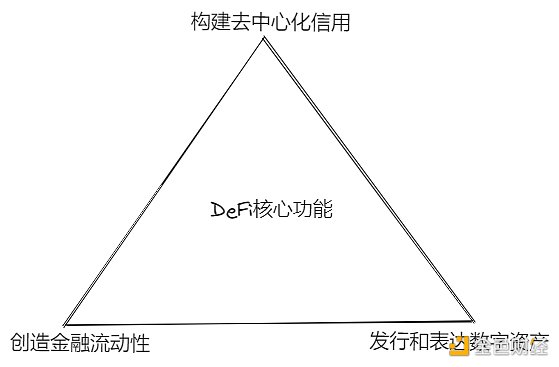
Figure 3-1 DeFi core functional triangle
Part 04. Welcome DeCredit Summer
We hope to see that on the basis of building a complete DeFi core function triangle, DeFi and even the crypto economy will gradually show a "Crypto+DeCredit" two-wheel drive development trend:
● Crypto : Encrypted digital currencies or assets will be associated with real currencies or transactions, carry external liquidity injection, and realize value exchange between the crypto economy and the real economy. This is the driving force from "money", which has externalities.
● DeCredit : DeCredit is based on Crypto and is native on the chain. It is the driving force native to DeFi and the crypto economy. It obtains decentralized consensus and decentralized endorsement through on-chain liquidity governance and achieves the dynamic expansion of decentralized credit. Improve the scale and efficiency of DeFi liquidity and accelerate the large-scale development of the crypto economy.
From this point on, "DeCredit" will play a pivotal role in crypto economic activities just like in traditional economic activities.
What I want to emphasize is that because DeCredit is "Trustless", it is a decentralized high-dimensional trust that can flow to the low-dimensional trust field, such as providing open, transparent and verifiable trust endorsement for real-life application scenarios to achieve encryption. The integration and value expansion of the economy into the real economy.
We are very interested in investing our energy to pay attention to these innovations and changes taking place in the encryption industry, and are also pleased to see innovations such as "decentralized credit modular protocols and primitives" and the emergence of OR Native applications. We will follow up Analysis will be conducted in the research report, so stay tuned. Perhaps, as it develops, we will have the opportunity to usher in a two-wheel drive "DeCredit Summer" in the next industry cycle. Once it happens, it won't be the same as before.
So, are you ready?






