On November 17, local time, the American artificial intelligence research company OpenAI officially announced that Sam Altman will step down as CEO and withdraw from the board of directors.
The announcement was quite harsh: "Mr. Altman's resignation is a decision made by the Board of Directors after careful consideration. The Board believes that Mr. Altman was not candid enough in his communications with the Board and hindered the Board's ability to perform its duties. The Board no longer I believe in his ability to continue to lead OpenAI."
Judging from the post posted by Greg, the chairman and president of OpenAI, the expulsion process is as follows: On Thursday night, Altman received a text message from chief scientist Ilya and made an appointment for a meeting at noon on Friday. At noon on Friday, Altman called into the meeting. All other board members except Greg were present, and Altman was informed that he had been fired. Greg received a call from Ilya at 12:19 p.m. At 12:23 Greg joined the meeting and was told that he had been removed from the board of directors and remained in management, and that Altman had been fired.
At the end of November last year, with the brilliant launch of ChatGPT, the artificial intelligence wave swept the world, and Ultraman won the reputation as the "Father of ChatGPT". A year later, he was fired, which was quite dramatic.
Previously, on November 6, Ultraman also announced a series of product updates to global developers and ChatGPT users at OpenAI’s first developer conference, including the rapid creation of customized ChatGPT GPTs to realize the dream of everyone having large models. And said it will compete with companies such as Microsoft and Google.
On Thursday, Altman also spoke at the APEC meeting, expressing his optimism about artificial intelligence technology and believing that this technology does not require major supervision in the short term. He even claimed: "As a species, humans are now on the road to self-destruction." , and artificial intelligence may be the means to prevent humanity from destroying itself."
Then I was suddenly "resigned" on Friday.
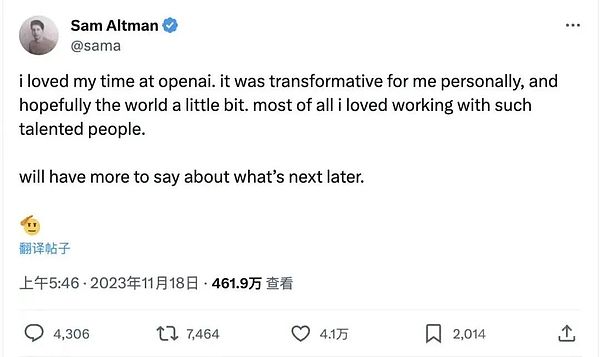
At 5:46 a.m. on November 18, Ultraman sent a message on the people working together. I will explain more about the next steps later.”
OpenAI Chief Technology Officer Mira Murati (Mira Murati), the former CTO, was appointed as interim CEO. At the same time, company president Greg Brockman announced that he will resign as chairman of the board of directors, but he will continue to hold a position in the company and report directly to the CEO.
The board of directors said that interim CEO Mulati has comprehensive skills and is especially experienced in AI management and policy implementation. Previous reports have called her a "dynamic mediator in the field of artificial intelligence" who has welcomed government regulation.
She told employees at a company-wide meeting on Friday that Microsoft's relationship with OpenAI remains stable following Altman's departure. Affected by the news of Altman's resignation, Microsoft's stock price "dived" and fell by more than 2% in late trading, closing down 1.68%. Microsoft issued a statement saying that the company has a long-term cooperative relationship with OpenAI and adheres to its investment commitment to OpenAI.
It can be seen that there are at least two reasons why Altman was kicked out of the board of directors:
First, he disagreed with the board of directors on the issue of handling the relationship with Microsoft;
Second, there is disagreement with the board of directors on whether the regulation of artificial intelligence should be prevented in the short term.
Looking for support or independence?
Microsoft is by far the largest investor in OpenAI, investing $1 billion in 2019 and another $10 billion earlier in 2023.
Microsoft and OpenAI were once called the "romantic alliance" in the technology circle. But if you look closely, you will find that the shrewd Microsoft has not lost its mind at all in the face of "romance". When it invested US$1 billion in OpenAI in 2019, the conditions were very favorable to Microsoft. It bought out the exclusive licensing rights of GPT-3's basic technology. Most of OpenAI's technologies were licensed to Microsoft products first, and Microsoft became OpenAI's exclusive cloud provider, that is, It is said that a large part of the investment from Microsoft received by OpenAI is paid to Microsoft as cloud usage fees.
In November last year, OpenAI released the ChatGPT chatbot, which became popular all over the world within a few weeks. At the beginning of February this year, ChatGPT started the furious mode, and a new global artificial intelligence competition was detonated, with giants vying for the top spot. Microsoft immediately connected ChatGPT to Microsoft cloud services and launched a series of new products such as GPT-3 and GPT-4 versions of Office Family Bucket. In particular, Microsoft incorporated ChatGPT into its search engine and launched a new version of Bing artificial intelligence search engine (Bing Chat). Industry insiders believe this is likely to help Microsoft gain ground in the search market.
Every time a new technology appears, it is a time of major reshuffle in the industry. Although in the global search market in October 2023, Google occupied 91.55% of the market share, while Bing only had 3.11%, a slight decrease from last year, the new wave of artificial intelligence has hit, and the uncertainty of the game has will be greatly increased, which is a huge challenge to the leader Google, and a huge opportunity to the follower Microsoft.
Microsoft obviously does not want OpenAI to provide products and services to other customers. The most beneficial situation for it is that OpenAI only acts as an enabler behind it and does not come to the front desk to pick up customers. At the same time, Microsoft has other enablers and partners to ensure flexibility. Just like in a romantic relationship, both parties hope that they have many lovers and the other party only has one lover.
An internal Microsoft document in March this year showed that in order to persuade customers to choose its Azure OpenAI service, Microsoft secretly ordered its sales staff to "suppress" OpenAI. When Meta released the open source large language model LIama 2, Microsoft announced that it would become the launch partner of Llama 2.
Ultraman is obviously unwilling to accept such a "supported" role, and he is also frequently contacting new "financiers".
Just when he was confident that he could survive independently, the OpenAI board of directors launched a "coup" and drove him out of the company overnight.
a for-profit company controlled by a non-profit organization
Although Microsoft has made a huge investment in OpenAI, it invested in OpenAI Global, which was established in 2019 and is "fully controlled" by the OpenAI non-profit organization registered in Delaware in 2015.
OpenAI Global is “permitted to earn and distribute profits” but is still subject to the mission advocated by its parent organization, the nonprofit OpenAI. OpenAI has been emphatic that Microsoft "accepted our capped equity offer and our request to keep AGI technology and governance in the hands of not-for-profit organizations and humanity at large."
In January 2023, Altman also said in an interview: "The future I hope to see is that the right to use artificial intelligence is super democratized. There are multiple AGIs in the world that can help people form multiple opinions and will not let people No one gets too powerful."
According to the investment agreement between Microsoft and OpenAI, Microsoft's profits from OpenAI Global are limited to "income before the realization of AGI (Artificial General Intelligence)" stipulated in the OpenAI charter.
“AGI” is defined as “a highly autonomous system capable of performing superhuman capabilities in the most economically valuable tasks.” So who gets to decide whether there is “AGI”?
OpenAI's six board members are known as the "Open AI Six": Chairman and President Greg Brockman, Chief Scientist Ilya Sutskever, CEO Sam Altman, and three independent directors who are not OpenAI employees, Adam D'Angelo and Tasha McCauley and Helen Toner.
If they believe they have "implemented AGI", then Microsoft no longer has the right to profit. It is indeed rare for a non-profit board of directors to decide whether shareholders of a for-profit company can obtain benefits, but OpenAI itself is very special. When Altman and others founded OpenAI, it was a non-profit organization with the mission of ensuring Secure general artificial intelligence (GAI) benefits humanity.
They believe that nonprofit boards focus on benefiting humanity as a whole, while for-profit boards serve investors. They also worked hard to establish another layer of protection, which is to keep the board of directors majority independent, that is, the majority of members do not hold shares in OpenAI Global.
Some experts believe that there are indeed some nonprofit organizations that own shares in for-profit organizations, the most famous of which is the Hershey Trust. But they have complete control over the profit-making companies under them, without opposition from small shareholders. With OpenAI, Microsoft's for-profit interests may directly conflict with the controlling entity's non-profit interests.
Once OpenAI achieves its proposed AGI mission, Microsoft may be kicked out. However, at the OpenAI Development Day event last week, Altman assured Microsoft CEO Satya Nadella: "I highly appreciate the cooperative relationship between the two parties at the technical level... and I look forward to working together to achieve the great cause of AGI."
In the Financial Times' latest interview with Altman on November 13, the OpenAI head said that the company's partnership with Microsoft was "working well" and expected that "over time, we will raise more funds." More funds.”
When asked whether Microsoft would inject further capital, Altman said, "I hope so... There is still a long way to go from the current progress to AGI, and a large number of computing facilities are indispensable during this period... AI training still requires huge costs. ."
In other words, Ultraman's point is that AGI has not yet been realized. According to sources, OpenAI’s six-member board of directors recently conducted a study and judgment on whether AGI has been implemented, and Altman’s dismissal may be a result.
idealist ultraman
In 2005, Altman dropped out of school to start a business with two classmates and developed Loopt, a social media software that can share locations with friends. The famous startup incubator Y Combinator invested in the software.
Three years later, Jobs invited Altman to attend the Apple mobile phone launch conference, and the software entered the Apple APP store. After that, Ultraman developed some more software, all of which were popular for a while. After operating for a period of time, he sold it. In 2011, he became a partner at Y Combinator.
In the summer of 2015, Altman held a private party at a hotel in Silicon Valley. He invited a number of industry celebrities, including Tesla's Musk and Musk's former Paypal partner Peter Thiel. Thiel and Reid Hoffman.
At that time, they saw that Silicon Valley giant Google acquired the artificial intelligence company Deep Mind for US$400 million, and they agreed that if Google and Deep Mind succeed, they are likely to monopolize artificial intelligence technology. They can't let this happen.
On December 11 of that year, OpenAI announced its establishment, with funds provided by Altman, Musk, Hoffman, Thiel and others. Its mission is to ensure safe general artificial intelligence (AGI) to benefit mankind. When it was established, it was a non-profit organization, which attracted attention in the industry.
Deep Mind released the blockbuster Alpha Go the following year, while Open AI was still in its infancy. In order to focus on developing OpenAI, Altman resigned from Y Combinator in 2019 and became the CEO of OpenAI.
It didn’t take long for Altman to discover that achieving the mission would require significant funding, and that the nonprofit nature of the organization hindered raising funds. In March 2019, OpenAI announced the creation of a for-profit entity to ensure that sufficient funds could be raised while retaining the mission, governance, and oversight of a non-profit organization. The reason for setting up such a "non-profit + for-profit company" structure is because "no existing legal structure that we know of can achieve the right balance."
This is indeed a paradox. In order to achieve the mission of "ensuring secure general artificial intelligence (AGI) to benefit mankind", he must raise huge funds; and funds need to be returned, and non-profit organizations cannot achieve this goal. So another for-profit entity had to be formed, a limited liability company.
Altman also made an unusual decision: He would not take an equity stake in the company. I have invested in several very successful technology start-ups, and I am already very wealthy and do not need money. Eschewing any equity would help him stay consistent with his original mission.
However, this decision actually discouraged some potential investors in OpenAI, who doubted that Altman would not see a return on the project without holding an equity stake. However, in July 2019, OpenAI received a US$1 billion investment from Microsoft.
Is being kicked out of the company you founded a badge of honor?
As soon as the news of Altman's dismissal came out, Musk's social platform "X" released a "job application link" through its official account, with the sentence "in case anyone needs it." The mockery is laced with sympathy, which is very characteristic of Musk. Perhaps he is extending an olive branch to Altman.
In early 2018, Musk told Altman that he believed OpenAI had fallen far behind Google and proposed that he control and operate OpenAI personally. This happened to Tesla back then. Musk turned out to be very successful after taking over. He may want to repeat Tesla's experience.
This time, however, he failed to gain control because Altman and the other founders unanimously rejected the offer. So on February 20, 2018, Musk announced that he would withdraw from the OpenAI board of directors and no longer participate in its affairs in any way, citing conflicts of interest between Tesla's development of autonomous driving technology and OpenAI.
At the end of November 2022, ChatGPT became very popular as soon as it was launched, and Musk was very angry. On February 17, 2023, he wrote on Twitter: "OpenAI was founded under the banner of open source, which is why I named it "Open" ("Open") AI. It was originally a non-profit organization, The intention was to become a counterweight to Google, and now it has become a closed-source, profit-maximizing company controlled by Microsoft."
On March 15, Musk wrote on Twitter: "I am still confused. How did the non-profit organization to which I donated approximately US$100 million now become a for-profit company with a market value of US$30 billion? What if It’s legal, why doesn’t everyone follow suit?”
Recently, OpenAI is negotiating to sell existing employee shares at a valuation of US$90 billion, and the valuation has soared during the year.
Musk’s anger is understandable. A non-profit organization suddenly becomes a for-profit company. If you invest 100 million US dollars in a profit-making company instead of a donation to a non-profit organization, you can still get shares; however, this should not be the case. The main reason for his anger.
One hundred million US dollars is a piece of cake for him, but he believes that Altman betrayed his original intention, purpose and mission when he helped him found OpenAI. It was originally to fight against Google, a potential monopoly in the field of artificial intelligence. As a result, Helped Microsoft, a real monopoly.
Now, Altman has been kicked out of OpenAI, proving that Musk was wrong about him and that he and Microsoft are not in the same group. It's a good time to go to Musk and continue to work on AI to fight against the monopoly Microsoft.
On July 12 this year, Musk announced the establishment of artificial intelligence company xAI on Twitter. The company’s goal is to understand the true nature of the universe. On November 5, Musk’s xAI team released its first large AI model product-Grok. According to reports, Grok understands the world in real time through the X platform and can also answer difficult questions rejected by most other AI systems.
Musk should be very happy to "take in" Altman. He himself was kicked out of the company he founded by the board of directors twice. This kind of trauma will be unforgettable for a lifetime, and the reason why he was kicked out is very similar to Altman. He wants to Pursue the dream of building an independent and great company, not a third-rate company that is supported.
Of course, another reason is his tough management style. Regardless, it should be easier for him to empathize with Ultraman.
Musk's first pot of gold came from the online yellow pages company Zip2 he founded. He wanted to buy the domain name "city.com" to compete head-on with Yahoo and AOL, but the board of directors was willing to downgrade the product to an unknown supplier to the newspaper group. . When Musk resisted, the board of directors kicked him out of the board of directors and reduced his power in the company, thus driving him out in disguise.
He was initially prepared to fight to the end, but later interim CEO Prodiang persuaded him: "This is your first company. Let's find an acquirer and make some money so that you can do the second, third, and third companies." Four companies.”
In January 1999, four years after Musk and his brother Kimball founded Zip2, Compaq acquired it for $307 million in cash. Musk, 27, received $22 million.
Then he founded a second company, X.com, an online payments company. The company later merged with Confinity, an online payment company founded by Thiel, Levchin and others, to launch the PayPal service. Later, Thiel and others took advantage of his honeymoon to launch a "coup" and drove him out of the company.
Musk felt like he had been stabbed in the back. “This incident makes me extremely sad, and I can’t describe it in words,” he wrote in an email. “I have worked hard for this company, and almost all of the money on the company’s books has been lost.” The cash came from money I earned from Zip2, my marriage was in jeopardy, and yet they said I was full of evil and didn't even give me a chance to appeal."
PayPal went public in 2002 and was acquired by eBay for $1.5 billion in July of that year. Musk received about $250 million in return. But it could have developed into a company worth trillions of dollars. When Musk founded it, his vision was social media + super bank, just like WeChat here later. He insisted on acquiring Twitter to realize his early dream.
He said: "This is the mission that Twitter may complete in the future. If you combine social media and payment platforms, you can create what I think X.com should be."
Musk later told Inc. magazine: "Great things will never be born in the hands of venture capitalists and professional managers. They have no creativity and no insight."
Within three years, Musk was driven out of the company he founded twice, which was much worse than Jobs' experience when he was driven out of Apple. Apple went from bad to worse after Jobs left, and finally had to bring Jobs back to turn the tide.
I don’t know which script God gave Ultraman. No matter what, people who have contributed to the development of human science and technology and the progress of civilization always deserve everyone’s respect. Bless him.