Koinos - Zero gas, zero fees, truly decentralized blockchain
Imagine if you had to pay every time you visited a website, would it be as globally adopted as it is today? If you had to pay 1 cent to access every website, would the Internet still thrive as it has in the past few decades? This is why Koinosgroup believes that blockchain has not yet become mainstream - every transaction using smart contracts requires gas fees, regardless of Layer 0, 1, 2, 3... without exception.
As a bull-bear cycle progresses, let’s take a look at how L1 #Koinos, which is said to be gas-free and free, sets out to solve the problem of high blockchain transaction costs.
The past and present life of Koinos
Koinos was founded by core members who left Steem during the dispute between Steem and Justin Sun Briefly: A member privately sold the illegally pre-mined tokens to Justin Sun The Steem community jointly voted to freeze the funds. Justin Sun united with multiple exchanges to vote to give himself the control to retrieve the tokens, forming Justin Sun In the confrontation with the community, Justin Sun finally won and gained control of Steem. Its members left Steem one after another and forked Hive (Hive was once among the top five cryptocurrencies by market capitalization!)
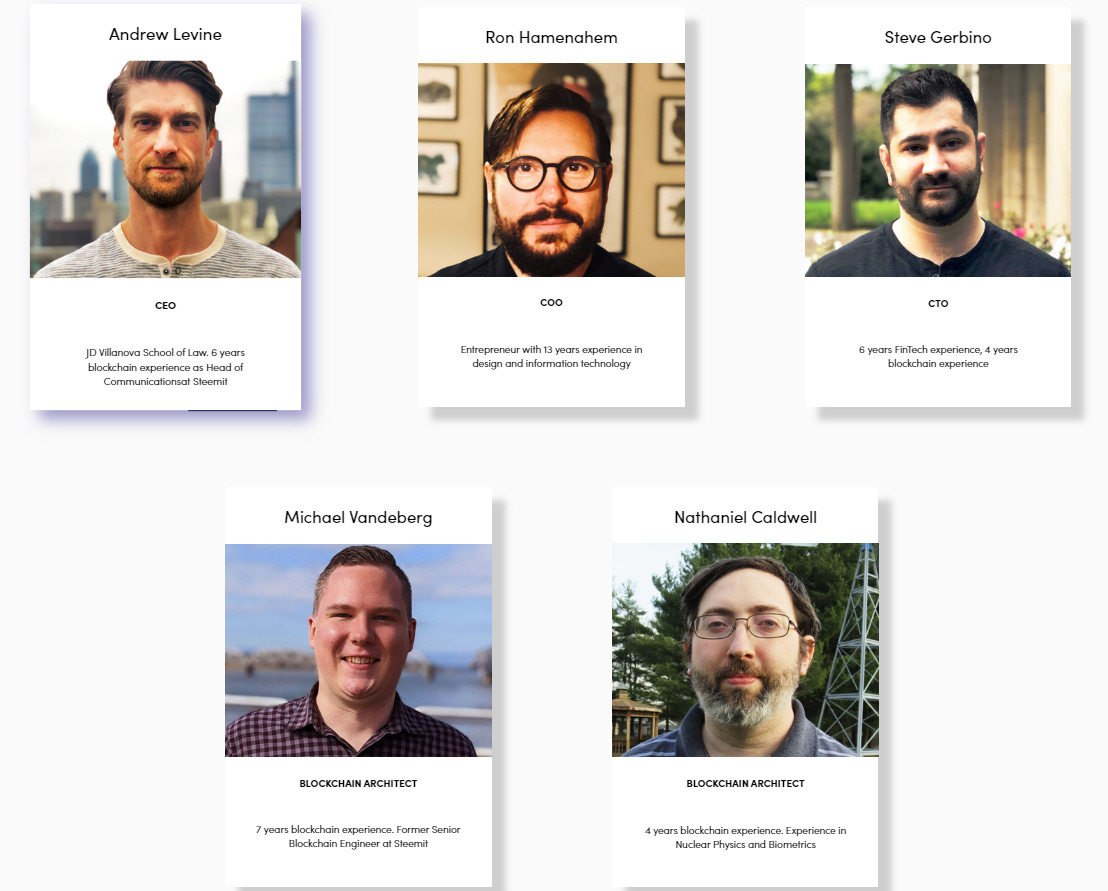
Among them, @andrarchy @michael joined several other Steem/Hive core developers to create Koinos. Because of this, Koinos has advocated decentralization since its creation and is committed to building a truly decentralized ecosystem where every participant can participate and benefit equally.
When looking for information about Koinos, I found that Koinos has a very interesting explanation: Unless everyone enjoys privileges, no one can enjoy exclusive privileges.
Koinos (Kοινός) is derived from the Greek word meaning "common", "public" or "universal". It can be used to describe a common, common characteristic or quality.
In ancient Greek philosophy, Koinos is often used as a concept of social community, emphasizing the interaction and sharing between individuals and the overall description. It emphasizes mutual interests, common goals and common responsibilities. I don’t know if it’s a coincidence, but it is indeed consistent with the concept of #koino.
What do Koinos do?
Koinos is designed to operate without gas fees through contracts, and is based on a modular (upgradable without hard fork) L1 chain created by the WASM virtual machine.
On Ethereum, BNB CHain and many L2s, every interactive operation requires a gas fee. For example, on Ethereum, if you use unisawp to exchange ETH for USDT, you need to pay about $10 when the gas is 35 gwei. gas fee. But on Koinos, when you convert KOIN to ETH through koinDx, the gas fee you need to pay is 0, and there is truly no gas fee.
At the same time, Koinos utilizes two key technologies: WebAssembly (WASM) and Google's Protocol Buffer (Protobuf) to achieve the broadest development language support. Any programming language compiled into WASM, such as TypeScript and C++, can build Dapps on Koinos. For non-blockchain developers, there is no need to learn a new development language and you can flexibly implement your ideas in the web3 world.
At the beginning of 2023, Koinos developer Koinos Group also announced the completion of a $500,000 seed round of financing, led by Blockchain Founders Fund and participated by Splinterlands. Koinos said this round of financing will be used to help developers develop Koinos Pro, a subscription product for dApps.
How does Koinos implement technology?
Here we focus on what is most directly related to users. Why can Koinos be used for free?
On Koinos, each $KOIN token has its own mana (1$KOIN=1mana, 100$KOIN=100mana). Mana cannot be bought or sold and does not have price attributes. Yes, just like "Mana" in video games, mana is an attribute assigned to a character in the game that allows them to use special magical abilities or spells. And, just like mana, Mana in $KOIN can "recharge" itself! 
Every time a contract interaction occurs, mana is consumed, not $KOIN. That is, you have 100 $KOIN. After interacting with a certain dapp hundreds of times, you still have 100 $KOIN, and the consumed mana will be lost as time goes by. Reborn again with the passage of time. During the rebirth, the consumed mana corresponding to $KOIN will be automatically locked and cannot be traded/transferred (for example, if there is 100$KOIN, and 5 mana is consumed, the corresponding 5$KOIN will be locked) , the entire rebirth cycle is 5 days. The more $KOIN you hold, the faster the rebirth time. When consuming 5 mana, holding 10 $KOIN will take about 3 days to rebirth. Holding 100$KOIN is It only takes a few minutes to hold 10,000$KOIN for about 1 day. When the mana is reborn to 100%, the locked $KOIN will also be unlocked.
The novel mana system design allows users holding $KOIN to use Koinos network resources without losing $KOIN. Similar to Ethereum, which needs to pay gas fees, Koinos only takes up time cost (rebirth of mana time).
Not only that, but what's even more interesting about Koinos is that mana can be shared. Koinos allows users to delegate their mana to other users. A directly related example: the wallet @Kondr created by Koinos community developer @julian is sharing his mana. Through the Kondr wallet, there is no need to hold $KOIN tokens And using the Koinos network, yes, you can interact with contracts or buy and sell tokens on Koinos with 0 fees and no need to hold any $KOIN tokens. 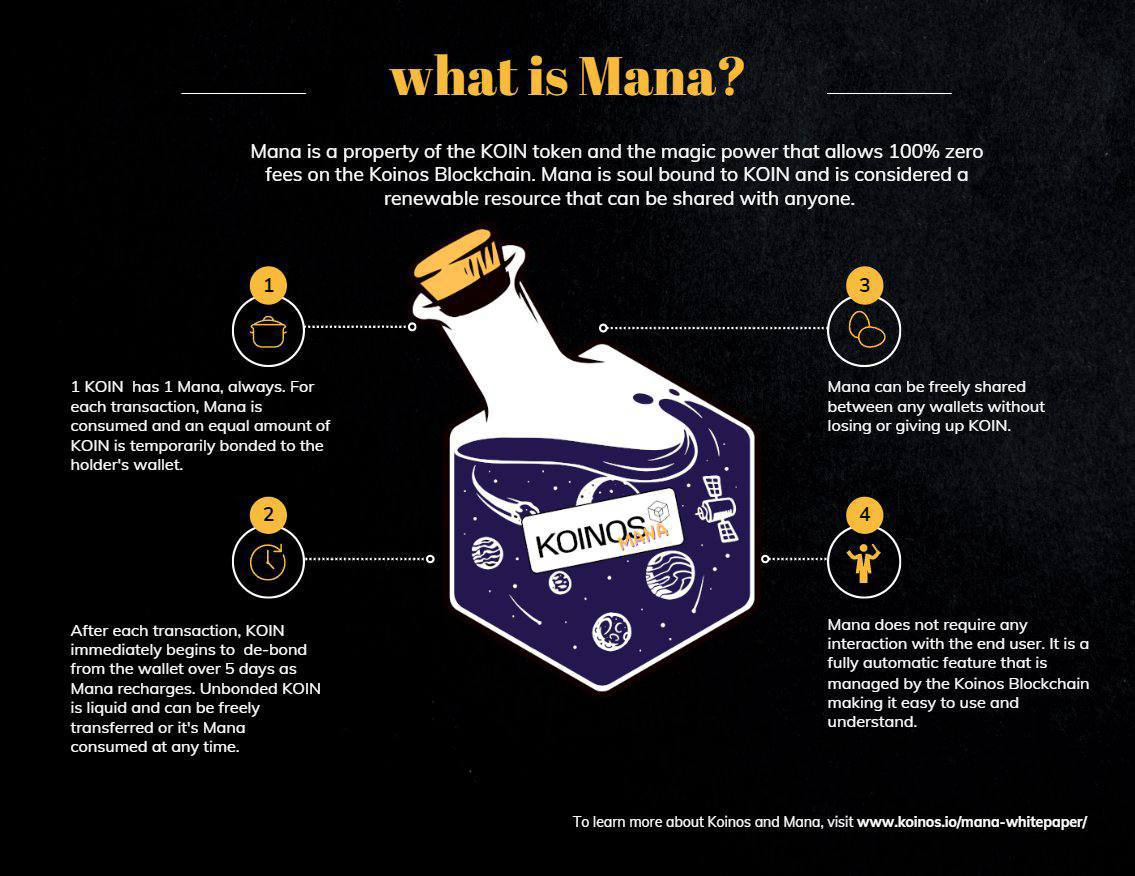
The Koinos team emphasizes this point: you don’t even need to buy $KOIN to use the Koinos ecosystem - they believe that end users don’t need to bother buying tokens, using smart contracts, and spending Gas to use DEX, play crypto games, or SocialFi and more.
In Koinos, no one’s $KOIN will be consumed or lost.
How Koinos works
Currently popular consensus algorithms include Proof of Work (PoW) and Proof of Stake (PoS). Koinos uses a different Proof of Burn (PoB) as the consensus algorithm. PoB was proposed by Iain Stewart in 2012. After more than 10 years of development, it has been verified to be safe and can effectively block 51% attacks.
Proof of Burn PoB is called a POW system without energy waste. The working principle can be explained simply: POW needs to purchase hardware equipment to obtain computing power to verify the network and obtain mining rewards. PoB obtains computing power by burning tokens. Verify the network and receive mining rewards.
On Koinos, burning $KOIN can obtain VHP (called virtual computing power) at 1:1, which is irreversible. If you want to exchange VHP back for $KOIN, you need to participate in mining in Koinos and can earn 2 % of the inflation income may be converted into $KOIN in the secondary market. The difference between VHP and mana is that VHP has trading attributes and is circulated at the secondary market level.
It takes about 1 year to convert VHP back to $KOIN through mining. The conversion is a dynamic process. Burn 100 $KOIN to obtain 100 VHP. After participating in mining, the VHP on the address will change accordingly. It decreases, and $KOIN increases accordingly. About half a year and 180 days later, there are 50 VHP and 51 $KOIN in the address. In order to encourage users to burn $KOIN to ensure the generation of network blocks, Koinos has set an inflation rate of 2%, that is, 100 VHP can get back 102$ KOIN after one year of participating in mining.
Microservice architecture blockchain
Microservices architecture is a modular collection of services that, when viewed as a whole, operate like a complete application. These services are loosely coupled and communicate with each other through a REST API or a message broker (such as Kafka or RabbitMQ).
Koinos is billed as the first truly free-to-use general purpose blockchain, but it is also the first blockchain built on a microservices architecture. By decomposing blockchain nodes into a set of loosely coupled services, Koinos becomes highly maintainable and easy to verify, while providing a great degree of deployment flexibility. This microservices structure was extremely difficult and time-consuming to create, and I understand it took the team developers over two years to create it and perfect it. The entire network node of the Koinos blockchain has been built as a microservice architecture.
$KOIN token economy, what is the current market value?
On October 13, 2020, the $KOIN token was launched on Ethereum with an initial supply of 100 million. Anyone can use CPU to mine $KOIN based on POW. No pre-mining, no ICO, no VC, all methods/costs of obtaining $KOIN are the same. The core team also needs to be recruited by themselves!
On October 14, 2020, a community member increased the liquidity of Koin/Eth on uniswap.
On November 5, 2022, the Koinos mainnet will be launched. A snapshot of $KOIN on Ethereum will be taken and can be claimed on the Koinos mainnet at a 1:1 ratio. The current claim ratio is 47.8%, which means there are still 52.2% of tokens that have not been claimed.
Because of the burning mechanism of Koinos, the market value seen on each platform is different. For example, on CoinGecko, the market value of $KOIN is 21M (koin$0.65). The calculation formula here is: the total amount of $KOIN received on the mainnet+ the mining output of the mainnet Total output - total amount of $KOIN burned × market price of $KOIN = 21M
Here, Koinos introduced the term virtual market capitalization, which is virtual market capitalization = (total circulation volume koin + total burning volume vhp) × market price.
Note: Total circulation = total amount received from the mainnet+ total mining output - total amount burned
It can be simply understood as: $KOIN is based on the current market price of $1.75 (it has skyrocketed in the past two days!), the total market value is 176M, and the circulating market value is 59M. It should be noted that 50.7% of the tokens have not yet been collected on the mainnet. This part can be collected and circulated at any time. The circulating market value here does not include $KOIN that was burned and turned into VHP.
Another effect of proof of burning is that it will cause $KOIN short-term deflation, which I call short-term representational deflation.
It is still different from the deflation of ETH. On ETH, part of the GAS is actually burned. The deflation of KOIN is short-lived and can be said to be a reduction in short-term market circulation.
For example, the current virtual market value of KOINOS is 40 million (KOIN + VHP), and its inflation is 2%, that is, the annual static inflation is: 800,000 koin, and the daily inflation is: 21,917 koin. If you have 50,000 koin and want to burn vhp today to participate in mining, then today Koinos will be deflated by 28,083 koin (the value is an integer for ease of calculation, not real-time data).
At the same time, the annual 2% inflation data of Koinos is not calculated based on the initial supply of 100 million, but is calculated based on the virtual market value, that is, the annual inflation = virtual mainnet value for 780,000 $KOIN. Because not everyone will burn $KOIN to participate in mining, the mining reward is now about 6%.
= = = = = = = = =
Official social platform
X account: https://twitter.com/koinosnetwork
Official website:
Telegram community: https://t.me/koinos_community
Telegram Chinese community: https://t.me/koinos_cn
Koinos Network mining pool link: https://fogata.io/
Overview of the Koinos ecosystem
DEX @koindx
Wallet @kondorwallet
Mobile wallet @konio_io
Domain Name Services @kapdomains
NFT platform @KollectionMkt
Launchpad @TheRealKoincity
Games @KanvasOfficial
Invest in @KoinosGarden
…
Koinos founding team