
Blockchain provides a bridge to access lower computational cost GPUs by allowing distributed access to models and creating a marketplace for cheaper models with cryptographic incentives.
Original text: The Rise of AI and GPU Shortages: How Blockchain Alleviates Machine Learning Bottlenecks (Foundry)
Author: Tommy Eastman
Compiled by: Frank, Foresight News
Cover: Photo by Martin Martz on Unsplash
As artificial intelligence develops and the demand for GPUs increases, the machine learning industry faces the issue of GPU cost and accessibility. Let’s see how blockchain technology can provide a solution.
GPU industry
There has been tremendous growth in AI-based applications and integrations over the past year. OpenAI's ChatGPT became the fastest-growing application ever, reaching 100 million monthly active users just two months after launch. By comparison, it took TikTok 9 months and Instagram 18 months to reach the same milestone.
The demand for artificial intelligence has greatly impacted the value and availability of graphics processing units (GPUs). GPUs are processing units optimized for performing parallel calculations and processing many data simultaneously, which makes them useful for machine learning, video editing, and gaming applications. Due to the multi-purpose use of GPUs in the artificial intelligence circuit, the market demand for GPUs has increased.
GPUs are developed and distributed by a handful of companies, which is evident in delays in the manufacturing supply chain. They have been closely associated with the blockchain industry since the 2017 bull run, with Ethereum proof-of-work miners purchasing nearly every available GPU in 2018. The Ethereum blockchain has moved to proof-of-stake, but with the explosion of artificial intelligence, blockchain technology still provides useful solutions to common problems such as access to GPUs, training costs, distributed inference, and more.
Machine learning process and bottlenecks
Machine learning is a large and rapidly growing industry. Model training is usually divided into several steps, and each step has certain bottlenecks.

1. Basic model training
Base model training involves taking a large dataset (such as Wikipedia) and training an initial base model to be used as a general intelligence model or eventually fine-tuned, which uses learned patterns and relationships to predict the next item in the sequence.
For example, image generation models are trained to associate image patterns with corresponding text, so when given text input, they generate images based on these learned patterns. Similarly, for text, the model predicts the next word in a text string based on previous words and context.
Training of base models is expensive in terms of labor, infrastructure, time, and effort, and the current supply chain makes it difficult to obtain state-of-the-art NVIDIA GPUs, even for companies with deep pockets.
For example, the iterative training of OpenAI's GPT-3 lasted for several months and consumed millions of dollars in energy costs alone. Training of base models therefore remains a prohibitively expensive endeavor, accessible only to a handful of private companies.
2. Fine-tuning
Notably, less resource intensive than base model training, fine-tuning optimizes models for specific tasks (such as language models for learning new dialects). The performance of a base model on a specific task can be greatly improved through fine-tuning.
While GPU scarcity affects these three areas, fine-tuning is least affected. However, fine-tuning relies entirely on the open source base model. If private companies decide to stop open sourcing their models, community models will fall behind state-of-the-art (SOTA) models at an alarming rate.
3. Reasoning
Accessing the model represents the final step in this step—such as receiving answers to questions from ChatGPT, which are images generated based on stable diffusion of user prompts—requiring GPU resources for model querying. Inference is rapidly escalating in terms of computing requirements, especially in terms of GPU spending.
Inference involves both end users and developers incorporating the model into their applications, which is the way to ensure the economic viability of the model. This concept is crucial for integrating artificial intelligence systems into society, and its importance is reflected in the rapid adoption rate of end-users actively using tools such as ChatGPT.
The scarcity of GPUs makes inference costs rise rapidly. While the baseline requirements for inference are lower than base model training, the scale of the company's deployed applications requires a staggering GPU load on querying the model. As the diversity of GPU models increases (through fine-tuning and new base model development), the diversity of applications will increase, and GPU demand from inference will increase dramatically.
Blockchain provides solutions to machine learning bottlenecks
In the past, GPUs have been used to mine Ethereum and other PoW tokens. Now, blockchain is seen as a unique opportunity to provide access and increase the coordination between GPU space bottlenecks - especially in machine learning.
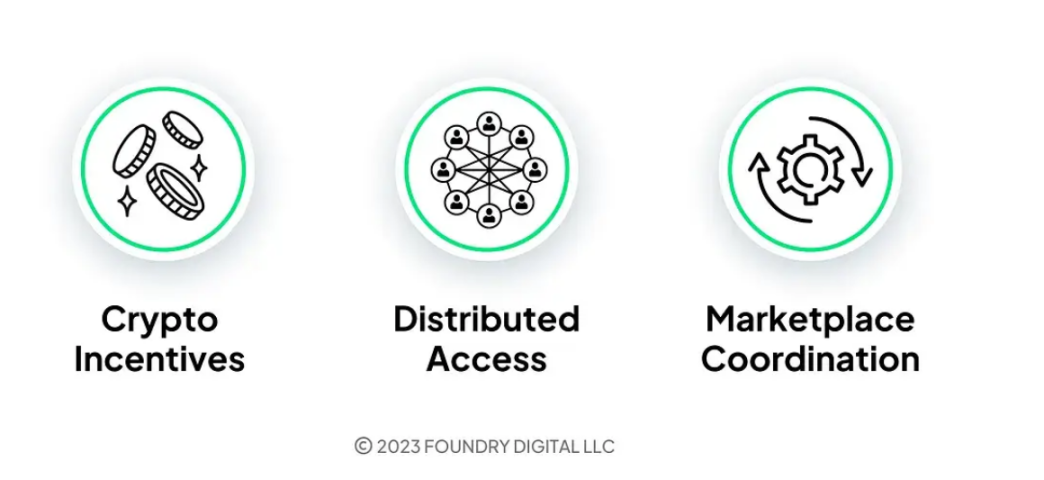
Crypto incentives
Large-scale GPU deployment requires significant upfront capital, which has hindered progress in this area for all but the largest companies. Blockchain incentives create the potential for GPU owners to profit from spare computing, creating a cheaper and more accessible market for users.
distributed access
Anyone can provide/use calculations, hosting models and query models - this is significantly different from needing to be in beta or have limited access in a traditional space.
An important feature that blockchain can provide to the machine learning space is distributed access. Machine learning has traditionally required large data centers because FMT has not yet been accomplished at scale on non-clustered GPUs, and distributed protocols are trying to solve this problem and, if successful, will open the floodgates for FMT.
market coordination
The blockchain marketplace helps coordinate GPU purchases, allowing individuals and companies that own GPUs to find people who want to rent them, rather than letting them sit idle, and generating revenue while GPUs are idle can help offset the upfront cost of purchasing GPUs, allowing more Entity participates in GPU hosting.
Foundry’s Commitment to Responsible AI
The field of blockchain machine learning is a nascent industry with only a few projects on the mainnet. Foundry is currently supporting the Bittensor AI project as well as Akash, which has proven to be a meaningful way to advance distributed AI.

Bittensor
Bittensor is a decentralized, permissionless computing network that enables easier access to models and creates a cheaper model marketplace through cryptographic incentives, where anyone can host models, and user prompts rank with a given modality Matches the highest models.
Bittensor has grown into one of the largest artificial intelligence projects in crypto, leveraging blockchain to create a large-scale computational inference network that recently released subnets that incentivize different modes, including image generation, prediction markets, and more.
Foundry performs validation and mining on the network and runs Proof-of-Authority nodes to ensure consensus.
Akash
Akash is a general-purpose computing marketplace that allows easier access to GPUs at scale, trains more base models, and reduces the cost of GPUs.
Akash recently launched their GPU Marketplace, with goals similar to reducing the financial barrier to entry, lowering GPU compute costs, and increasing accessibility, and the underlying model training program is growing at Akash. Foundry is providing GPU computing for the network and working with teams to develop features.
What's next?
As machine learning continues to be integrated into the enterprise, demand for GPUs will continue to soar, causing ongoing supply chain issues in the machine learning space. Blockchain technology is helping by allowing distributed access to models and creating a cheaper model market with crypto incentives. , provides a bridge to access lower computational cost GPUs.
Disclaimer: As a blockchain information platform, the articles published on this site only represent the personal opinions of the author and guests, and have nothing to do with the position of Web3Caff. The information in the article is for reference only and does not constitute any investment advice or offer. Please comply with the relevant laws and regulations of the country or region where you are located.