



JPEX is still here, Hounax is here again.
Written by: Gyro Finance
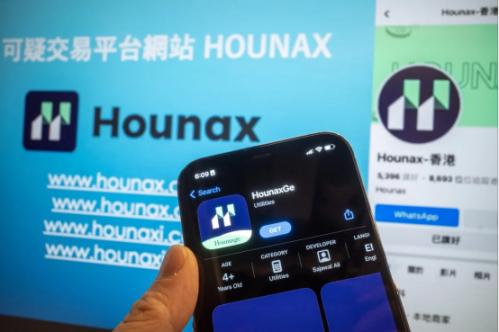
The head comes from South China Morning Post
One wave has not subsided, and another wave has arisen.
The mess of JPEX has not yet been dealt with, and another scandal broke out in the Hong Kong encryption field, and coincidentally, it was also an exchange.
On November 25, the Hong Kong police held a press conference to report on the platform. According to the Hong Kong authorities, 145 users became victims of the Hounax fraud case of the unlicensed cryptocurrency exchange. The Hong Kong Securities and Futures Commission revealed that as of Monday this week, it had received 18 complaints about exchanges, with the amount involved ranging from HK$12,000 to HK$10 million. At present, the incident has caused losses of HK$148 million.
It is worth noting that the Hong Kong Securities and Futures Commission said that it had received the first complaint about the platform in September. After launching an investigation, it listed the platform as a suspicious platform on November 1 and issued a risk warning.
But for users who have already faced losses, the warning seems to have come too late.
The HOUNAX company has been operating since the beginning of this year. In order to achieve local integration, its website uses traditional Chinese, and the login page presets the Hong Kong area code "+852". In order to escape pursuit, the company continues to change domain names, and has used as many as 32 URLs. Judging from the platform settings, the platform’s goal of targeting Hong Kong residents is obvious. The platform claims to be operated by a Singaporean company and pretends that it is a formal trading platform founded by the original Coinbase technical team and has a Canadian license. It is also seeking investment from entities such as Sequoia Capital and IDG Capital. The gorgeous background quickly attracted the first Bo's local customers.

Domain names used by fraudulent exchanges, source: South China Morning Post
Judging from the characteristics of the scam, the scams on this platform are very common and there is nothing obvious about them.
Scammers contact users via social media and WhatsApp, inviting them to join group chats where investment information is shared. When a user downloads the APP through a hyperlink, the original amount has been defrauded the moment the funds are transferred to the account, but the data in the investment account will continue to increase to attract more investment. Even if the intermediate user wants to withdraw money, the so-called investment manager will either disappear directly or kick the user out of the group chat. Otherwise, he will default on the payment for various reasons, and even once demanded a "verification" fee of up to 80% of the initial capital, claiming This is a requirement of international anti-fraud organizations.
Even though the scam is not new, many investors have still been deceived. According to the descriptions of the deceived, the scam is sophisticated and deceptive. More than one investor said that Hong Kong's supervision came too late.
Mr. Wu, who works in the maintenance industry, said he was defrauded of HK$150,000 and reported the case to the police on November 14, but has not received any reply since then. A week later, he found the relevant Facebook group and learned about other cases involving the platform. In April, Mr. Wu first established contact with a scammer posing as a "financial expert" on Facebook, and then joined the organization's WhatsApp chat group, which mainly provides stock investment advice and deepens investor trust through dialogue and guidance. It wasn’t until August that “experts” in WhatsApp groups began recommending trading cryptocurrencies on the Hounax platform due to poor stock performance.
In retrospect, Mr. Wu found that in the chat group of 50 to 60 people, most of the people were forged by accomplices, and only a few members were real people. Associates in the group will claim to be able to withdraw cash from the platform and show their account transactions to create the illusion of high returns and legitimacy. "With this method, it is ensured that it is impossible to distinguish between true and false, so the information cannot be verified," he said. He said the CSRC's action on November 1 was too late because many customers' funds had already been stolen by the platform through a special process at the end of September. occupied in the transaction, which prohibits them from making withdrawals until November 12th.
In fact, in view of the financial scandal of approximately HK$1.6 billion at JPEX, Mr. Wu initially did not believe in Hounax and only deposited a small amount of HK$20,000. After successfully withdrawing funds from the platform in September, he discovered that Hounax was listed on Canada's business registry. He then searched the Hong Kong police's online fraud notice CyberDefender website, which yielded no results, and he became convinced. this platform. "Because of this information, I was willing to invest. Who knew that after so many checks, this was just a scam."
Another investor, an accountant surnamed Huang, repeatedly stressed that the official warning came too late, causing her to lose about HK$100,000. She was attracted to the financial advice offered by a YouTube channel run by a fraudster and joined a WhatsApp chat group in June after clicking on a link left on the video-sharing platform. The scammer then shared his experience in the group and gave investors bonuses of HK$1,000 several times, thereby building trust with the accountant. After two consecutive returns, she was convinced to sign up for a Hounax account to receive cash. She also searched for information like Mr. Wu and found that the company was registered as a "money service enterprise" in the United States and Canada. At the same time, she had successfully withdrawn money twice before mid-September, which renewed her trust in the platform. Increase.
But at the time, she was still disturbed by details of the company's operating model, such as frequent gross miscalculations of fees and the fact that in August and September, fraudsters attempted to provide her with a large loan. She refused to take out a loan and left her account in limbo until the platform refused to let her withdraw her funds, and she eventually reported the incident to police on November 13. "In the whole incident, the warning to the public was too late," she said. "The scam is not new, but the planning and execution were quite perfect."
In addition to investors, with the frequent occurrence of fraud on trading platforms, some legislators are also dissatisfied with the SEC's current supervision.
Legislative Council members Jiang Yufen and Wu Jiezhuang directly stated that SCF was too passive in issuing warnings to the public. "Currently, hundreds of companies have been classified as 'suspicious' by the Securities and Futures Commission. We cannot just say that we have notified you. This is like the regulatory agency saying to the public that I wish you the best." Good luck is child's play, and the current regulatory actions are too passive."
Jiang Yufen also highlighted the loopholes in the existing regulatory mechanism, which prevent regulatory agencies from proactively responding to unlicensed platforms because unlicensed platforms are not banned and exist in a legal gray area. "In such a developed financial market in Hong Kong, these things should not be allowed to happen," she added. "The SFC cannot make excuses for itself."
She suggested that the Telecommunications Ordinance could be used to ban websites deemed suspicious to protect the public, and urged the SFC and the police to work closely together. "Fraud platforms also use telecommunications networks, and developed countries such as the United Kingdom and Australia are also regulated by similar laws. What Hong Kong lacks is not the ability to solve this problem, but the will. If regulators and law enforcement agencies are willing to do it, why can fraud continue? So rampant?"
In this regard, the China Securities Regulatory Commission is also quite helpless. In terms of powers, the China Securities Regulatory Commission is only responsible for entities engaged in securities business. It is difficult to directly supervise violators who are not involved in the business. It can only issue warnings and announcements. In this regard, the former chairman of the Securities and Futures Commission, Liang Dingbang, explained that he believed that the regulatory agency had "done its best" in the current case. In the Hounax case, the difficulty in enforcement was that the platform was operated online from a location outside Hong Kong, so the authorities It's hard to turn it off.
On the other hand, there are so many trading platforms that it still takes time to monitor fraud platforms. From the current methods, encryption fraud is the same as traditional fraud, and it is not reasonable to take special actions against a single encryption field. SFC Chief Executive Officer Leung Fengyi said that before receiving the complaint, the Hong Kong Securities and Futures Commission was not aware of HOUNAX’s activities in Hong Kong. She emphasized that the fraud methods of virtual asset trading platforms are consistent with the usual methods of "selling bulk commodities" in traditional financial market products. Therefore, the existence of fraud does not mean that there are major flaws in supervision. The Hong Kong Securities and Futures Commission also continues to pay attention to the use of unlicensed trading platforms on social media. Media propaganda.
Currently, the Securities and Futures Commission has identified nine suspicious cryptocurrency investment platforms. In addition to Hounax and JPEX, the Hong Kong Digital Research Institute, BitCuped, FUBT, futubit/futu-pro, EFPSD, OSL Trading and arrano.network are all listed. .
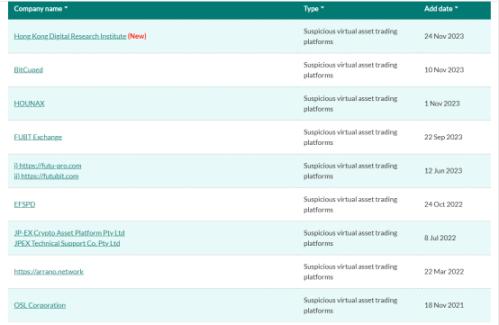
List of suspicious cryptocurrency platforms, source: Hong Kong Securities and Futures Commission official website
Overall, after the new regulations were officially released in June, Hong Kong’s encryption ecosystem has developed rapidly and favorable policies have been frequent. Not only banks have begun to receive encryption services one after another, but after the intermediary circular was updated, many securities firms are looking for second growth points. As efforts are being made to join in, securities companies led by Victory Securities and Futu Securities have successively designed trading systems. Currently, more than 60 securities companies have begun to expand cryptocurrency business this year. Recently, Victory Securities was approved to open retail trading, allowing Hong Kong retail customers to trade digital assets including Bitcoin (BTC) and Ethereum (ETH) through the OSL platform. From the perspective of participants, Hong Kong has gradually formed a development pattern led by compliance platforms such as OSL and Hashkey, with securities firms developing rapidly, and other offshore global platforms supplementing and coexisting. The ecological development is moving closer to the American model.
However, in terms of frequent crypto fraud cases, unlike Western developed countries where investor awareness is relatively complete, Hong Kong’s public education in the crypto field is still in a very early stage. The public’s stereotypes still exist, and investment awareness has not yet been fully formed. Due to the limitations of the market, the ecological activity in Hong Kong’s encryption field is still insufficient. A typical example is that after June, despite frequent positive actions in Hong Kong, the market response was that except for these two well-known fraud cases, there was not much discussion.
Of course, Hong Kong is not sitting still.
Against the background of inactive ecology, Hong Kong still adheres to its policy consistency. In order to balance the relationship between innovation and supervision and give compliance platforms sufficient time to apply for licenses, the China Securities Regulatory Commission has stated that the one-year grace period for cryptocurrency exchanges will remain unchanged even after the recent regulatory upgrades caused by encryption. Recently, the suggestion that Hong Kong can conduct an initial coin offering (ICO) appeared in a series of proposals formulated by the Hong Kong Securities and Futures Professional Association to revitalize the Hong Kong economy.
In view of the current situation of insufficient supervision, it is very likely that the China Securities Regulatory Commission will be delegated more authority in the future. Chief Executive Lee Chia-chao responded to the Hounax exchange incident by saying, "If any of our laws in this area need to be strengthened, or if there is room for improvement in the transparency of the information we publish, the government will consider giving more powers to regulators if necessary," ” and added, “The Securities and Futures Commission will consider current measures that can be taken, such as using laws to combat money laundering.”
After the JPEX incident, the Securities and Futures Commission cooperated with the Hong Kong Police Force (HKPF) to establish a working group to jointly strengthen vigilance and law enforcement against illegal activities within the Virtual Asset Trading Platform (VATP).
However, it can be seen that whether it is encryption ecology or regulatory prevention, Hong Kong still has a long way to go.
references
South China Morning Post: Hounax scam—— Hongkongers who lost HK$148 million to cryptocurrency platform say watchdog warning came too late
South China Morning Post: Hong Kong may further empower regulators to tackle cryptocurrency scams, John Lee says, amid fallout from Hounax, JPEX cases






